Ohio Renunciation And Disclaimer of Property received by Intestate Succession
About this form
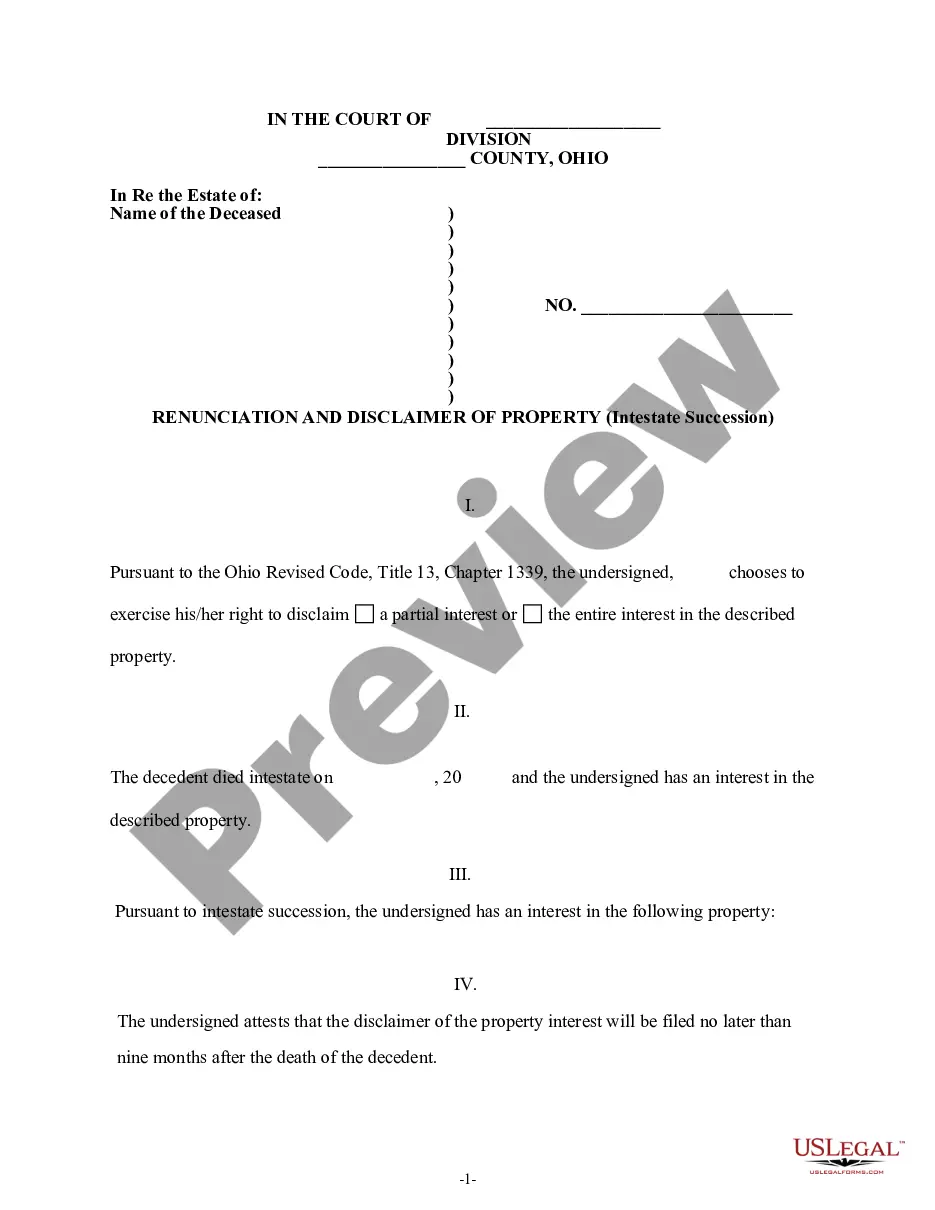
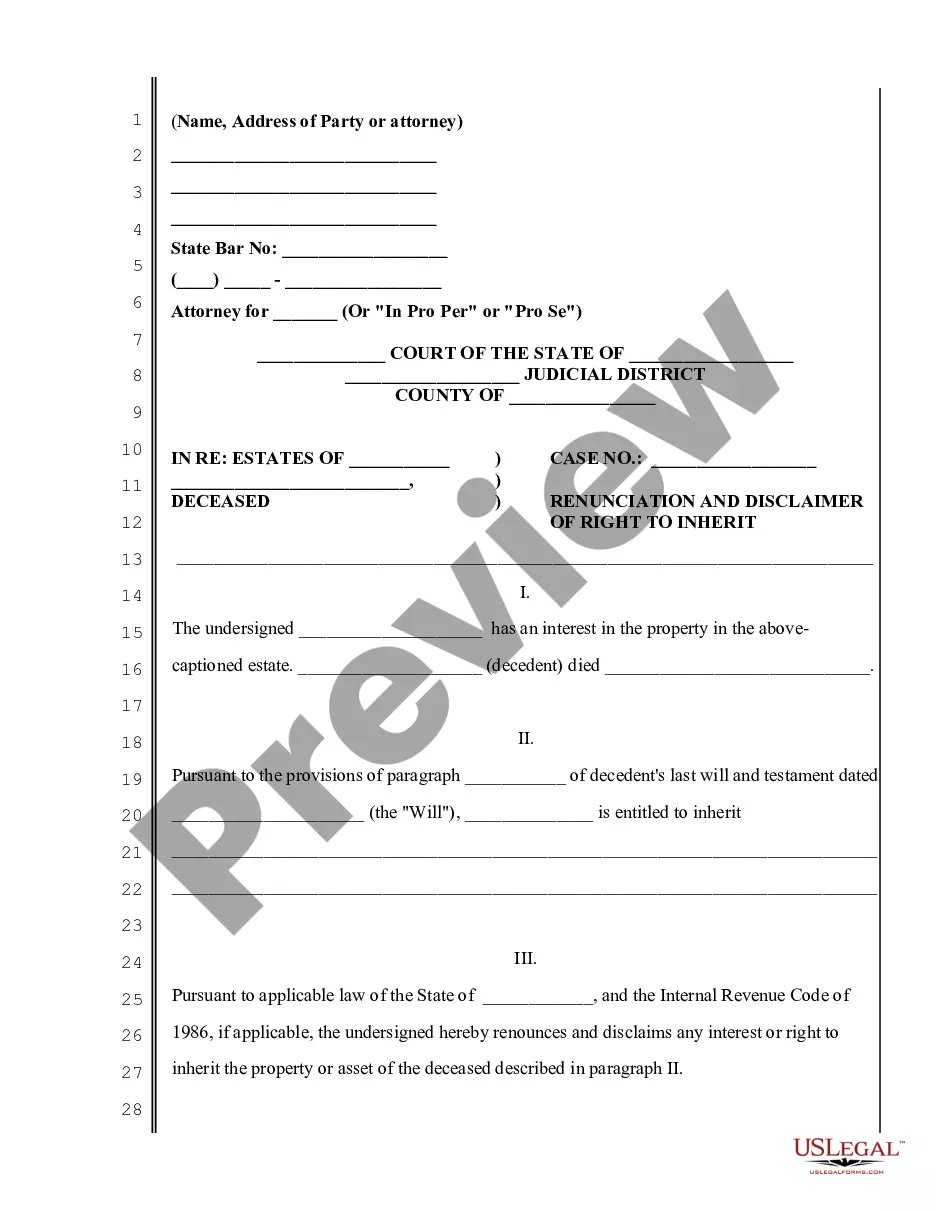
The Renunciation and Disclaimer of Property received by Intestate Succession is a legal document that allows a beneficiary to formally decline any interest in property inherited from a decedent who died without a will. By filing this form, the beneficiary ensures that the property will be distributed to other heirs as if they had predeceased the decedent. This form is particularly important in Ohio, as it adheres to specific state laws regarding intestate succession, differentiating it from other estate planning forms such as a Last Will and Testament.
Main sections of this form
- Identification of the decedent and the property involved.
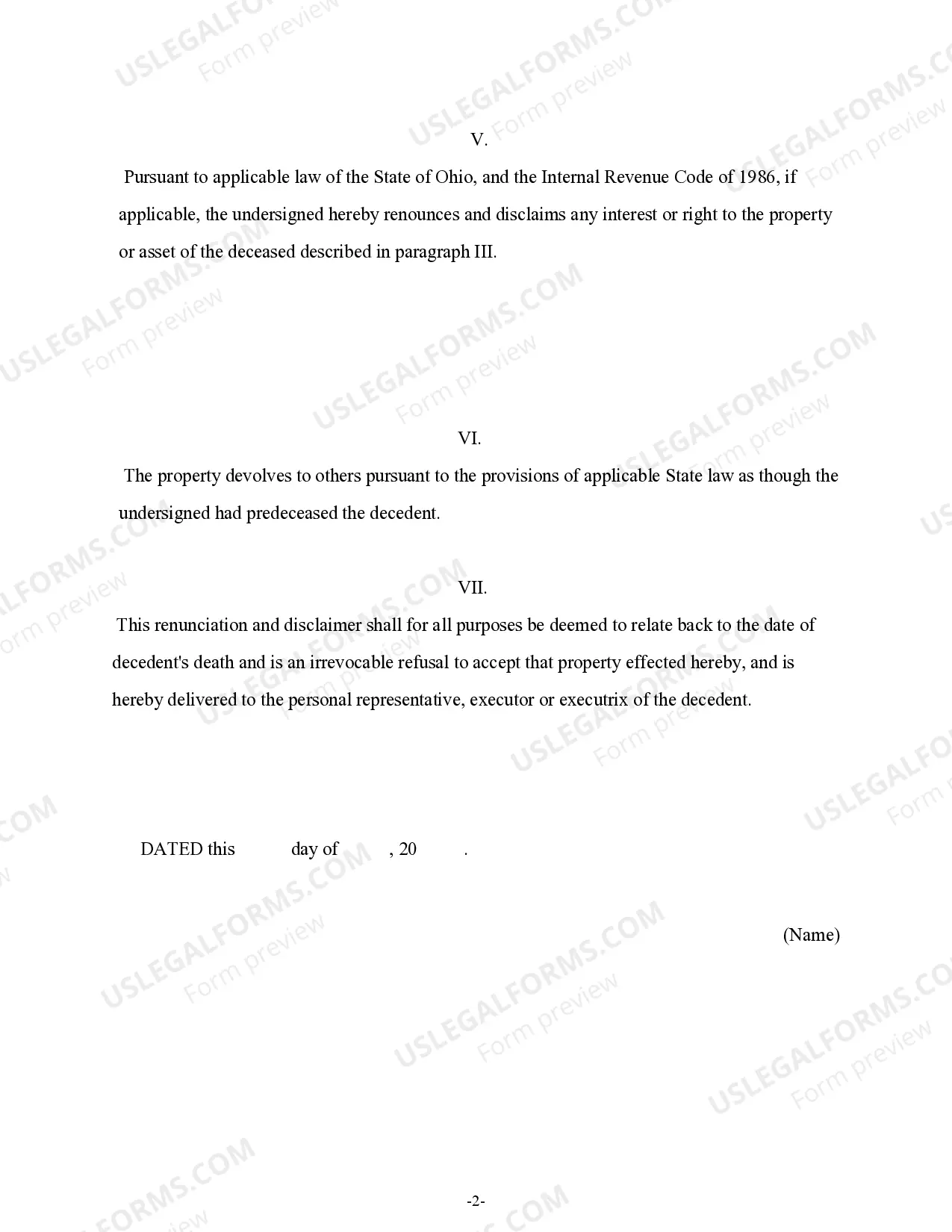
- Statement of renunciation and disclaimer of interest.
- Legal basis for the disclaimer referencing Ohio law.
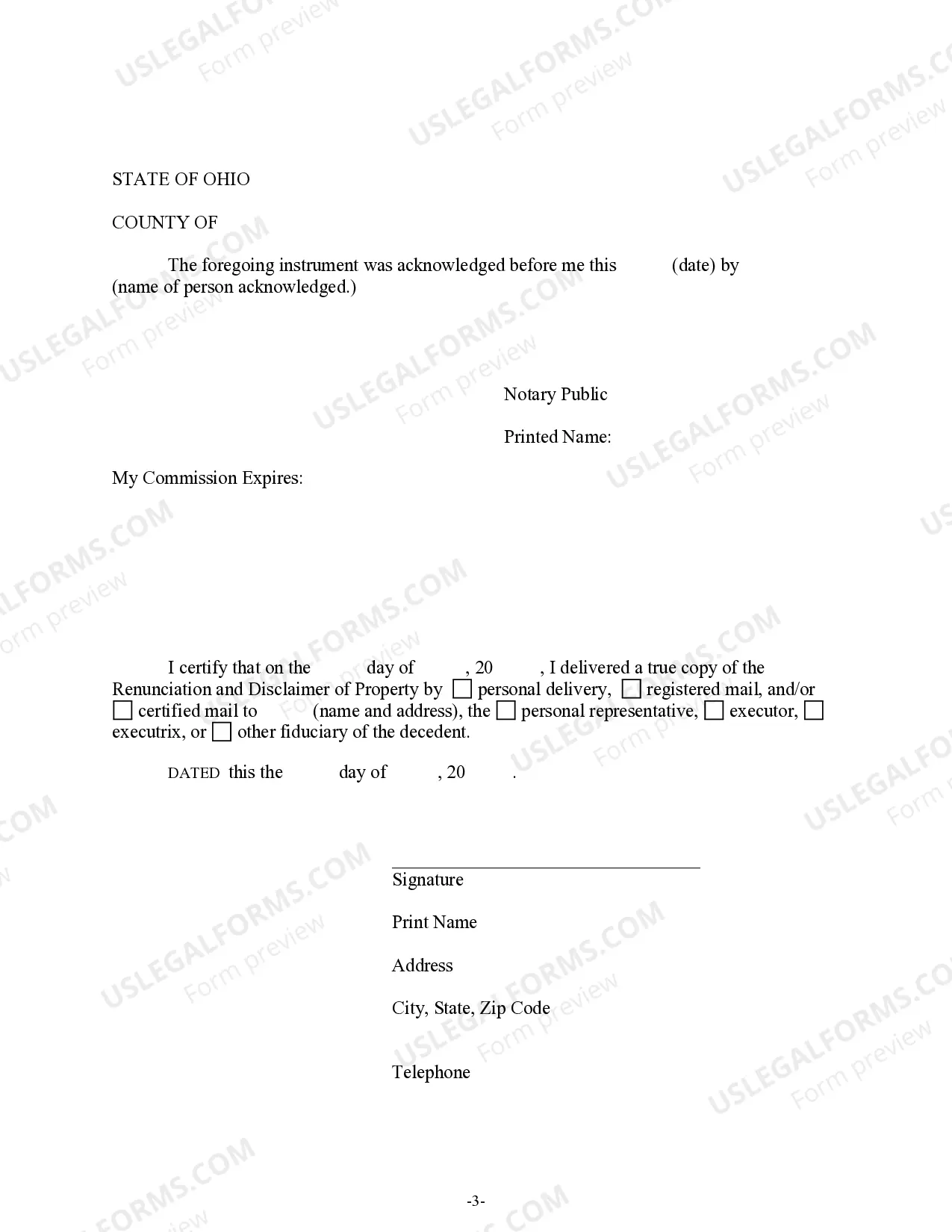
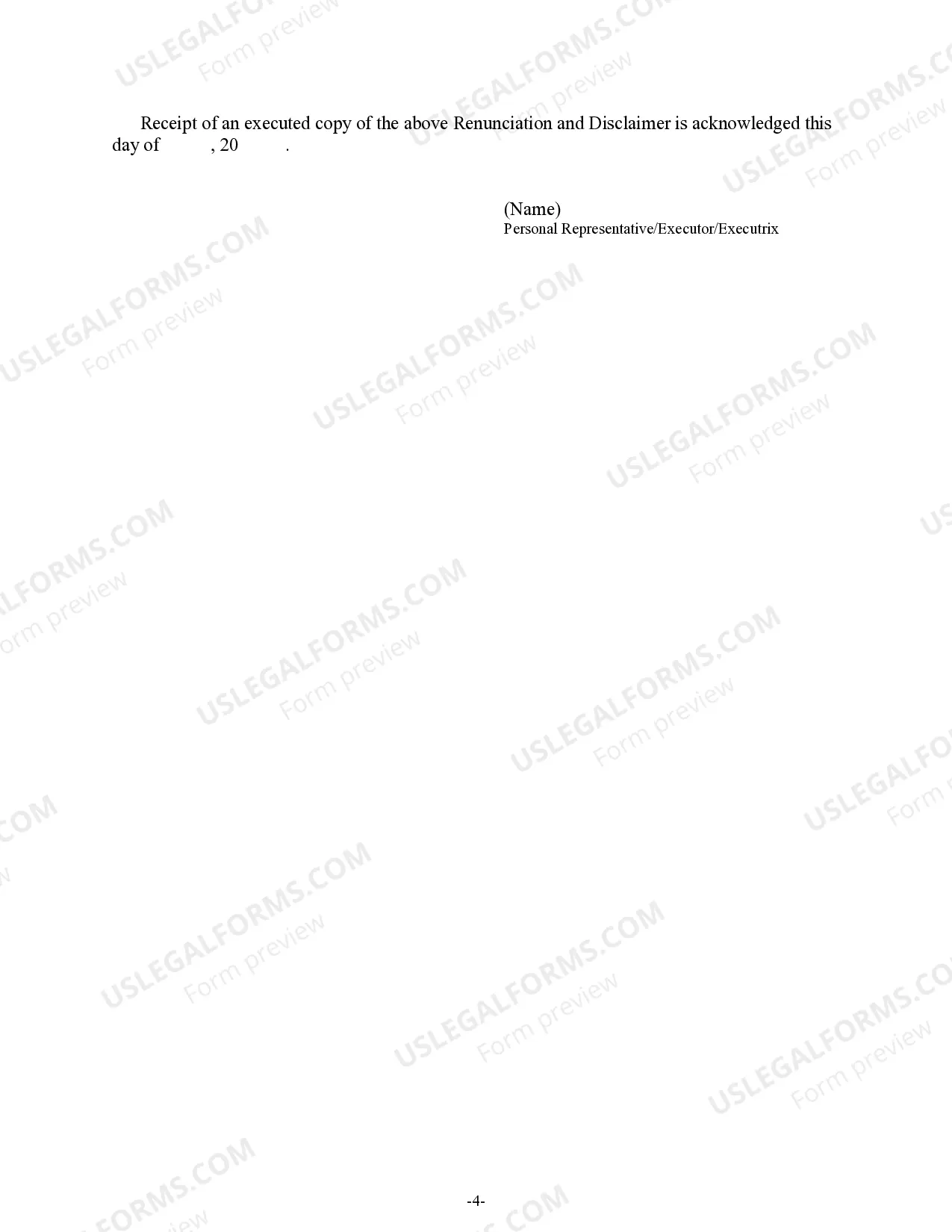
- Certification and acknowledgment sections to verify intent and delivery.

When to use this document
This form is used when a beneficiary inherits property under Ohio intestate succession laws but wishes to renounce their interest. Common scenarios include situations where the beneficiary cannot or does not want to manage the property, or when they wish to allow other relatives to inherit it instead. For example, if multiple heirs exist, one may opt out to simplify the distribution process.
Who needs this form
- Beneficiaries who have inherited property but wish to decline their rights to it.
- Individuals involved in managing intestate estates without a will.
- Heirs wanting to redirect their share to other family members or parties.
Steps to complete this form
- Identify the deceased individual by entering their full name and date of death.
- Specify the property or asset you are renouncing.
- State your intent to renounce and disclaim any interest in that property.
- Sign and date the form in the presence of a witness or notary if required.
- Submit the form to the appropriate legal entity or court as directed by your local laws.
Does this form need to be notarized?
This form does not typically require notarization unless specified by local law. However, it is advisable to have the document signed in the presence of a witness or notary to enhance its credibility and ensure its acceptance in legal contexts.
Get your form ready online
Our built-in tools help you complete, sign, share, and store your documents in one place.
Make edits, fill in missing information, and update formatting in US Legal Forms—just like you would in MS Word.
Download a copy, print it, send it by email, or mail it via USPS—whatever works best for your next step.
Sign and collect signatures with our SignNow integration. Send to multiple recipients, set reminders, and more. Go Premium to unlock E-Sign.
If this form requires notarization, complete it online through a secure video call—no need to meet a notary in person or wait for an appointment.
We protect your documents and personal data by following strict security and privacy standards.
Make edits, fill in missing information, and update formatting in US Legal Forms—just like you would in MS Word.
Download a copy, print it, send it by email, or mail it via USPS—whatever works best for your next step.
Sign and collect signatures with our SignNow integration. Send to multiple recipients, set reminders, and more. Go Premium to unlock E-Sign.
If this form requires notarization, complete it online through a secure video call—no need to meet a notary in person or wait for an appointment.
We protect your documents and personal data by following strict security and privacy standards.
Avoid these common issues
- Failing to include all required identifying information about the decedent.
- Not properly stating the intent to renounce the property.
- Overlooking the signature and date requirement.
Advantages of online completion
- Convenience of instant download and completion at your own pace.
- Editable templates that allow for easy customization.
- Reliable legal compliance with up-to-date information and language.
Legal use & context
- Renouncing an inheritance is a legal act that can affect estate distribution.
- Proper use of the form ensures clarity in ownership and avoids potential disputes among heirs.
- This form is recognized as valid under Ohio law when properly executed.
Quick recap
- The Renunciation and Disclaimer of Property is crucial for managing intestate estates in Ohio.
- Understanding the implications of renunciation can benefit potential heirs and ensure proper succession.
- Completing the form accurately is essential to protect your interests and comply with legal requirements.
Looking for another form?
Form popularity
FAQ
A qualified disclaimer is a part of the U.S. tax code that allows estate assets to pass to a beneficiary without being subject to income tax. Legally, the disclaimer portrays the transfer of assets as if the intended beneficiary never actually received them.
Disclaim the asset within nine months of the death of the assets' original owner (one exception: if a minor beneficiary wishes to disclaim, the disclaimer cannot take place until after the minor reaches the age of majority, at which time they will have nine months to disclaim the assets).
Put the disclaimer in writing. Deliver the disclaimer to the person in control of the estate usually the executor or trustee. Complete the disclaimer within nine months of the death of the person leaving the property. Do not accept any benefit from the property you're disclaiming.
The answer is yes. The technical term is "disclaiming" it. If you are considering disclaiming an inheritance, you need to understand the effect of your refusalknown as the "disclaimer"and the procedure you must follow to ensure that it is considered qualified under federal and state law.
The beneficiary can disclaim only a portion of an inherited IRA or asset, allowing some to flow to the contingent beneficiary(s). Partial disclaiming is either a specific dollar or percentage amount as of the date of death.The balance will go to the next beneficiary(s).
Put the disclaimer in writing. Deliver the disclaimer to the person in control of the estate usually the executor or trustee. Complete the disclaimer within nine months of the death of the person leaving the property.
Disclaim Inheritance, DefinitionDisclaiming means that you give up your rights to receive the inheritance. If you choose to do so, whatever assets you were meant to receive would be passed along to the next beneficiary in line.
You can head off an inheritance by renouncing or disclaiming it. This involves notifying the executor or personal representative of the estate the individual charged with guiding it through the probate process and settling it that you don't want the gift. You must do so in writing, and it's an irrevocable decision.