New York Demand for Notice of Completion and Acceptance - Individual
About this form
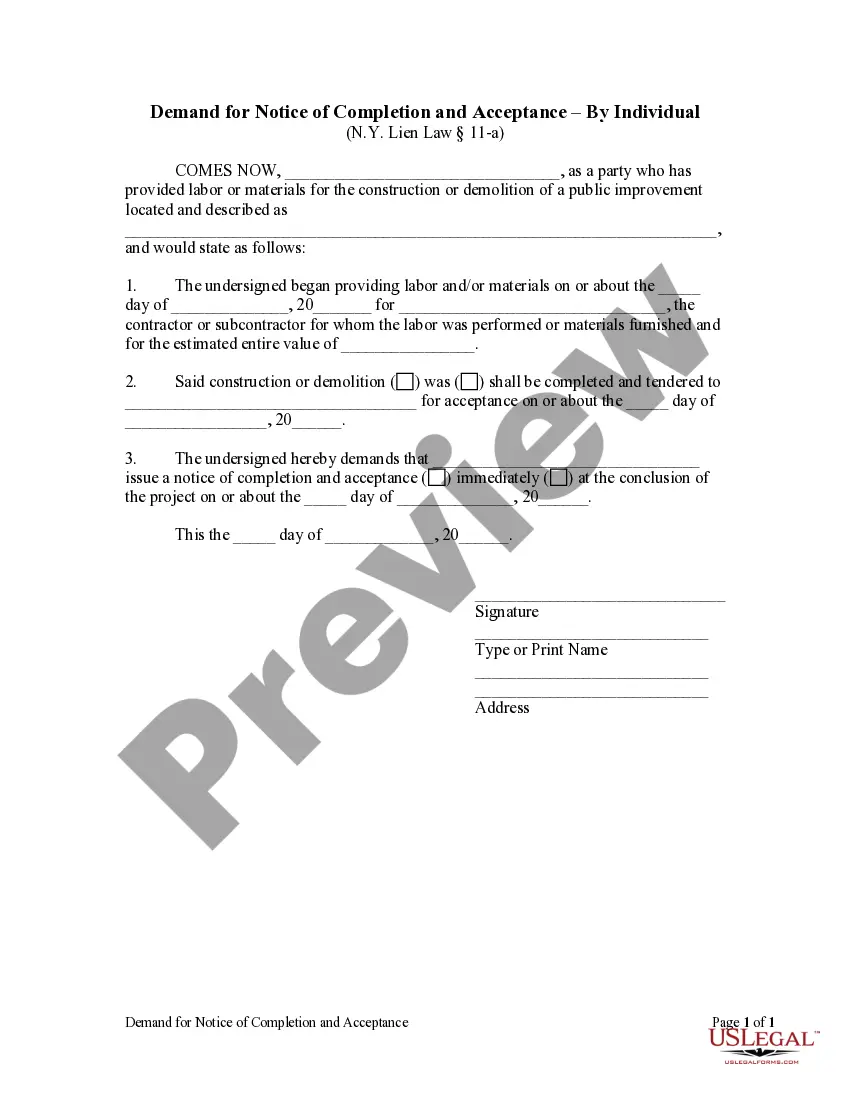
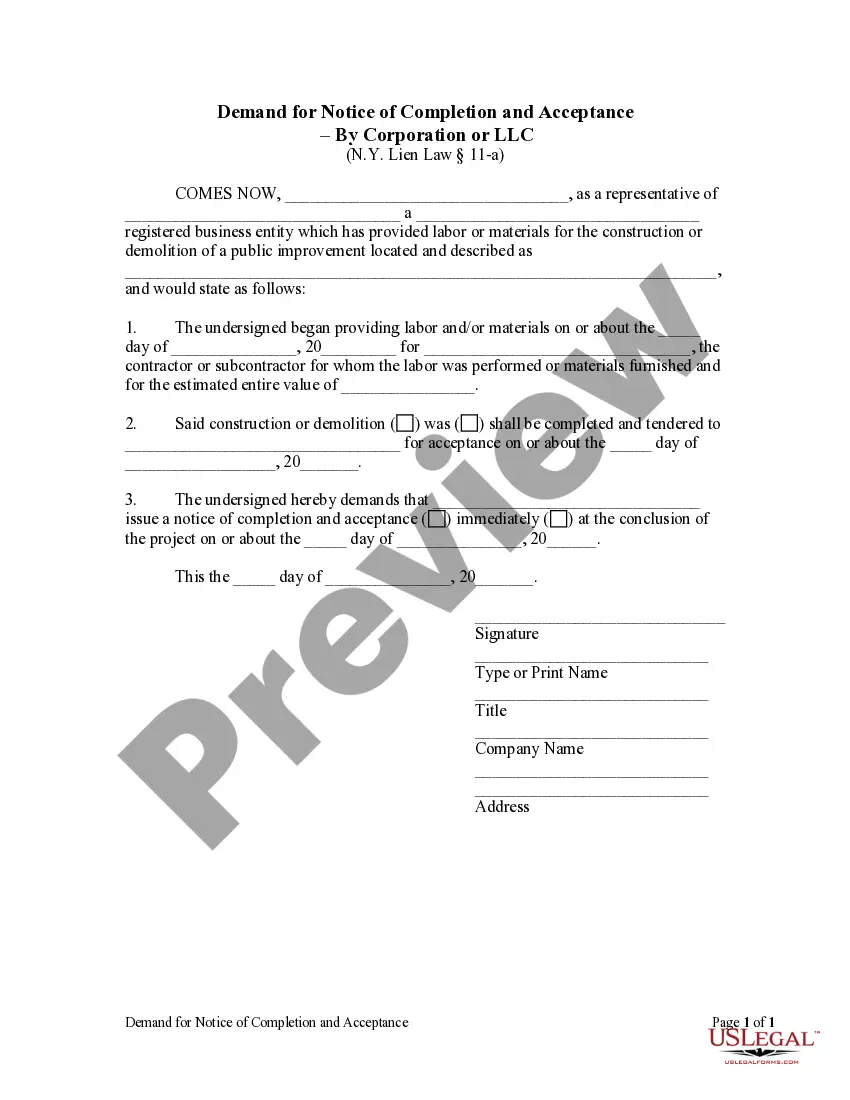
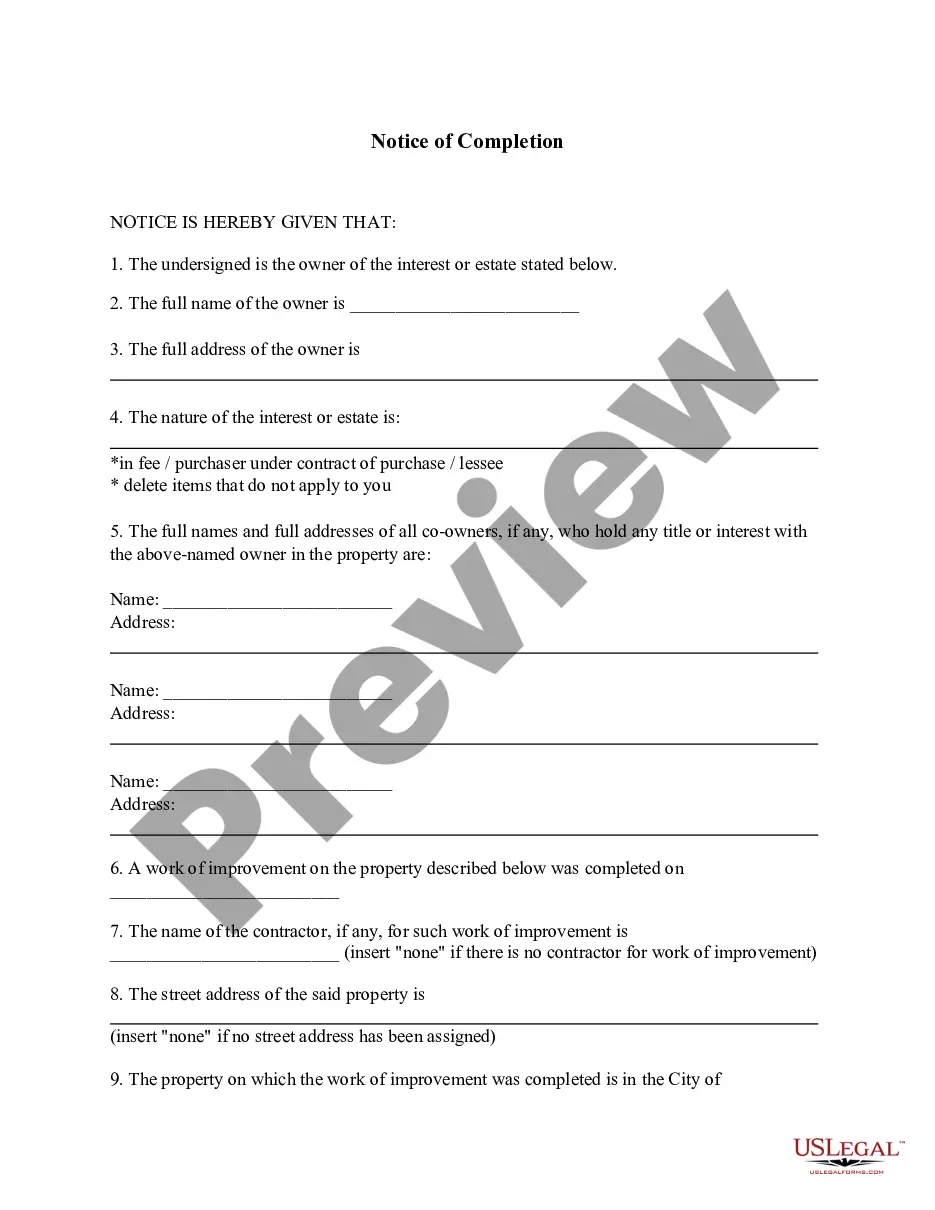
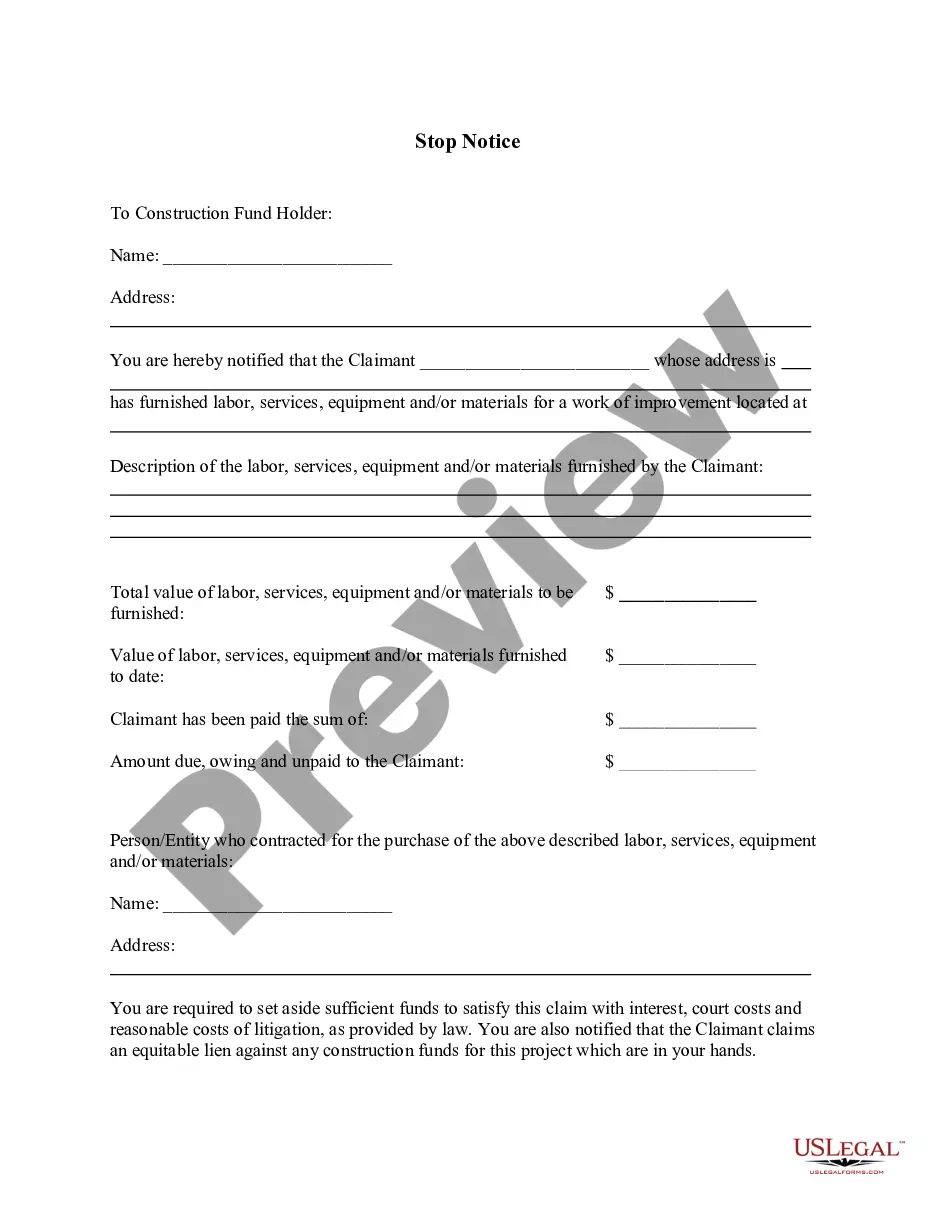
The Demand for Notice of Completion and Acceptance - Individual is a legal document used by contractors or individuals who have provided labor or materials for a public improvement project. This form enables them to formally request that the overseeing state agency issue a notice confirming the completion and acceptance of the work done. Unlike other forms related to construction, this specific demand focuses solely on requesting acknowledgement from the state agency regarding the project's completion status, providing clarity on the contractual obligations involved.
Key parts of this document
- Identification of the individual or contractor making the demand.
- Description of the public improvement project and its location.
- Dates regarding when labor or materials were provided.
- Request for the state agency to issue a notice of completion and acceptance.
- Signature and contact information of the individual requesting the notice.

When to use this form
This form should be used when a contractor or individual has completed a project involving public improvements and wishes to ensure proper documentation of the project's completion. It is particularly necessary in situations where there may be uncertainties about the status of the project or to protect the contractual interests of those who provided labor or materials. Using this form can help prompt the state agency to formally recognize the completion and acceptance of the project.
Who can use this document
- Contractors who have provided services or materials for public improvement projects.
- Subcontractors wishing to formally request completion acknowledgment.
- Anyone involved in providing labor or materials for relevant construction or demolition work.
How to complete this form
- Identify yourself as the party providing labor or materials.
- Clearly describe the public improvement project, including its location.
- Enter the date when labor or materials commenced.
- Indicate the expected completion date of the project.
- Sign the form and provide your name and address.
Notarization guidance
Notarization is not commonly needed for this form. However, certain documents or local rules may make it necessary. Our notarization service, powered by Notarize, allows you to finalize it securely online anytime, day or night.
Get your form ready online
Our built-in tools help you complete, sign, share, and store your documents in one place.
Make edits, fill in missing information, and update formatting in US Legal Forms—just like you would in MS Word.
Download a copy, print it, send it by email, or mail it via USPS—whatever works best for your next step.
Sign and collect signatures with our SignNow integration. Send to multiple recipients, set reminders, and more. Go Premium to unlock E-Sign.
If this form requires notarization, complete it online through a secure video call—no need to meet a notary in person or wait for an appointment.
We protect your documents and personal data by following strict security and privacy standards.

Make edits, fill in missing information, and update formatting in US Legal Forms—just like you would in MS Word.

Download a copy, print it, send it by email, or mail it via USPS—whatever works best for your next step.

Sign and collect signatures with our SignNow integration. Send to multiple recipients, set reminders, and more. Go Premium to unlock E-Sign.

If this form requires notarization, complete it online through a secure video call—no need to meet a notary in person or wait for an appointment.

We protect your documents and personal data by following strict security and privacy standards.
Typical mistakes to avoid
- Failing to provide complete and accurate project descriptions.
- Not including the correct dates for commencement or expected completion.
- Omitting signatures or contact information, which are crucial for validity.
Benefits of using this form online
- Convenient access to legally compliant templates.
- Edit and customize the form easily to fit specific project details.
- Secure downloading ensures your sensitive information remains private.
Looking for another form?



Form popularity
FAQ
Can a landlord evict you for no reason? The short answer is no. Landlords have several guidelines to follow regarding evictions and will need to take tenants to housing court prior to giving them the boot. The most common reasons a landlord may move to evict fall into two categories: nonpayment and holdover.
To begin eviction proceedings, the landlord must file a petition with either the district court or housing court of the county in which the rental property is located. The court will assign a time and date for a hearing before a judge and will notify the tenant.
No. The landlord must go to court, must win the case, and then must pay a fee to have a law enforcement officer properly evict you.
How much does it cost to evict someone in legal fees? A real estate or eviction attorney can charge either a flat fee or by the hour, and what it costs to evict someone depends both on your attorney's experience and complexity of the case. The low-end average cost of eviction in legal fees is $500.
A notice of appearance indicates that defendant will appear on his or her own behalf. A corporation must appear through an attorney. See Civil Practice Law and Rules (CPLR) 321(a). A defendant must have plaintiff served with a copy of the notice of appearance (see attached).
You must give a 30-Day Notice The tenant must either a). The notice must be provided in writing (i.e. Notice to Quit). You must let the tenant know they can contest the eviction in housing court. You must make three "good faith" efforts to hand-deliver the notice.
The average is 3 months at least. If you have a slick professional tenant that knows the rent stabilization system (pro-tenant system by the way) then he or she will try to extend their stay by filing an "order to show cause" which the judge would usually grant.
To begin the eviction lawsuit for nonpayment of rent, the landlord must file a petition with the district court or housing court of the county in which the rental unit is located. The court will assign a date for a hearing before a judge, and the tenant will be notified of the proceedings.
If you have lived there less than one year, the landlord must provide at least 30 days' notice. If you have lived there more than one year, but less than two years, the landlord must provide at least 60 days' notice. If you have lived there more than two years, the landlord must provide at least 90 days' notice.