Nevada Notice to Lessor Exercising Option to Purchase
Overview of this form
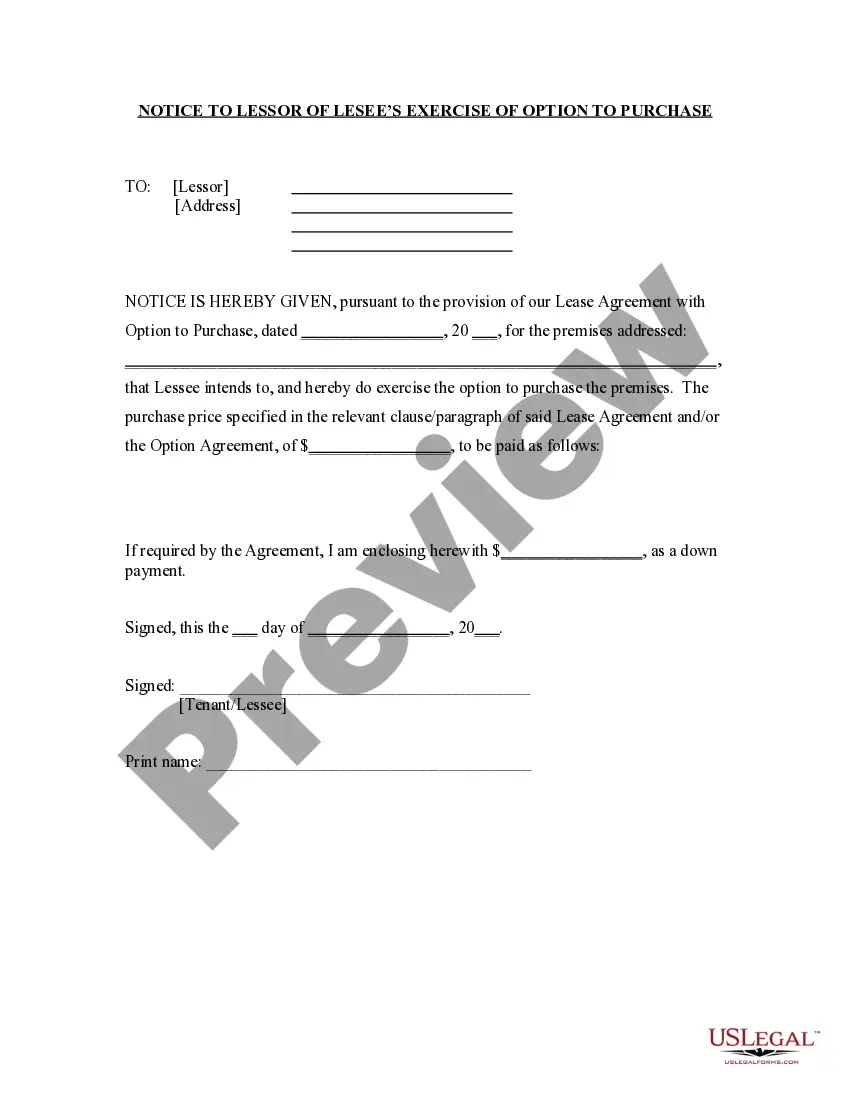
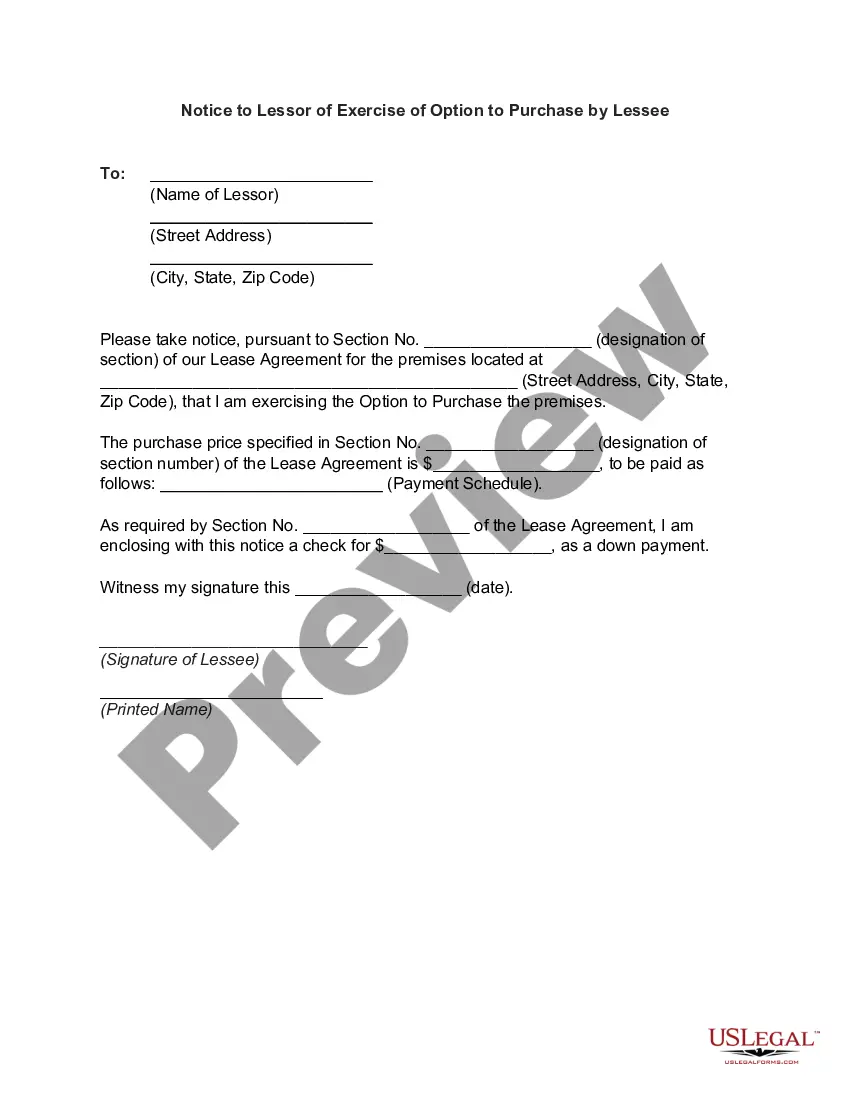
The Notice to Lessor Exercising Option to Purchase is a legal document that notifies a landlord of a tenant's intent to exercise their right to purchase the property as outlined in the lease agreement. This form serves to formally communicate the tenant's intent to buy the property, which differentiates it from general lease agreements or notices. The **option to purchase** is a specific contractual right, typically included in leasing arrangements, that allows a tenant to buy the leased property at a predetermined price within a specified timeframe.
Main sections of this form
- Identification of the tenant and landlord.
- Specification of the property being purchased.
- Purchase price as stated in the lease or option agreement.
- Statement of the tenant's intent to exercise the purchase option.
- Signature space for the tenant to affirm their intentions.

Situations where this form applies
This form should be used when a tenant wishes to inform their landlord that they intend to exercise an option to purchase the property they are renting. This scenario commonly arises near the end of a lease term, or whenever a tenant decides to make use of their contractual right to buy the property instead of continuing to rent it. Using this notice ensures clarity and compliance with the obligations established in the original agreement.
Who should use this form
This form is suitable for:
- Tenants who have a lease with a purchase option clause.
- Individuals looking to secure their right to buy a property as per the terms of their rental agreement.
- Landlords needing formal notification of a tenant's purchase intent.
Steps to complete this form
- Identify the parties by filling in the full names of the tenant and landlord.
- Specify the property address being purchased clearly.
- Enter the purchase price as stated in the lease or option agreement.
- Include the date of the notice and other relevant details, if applicable.
- Have the tenant sign and print their name to finalize the document.
Does this document require notarization?
This document requires notarization to meet legal standards. US Legal Forms provides secure online notarization powered by Notarize, allowing you to complete the process through a verified video call, available 24/7.
Get your form ready online
Our built-in tools help you complete, sign, share, and store your documents in one place.
Make edits, fill in missing information, and update formatting in US Legal Forms—just like you would in MS Word.
Download a copy, print it, send it by email, or mail it via USPS—whatever works best for your next step.
Sign and collect signatures with our SignNow integration. Send to multiple recipients, set reminders, and more. Go Premium to unlock E-Sign.
If this form requires notarization, complete it online through a secure video call—no need to meet a notary in person or wait for an appointment.
We protect your documents and personal data by following strict security and privacy standards.

Make edits, fill in missing information, and update formatting in US Legal Forms—just like you would in MS Word.

Download a copy, print it, send it by email, or mail it via USPS—whatever works best for your next step.

Sign and collect signatures with our SignNow integration. Send to multiple recipients, set reminders, and more. Go Premium to unlock E-Sign.

If this form requires notarization, complete it online through a secure video call—no need to meet a notary in person or wait for an appointment.

We protect your documents and personal data by following strict security and privacy standards.
Avoid these common issues
- Failing to provide the correct property details and purchase price.
- Not signing the notice or omitting the date.
- Submitting the notice after the deadline to exercise the option.
Advantages of online completion
- Convenient access to download and complete the form at any time.
- Editable fields allow for easy customization to fit specific situations.
- Access to forms created by licensed attorneys ensures legal compliance.
Legal use & context
- This form acts as a formal notice and preserves the tenant's rights as outlined in the lease agreement.
- It is crucial to adhere to the terms of the purchase option to avoid legal disputes.
- Failure to properly exercise the option could lead to forfeiting the right to purchase.
What to keep in mind
- Utilize the notice to inform the landlord of the intent to purchase the rental property.
- Complete all sections accurately to avoid delays or rejection of the notice.
- Be mindful of the time frame in which the notice must be submitted.
Looking for another form?
Form popularity
FAQ
Selling the Call Options In other words, there really is no need to exercise the option, receive the shares and quickly sell them. A better reason to exercise a call would be to obtain the shares as a longer term investment, but if you do not have the money to pay for the shares, that is not an option.
With the option to purchase route, the buyer pays the seller money for the exclusive right to purchase the property within a specified term (often six months to a year). The buyer and seller might agree to a purchase price at that time, or the buyer can agree to pay market value at the time their option is exercised.
The Basic Structure of a Lease Purchase In a lease purchase contract, the buyer and seller agree to a lease period followed by sale of the property when the lease ends. This type of agreement combines both a lease and a purchase with the tenant/purchaser securing the option to purchase the house.
A lease-option is a contract in which a landlord and tenant agree that, at the end of a specified period, the renter can buy the property. The tenant pays an up-front option fee and an additional amount each month that goes toward the eventual down payment.
You can choose to exercise your call option if it is in the money, meaning the strike price is lower than the stock price. For example, if the strike price is $30 and the stock price is $20, exercising would not make you money because you can purchase the stock for $10 less than the strike price.
When you exercise an option, you usually pay a fee to exercise and a second commission to sell the shares. This combination is likely to cost more than simply selling the option, and there is no need to give the broker more money when you gain nothing from the transaction.
Lease-option contracts give you the right to buy the home when the lease expires, while lease-purchase contracts require you to buy it. You pay rent throughout the lease, and in some cases, a percentage of the payment is applied to the purchase price.
Step 1: Negotiate and agree on the resale price. Step 2: You grant the OTP to the buyers. Step 3a: Buyers exercise the OTP if they wish to proceed with the purchase. Step 3b: Let the OTP expire if the buyers do not wish to proceed with the purchase. Step 4: Decide when to submit the resale application.