Nevada Renunciation And Disclaimer of Joint Tenant or Tenancy Interest
Overview of this form
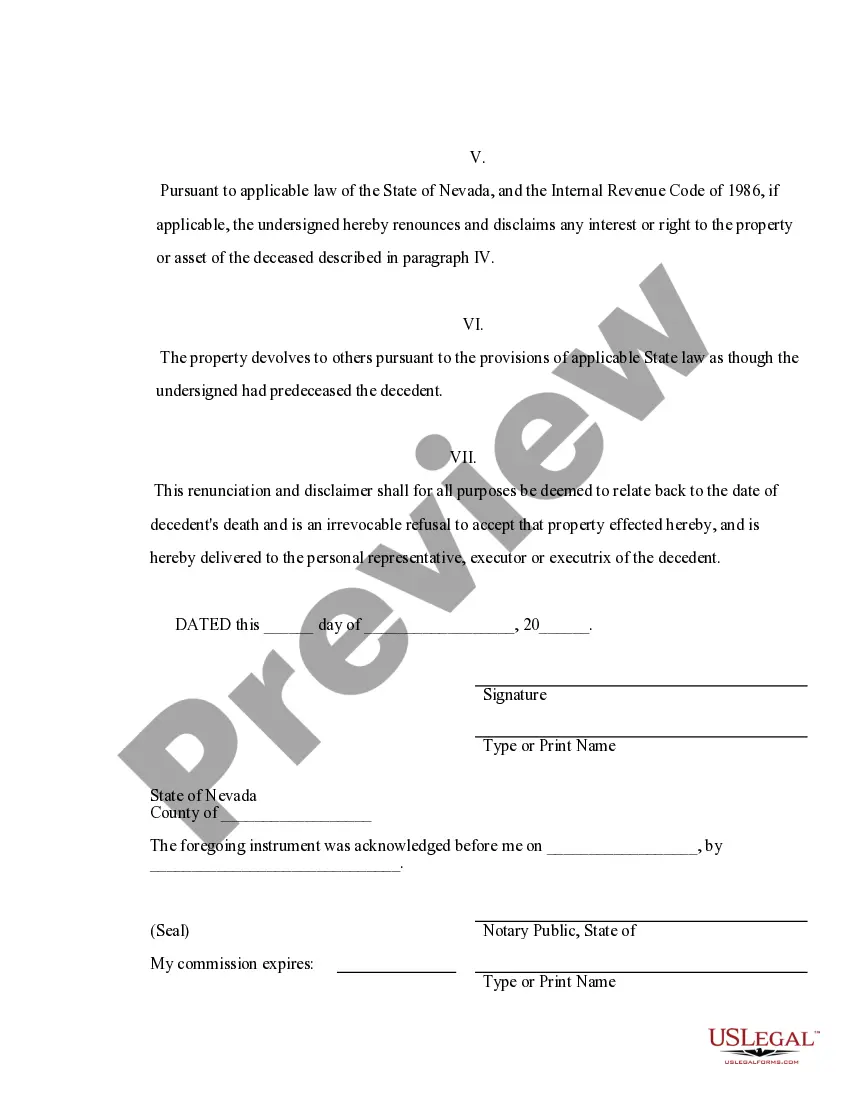
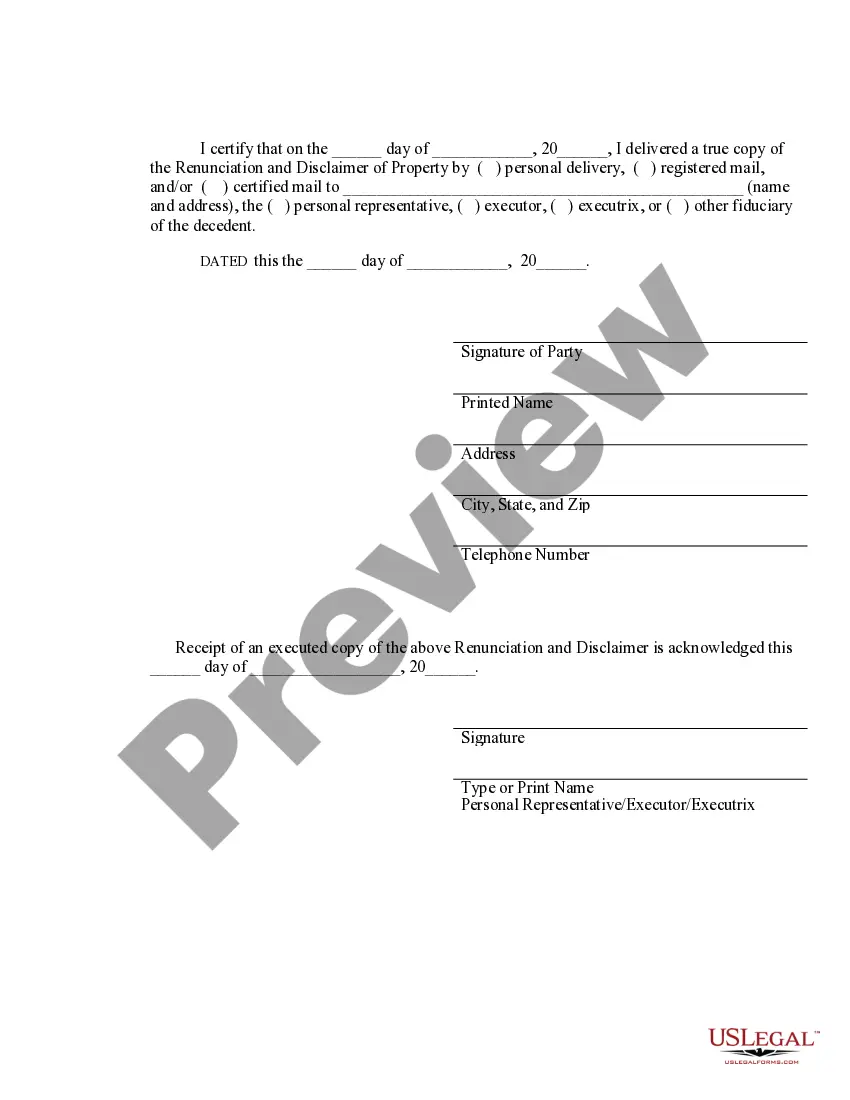
The Renunciation and Disclaimer of Joint Tenant Interest is a legal document used by a surviving joint tenant to formally refuse their interest in property following the death of a co-tenant. This legal form is specific to the state of Nevada and ensures that the property does not pass to the disclaiming tenant but instead devolves to other beneficiaries as if the joint tenant had predeceased the decedent. This document differs from other property-related forms by focusing on the renunciation of inherited interests rather than the transfer of property ownership.
Form components explained
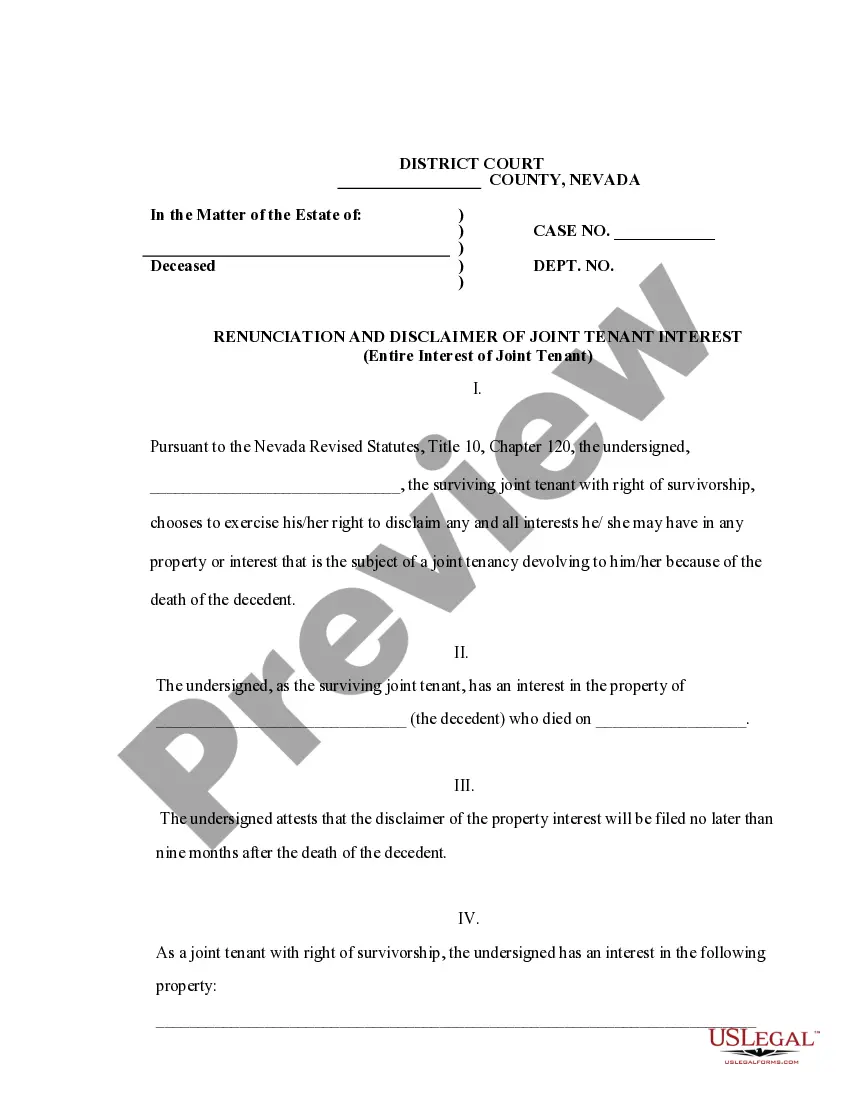
- Identification of the surviving joint tenant and the decedent.
- Statement of the decision to disclaim interest in the property.
- Details regarding the property affected by the disclaimer.
- Confirmation that the disclaimer will be filed within nine months of the decedent's death.
- Acknowledgment of the irrevocable nature of the disclaimer.


Situations where this form applies
This form is necessary when a surviving joint tenant chooses to renounce their interest in a property that automatically passes to them upon the death of another joint tenant. It is commonly used in situations where the surviving tenant does not wish to inherit the property for personal, financial, or familial reasons, such as avoiding disputes among heirs or managing tax implications.
Who needs this form
- Surviving joint tenants who wish to disclaim their interest in a property.
- Individuals involved in estate planning or management of a deceased person's assets.
- Those needing to clarify property rights to avoid future legal disputes.
Instructions for completing this form
- Identify the surviving joint tenant and provide their details.
- State the name of the decedent and the date of their death.
- Specify the property that is subject to the disclaimer.
- Sign and date the document at the designated locations.
- Ensure the document is filed appropriately within the nine-month timeframe.
Notarization guidance
To make this form legally binding, it must be notarized. Our online notarization service, powered by Notarize, lets you verify and sign documents remotely through an encrypted video session.
Get your form ready online
Our built-in tools help you complete, sign, share, and store your documents in one place.
Make edits, fill in missing information, and update formatting in US Legal Forms—just like you would in MS Word.
Download a copy, print it, send it by email, or mail it via USPS—whatever works best for your next step.
Sign and collect signatures with our SignNow integration. Send to multiple recipients, set reminders, and more. Go Premium to unlock E-Sign.
If this form requires notarization, complete it online through a secure video call—no need to meet a notary in person or wait for an appointment.
We protect your documents and personal data by following strict security and privacy standards.
Make edits, fill in missing information, and update formatting in US Legal Forms—just like you would in MS Word.
Download a copy, print it, send it by email, or mail it via USPS—whatever works best for your next step.
Sign and collect signatures with our SignNow integration. Send to multiple recipients, set reminders, and more. Go Premium to unlock E-Sign.

If this form requires notarization, complete it online through a secure video call—no need to meet a notary in person or wait for an appointment.
We protect your documents and personal data by following strict security and privacy standards.
Common mistakes to avoid
- Failing to file the disclaimer within the nine-month period.
- Not providing complete or accurate property details.
- Overlooking the need for signatures and proper dates on the document.
Benefits of completing this form online
- Convenient access to the form whenever needed.
- Editability allows for tailored information insertion before printing.
- Reliability of documents drafted according to current Nevada laws.
Summary of main points
- The Renunciation and Disclaimer of Joint Tenant Interest allows a surviving tenant to legally disclaim their property rights.
- Filing this form within nine months of the decedent's death is crucial for its validity.
- The document must include clear identification of all parties and the property involved.
- Using an online service simplifies the process and ensures access to professionally drafted forms.
Looking for another form?

Form popularity
FAQ
In the law of inheritance, wills and trusts, a disclaimer of interest (also called a renunciation) is an attempt by a person to renounce their legal right to benefit from an inheritance (either under a will or through intestacy) or through a trust.A disclaimer of interest is irrevocable.
Jointly owned property is treated as consisting of a both present and a future interest in the jointly owned property. Thus, a surviving spouse may disclaim the future interest in jointly owned property on the death of their spouse, including assets that were held by the spouses as tenants by the entirety.
In order to sever the right of survivorship, a tenant must only record a new deed showing that his or her interest in the title is now held in a Tenancy-in-Common or as Community Property.
The surviving spouse can serve as the sole trustee, but cannot have any power to direct the beneficial enjoyment of the disclaimed property unless the power is limited by an "ascertainable standard." This is necessary both to qualify the disclaimer and to avoid any taxable general power of appointment.
In California, the majority of married couples hold their real estate property as joint tenants with right of survivorship. Joint tenancy creates a right of survivorship, so upon the death of one party, his or her share will pass on to the remaining joint tenant(s).
Danger #1: Only delays probate. Danger #2: Probate when both owners die together. Danger #3: Unintentional disinheriting. Danger #4: Gift taxes. Danger #5: Loss of income tax benefits. Danger #6: Right to sell or encumber. Danger #7: Financial problems.
Property owned in joint tenancy automatically passes, without probate, to the surviving owner(s) when one owner dies. Setting up a joint tenancy is easy, and it doesn't cost a penny.
Disclaim Inheritance, Definition In a nutshell, it means you're refusing any assets that you stand to inherit under the terms of someone's will, a trust or, in the case of a person who dies intestate, the inheritance laws of your state.
It must be in writing. It must be made within 9 months of the date of death of the decedent. The disclaimant cannot receive any benefits from the assets.