Nevada Grant, Bargain, Sale Deed from Corporation to Two Individuals
What this document covers
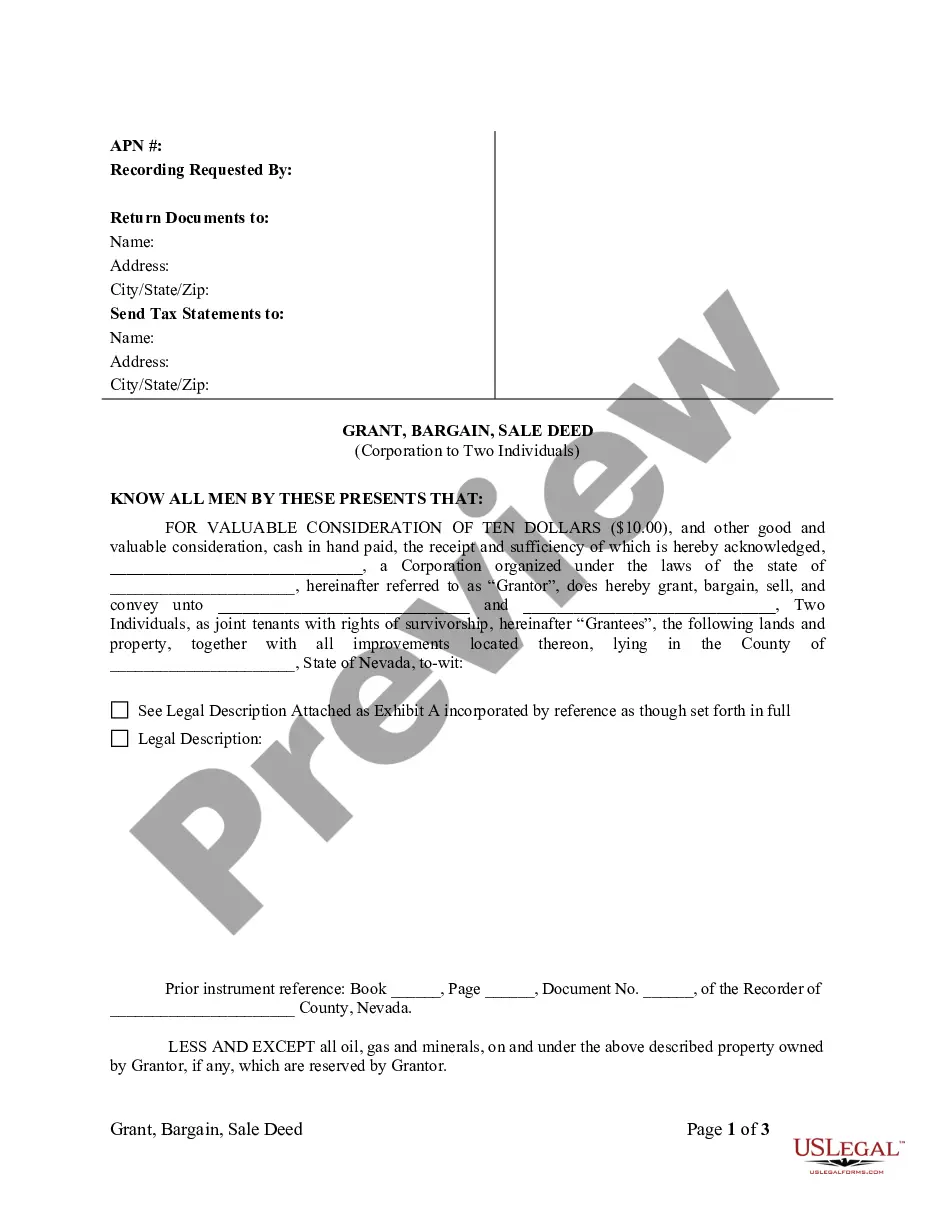
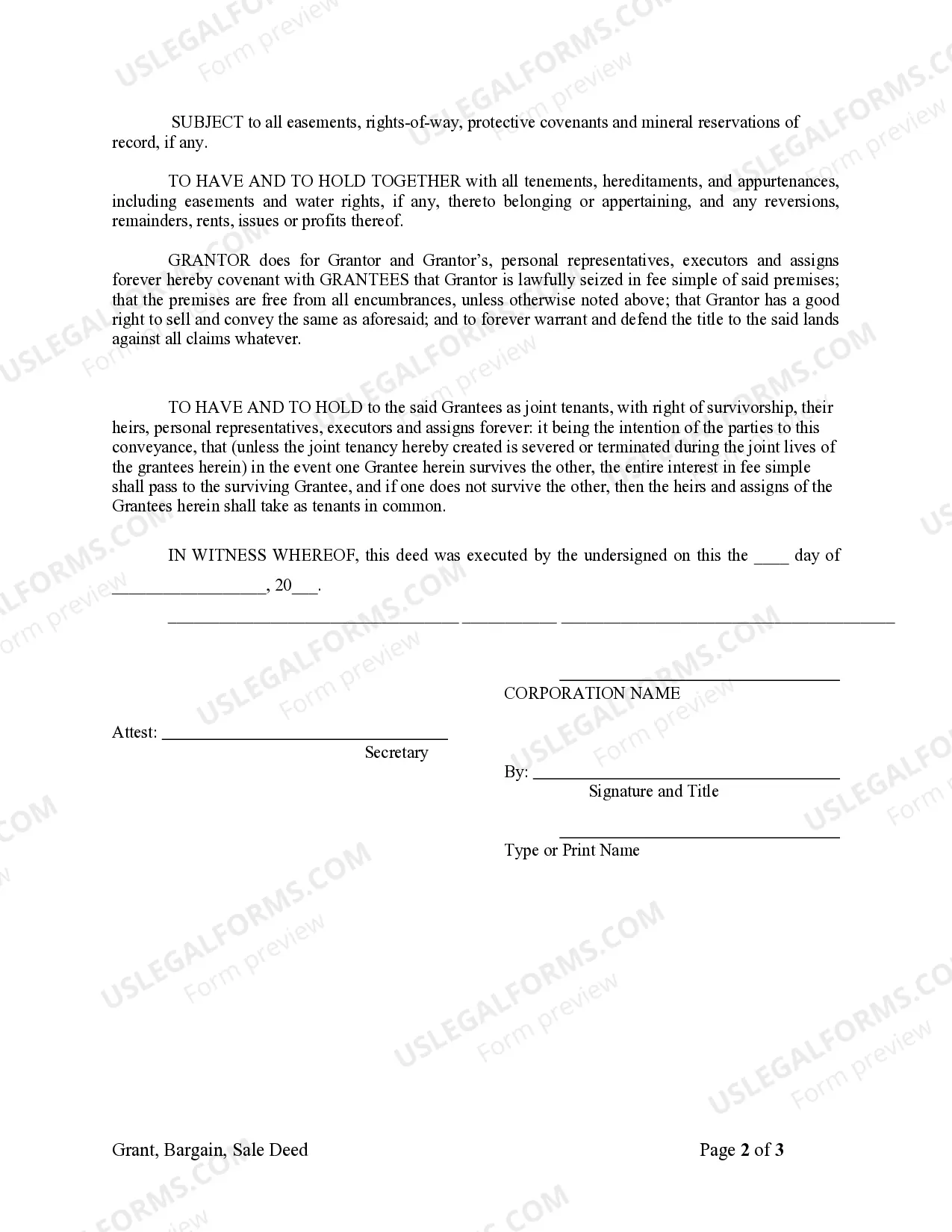
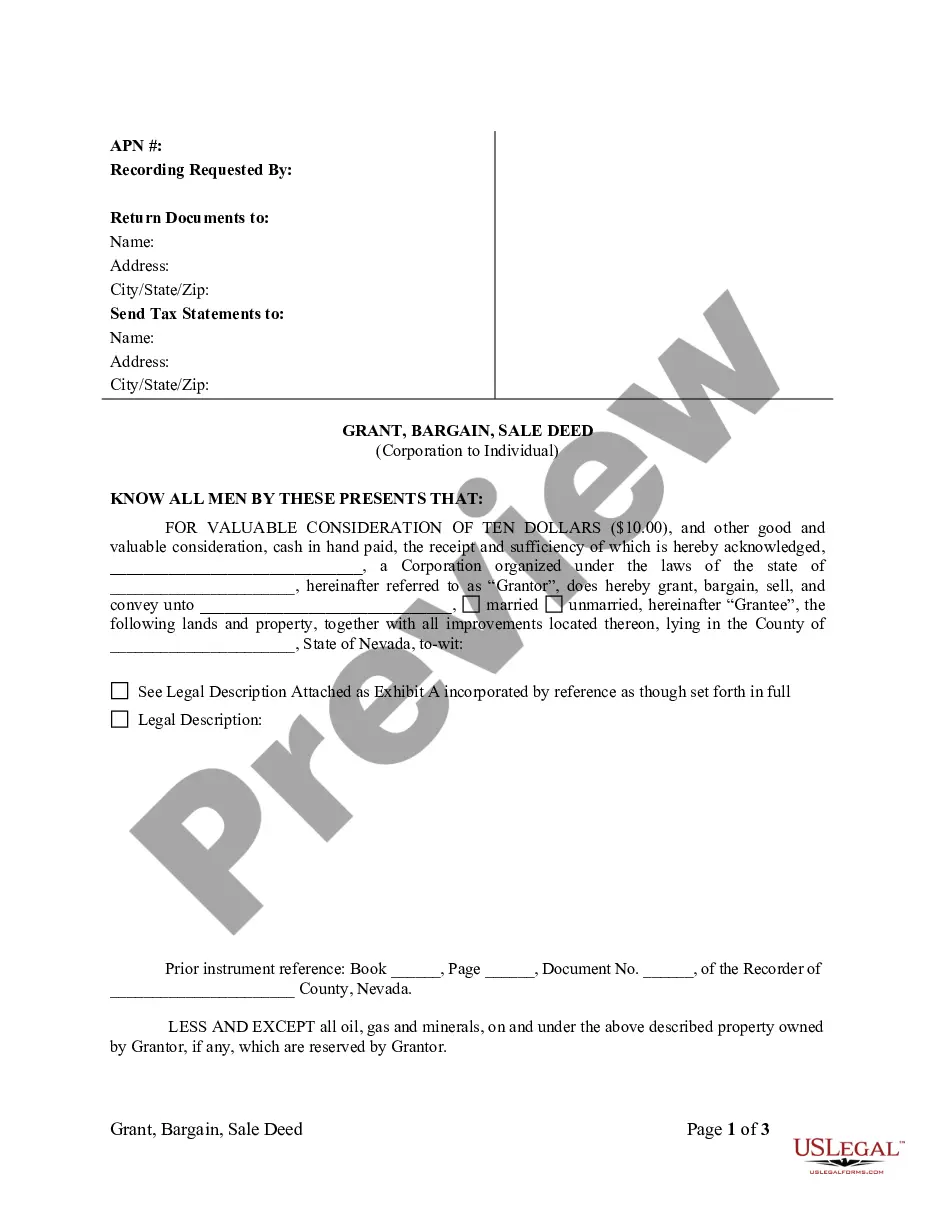
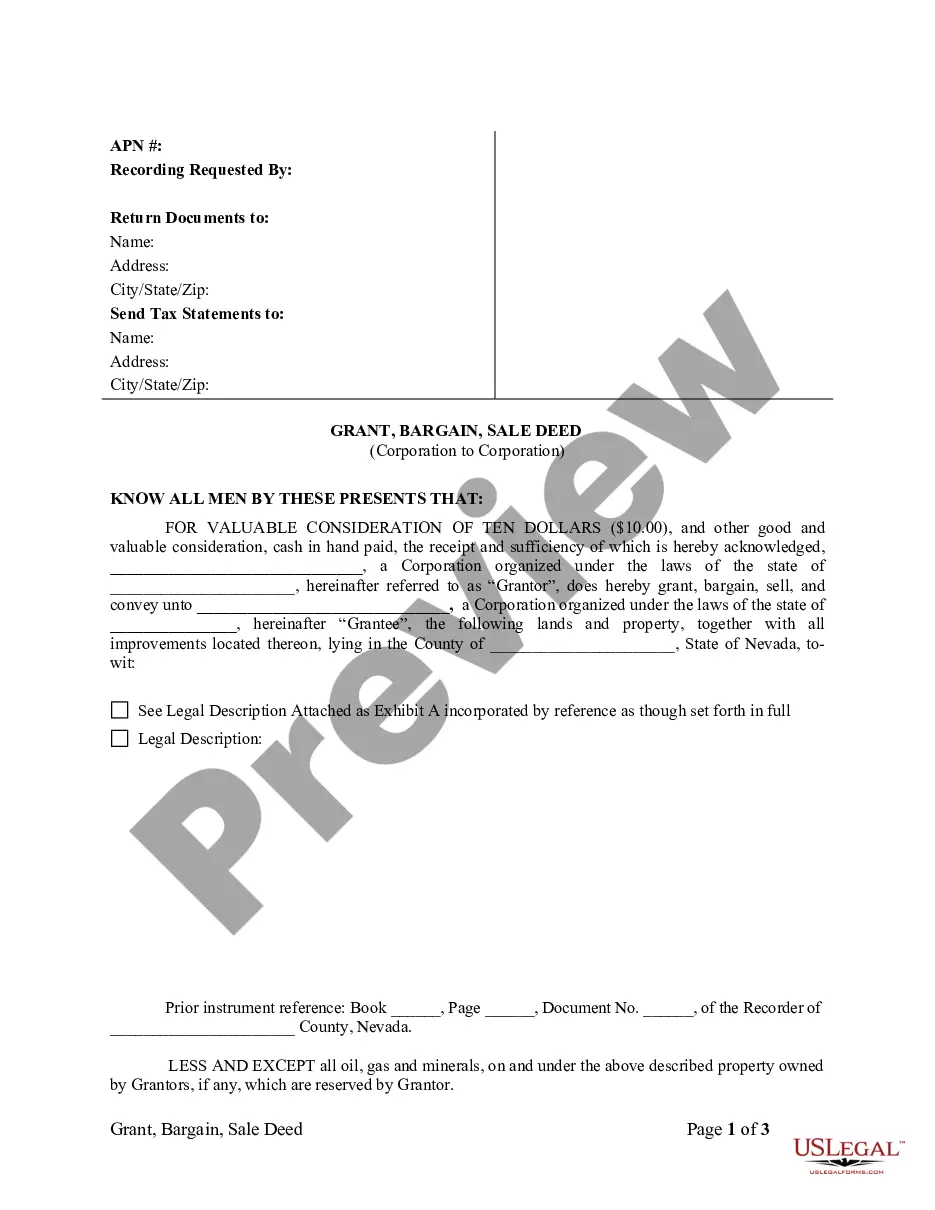
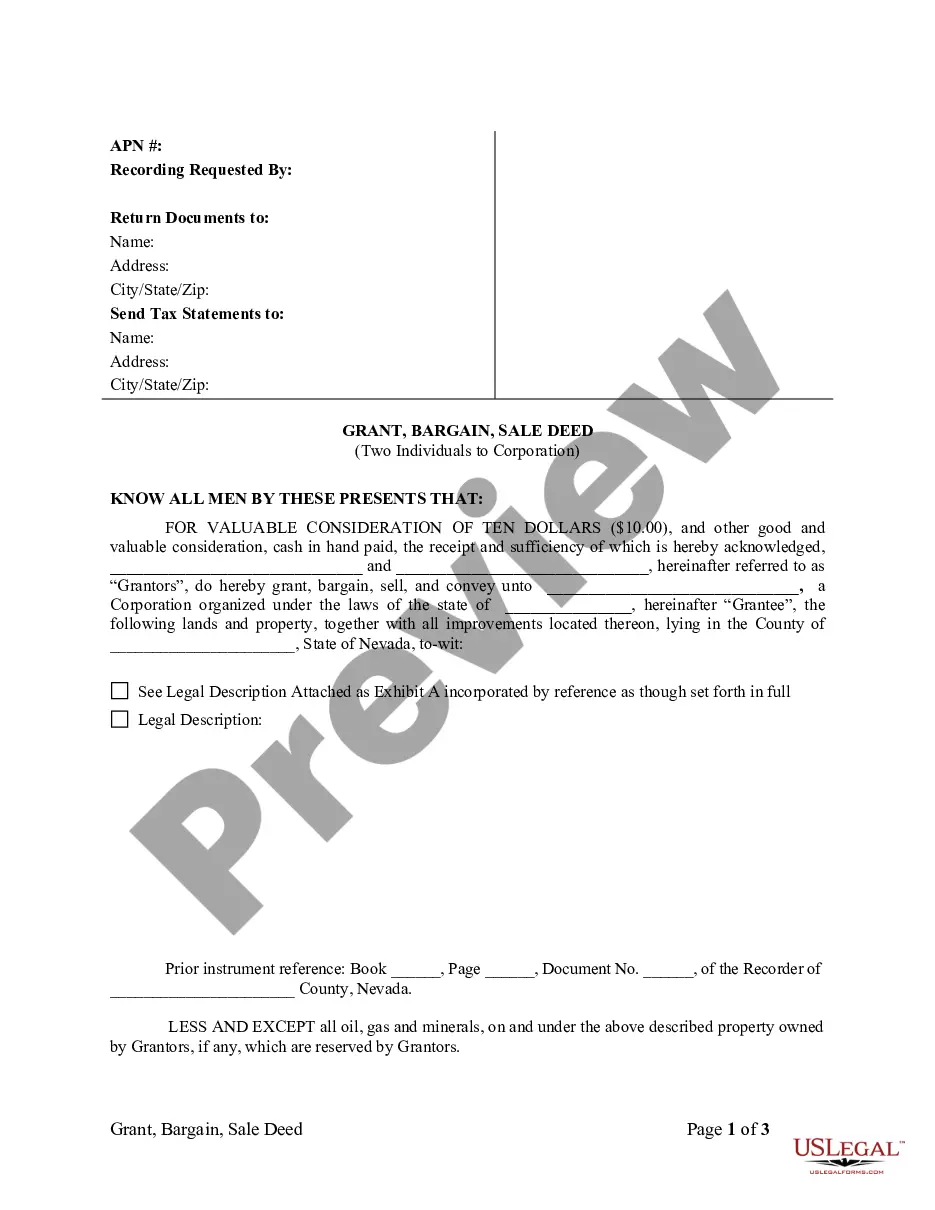
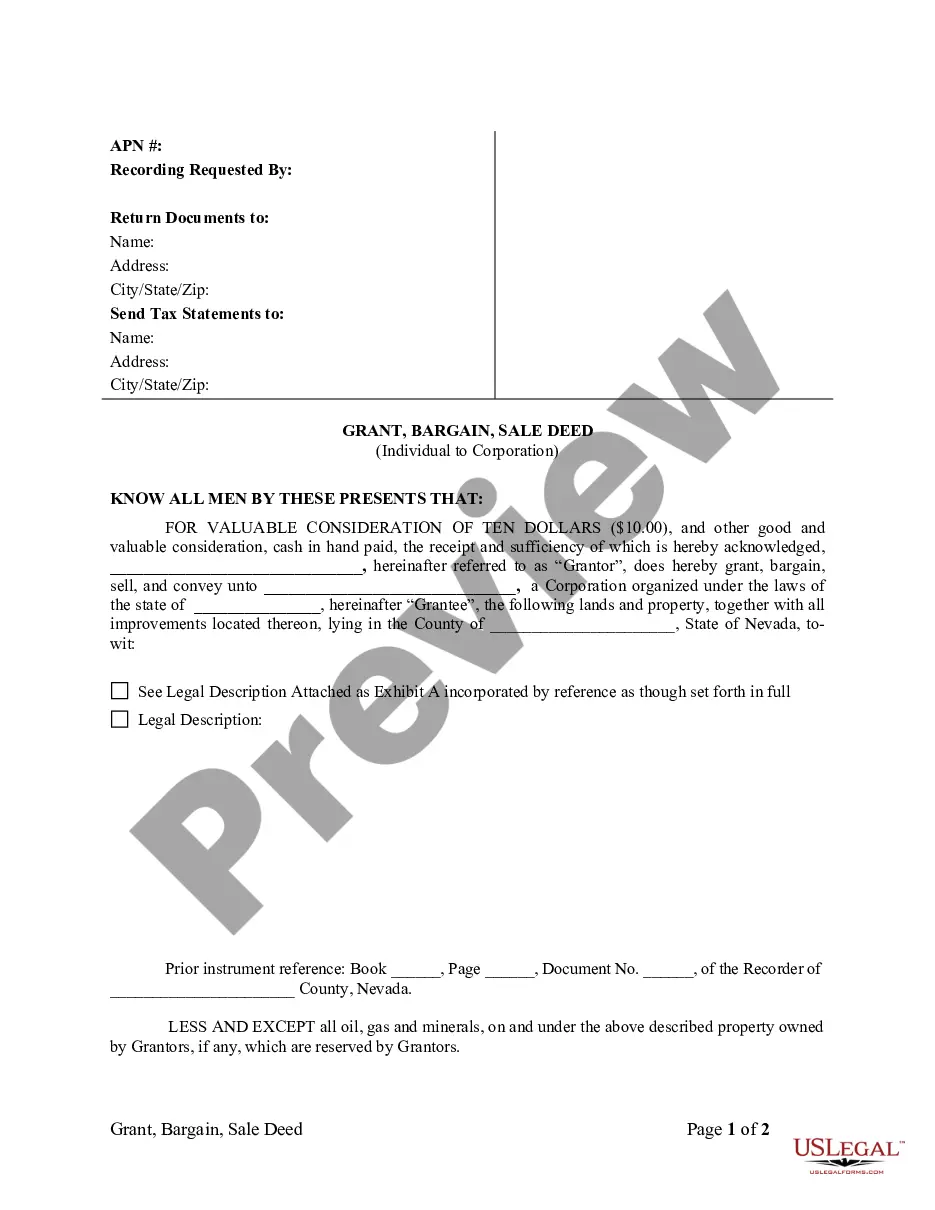
The Grant, Bargain, Sale Deed from Corporation to Two Individuals is a legal document that transfers ownership of property from a corporation (the Grantor) to two individual persons (the Grantees). This warranty deed includes assurances that the Grantor has proper title to the property and guarantees it is free from most encumbrances. It allows for joint ownership of the property, with the right of survivorship, meaning that if one Grantee passes away, full ownership will pass to the surviving Grantee.
Key parts of this document
- Identification of the Grantor (the corporation) and Grantees (the two individuals).
- Legal description of the property being conveyed.
- Grantor's warranty of title and assurance that the property is free from encumbrances.
- Specification of the joint tenancy agreement between the Grantees.
- Provisions regarding reservations of oil, gas, and minerals, if applicable.

Situations where this form applies
This form is typically used when a corporation wishes to transfer real estate ownership to two individuals. It is essential in situations such as business property sales, inheritance transitions where a corporation holds the property, or any scenario requiring legal ownership transfer while maintaining rights for surviving owners.
Who should use this form
- Corporations looking to convey property to individual stakeholders.
- Individuals who have jointly purchased property and want to formalize ownership.
- Real estate professionals facilitating the transfer of properties from corporations to individuals.
Completing this form step by step
- Identify and enter the names of the Grantor (the corporation) and each Grantee (the two individuals).
- Provide a detailed legal description of the property being conveyed.
- Specify any reservations, such as oil, gas, and mineral rights.
- Indicate the effective date of the transfer.
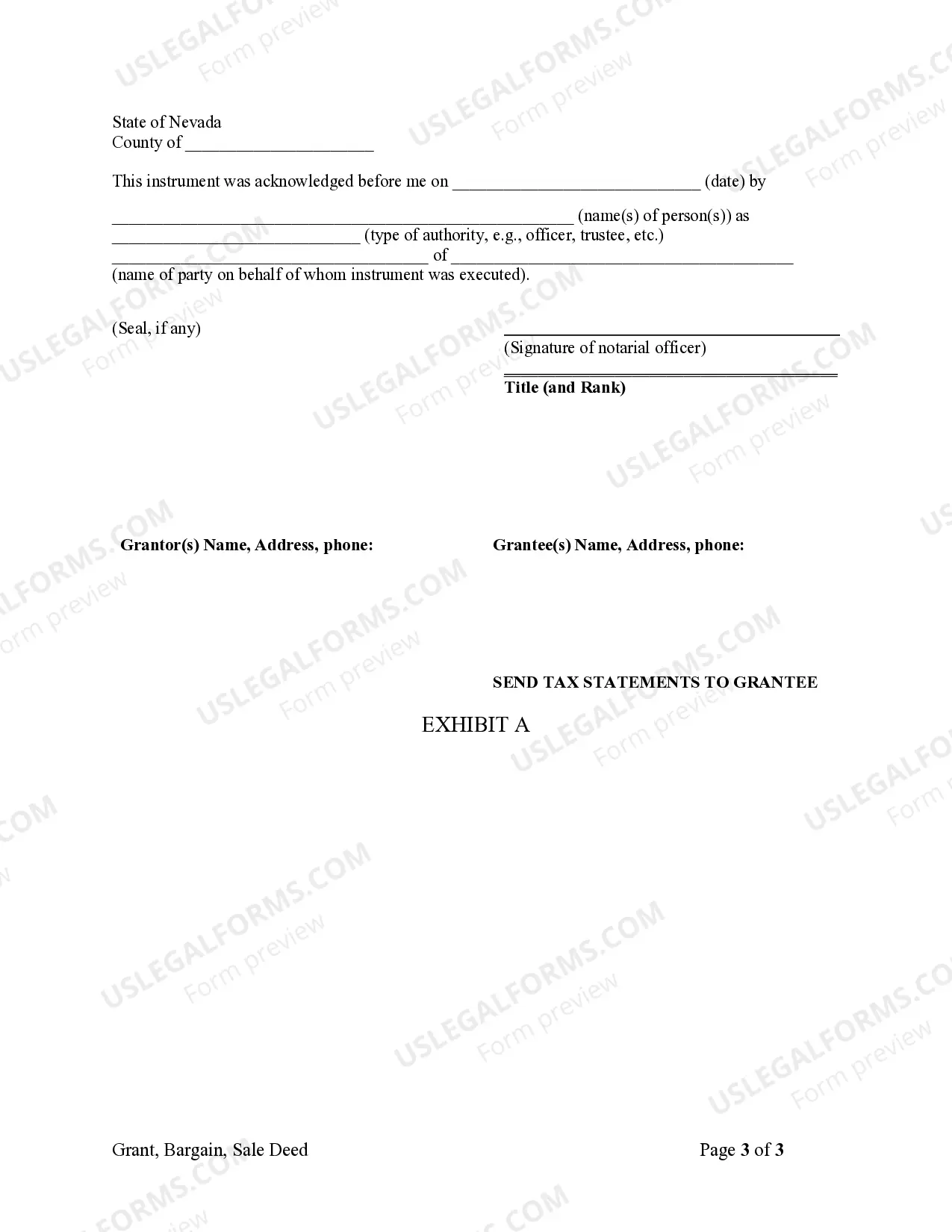
- Ensure all parties sign the document, adhering to any local notarization requirements.
Notarization requirements for this form
This form needs to be notarized to ensure legal validity. US Legal Forms provides secure online notarization powered by Notarize, allowing you to complete the process through a verified video call, available anytime.
Get your form ready online
Our built-in tools help you complete, sign, share, and store your documents in one place.
Make edits, fill in missing information, and update formatting in US Legal Forms—just like you would in MS Word.
Download a copy, print it, send it by email, or mail it via USPS—whatever works best for your next step.
Sign and collect signatures with our SignNow integration. Send to multiple recipients, set reminders, and more. Go Premium to unlock E-Sign.
If this form requires notarization, complete it online through a secure video call—no need to meet a notary in person or wait for an appointment.
We protect your documents and personal data by following strict security and privacy standards.

Make edits, fill in missing information, and update formatting in US Legal Forms—just like you would in MS Word.

Download a copy, print it, send it by email, or mail it via USPS—whatever works best for your next step.

Sign and collect signatures with our SignNow integration. Send to multiple recipients, set reminders, and more. Go Premium to unlock E-Sign.

If this form requires notarization, complete it online through a secure video call—no need to meet a notary in person or wait for an appointment.

We protect your documents and personal data by following strict security and privacy standards.
Mistakes to watch out for
- Failing to include a full legal description of the property.
- Not specifying any reservations regarding mineral rights.
- Incorrectly identifying the Grantor or Grantees, including spelling issues.
- Ignoring local requirements for notarization and recording of the deed.
Benefits of completing this form online
- Convenience of quickly accessing and customizing the form from any location.
- Instant downloads enable immediate use without waiting for physical paperwork.
- Forms are drafted by licensed attorneys, ensuring legal compliance and accuracy.
Looking for another form?
Form popularity
FAQ
Bargain and sale deeds, as the term suggests, is used in a sale. Unlike a quitclaim, the bargain and sale deed indicates that the grantor has the title and can convey it to a buyer.The bargain and sale deed indicates that the grantor has title; but property might come with encumbrances and defects.
A grant, bargain, and sale deed is commonly used in Nevada for a conveyance of real property.A certificate of the acknowledgement or proof of execution, signed by the person taking the acknowledgment or proof, and under the seal or stamp of that person, will entitle the deed to be recorded (NRS 111.310).
Sale deed can be challenged only if there are sound legal grounds. If it has been executed by fraud, co ertion etc it can be challenged but one need to prove to the court the grounds on which it is challenged.
The quitclaim deed provides no warranties; it conveys the interest the grantor had in the propertynothing more.The bargain and sale deed indicates that the grantor has title; but property might come with encumbrances and defects.
Bargain and sale deeds are most often used when property is transferred after a foreclosure, tax sale, or the settlement of a deceased person's estate. They may also be used in the same situations as a quitclaim deed, although they give the grantee a little more protection.
Buying property with this type of deed is not necessarily a bad idea, but it is advisable to take some precautions. If possible, a title search should be conducted to look for any clouds on the title and to see how difficult it would be to release them.
The drawback, quite simply, is that quitclaim deeds offer the grantee/recipient no protection or guarantees whatsoever about the property or their ownership of it. Maybe the grantor did not own the property at all, or maybe they only had partial ownership.