Nebraska - Quitclaim Deed from Individual to Two Individuals
About this form
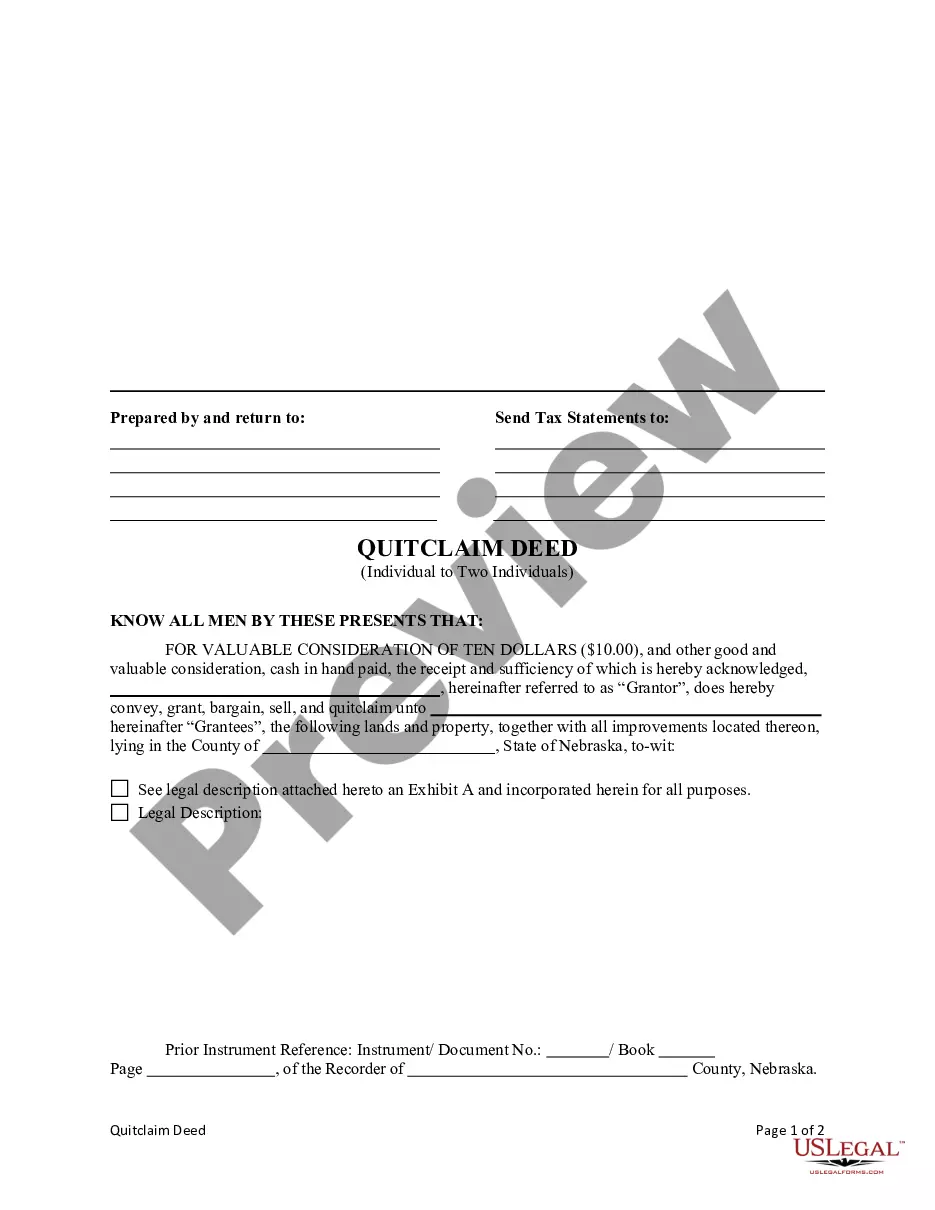
This Quitclaim Deed is a legal document allowing an individual to convey property ownership to two individuals as tenants in common. Unlike warranty deeds, this form does not guarantee clear title, making it essential for situations where the grantor only wants to relinquish their interest in the property without any assurances.
Key parts of this document
- Identification of the grantor and grantees
- Legal description of the property being transferred
- Statement of consideration received
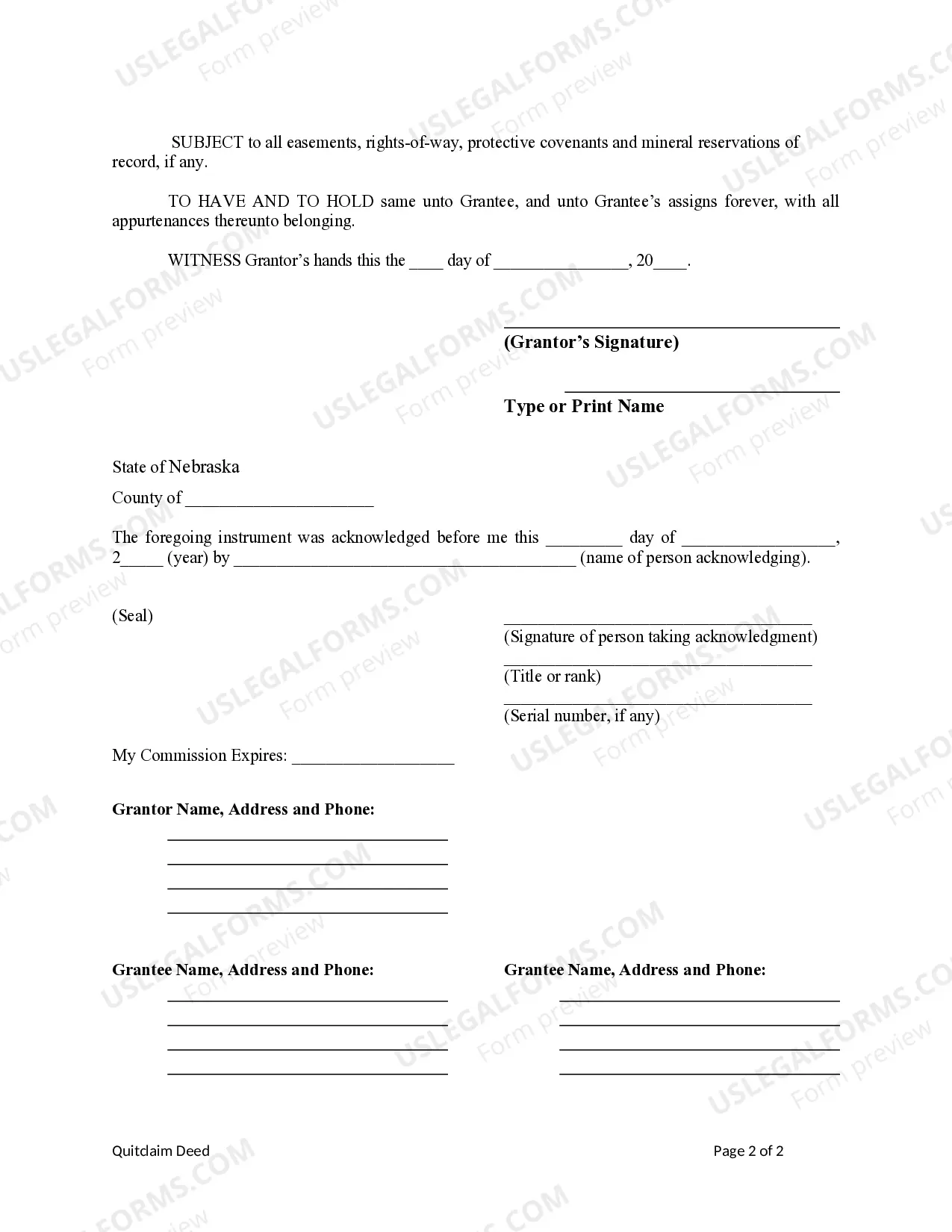
- Signature of the grantor
- Notarization requirements, if applicable






When to use this document
This form is used when an individual wants to transfer property ownership to two other individuals. Common scenarios include transferring property to family members, dividing property among co-owners, or handling estate matters where the grantor needs to relinquish interest without guarantees on title.
Who needs this form
- Property owners who wish to convey their interest to two parties
- Individuals involved in estate planning
- Family members transferring property among themselves
Completing this form step by step
- Identify the grantor and grantees by entering their full legal names.
- Provide a complete and accurate legal description of the property.
- State the consideration amount, typically a nominal amount like ten dollars.
- Have the grantor sign the deed in front of a notary public, if required.
- Submit the deed to the appropriate local government office to record the transfer.
Notarization requirements for this form
To make this form legally binding, it must be notarized. Our online notarization service, powered by Notarize, lets you verify and sign documents remotely through an encrypted video session.
Get your form ready online
Our built-in tools help you complete, sign, share, and store your documents in one place.
Make edits, fill in missing information, and update formatting in US Legal Forms—just like you would in MS Word.
Download a copy, print it, send it by email, or mail it via USPS—whatever works best for your next step.
Sign and collect signatures with our SignNow integration. Send to multiple recipients, set reminders, and more. Go Premium to unlock E-Sign.
If this form requires notarization, complete it online through a secure video call—no need to meet a notary in person or wait for an appointment.
We protect your documents and personal data by following strict security and privacy standards.

Make edits, fill in missing information, and update formatting in US Legal Forms—just like you would in MS Word.

Download a copy, print it, send it by email, or mail it via USPS—whatever works best for your next step.

Sign and collect signatures with our SignNow integration. Send to multiple recipients, set reminders, and more. Go Premium to unlock E-Sign.

If this form requires notarization, complete it online through a secure video call—no need to meet a notary in person or wait for an appointment.

We protect your documents and personal data by following strict security and privacy standards.
Common mistakes to avoid
- Failing to include the legal description of the property.
- Not having the deed notarized when required.
- Incorrectly identifying the parties involved in the transfer.
Benefits of using this form online
- Convenience of downloading and printing the form at your convenience.
- Easy to complete with guided instructions.
- Access to forms prepared by licensed attorneys ensuring legal compliance.
Looking for another form?
Form popularity
FAQ
Yes, you can use a Quitclaim Deed to transfer a gift of property to someone. You must still include consideration when filing your Quitclaim Deed with the County Recorder's Office to show that title has been transferred, so you would use $10.00 as the consideration for the property.
Laws NRS 23-1510. Recording Must be filed in the County Recorder's Office where the property is located (See County List). Signing (NRS 76-211) All quit claim deeds must be signed with the Grantor(s) being acknowledged by a Notary Public.
To use a Quitclaim Deed to add someone to a property deed or title, you would need to create a Quitclaim Deed and list all of the current owners in the grantor section. In the grantee section, you would list all of the current owners as well as the person you would like to add.
If you own your own home, you are free to gift or sell an interest in the real property to someone else.You'll need to transfer an interest by writing up another deed with the person's name on it. In California, you can use either a grant deed, a quitclaim deed or an interspousal deed, depending on your circumstances.
A person who signs a quitclaim deed to transfer property they do not own results in no title at all being transferred since there is no actual ownership interest. The quitclaim deed only transfers the type of title you own.
But you might be wondering if an owner can transfer a deed to another person without a real estate lawyer. The answer is yes. Parties to a transaction are always free to prepare their own deeds.A quitclaim deed, for example, is far simpler than a warranty deed.