North Carolina Claim of Lien by Individual
What is this form?
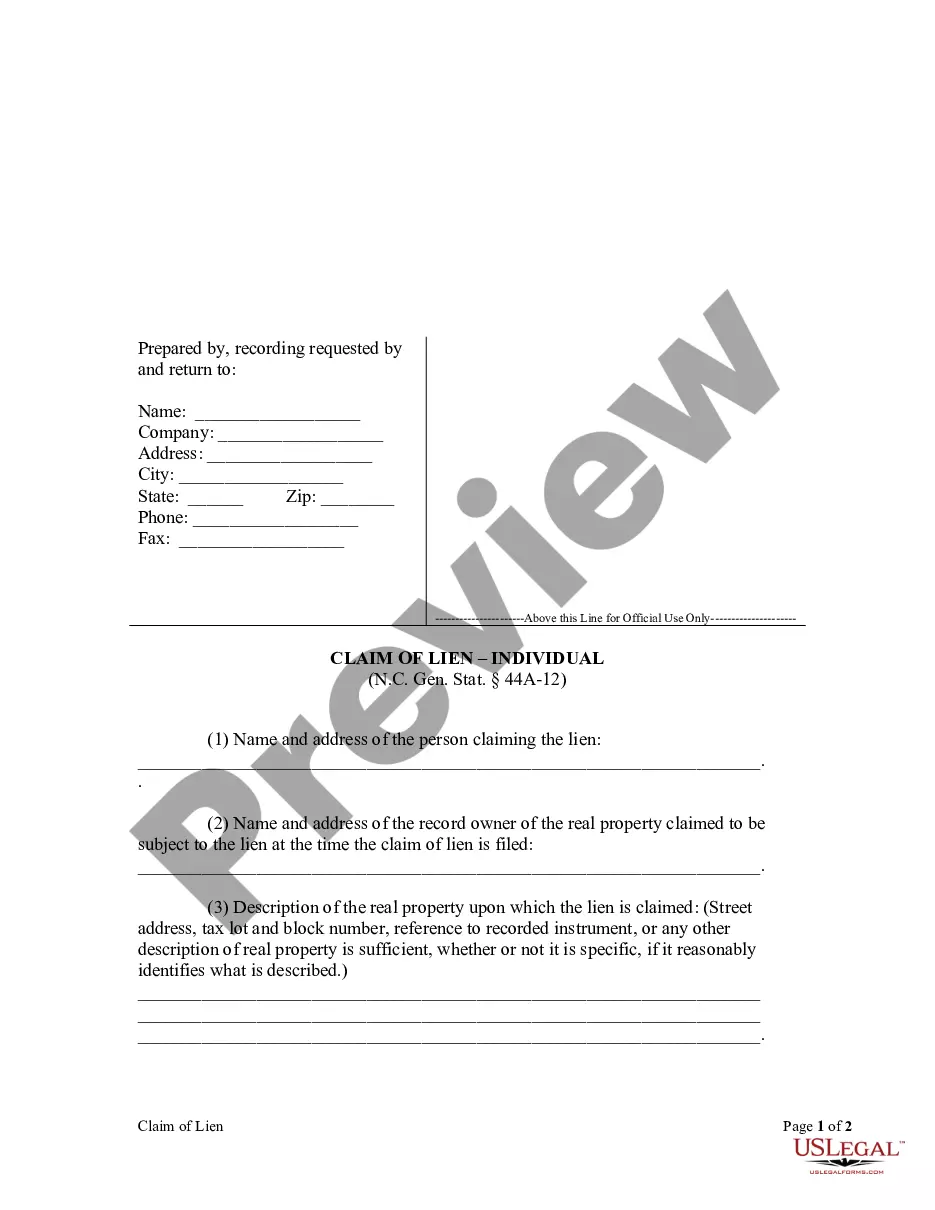
The Claim of Lien by Individual form allows an individual to file a lien against real property in North Carolina. This legal document is necessary for anyone who has supplied labor or materials and has not received payment. By filing this claim, individuals protect their right to seek payment through a lien, which provides a security interest in the property until debts are settled. This form specifically caters to individual claimants, distinguishing it from other lien forms intended for businesses or contractors.
Key parts of this document
- Name and address of the individual claiming the lien.
- Name and address of the property owner at the time of filing.
- Description of the property subject to the lien.
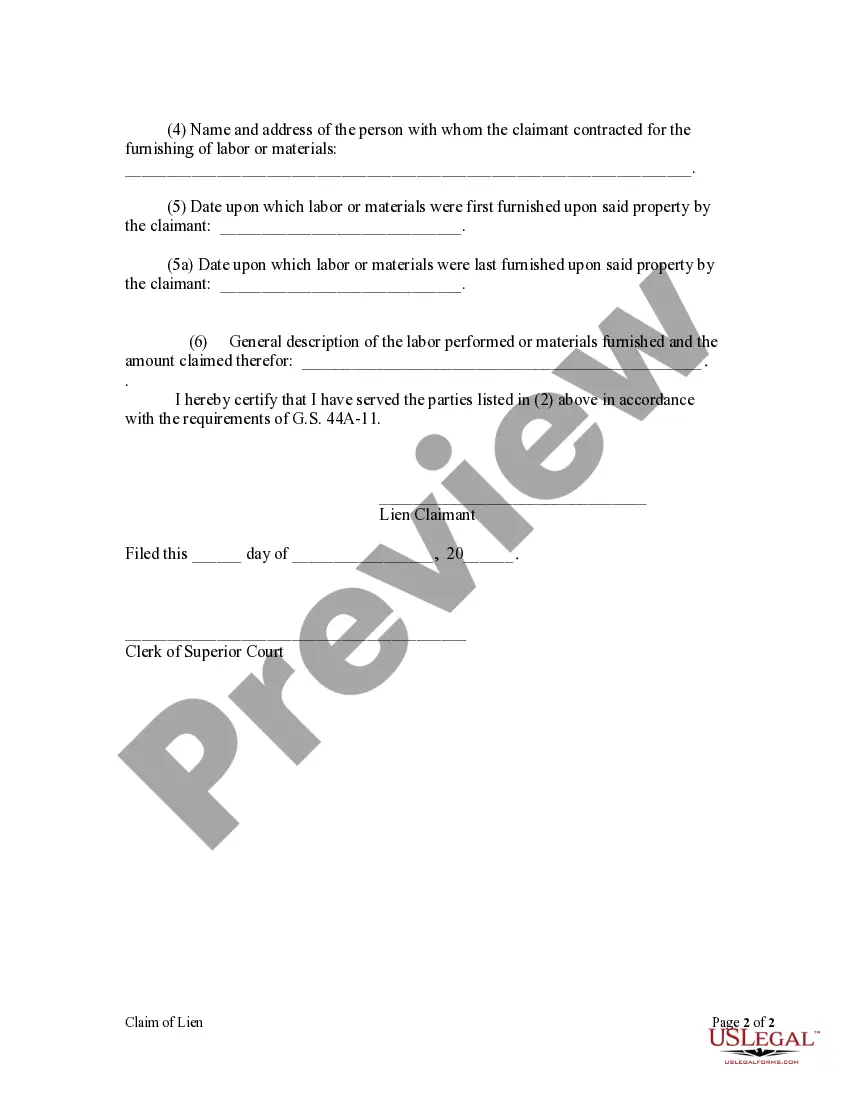
- Name and address of the party contracted for labor or materials.
- Dates when labor or materials were first and last provided.
- Description of the labor performed or materials provided along with the claimed amount.
When to use this document
You should use the Claim of Lien by Individual form when you have provided labor or materials for a property and have not been compensated. This form must be filed within one hundred and twenty days after the last provision of these services or materials. Situations may include contracting for renovations, repairs, or supplying building materials without receiving payment.
Who should use this form
- Individuals who have provided labor or materials for a real property.
- Subcontractors or suppliers who have not been paid for their services or goods.
- Anyone looking to secure a lien against a property in North Carolina to protect their financial interests.
How to complete this form
- Identify the parties involved, including your name and address as the claimant.
- Provide the name and address of the property owner.
- Describe the property accurately to ensure proper identification.
- Insert details of the contract, including who you worked with and the relevant dates.
- Detail the work or materials provided and the total amount owed.
- Sign and date the form, ensuring it is notarized if required.
Notarization guidance
This form must be notarized to be legally valid. This ensures that the signature is authentic and that the claimant has met all required legal formalities. With US Legal Forms, you can access integrated online notarization services, allowing you to complete this process securely via video call at any time.
Get your form ready online
Our built-in tools help you complete, sign, share, and store your documents in one place.
Make edits, fill in missing information, and update formatting in US Legal Forms—just like you would in MS Word.
Download a copy, print it, send it by email, or mail it via USPS—whatever works best for your next step.
Sign and collect signatures with our SignNow integration. Send to multiple recipients, set reminders, and more. Go Premium to unlock E-Sign.
If this form requires notarization, complete it online through a secure video call—no need to meet a notary in person or wait for an appointment.
We protect your documents and personal data by following strict security and privacy standards.

Make edits, fill in missing information, and update formatting in US Legal Forms—just like you would in MS Word.

Download a copy, print it, send it by email, or mail it via USPS—whatever works best for your next step.

Sign and collect signatures with our SignNow integration. Send to multiple recipients, set reminders, and more. Go Premium to unlock E-Sign.

If this form requires notarization, complete it online through a secure video call—no need to meet a notary in person or wait for an appointment.

We protect your documents and personal data by following strict security and privacy standards.
Avoid these common issues
- Failing to file within the one hundred and twenty-day deadline.
- Not providing complete and accurate descriptions of the property.
- Omitting essential details like dates of service and the amount owed.
- Neglecting to sign or provide a notary if required.
Benefits of completing this form online
- Convenient access to downloadable templates anytime.
- Editable forms allow you to fill in your specific information securely.
- Reliability of forms drafted by licensed attorneys.
Key takeaways
- The Claim of Lien by Individual is crucial for protecting payment rights for labor or materials in North Carolina.
- Always file this claim within one hundred and twenty days of the last work or service provided.
- Ensure all details are correctly filled out and notarization is completed for legal enforceability.
Looking for another form?
Form popularity
FAQ
A judgment lien in North Carolina will remain attached to the debtor's property (even if the property changes hands) for ten years.
Fill out a mechanics lien form that meets NC requirements. North Carolina law sets specific guidelines claimants must meet in order to file a lien. File the lien with the county recorder's office. Serve a copy of the lien on the property owner.
Subject to some exceptions, a lien for materials, services, or wages may be registered any time up to 45 days from the day the last materials, services, or wages were provided, or since the contract was abandoned. After those 45 days elapse, the lien expires.
In North Carolina, a mechanics lien must be filed after the debt becomes due, but within 120 days from the date of last furnishing labor or materials to the project.
A judgment lien continues for a period of 20 years from the date of the filing of the writ of execution, and the lien may be renewed once for a period of 20 years.
In North Carolina, a judgment is valid for ten years from the date it was awarded by the Court. The judgment can be renewed for another ten years, giving a judgment creditor additional time to try to collect the money owed.
A: The filing fee for an Appointment of Lien Agent is $30 for a 1-2 Family Dwelling and $58 for any Other property type.
The simplest way to prevent liens and ensure that subcontractors and suppliers are paid is to pay with joint checks. This is when both parties endorse the check. Compare the contractor's materials or labor bill to the schedule of payments in your contract and the Preliminary Notices.