Missouri Letter from Tenant to Landlord about Landlord's refusal to allow sublease is unreasonable
What this document covers
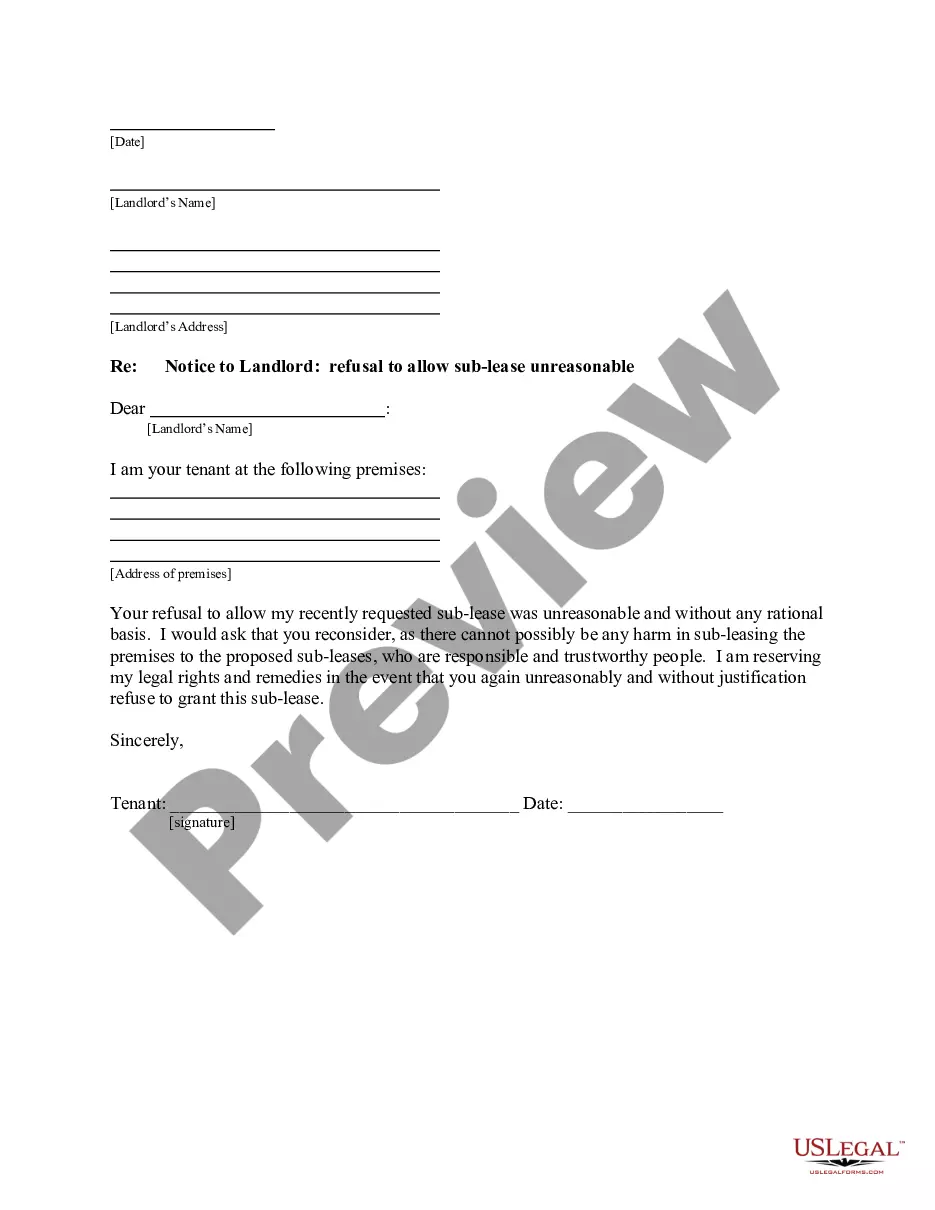
This letter from tenant to landlord addresses the landlord's refusal to allow a sublease. It serves to formally notify the landlord of the tenant's intent to challenge this refusal and to reserve legal rights should the landlord persist in denying the sublet. This form is crucial for tenants needing to legally assert their rights regarding subletting, distinguishing itself from other forms of tenant-landlord communication by its specific focus on subleasing issues.
Form components explained
- Identification of the tenant and landlord including contact information.
- Clear statement of the landlord's refusal to permit subleasing.
- Assertion of the tenant's legal rights regarding the sublease decision.
- Date of the communication and tenant's signature for authenticity.

Common use cases
This form should be used when a tenant seeks to sublease their rental unit but faces an unreasonable refusal from the landlord. It is applicable in scenarios where the tenant believes that the landlord's denial violates their lease agreement or legal rights, and they wish to reserve the right to take further action if necessary.
Intended users of this form
- Tenants who have a signed lease agreement and wish to sublet their rental property.
- Renters facing an unreasonable refusal from their landlord regarding subletting.
- Individuals who want to document their communication with the landlord for potential future disputes.
Steps to complete this form
- Identify the tenant and landlord, including full names and contact details.
- Clearly outline the refusal from the landlord to permit the sublease.
- State your understanding of your legal rights regarding the sublease.
- Sign and date the letter to authenticate your communication.
Notarization requirements for this form
This form does not typically require notarization unless specified by local law. It's important to check specific state requirements to confirm any notarization needs.
Get your form ready online
Our built-in tools help you complete, sign, share, and store your documents in one place.
Make edits, fill in missing information, and update formatting in US Legal Forms—just like you would in MS Word.
Download a copy, print it, send it by email, or mail it via USPS—whatever works best for your next step.
Sign and collect signatures with our SignNow integration. Send to multiple recipients, set reminders, and more. Go Premium to unlock E-Sign.
If this form requires notarization, complete it online through a secure video call—no need to meet a notary in person or wait for an appointment.
We protect your documents and personal data by following strict security and privacy standards.

Make edits, fill in missing information, and update formatting in US Legal Forms—just like you would in MS Word.

Download a copy, print it, send it by email, or mail it via USPS—whatever works best for your next step.

Sign and collect signatures with our SignNow integration. Send to multiple recipients, set reminders, and more. Go Premium to unlock E-Sign.

If this form requires notarization, complete it online through a secure video call—no need to meet a notary in person or wait for an appointment.

We protect your documents and personal data by following strict security and privacy standards.
Common mistakes
- Failing to include all relevant contact information for both parties.
- Not clearly stating the specific reasons why the landlord's refusal is deemed unreasonable.
- Neglecting to keep a copy of the sent letter for personal records.
Benefits of using this form online
- Convenient access and immediate download of the form.
- Editability allows for customization to suit individual circumstances.
- Reliability in having a legally drafted document by professionals.
Legal use & context
- The letter serves as an official record of the tenant's request and the landlord's response.
- It can be used as evidence in any future legal disputes regarding subletting.
Summary of main points
- Communicating with your landlord about subleasing is essential for protecting your rights.
- Documenting the refusal can strengthen your position in potential legal matters.
- Always refer to local laws for specific requirements related to subleasing and tenant rights.
Looking for another form?
Form popularity
FAQ
If you're seeking damages for emotional distress caused by a landlord's discrimination, or punitive damages for especially blatant and intentional discrimination, a lawsuit may well be your best bet. Understand what's involved in suing your landlord. You may file a lawsuit in either federal or state court.
Step 1: make a formal complaint. You can make a formal complaint by writing a letter to your landlord. Step 2: complain to your local council. If making a formal complaint to your landlord doesn't solve your problem you might be able to complain to your local council.
1 tr to keep back; refrain from giving. he withheld his permission.
The landlord cannot refuse the assignment or sublet unless there is a good reason, such as the proposed tenant's inability to pay the rent or problematic behavior of this tenant. This is the case no matter what your lease or the building rules say.
Know your state's landlord/tenant laws. Read and respond to the court summons. Try to work out a settlement. Consider legal counsel. Show up for court. Look sharp and provide evidence.
If the lease contains no restrictions, the tenant has absolute freedom. If the lease contains an absolute prohibition then the landlord can refuse or impose unreasonable conditions.If the lease contains a fully qualified covenant, the landlord's consent is not to be unreasonably withheld.
A qualified covenant requires the landlord's consent.A fully qualified covenant is a covenant that requires the landlord's consent but states that the landlord's consent will not be unreasonably withheld.
The phrase is typically used in assignment clauses: No Party may assign rights or obligations of this Agreement without the consent of the other Party, which consent shall not unreasonably be withheld or delayed.