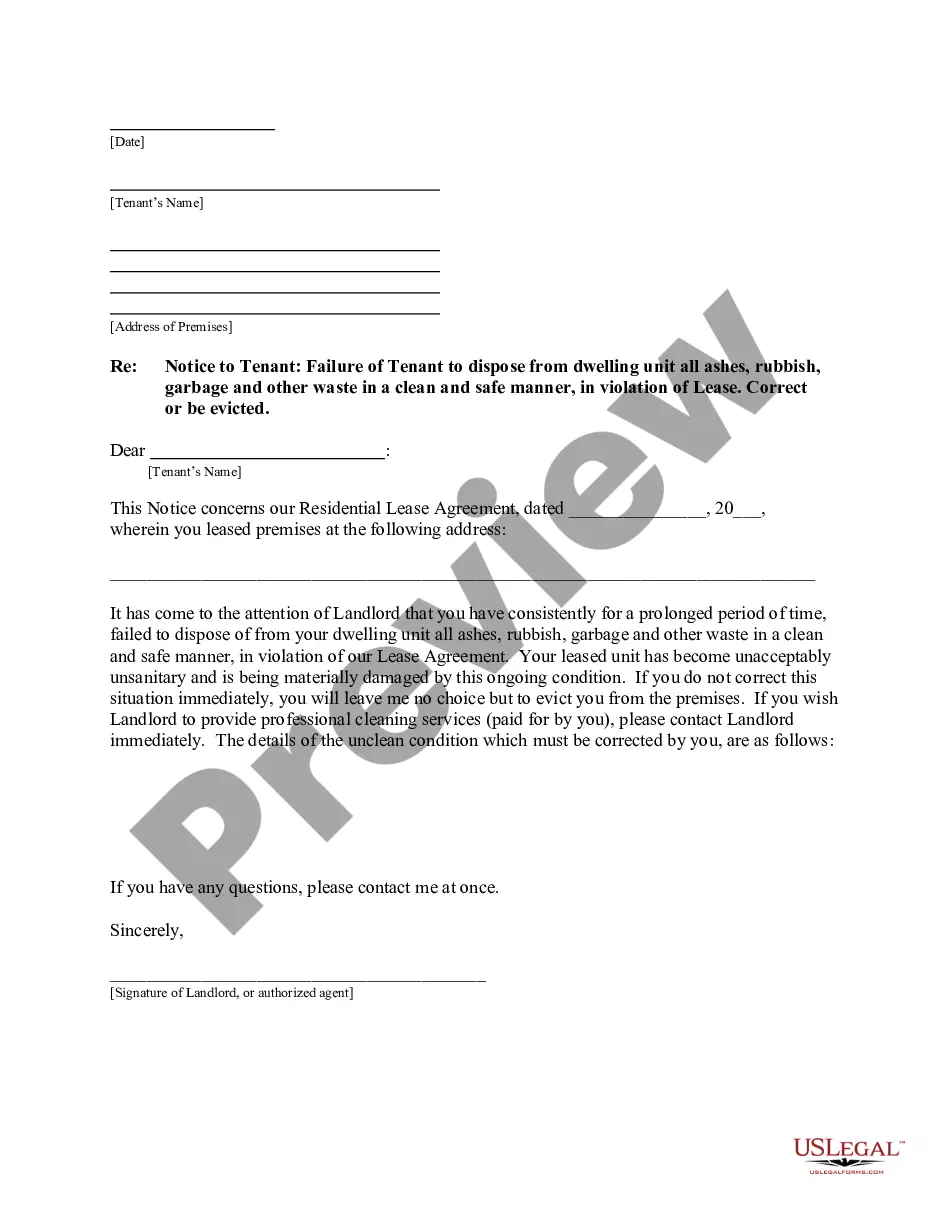
Missouri Partial Release of Mechanic's Lien - Corporation
What this document covers
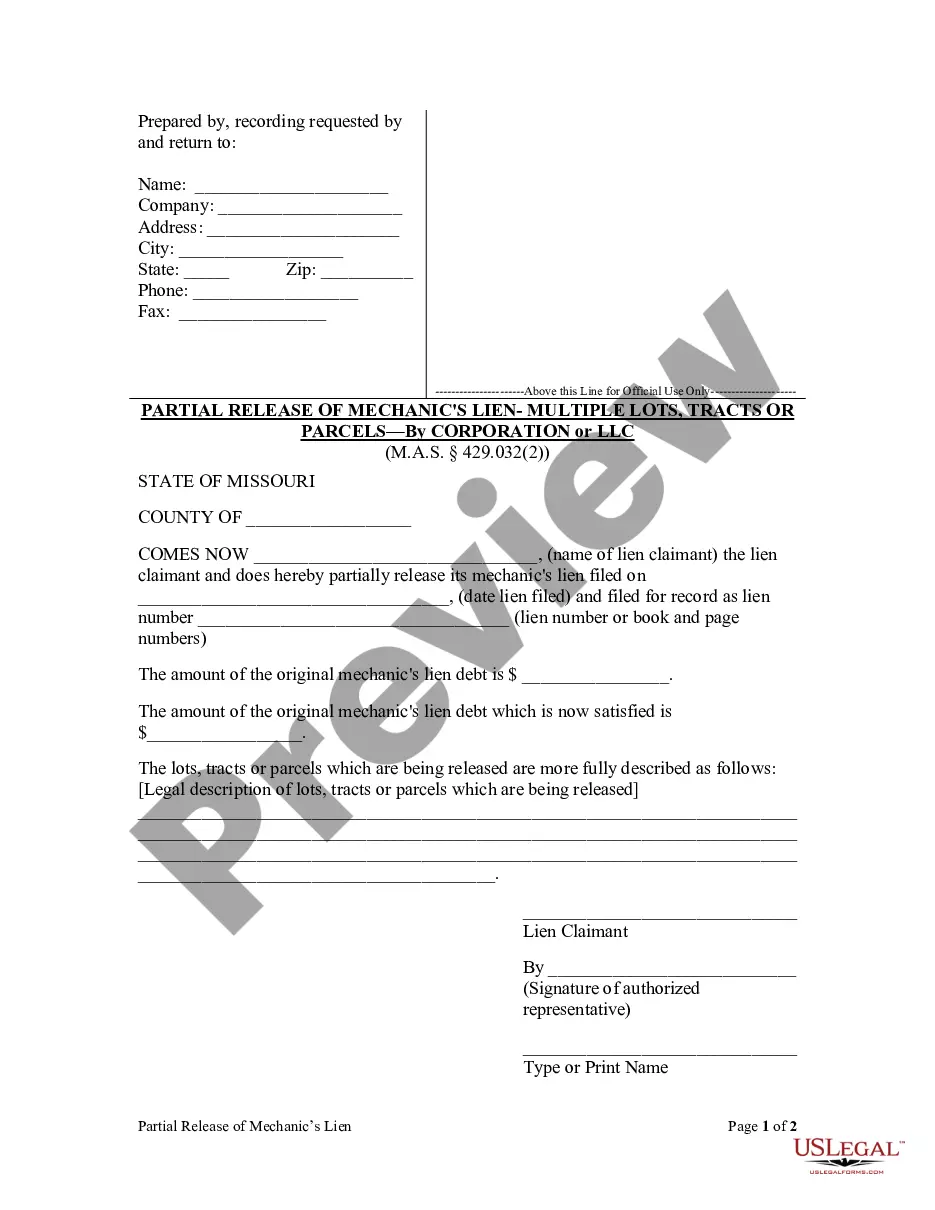
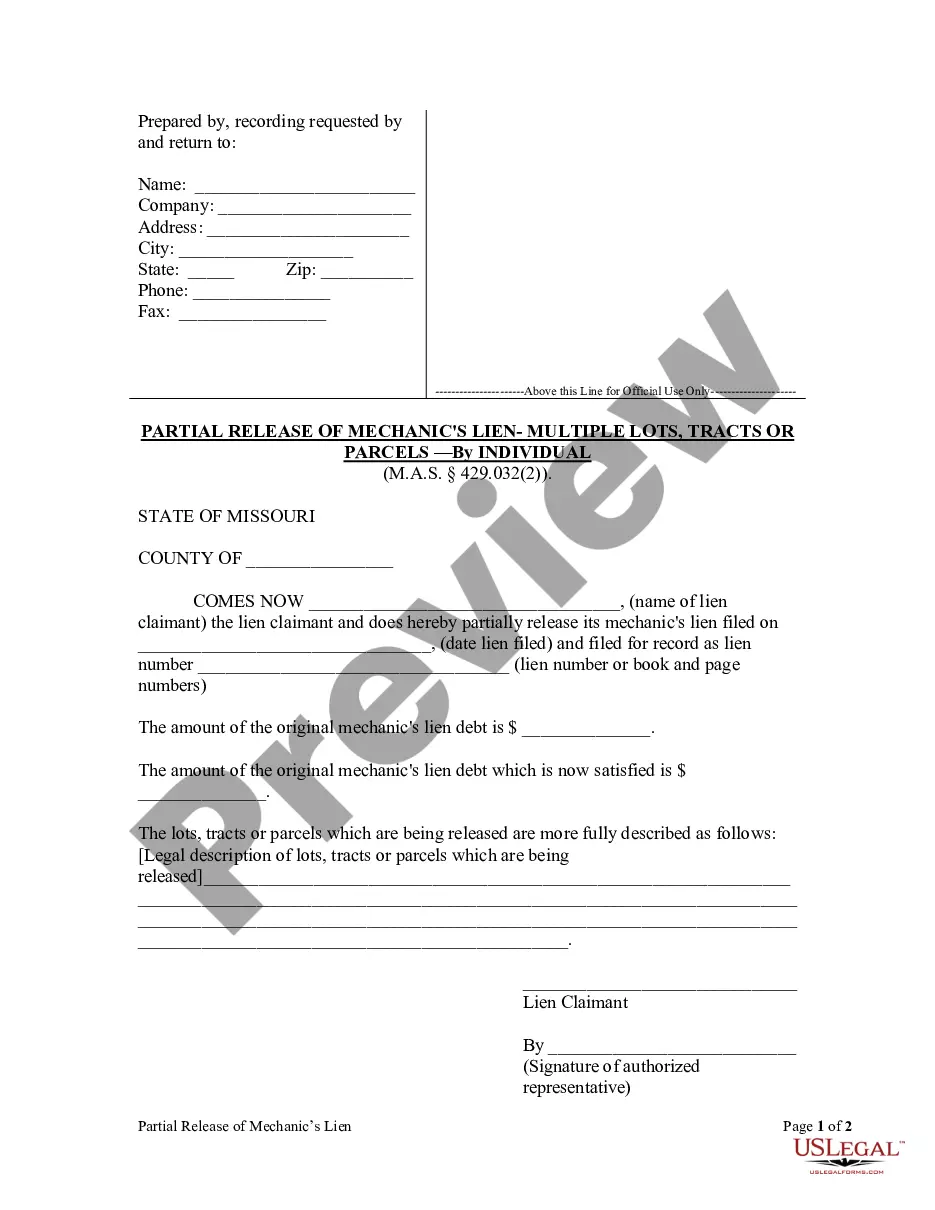
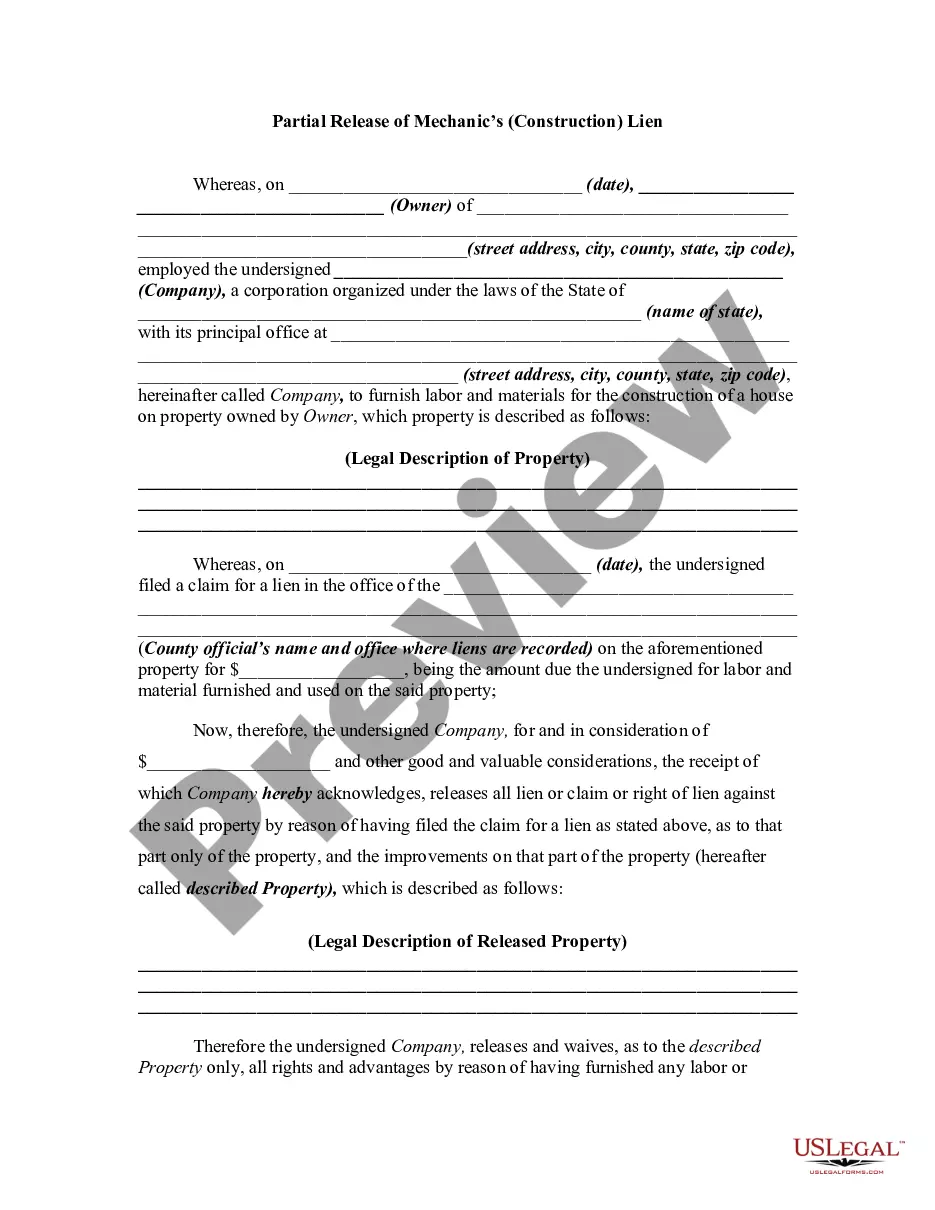
The Partial Release of Mechanic's Lien for Corporations is a legal document that allows a lien claimant to release a portion of a mechanic's lien after receiving payment in full. This form is specifically for liens filed against multiple lots, tracts, or parcels and is designed to clearly identify which part of the lien has been satisfied. Unlike other lien release forms, this one caters specifically to corporate entities, ensuring the requirements of corporate law are met.
Key parts of this document
- Name and contact information of the lien claimant
- Date the lien was originally filed
- Record of the lien number or book and page numbers
- Details of the original lien debt and the amount satisfied
- Legal description of the lots, tracts, or parcels being released
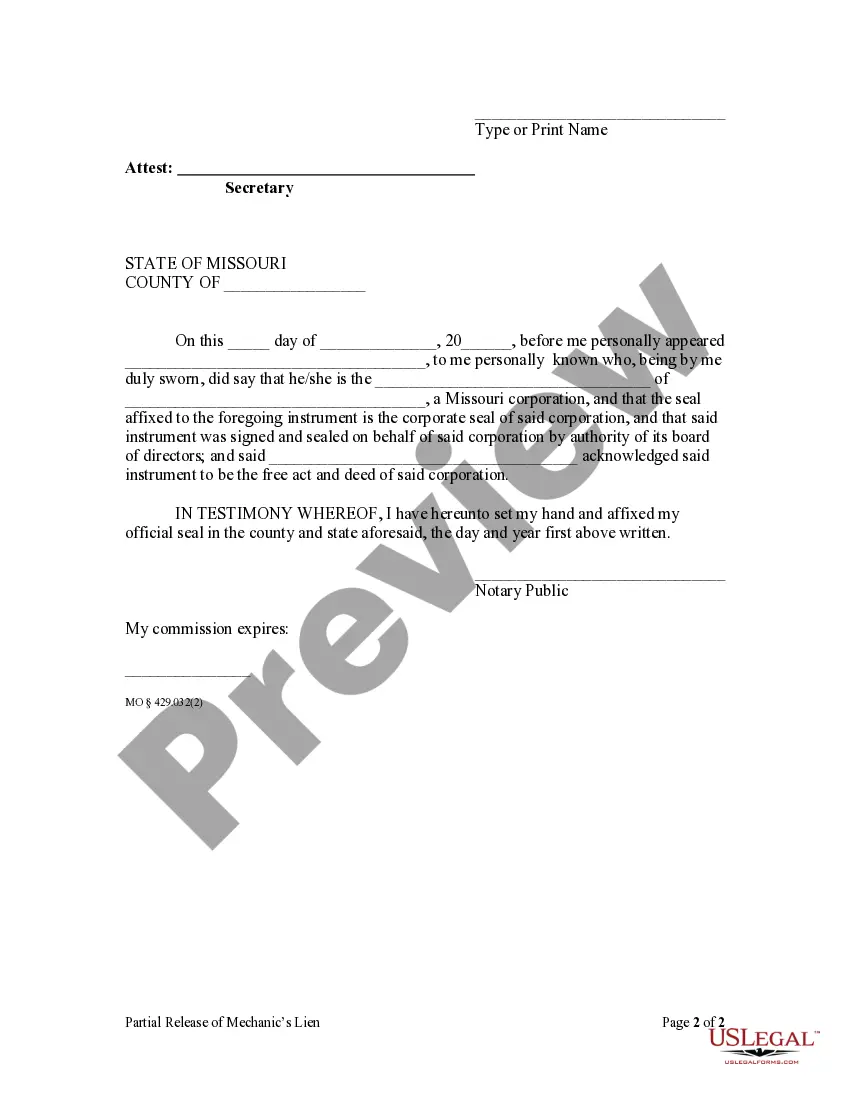
- Signature of the authorized representative and the corporate seal
- Notary acknowledgment to validate the document

When to use this form
This form should be used when a corporation has received partial payment for work performed on multiple properties and needs to release the corresponding portion of the mechanic's lien. It is particularly useful in real estate and construction scenarios where several parcels are involved, and the lien claimant intends to acknowledge payment and formalize the release of their rights against those specific properties.
Who this form is for
- Corporations that have filed a mechanic's lien on multiple properties
- Contractors and subcontractors seeking to release a portion of a lien after receiving payment
- Legal representatives of corporations managing lien matters
- Property owners who have made partial payment and need documentation of the lien release
Steps to complete this form
- Identify and enter the name and address of the lien claimant.
- Fill in the date the lien was originally filed and the lien identification numbers.
- Provide the total original lien amount and specify the amount that has been paid off.
- Describe the properties being released by entering their legal descriptions accurately.
- Ensure the authorized representative signs the form and adds the corporate seal.
- Have the document notarized to validate its execution.
Does this form need to be notarized?
This document requires notarization to meet legal standards. US Legal Forms provides secure online notarization powered by Notarize, allowing you to complete the process through a verified video call, available 24/7.
Get your form ready online
Our built-in tools help you complete, sign, share, and store your documents in one place.
Make edits, fill in missing information, and update formatting in US Legal Forms—just like you would in MS Word.
Download a copy, print it, send it by email, or mail it via USPS—whatever works best for your next step.
Sign and collect signatures with our SignNow integration. Send to multiple recipients, set reminders, and more. Go Premium to unlock E-Sign.
If this form requires notarization, complete it online through a secure video call—no need to meet a notary in person or wait for an appointment.
We protect your documents and personal data by following strict security and privacy standards.

Make edits, fill in missing information, and update formatting in US Legal Forms—just like you would in MS Word.

Download a copy, print it, send it by email, or mail it via USPS—whatever works best for your next step.

Sign and collect signatures with our SignNow integration. Send to multiple recipients, set reminders, and more. Go Premium to unlock E-Sign.

If this form requires notarization, complete it online through a secure video call—no need to meet a notary in person or wait for an appointment.

We protect your documents and personal data by following strict security and privacy standards.
Common mistakes
- Failing to provide the full legal description of the properties being released.
- Not obtaining the necessary signatures from authorized representatives.
- Leaving out the notary acknowledgment, which is required for the form's validity.
- Incorrectly stating the amounts satisfied versus the original lien amounts.
- Not checking for compliance with state-specific requirements.
Why use this form online
- Quick access to professionally drafted legal templates.
- Easy customization to fit specific requirements and details.
- Immediate download enables timely filing of important documents.
- Eliminates potential errors by using a form designed by licensed attorneys.
- Secure online storage and retrieval of legal documents for future reference.
Looking for another form?


Form popularity
FAQ
The process of bonding off a mechanics lien starts after a claimant has filed a mechanics lien. After the claim is made, a general contractor or a property owner can contact a surety bond company to purchase a surety bond that replaces the value of the lien that was filed against the property.
Negotiate with the contractor who placed the lien (the "lienor" to remove it. Obtain a lien bond to discharge the lien, or. File a lawsuit to vacate the lien.
Avoid harassing the people that owe you money. Keep phone calls short. Write letters. Get a collection agency to write demand letters. Offer to settle for less than is due. Hire a collection agency. Small claims court. File a lawsuit.
In Missouri, when the claim is paid, the lien claimant is required to file a release of mechanics lien statement in the circuit court in which the lien was filed. This should be done whether or not requested by the party making payment as failure to file the release within 10 days may result in a claim for damages.
Missouri does not require that lien waivers be notarized in order to be effective. However, there are specific signature requirements that apply to residential jobs.
Keep in mind, however, that you must file this notice within 6 months after you recorded the mechanics lien. If you do not initiate foreclosure within the 6-month period, the mechanics lien will expire and it will no longer hold a claim against the property.
When your efforts to collect a bill from a business that owes you money have been unsuccessful, you can place a lien on the assets of the business. As a lienholder, you gain legal rights to the company's property and the authority to sell the property and use the proceeds to repay what is owed to you.
Generally, this requires the assistance of a lawyer. The homeowner may petition the courts under Civil Code Section 8480 in California to remove the mechanic's lien when it is not timely issued or recorded. A lawsuit is usually necessary to file it against the owner by the contractor or subcontractor.