Boarding Stable Agreement - Horse Equine Forms
MO Rev. Stat. 537.325 Definitions--liability for equine activities, limitations, exceptions--signs required, contents (Missouri Revised Statutes (2015 Edition)
Section 537.325.1
August 28, 2015
Definitions--liability for equine activities, limitations, exceptions--signs required, contents.
537.325.
1. As used in this section, unless the context otherwise requires, the following words and phrases shall mean:
(1) "Engages in an equine activity", riding, training, assisting in medical treatment of, driving or being a passenger upon an equine, whether mounted or unmounted, or any person assisting a participant or any person involved in show management. The term "engages in an equine activity" does not include being a spectator at an equine activity, except in cases where the spectator places himself in an unauthorized area;
(2) "Equine", a horse, pony, mule, donkey or hinny;
(3) "Equine activity":
(a) Equine shows, fairs, competitions, performances or parades that involve any or all breeds of equines and any of the equine disciplines, including, but not limited to, dressage, hunter and jumper horse shows, grand prix jumping, three-day events, combined training, rodeos, driving, pulling, cutting, polo, steeplechasing, English and western performance riding, endurance trail riding and western games and hunting;
(b) Equine training or teaching activities or both;
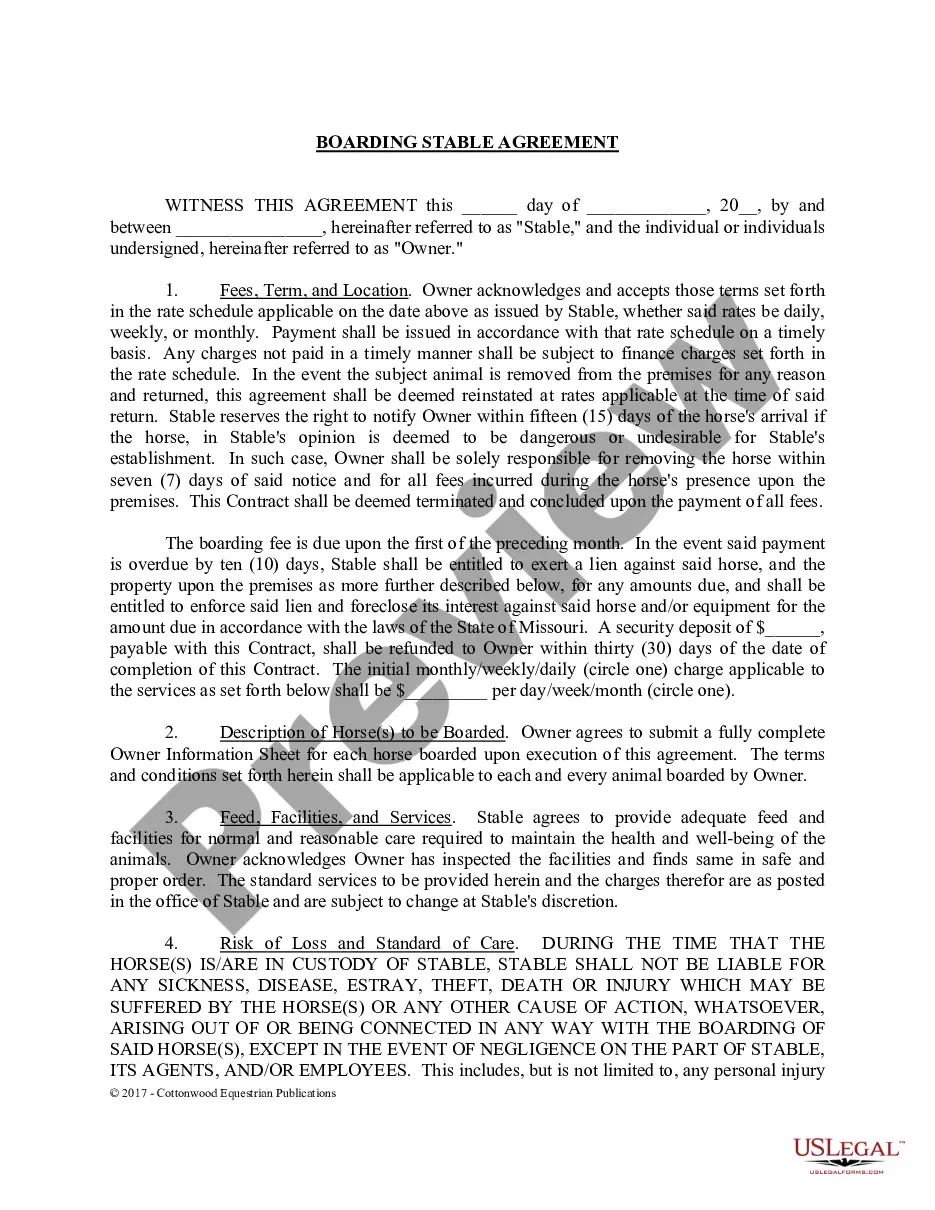
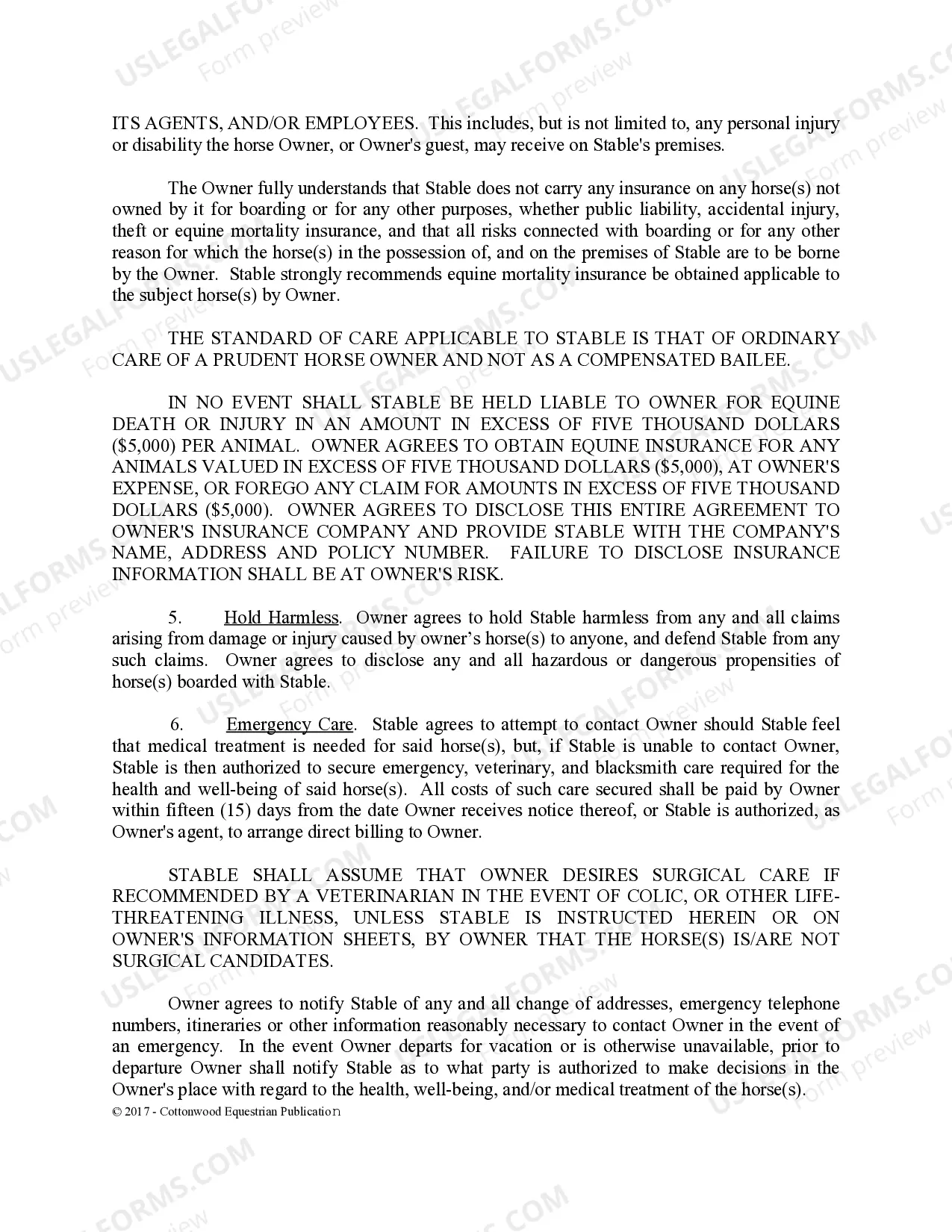
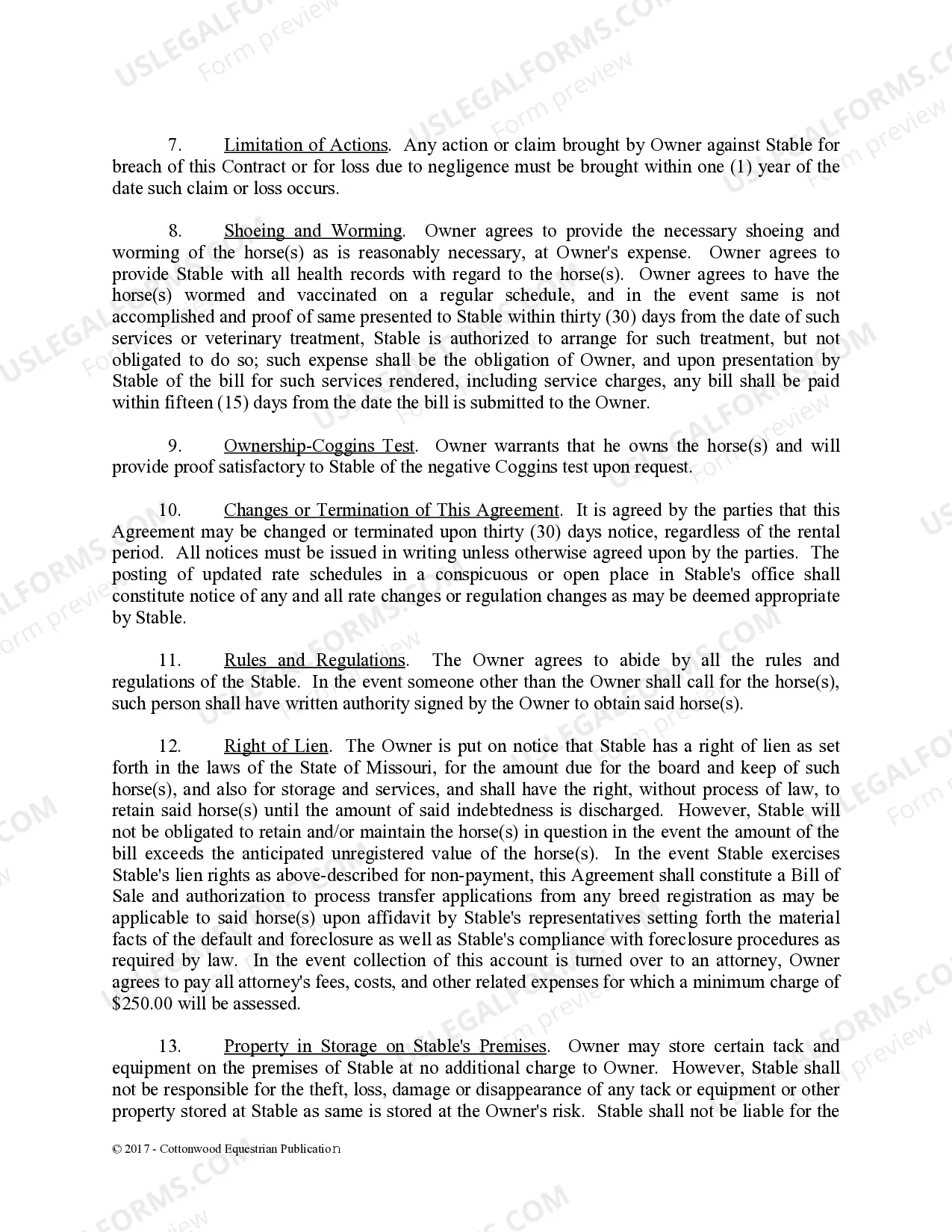
(c) Boarding equines;
(d) Riding, inspecting or evaluating an equine belonging to another, whether or not the owner has received or currently receives monetary consideration or other thing of value for the use of the equine or is permitting a prospective purchaser of the equine to ride, inspect or evaluate the equine;
(e) Rides, trips, hunts or other equine activities however informal or impromptu that are sponsored by an equine activity sponsor; and
(f) Placing or replacing horseshoes on an equine;
(4) "Equine activity sponsor", an individual, group, club, partnership or corporation, whether or not operating for profit or nonprofit, legal entity, or any employee thereof, which sponsors, organizes or provides the facilities for, an equine activity, including but not limited to pony clubs, 4-H clubs, hunt clubs, riding clubs, school- and college-sponsored classes, programs and activities, therapeutic riding programs and operators, instructors and promoters of equine facilities, including but not limited to stables, clubhouses, pony ride strings, fairs and arenas at which the activity is held;
(5) "Equine professional", a person engaged for compensation, or an employee of such a person engaged:
(a) In instructing a participant or renting to a participant an equine for the purpose of riding, driving or being a passenger upon the equine; or
(b) In renting equipment or tack to a participant;
(6) "Inherent risks of equine or livestock activities", those dangers or conditions which are an integral part of equine or livestock activities, including but not limited to:
(a) The propensity of any equine or livestock to behave in ways that may result in injury, harm or death to persons on or around it;
(b) The unpredictability of any equine's or livestock's reaction to such things as sounds, sudden movement and unfamiliar objects, persons or other animals;
(c) Certain hazards such as surface and subsurface conditions;
(d) Collisions with other equines, livestock, or objects;
(e) The potential of a participant to act in a negligent manner that may contribute to injury to the participant or others, such as failing to maintain control over the animal or not acting within his ability;
(7) "Livestock", the same as used in section 277.020;
(8) "Livestock activity":
(a) Grazing, herding, feeding, branding, milking, or other activity that involves the care or maintenance of livestock;
(b) A livestock show, fair, competition, or auction;
(c) A livestock training or teaching activity;
(d) Boarding livestock; and
(e) Inspecting or evaluating livestock;
(9) "Livestock activity sponsor", an individual, group, club, partnership, or corporation, whether or not operating for profit or nonprofit, legal entity, or any employee thereof, which sponsors, organizes, or provides the facilities for a livestock activity;
(10) "Livestock facility", a property or facility at which a livestock activity is held;
(11) "Livestock owner", a person who owns livestock that is involved in livestock activity;
(12) "Participant", any person, whether amateur or professional, who engages in an equine activity or a livestock activity, whether or not a fee is paid to participate in the equine activity or livestock activity.
2. Except as provided in subsection 4 of this section, an equine activity sponsor, an equine professional, a livestock activity sponsor, a livestock owner, a livestock facility, a livestock auction market, any employee thereof, or any other person or corporation shall not be liable for an injury to or the death of a participant resulting from the inherent risks of equine or livestock activities and, except as provided in subsection 4 of this section, no participant or a participant's representative shall make any claim against, maintain an action against, or recover from an equine activity sponsor, an equine professional, a livestock activity sponsor, a livestock owner, a livestock facility, a livestock auction market, any employee thereof, or any other person from injury, loss, damage or death of the participant resulting from any of the inherent risks of equine or livestock activities.
3. This section shall not apply to the horse racing industry as regulated in sections 313.050 to 313.720. This section shall not apply to any employer-employee relationship governed by the provisions of, and for which liability is established pursuant to, chapter 287.
4. The provisions of subsection 2 of this section shall not prevent or limit the liability of an equine activity sponsor, an equine professional, a livestock activity sponsor, a livestock owner, a livestock facility, a livestock auction market, any employee thereof, or any other person if the equine activity sponsor, equine professional, livestock activity sponsor, livestock owner, livestock facility, livestock auction market, any employee thereof, or person:
(1) Provided the equipment or tack and knew or should have known that the equipment or tack was faulty and such equipment or tack was faulty to the extent that the equipment or tack caused the injury; or<br />
<br />
(2) Provided the equine or livestock and failed to make reasonable and prudent efforts to determine the ability of the participant to engage safely in the equine activity or livestock activity and determine the ability of the participant to safely manage the particular equine or livestock based on the participant’s age, obvious physical condition or the participant’s representations of his or her ability;<br />
<br />
(3) Owns, leases, rents or otherwise is in lawful possession and control of the land or facilities upon which the participant sustained injuries because of a dangerous latent condition which was known to the equine activity sponsor, equine professional, livestock activity sponsor, livestock owner, livestock facility, livestock auction market, any employee thereof, or person and for which warning signs have not been conspicuously posted;<br />
<br />
(4) Commits an act or omission that constitutes willful or wanton disregard for the safety of the participant and that act or omission caused the injury;<br />
<br />
(5) Intentionally injures the participant;<br />
<br />
(6) Fails to use that degree of care that an ordinarily careful and prudent person would use under the same or similar circumstances.<br />
<br />
5. The provisions of subsection 2 of this section shall not prevent or limit the liability of an equine activity sponsor, an equine professional, a livestock activity sponsor, a livestock owner, a livestock facility, a livestock auction market, or any employee thereof under liability provisions as set forth in any other section of law.<br />
<br />
6. Every equine activity sponsor and livestock activity sponsor shall post and maintain signs which contain the warning notice specified in this subsection. Such signs shall be placed in a clearly visible location on or near stables, corrals or arenas where the equine activity sponsor or livestock activity sponsor conducts equine or livestock activities if such stables, corrals or arenas are owned, managed or controlled by the equine activity sponsor or livestock activity sponsor. The warning notice specified in this subsection shall appear on the sign in black letters on a white background with each letter to be a minimum of one inch in height. Every written contract entered into by an equine professional, an equine activity sponsor, a livestock activity sponsor, a livestock owner, a livestock facility, a livestock auction market, or any employee thereof for the providing of professional services, instruction or the rental of equipment, tack, or an equine to a participant, whether or not the contract involves equine or livestock activities on or off the location or site of the equine professional’s, equine activity sponsor’s, or livestock activity sponsor’s business, shall contain in clearly readable print the warning notice specified in this subsection. The signs and contracts described in this subsection shall contain the following warning notice:<br />
<br />
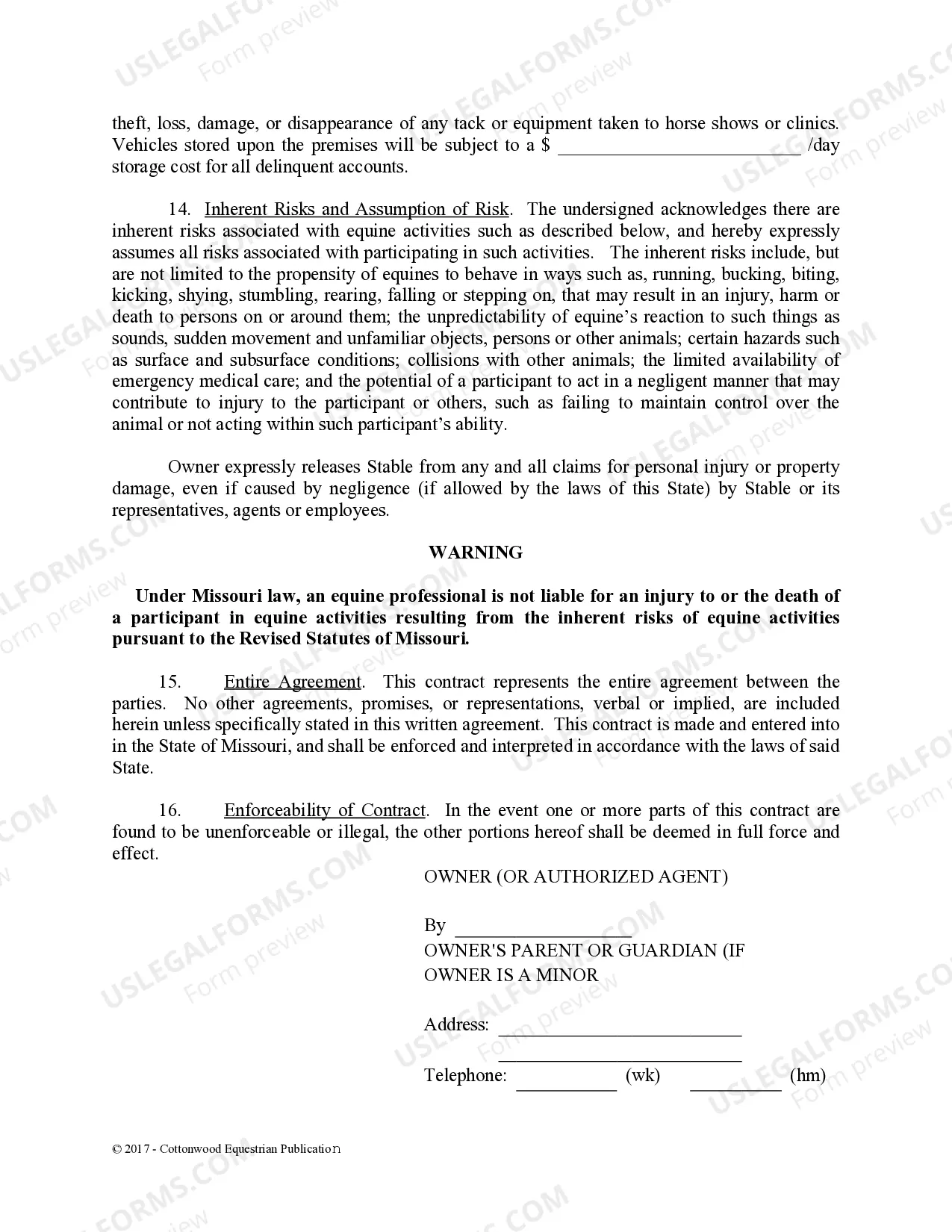
WARNING<br />
<br />
Under Missouri law, an equine activity sponsor, an equine professional, a livestock activity sponsor, a livestock owner, a livestock facility, a livestock auction market, or any employee thereof is not liable for an injury to or the death of a participant in equine or livestock activities resulting from the inherent risks of equine or livestock activities pursuant to the Revised Statutes of Missouri.<br />
<br />
(L. 1994 S.B. 457, A.L. 2015 S.B. 12) (2004) Exculpatory clause must show clear and unmistakable waiver and shifting of risk to be enforceable, and section does not relieve riding instructors or stable owners of duty to exercise reasonable care. Frank v. Mathews, 136 S.W.3d 196 (Mo.App.W.D.).<br />
<br />
1994<br />
<br />
537.325.<br />
<br />
1. As used in this section, unless the context otherwise requires, the following words and phrases shall mean:<br />
<br />
(1) “Engages in an equine activity”, * riding, training, assisting in medical treatment of, driving or being a passenger upon an equine, whether mounted or unmounted, or any person assisting a participant or any person involved in show management. The term “engages in an equine activity” does not include being a spectator at an equine activity, except in cases where the spectator places himself in an unauthorized area;<br />
<br />
(2) “Equine”, * a horse, pony, mule, donkey or hinny;<br />
<br />
(3) “Equine activity” *:<br />
<br />
(a) Equine shows, fairs, competitions, performances or parades that involve any or all breeds of equines and any of the equine disciplines, including, but not limited to, dressage, hunter and jumper horse shows, grand prix jumping, three-day events, combined training, rodeos, driving, pulling, cutting, polo, steeplechasing, English and western performance riding, endurance trail riding and western games and hunting;<br />
<br />
(b) Equine training or teaching activities or both;<br />
<br />
(c) Boarding equines;<br />
<br />
(d) Riding, inspecting or evaluating an equine belonging to another, whether or not the owner has received some monetary consideration or other thing of value for the use of the equine or is permitting a prospective purchaser of the equine to ride, inspect or evaluate the equine;<br />
<br />
(e) Rides, trips, hunts or other equine activities of any type however informal or impromptu that are sponsored by an equine activity sponsor; and<br />
<br />
(f) Placing or replacing horseshoes on an equine;<br />
<br />
(4) “Equine activity sponsor”, * an individual, group, club, partnership or corporation, whether or not operating for profit or nonprofit, or any employee thereof, which sponsors, organizes or provides the facilities for, an equine activity, including but not limited to pony clubs, 4-H clubs, hunt clubs, riding clubs, school- and college-sponsored classes, programs and activities, therapeutic riding programs and operators, instructors and promoters of equine facilities, including but not limited to stables, clubhouses, pony ride strings, fairs and arenas at which the activity is held;<br />
<br />
(5) “Equine professional”, * a person engaged for compensation, or an employee of such a person engaged:<br />
<br />
(a) In instructing a participant or renting to a participant an equine for the purpose of riding, driving or being a passenger upon the equine; or<br />
<br />
(b) In renting equipment or tack to a participant;<br />
<br />
(6) “Inherent risks of equine activities”, * those dangers or conditions which are an integral part of equine activities, including but not limited to:<br />
<br />
(a) The propensity of any equine to behave in ways that may result in injury, harm or death to persons on or around it**;<br />
<br />
(b) The unpredictability of any equine’s reaction to such things as sounds, sudden movement and unfamiliar objects, persons or other animals;<br />
<br />
(c) Certain hazards such as surface and subsurface conditions;<br />
<br />
(d) Collisions with other equines or objects;<br />
<br />
(e) The potential of a participant to act in a negligent manner that may contribute to injury to the participant or others, such as failing to maintain control over the animal or not acting within his ability;<br />
<br />
(7) “Participant”, * any person, whether amateur or professional, who engages in an equine activity, whether or not a fee is paid to participate in the equine activity.<br />
<br />
2. Except as provided in subsection 4 of this section, an equine activity sponsor, an equine professional or any other person or corporation shall not be liable for an injury to or the death of a participant resulting from the inherent risks of equine activities and, except as provided in subsection 4 of this section, no participant or a participant’s representative shall make any claim against, maintain an action against, or recover from an equine activity sponsor, an equine professional, or any other person from injury, loss, damage or death of the participant resulting from any of the inherent risks of equine activities.<br />
<br />
3. This section shall not apply to the horse racing industry as regulated in sections 313.050 to 313.720. This section shall not apply to any employer-employee relationship governed by the provisions of, and for which liability is established pursuant to, chapter 287.<br />
<br />
4. The provisions of subsection 2 of this section shall not prevent or limit the liability of an equine activity sponsor, an equine professional or any other person if the equine activity sponsor, equine professional or person:<br />
<br />
(1) Provided the equipment or tack and knew or should have known that the equipment or tack was faulty and such equipment or tack was faulty to the extent that it did cause the injury; or<br />
<br />
(2) Provided the equine and failed to make reasonable and prudent efforts to determine the ability of the participant to engage safely in the equine activity and determine the ability of the participant to safely manage the particular equine based on the participant’s age, obvious physical condition or the participant’s representations of his ability;<br />
<br />
(3) Owns, leases, rents or otherwise is in lawful possession and control of the land or facilities upon which the participant sustained injuries because of a dangerous latent condition which was known to the equine activity sponsor, equine professional or person and for which warning signs have not been conspicuously posted;<br />
<br />
(4) Commits an act or omission that constitutes willful or wanton disregard for the safety of the participant and that act or omission caused the injury;<br />
<br />
(5) Intentionally injures the participant;<br />
<br />
(6) Fails to use that degree of care that an ordinarily careful and prudent person would use under the same or similar circumstances.<br />
<br />
5. The provisions of subsection 2 of this section shall not prevent or limit the liability of an equine activity sponsor or an equine professional under liability provisions as set forth in any other section of law.<br />
<br />
6. Every equine activity sponsor shall post and maintain signs which contain the warning notice specified in this subsection. Such signs shall be placed in a clearly visible location on or near stables, corrals or arenas where the equine professional conducts equine activities if such stables, corrals or arenas are owned, managed or controlled by the equine professional. The warning notice specified in this subsection shall appear on the sign in black letters on a white background with each letter to be a minimum of one inch in height. Every written contract entered into by an equine professional and equine activity sponsor for the providing of professional services, instruction or the rental of equipment or tack or an equine to a participant, whether or not the contract involves equine activities on or off the location or site of the equine professional’s or equine activity sponsor’s business, shall contain in clearly readable print the warning notice specified in this subsection. The signs and contracts described in this subsection shall contain the following warning notice:<br />
<br />
WARNING<br />
<br />
Under Missouri law, an equine professional is<br />
not liable for an injury to or the death of a<br />
participant in equine activities resulting from<br />
the inherent risks of equine activities pursuant<br />
to the Revised Statutes of Missouri.