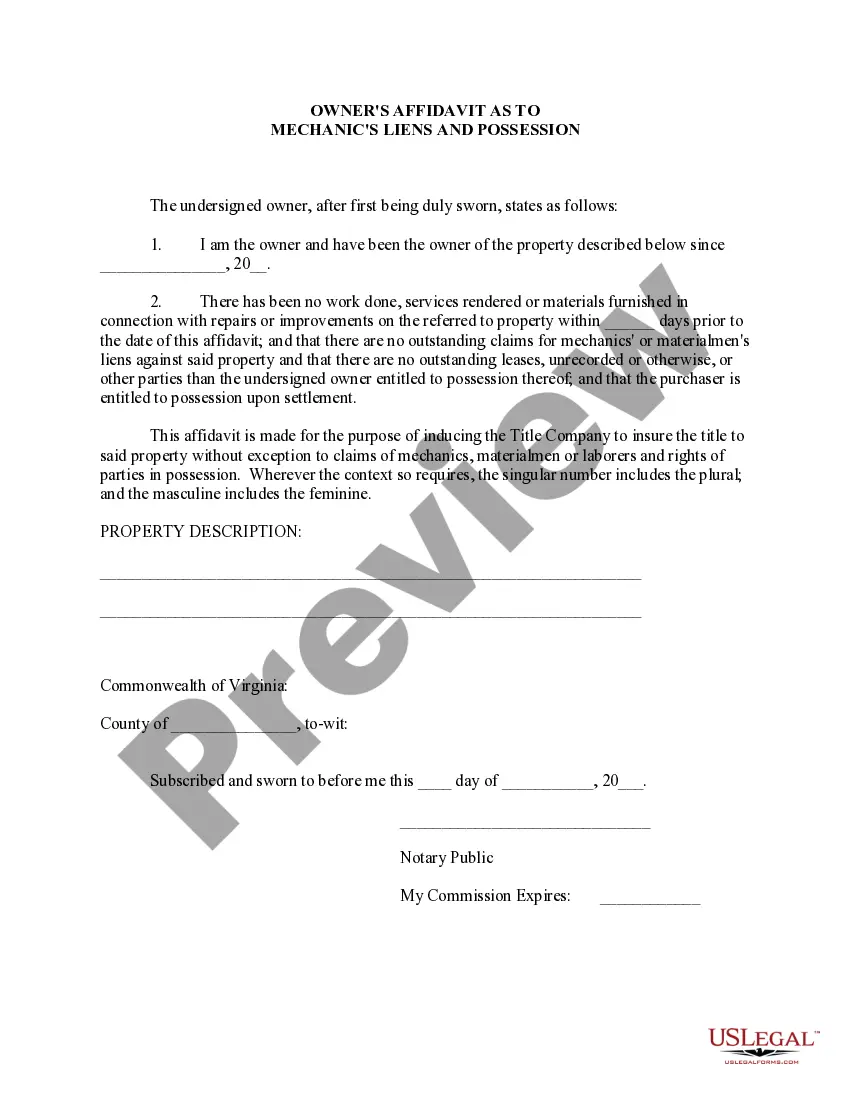
Missouri Notice to Owner - Individual
What is this form?
The Notice to Owner - Individual is a legal document required by Missouri law for original contractors who provide labor, materials, or machinery for property improvements. This form serves to notify the property owner about the contractor's work and the potential consequences of non-payment to subcontractors or suppliers. It is essential to provide this notice as a condition to enforce a mechanics lien, ensuring that contractors secure their rights before receiving payment.
What’s included in this form
- Name and contact information of the contractor.
- Description of the property being improved.
- Notice of potential mechanics lien for non-payment.
- Signature section for the contractor.
- Certificate of delivery to verify notice receipt.

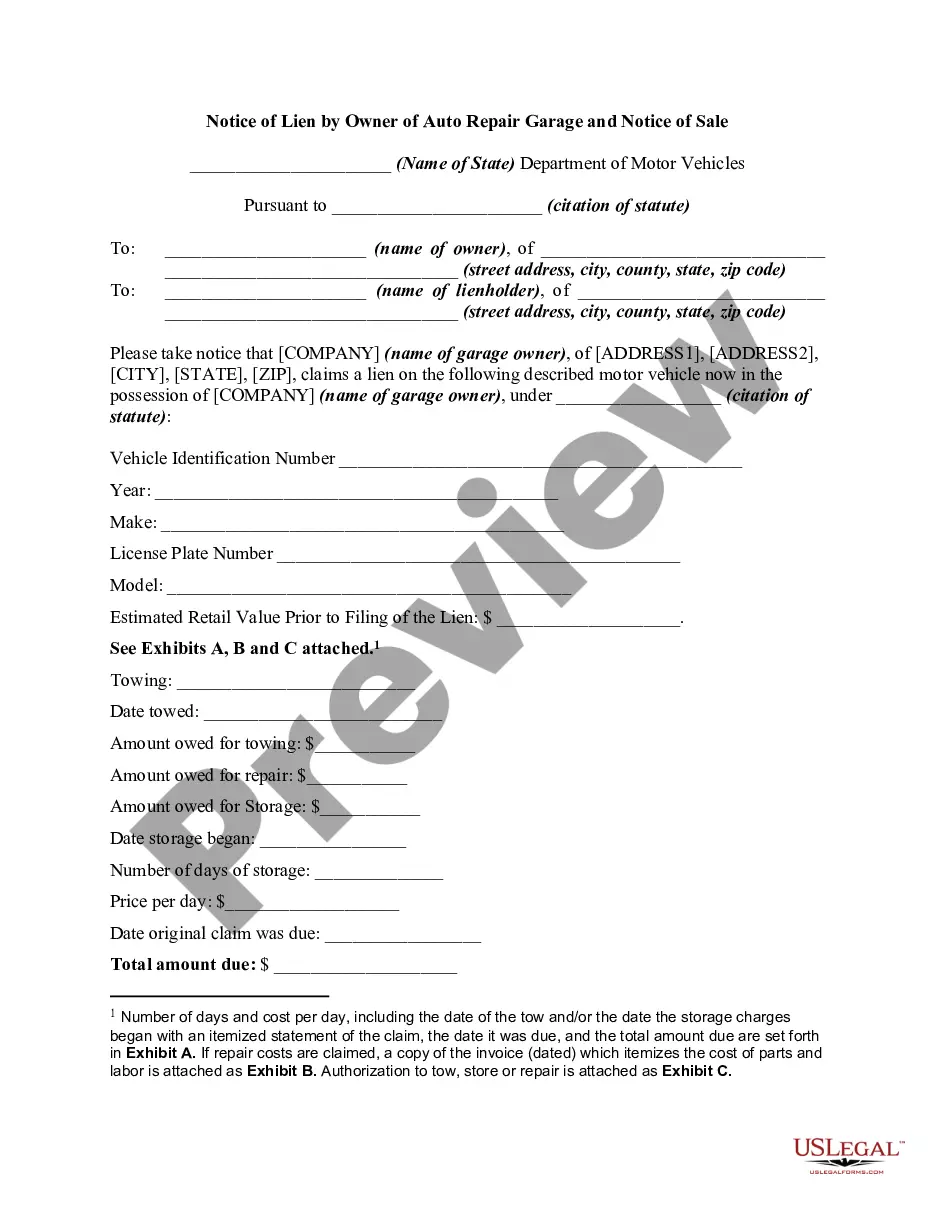
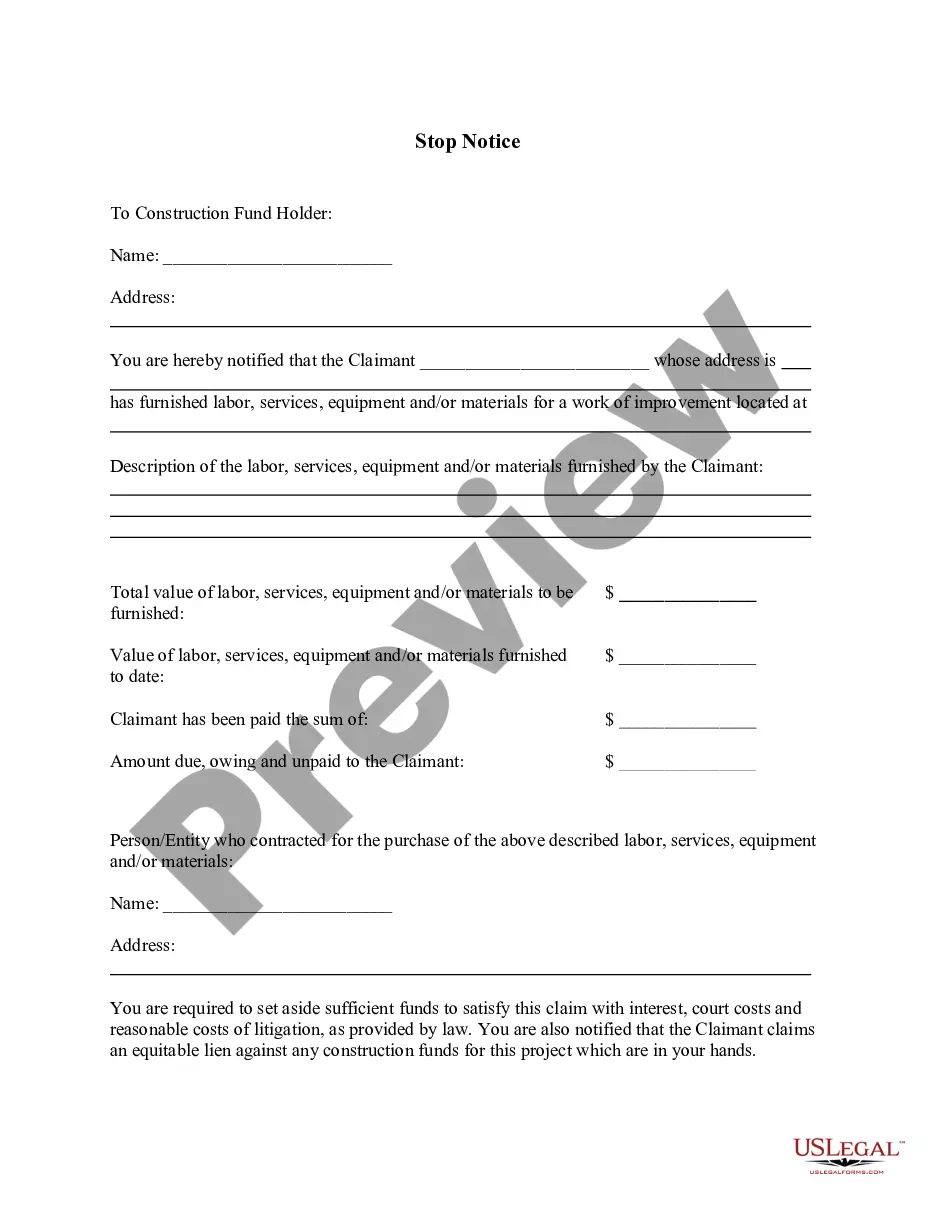
Common use cases
This form should be used by contractors in Missouri when they begin work on a property. It should be provided to the property owner before any payment is made. The notice is vital for contractors who want to protect their right to a mechanics lien if payments are not made to them or their suppliers.
Intended users of this form
- Original contractors in Missouri providing labor or materials.
- Subcontractors needing to inform property owners of payment risks.
- Property owners who want to understand their obligations when hiring contractors.
How to prepare this document
- Identify and enter the name of the contractor.
- Specify the address of the property being improved.
- Complete the notice sections regarding mechanics lien risk and payment responsibility.
- Sign and date the form to authenticate the notice.
- Deliver the completed form to the property owner and maintain a record of this delivery.
Notarization guidance
Notarization is not commonly needed for this form. However, certain documents or local rules may make it necessary. Our notarization service, powered by Notarize, allows you to finalize it securely online anytime, day or night.
Get your form ready online
Our built-in tools help you complete, sign, share, and store your documents in one place.
Make edits, fill in missing information, and update formatting in US Legal Forms—just like you would in MS Word.
Download a copy, print it, send it by email, or mail it via USPS—whatever works best for your next step.
Sign and collect signatures with our SignNow integration. Send to multiple recipients, set reminders, and more. Go Premium to unlock E-Sign.
If this form requires notarization, complete it online through a secure video call—no need to meet a notary in person or wait for an appointment.
We protect your documents and personal data by following strict security and privacy standards.

Make edits, fill in missing information, and update formatting in US Legal Forms—just like you would in MS Word.

Download a copy, print it, send it by email, or mail it via USPS—whatever works best for your next step.

Sign and collect signatures with our SignNow integration. Send to multiple recipients, set reminders, and more. Go Premium to unlock E-Sign.

If this form requires notarization, complete it online through a secure video call—no need to meet a notary in person or wait for an appointment.

We protect your documents and personal data by following strict security and privacy standards.
Common mistakes to avoid
- Failing to deliver the notice before payment is received.
- Not including the property address or description accurately.
- Neglecting to sign the form before delivering it.
Benefits of using this form online
- Convenient download and edit options allow for quick completion.
- Access to professionally drafted language with less risk of legal errors.
- Instant availability, ensuring timely compliance with notification laws.
Main things to remember
- The Notice to Owner - Individual form is essential for contractors in Missouri to protect their lien rights.
- It must be delivered to the property owner before receiving payment.
- Completing the form accurately helps avoid potential legal and financial complications.
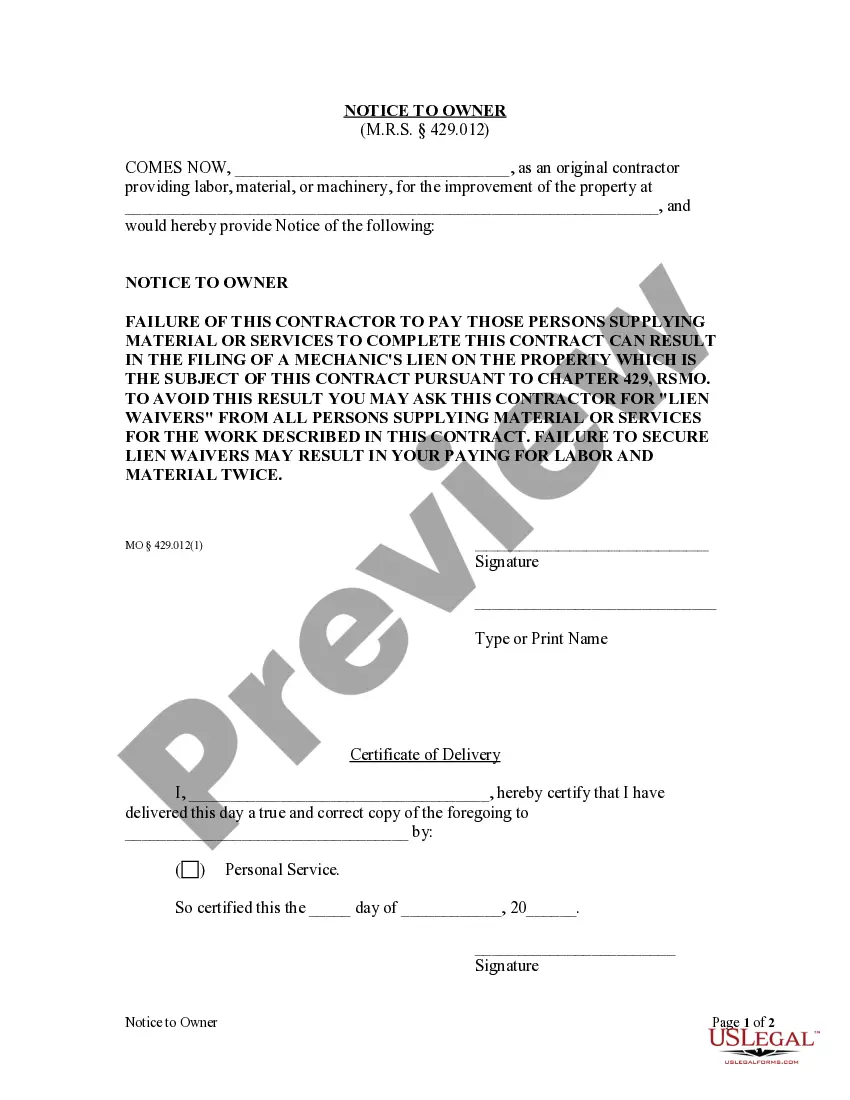
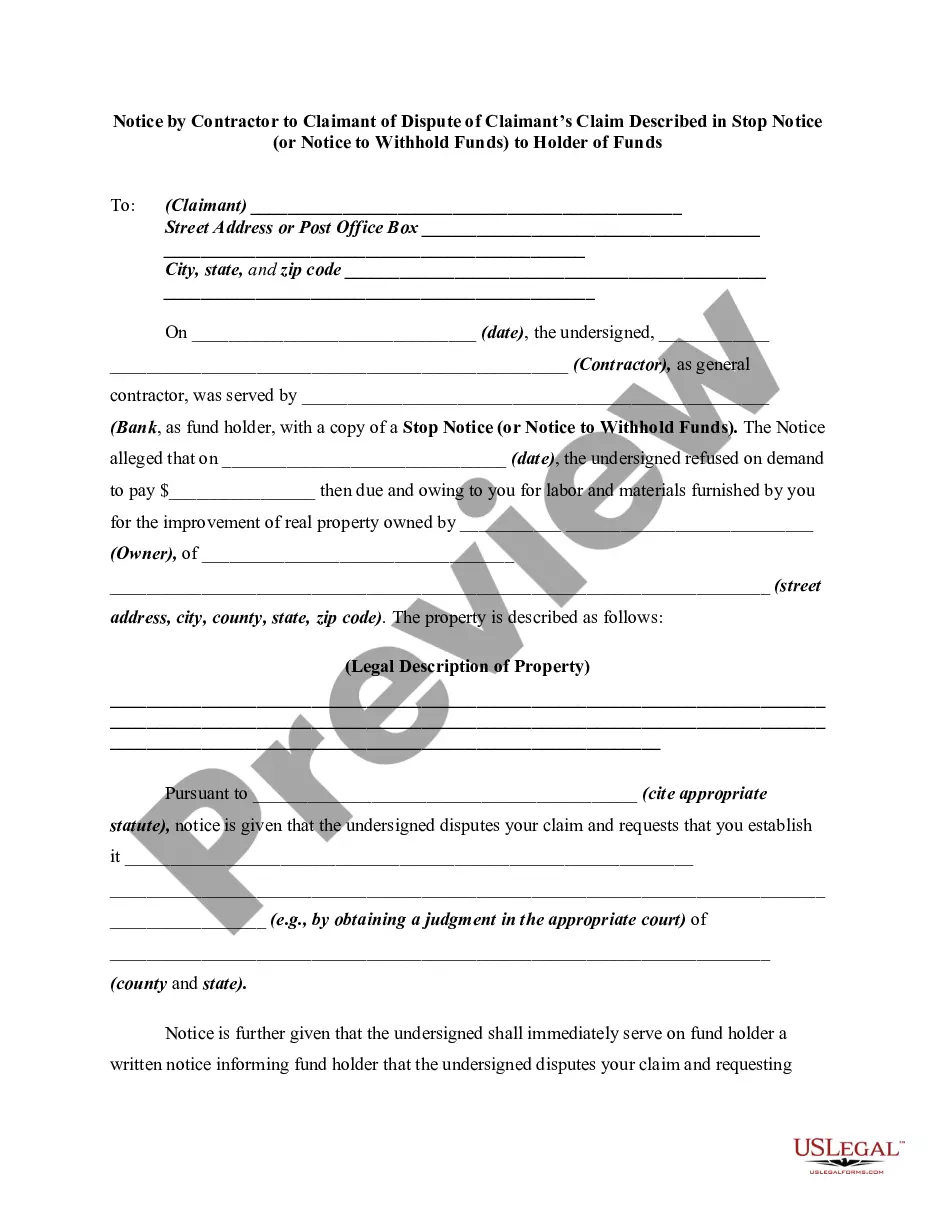
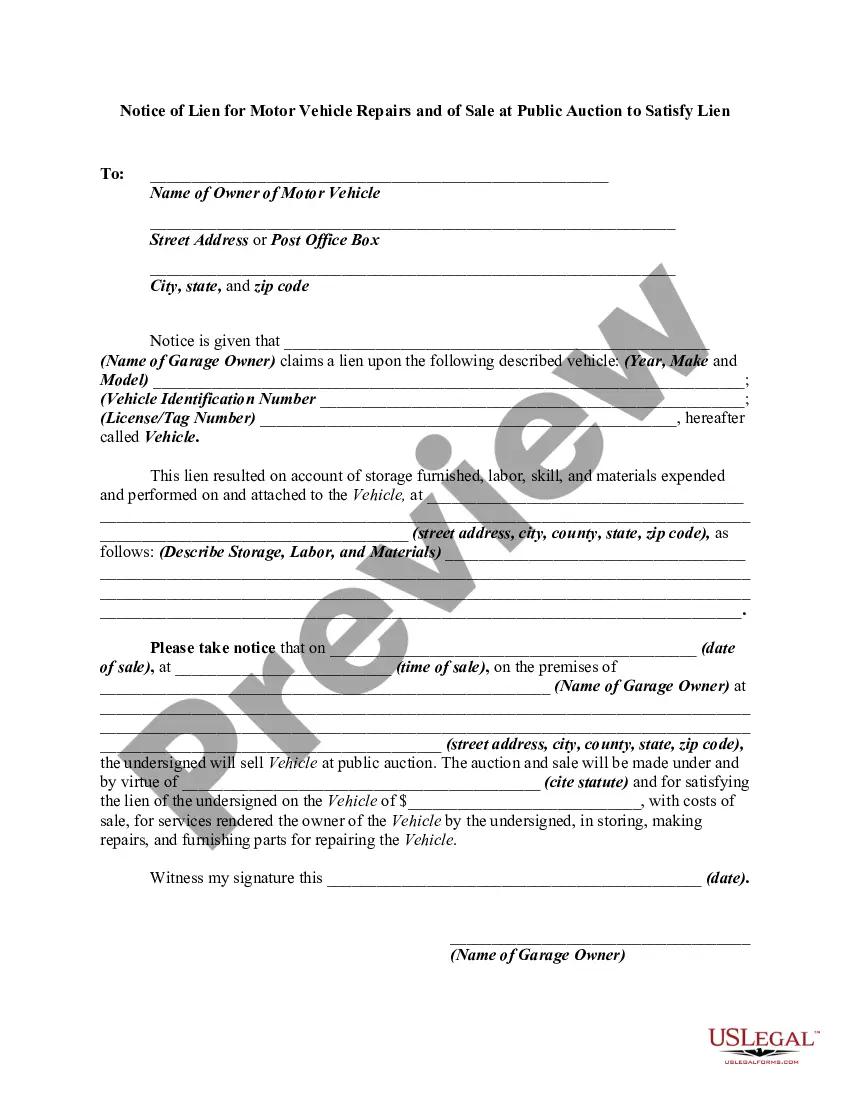
Looking for another form?
Form popularity
FAQ
Lien Release: After a lien has been filed, the California claimant can release or cancel the lien by filing a Mechanics Lien Release form with the county recorder's office where the lien was originally recorded.
After you make your final auto loan payment, the lender sends an electronic release to California's DMV. Once the DMV receives the electronic release, it issues a new certificate of title and registration card showing you're the sole owner.
How can I remove the lien from my title? You may apply for a new title at any Missouri license office. You must submit the notarized lien release (copy or original), your current title (if in your possession) and pay an $8.50 title fee and a $6.00 processing fee.
Depending on state laws, paper titles are generally mailed and electronic titles and/or liens are released to the motor vehicle agency approximately 10 business days after the payoff is received. Allow 15-30 days for receipt of your title based on mail time and/or motor vehicle agency process.
The lender will also notify the Department of Motor Vehicles (DMV) that the loan has been paid in full. If you don't receive the lien release, submit a request to your lender for proof that the loan has been satisfied. This request can be made through the DMV or directly to the lender.
To add or remove a lien on your vehicle title, visit your local county tax office. The title fee is $28 or $33, depending on your county, and must be paid at time of application. Please contact your local county tax office for the exact cost.
You may contact your county Recorder of Deeds office or go to https://www.courts.mo.gov/casenet to inquire about liens, releases and satisfactions.
The car (vehicle) lien release form is a document that is used by a lending institution or entity after a borrower has paid the loan in full and the borrower would like to retrieve the title to their vehicle.