Minnesota Notice of Lease for Recording
About this form
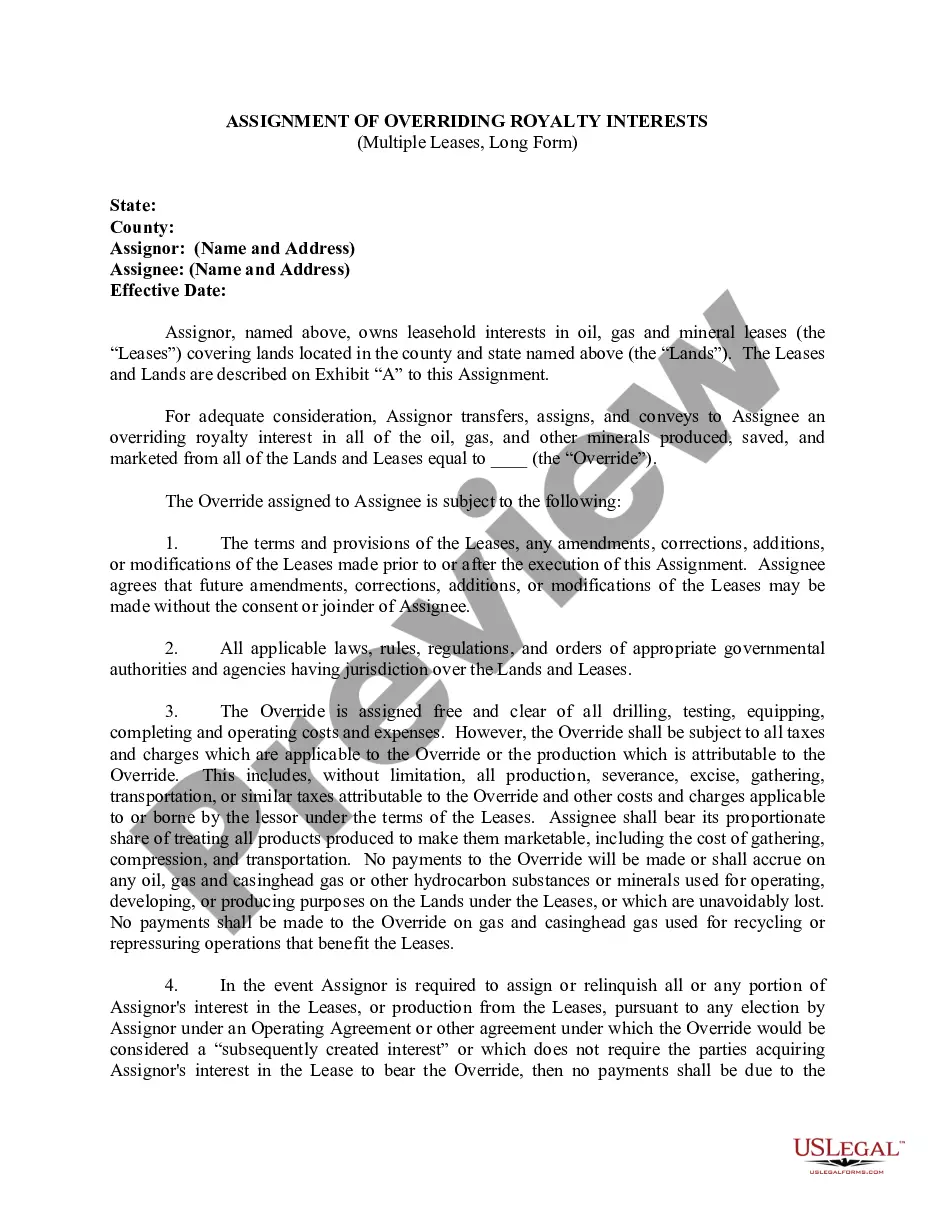
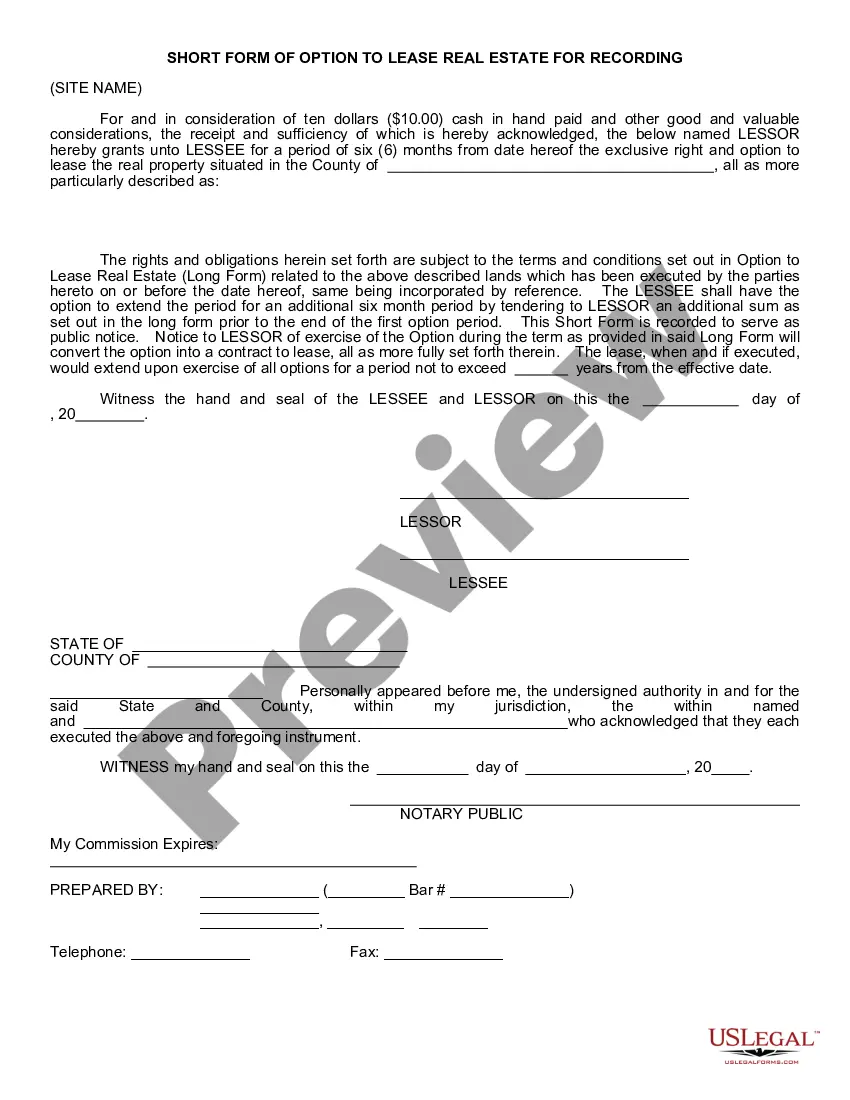
The Notice of Lease for Recording is a legal document that provides official notice of an existing lease on a specific parcel of real estate. Unlike the full lease agreement, this memorandum serves to record the essential details of the lease without needing to disclose the entire contract. It helps protect the rights of both the lessor and lessee by ensuring that the leasing arrangement is publicly recorded, which can be critical for resolving disputes or clarifying property use rights.
Main sections of this form
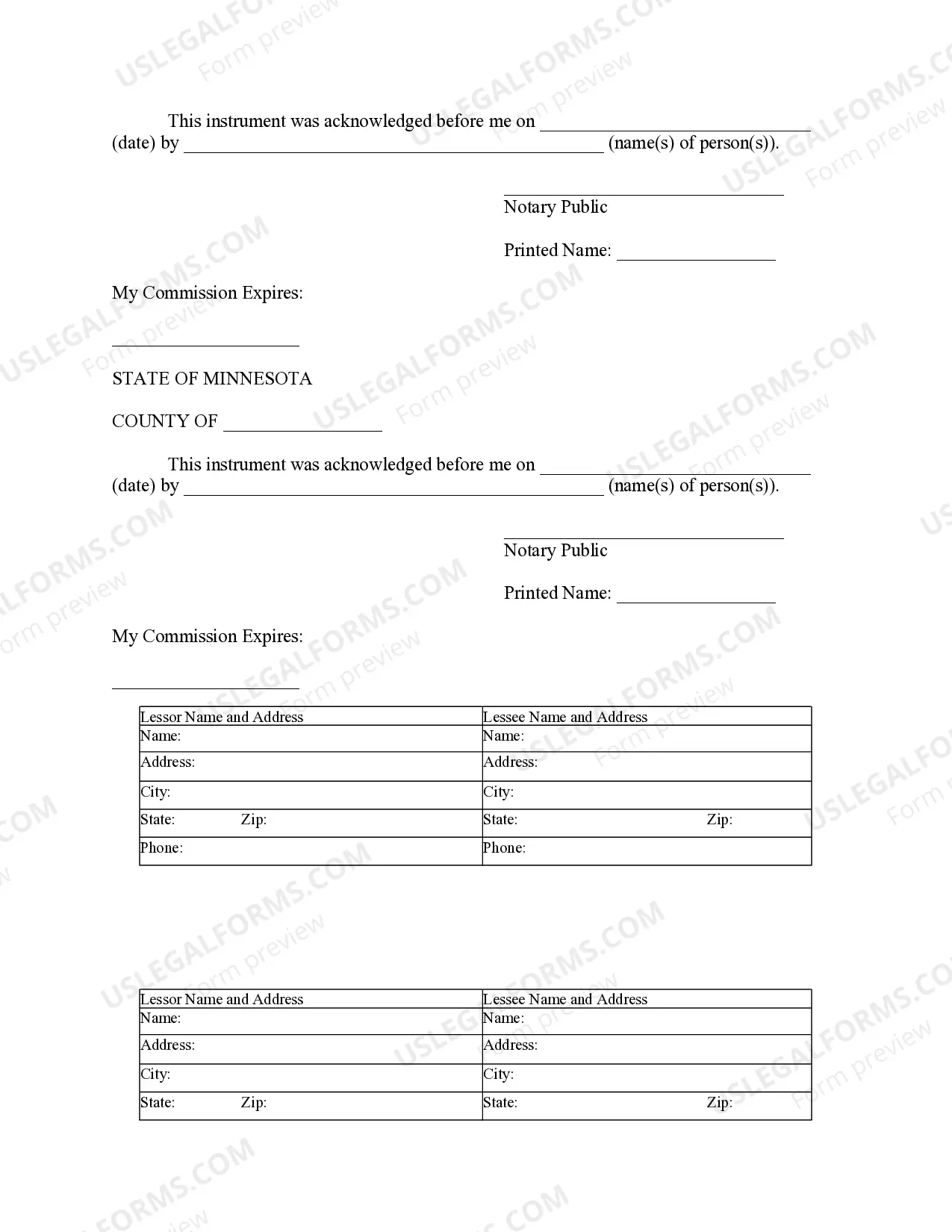
- Prepared by and recorded by details: specifies the parties involved in the recording.
- Memorandum and notice section: includes names of lessor and lessee along with the property description.
- Lease duration: indicates the term of the lease and its commencement and termination dates.
- Reference to the original lease agreement: highlights terms and conditions of the lease dated.
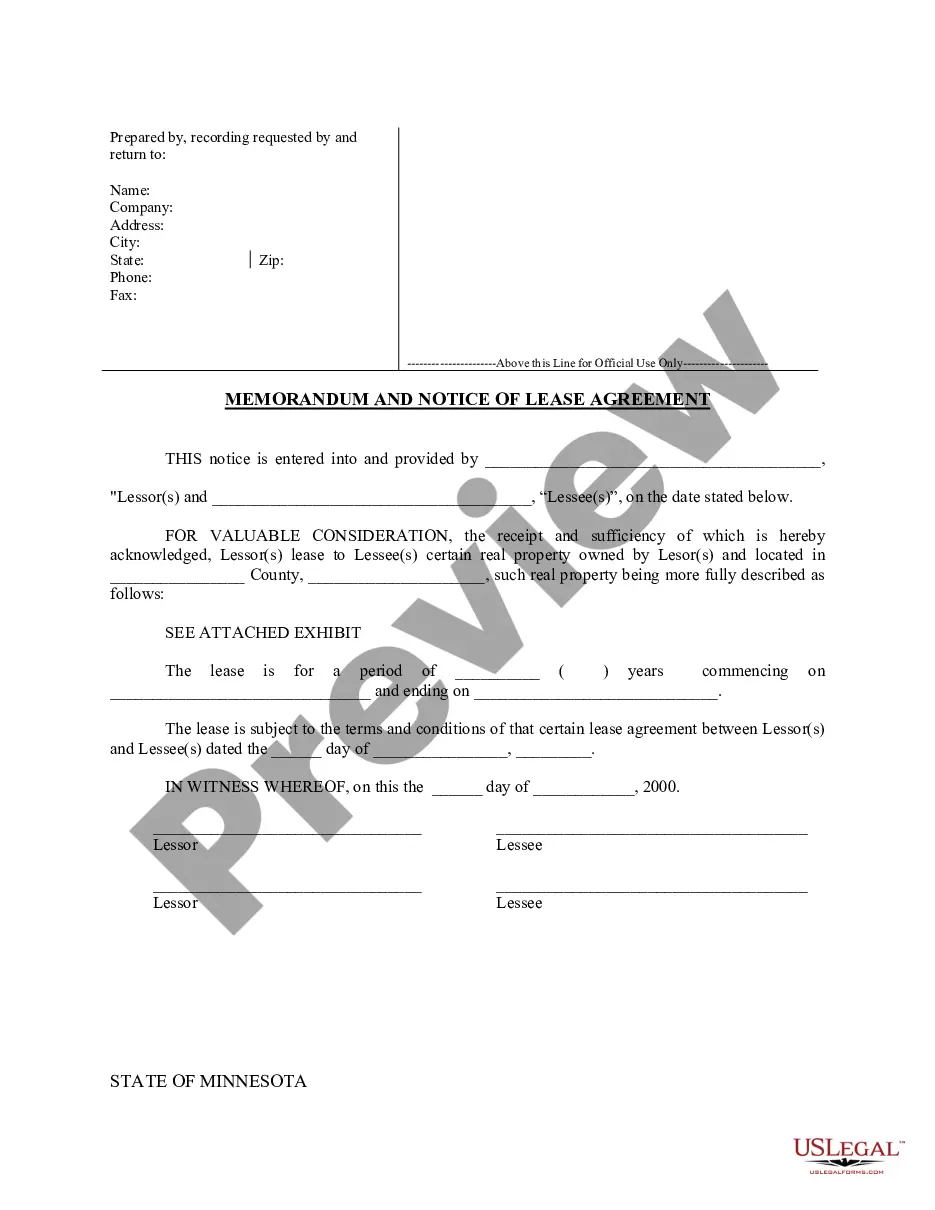
- Notary section: acknowledges the signatures before a notary public to validate the document.

When this form is needed
The Notice of Lease for Recording should be used when a lessor and lessee wish to publicly document their lease agreement to establish legal rights concerning the property. This form is ideal in situations where the lease affects future transactions or when providing notice to third parties about the property's leasing status is necessary. This is particularly useful in real estate transactions, property management, and landlord-tenant disputes.
Who can use this document
- Landlords or lessors who rent out property.
- Tenants or lessees entering into a lease agreement.
- Real estate agents or property managers handling lease transactions.
- Property owners seeking to record a lease for legal protection.
Completing this form step by step
- Identify the parties: Fill in the names of the lessor and lessee.
- Specify the property: Provide the detailed address and description of the real property.
- Enter the lease term: Indicate the duration of the lease and the commencement and expiration dates.
- Reference the original lease: Mention the date of the original lease agreement to clarify terms.
- Notarize the form: Ensure that all parties sign in the presence of a notary public to validate the document.
Is notarization required?
Yes, this form must be notarized to be legally valid. It requires signatures to be acknowledged by a notary public to verify the identities of the parties involved, which adds a layer of legal protection to the document. US Legal Forms provides integrated online notarization services for your convenience.
Get your form ready online
Our built-in tools help you complete, sign, share, and store your documents in one place.
Make edits, fill in missing information, and update formatting in US Legal Forms—just like you would in MS Word.
Download a copy, print it, send it by email, or mail it via USPS—whatever works best for your next step.
Sign and collect signatures with our SignNow integration. Send to multiple recipients, set reminders, and more. Go Premium to unlock E-Sign.
If this form requires notarization, complete it online through a secure video call—no need to meet a notary in person or wait for an appointment.
We protect your documents and personal data by following strict security and privacy standards.

Make edits, fill in missing information, and update formatting in US Legal Forms—just like you would in MS Word.

Download a copy, print it, send it by email, or mail it via USPS—whatever works best for your next step.

Sign and collect signatures with our SignNow integration. Send to multiple recipients, set reminders, and more. Go Premium to unlock E-Sign.

If this form requires notarization, complete it online through a secure video call—no need to meet a notary in person or wait for an appointment.

We protect your documents and personal data by following strict security and privacy standards.
Typical mistakes to avoid
- Not including full names and addresses of all parties involved.
- Failing to provide a clear property description.
- Omitting dates, particularly the lease commencement and expiration dates.
- Neglecting to have the form notarized, if required.
Why complete this form online
- Convenience of downloading and printing the form at your convenience.
- Editability allows you to customize the form to fit your specific lease agreement.
- Reliability of professionally drafted documents ensures legal compliance.
Key takeaways
- The Notice of Lease for Recording protects the partiesâ interests in a lease agreement.
- Accurate completion of the form is essential to avoid legal issues in the future.
- Ensuring notarization may be necessary depending on local laws.
- This form serves as official notice of a lease without needing to record the entire lease agreement.
Looking for another form?
Form popularity
FAQ
To put in a lease notice, start by drafting a clear and concise document that outlines your intentions, whether you are notifying of termination or changes to the lease. Include important details such as the date of the notice, the parties involved, and any relevant deadlines. Make sure to deliver the notice in accordance with local laws. Utilizing the Minnesota Notice of Lease for Recording can help formalize this notice and protect your rights.
To fill out a lease addendum, begin by referencing the original lease agreement and specifying what changes or additions you are making. Include details such as new terms, additional fees, or any modifications relevant to both parties. Make sure both the landlord and tenant sign the addendum to validate it. Using the Minnesota Notice of Lease for Recording can help ensure that this addendum is properly documented.
Filling out a lease agreement requires attention to detail and clarity. Start by including all essential information such as tenant and landlord names, property address, rental amount, and duration of the lease. Ensure that you outline the responsibilities of both parties clearly. By utilizing the Minnesota Notice of Lease for Recording, you can ensure that your lease agreement is legally recognized and protected.
In Minnesota, recording an assignment of lease is not mandatory, but it is highly recommended. By recording the assignment, you provide public notice of the change in leasehold interest, which can protect your rights and interests. Additionally, should any disputes arise, having a recorded assignment can serve as proof of the transaction. Using the Minnesota Notice of Lease for Recording can simplify this process.
In Minnesota, workers are generally entitled to $9.86 per hour if they work for a large employer and $8.04 per hour if they work for a small employer. Some cities, such as Minneapolis and St. Paul, provide higher minimum wages. Employers who pay less than the minimum wage are committing wage theft.
Wrongful Termination in Minnesota That means that your employer can fire you for any reason or no reason at all even a stupid, incorrect, unfair, or unethical reason provided that it's not an illegal reason. Employers can and often do make mistakes or bad business decisions when they terminate employees.
In the U.S., state right-to-work laws pertain to labor unions and workers at a company. Specifically, the right-to-work means that employees are entitled to work in unionized workplaces without actually joining the union or paying regular union dues.
The answer is no Minnesota is not a right to work state. Minnesota state law allows negotiation of a union security clause that requires all workers who receive the benefits of a collective bargaining agreement to pay union dues ( i.e., the proportion of union dues related to collective bargaining expenses).
Minnesota does not have a right to work law, which means employees that are part of a unionized workforce must join the union or make "fair share" payments equivalent to the cost of union dues.
Generally, under Minn. Stat. ?181.13, 181.14, an employer must issue a final paycheck to a terminated employee immediately, or within twenty-four (24) hours of his or her demand for payment.