Maine Donation of Anatomical Gift
Understanding this form
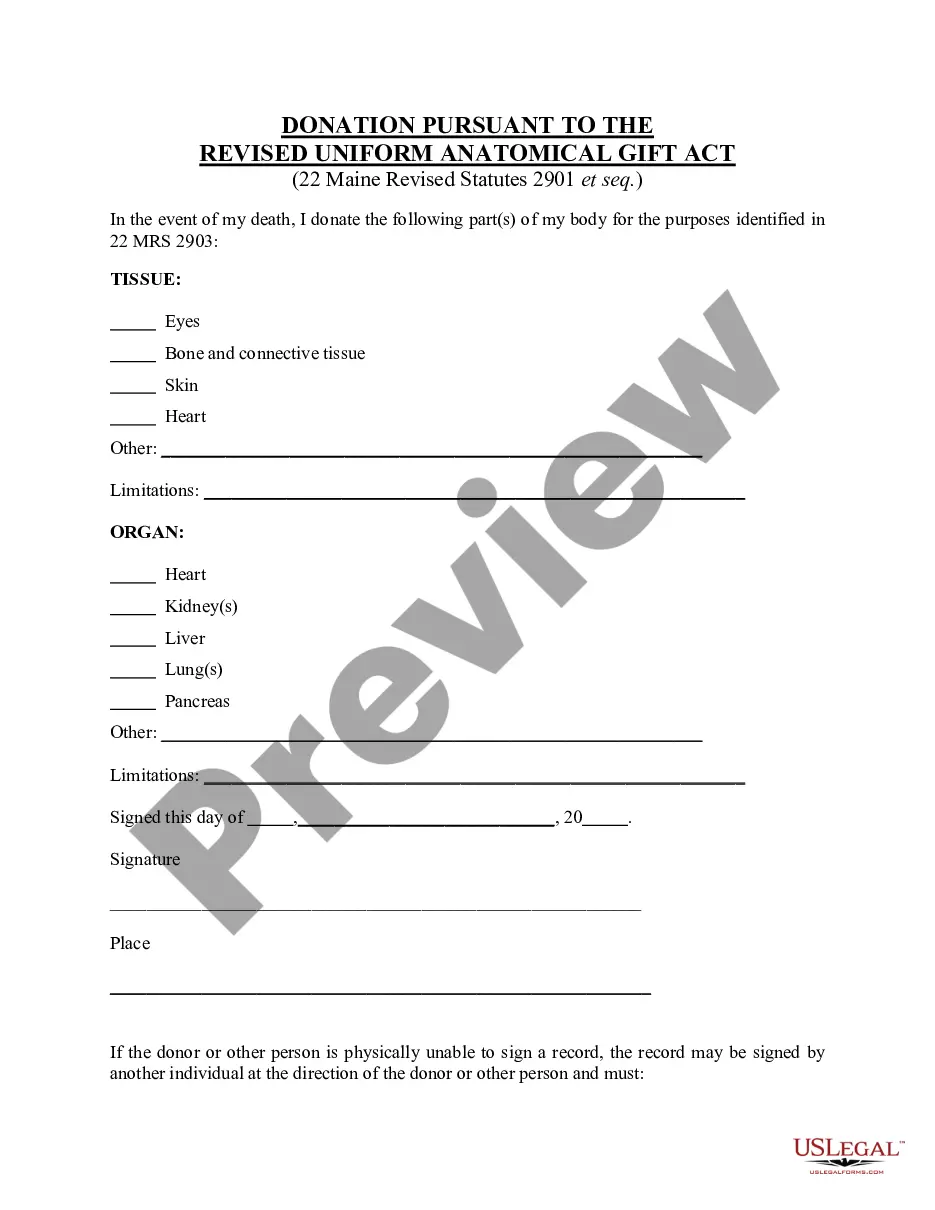
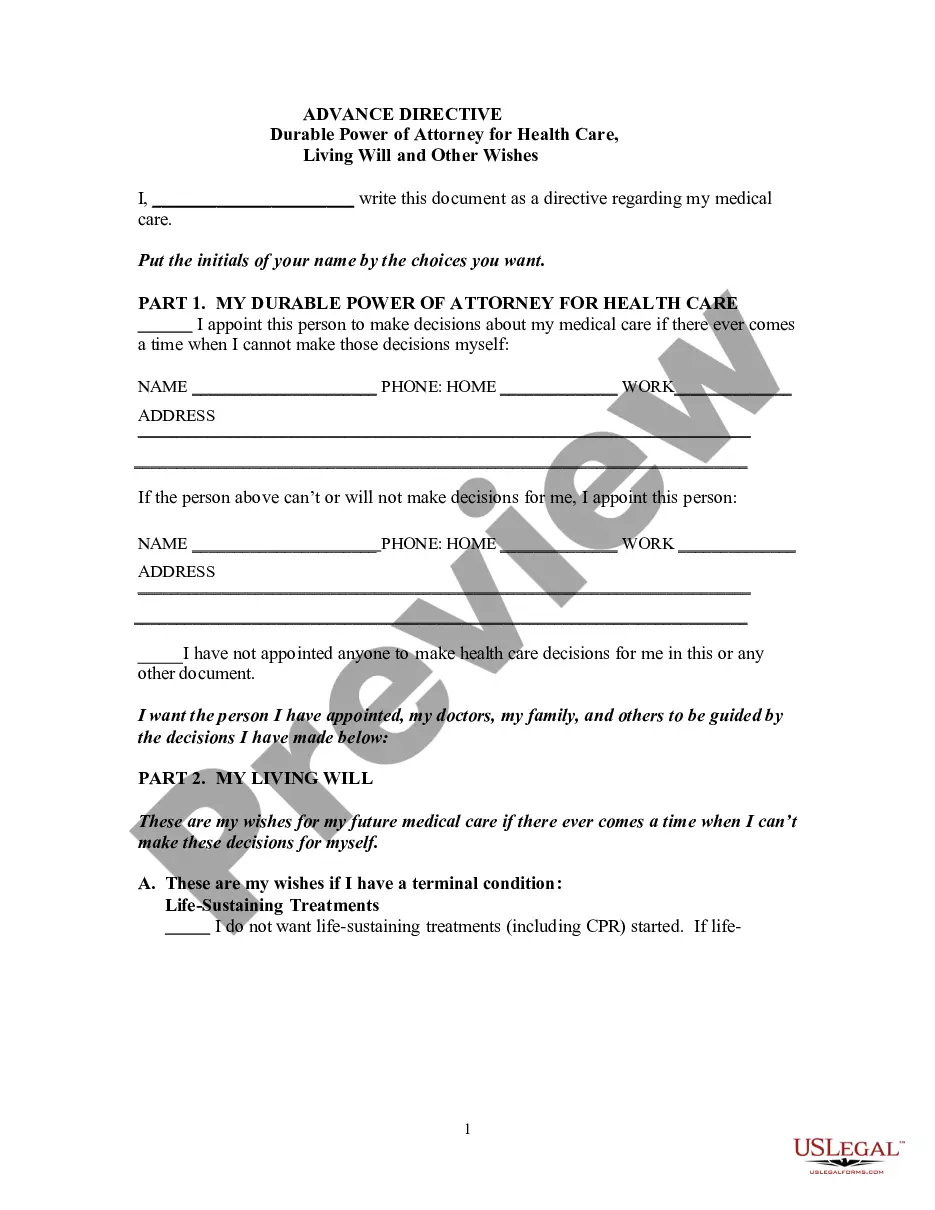
The Donation of Anatomical Gift form is a legally recognized document that allows an individual to specify which body parts or organs they wish to donate upon their death. It serves a critical purpose in ensuring that one's intentions regarding anatomical gifts are clearly documented and respected, aligning with the Revised Uniform Anatomical Gift Act. This form is distinct from general health care directives as it specifically addresses the donation of bodily organs and tissues for medical purposes.
Key components of this form
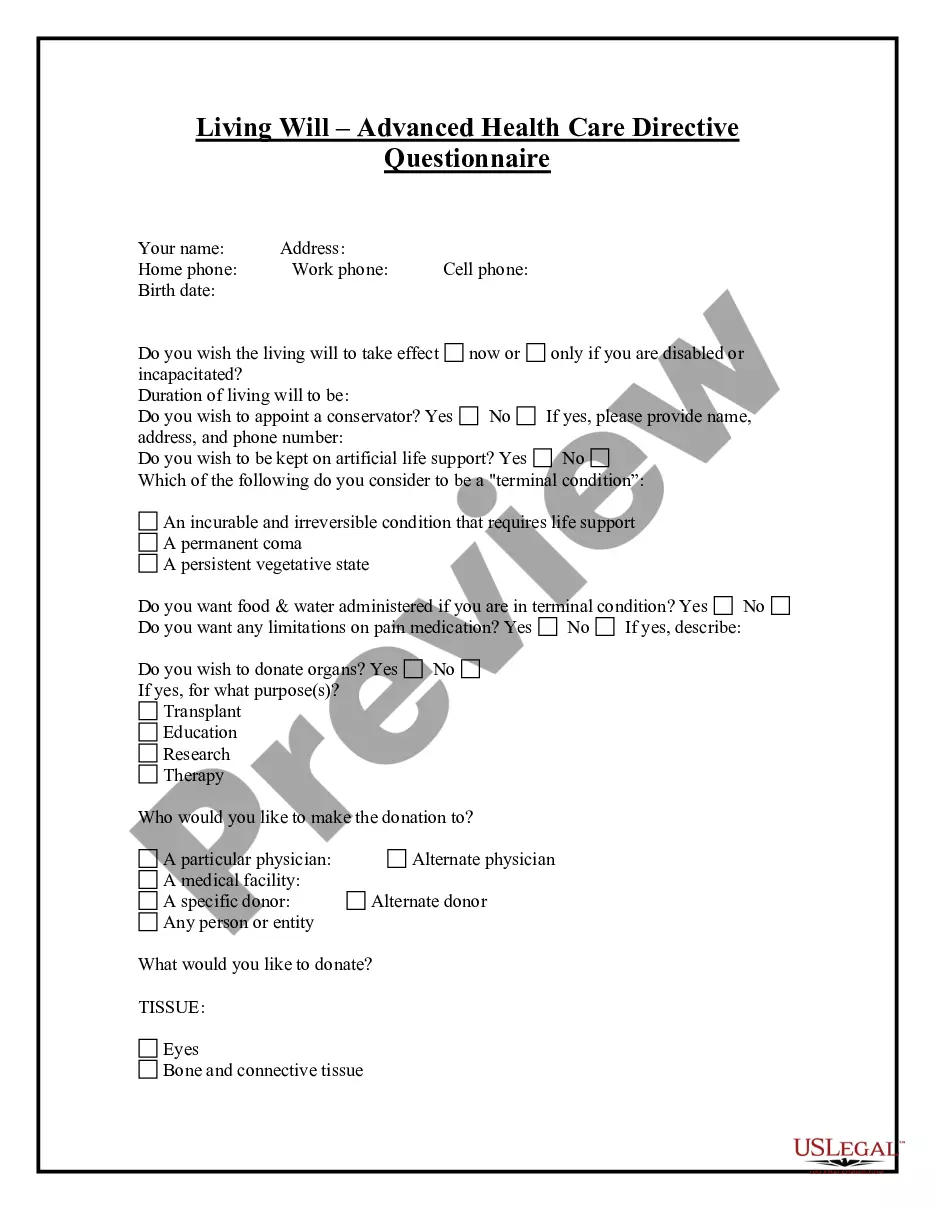
- Specific body parts and organs to be donated.
- A section for the donor's signature, with provisions for another individual to sign on their behalf if needed.
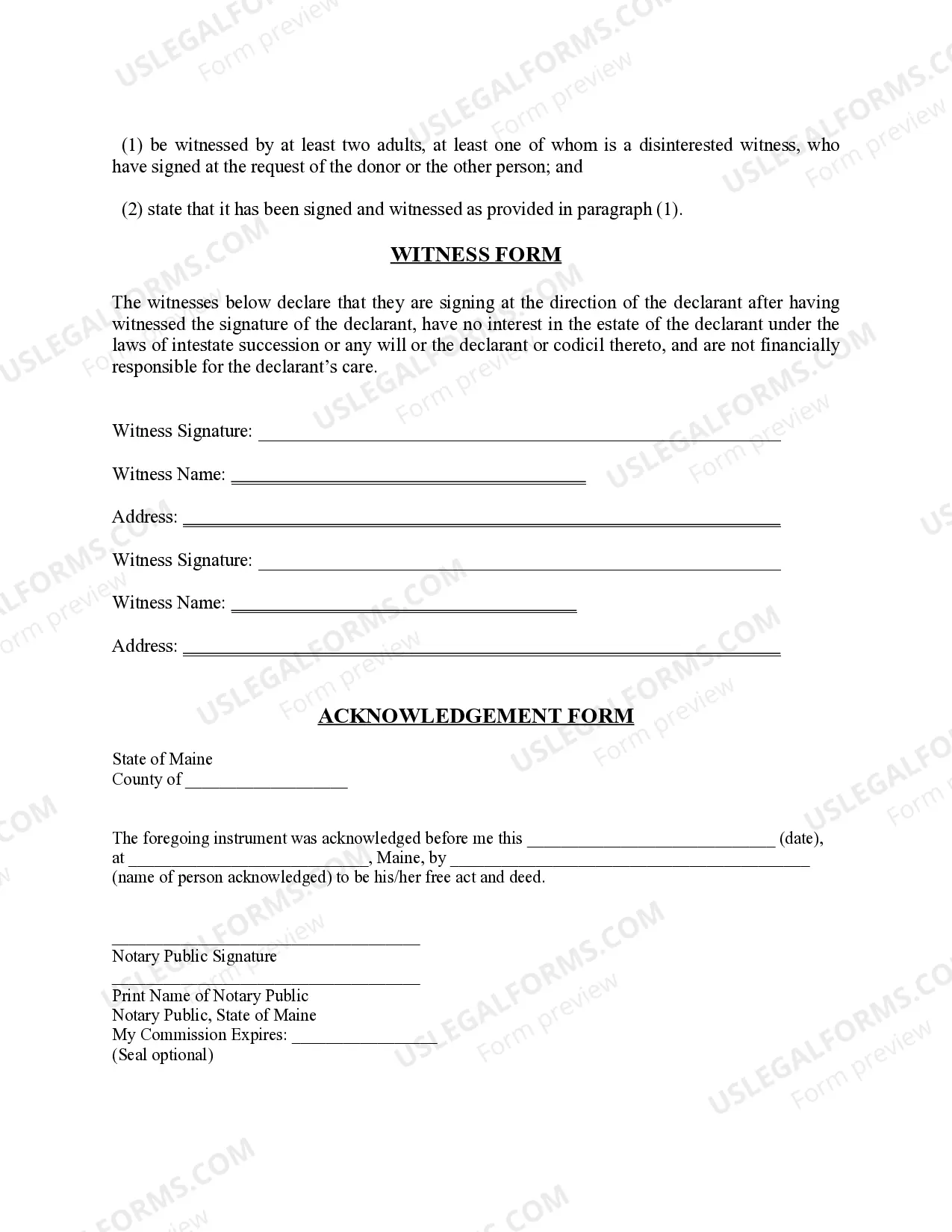
- Witness statements ensuring that the signing was observed according to legal requirements.
- Notarization space to enhance the form's legal validity.
When to use this form
This form should be utilized when an individual wishes to donate specific anatomical parts or organs following their death. It is important in situations where the donor desires to make their intentions clear to family members and medical professionals. Additionally, this form is necessary to comply with state laws regarding anatomical gifts, ensuring that the donation process is carried out efficiently and in accordance with the donorâs wishes.
Who needs this form
This form is intended for:
- Individuals who wish to donate organs or body parts at their time of death.
- Families or caregivers of individuals who may be unable to complete the form themselves.
- Anyone seeking to ensure that their wishes regarding anatomical gifts are legally documented and respected.
How to complete this form
- Identify the specific body parts or organs you wish to donate.
- Sign the form in the designated section; if unable, direct another person to sign on your behalf.
- Ensure two witnesses are present to observe the signing and sign the form themselves.
- Consider notarizing the document for added legal assurance.
- Store the completed form in a safe place and inform family members of its existence.
Does this form need to be notarized?
Yes, this form must be notarized to be legally valid, which will help confirm both the authenticity of the signatures and the intent of the donor. US Legal Forms offers an integrated online notarization service that is available 24/7, providing a secure video call process with a notary public to ensure your document is legally sound without the need for travel.
Get your form ready online
Our built-in tools help you complete, sign, share, and store your documents in one place.
Make edits, fill in missing information, and update formatting in US Legal Forms—just like you would in MS Word.
Download a copy, print it, send it by email, or mail it via USPS—whatever works best for your next step.
Sign and collect signatures with our SignNow integration. Send to multiple recipients, set reminders, and more. Go Premium to unlock E-Sign.
If this form requires notarization, complete it online through a secure video call—no need to meet a notary in person or wait for an appointment.
We protect your documents and personal data by following strict security and privacy standards.

Make edits, fill in missing information, and update formatting in US Legal Forms—just like you would in MS Word.

Download a copy, print it, send it by email, or mail it via USPS—whatever works best for your next step.

Sign and collect signatures with our SignNow integration. Send to multiple recipients, set reminders, and more. Go Premium to unlock E-Sign.

If this form requires notarization, complete it online through a secure video call—no need to meet a notary in person or wait for an appointment.

We protect your documents and personal data by following strict security and privacy standards.
Mistakes to watch out for
- Failing to sign the form personally or having no witness signatures.
- Not specifying the desired organs or tissues clearly.
- Neglecting to notarize when state law requires it.
Benefits of using this form online
- Convenient access from any location, allowing for easy completion at your own pace.
- Editability ensures that you can modify your choices as needed before finalizing the document.
- Reliable formats ensure that you receive a legally valid document, tailored to your needs.
Key takeaways
- Clearly specify your wishes regarding anatomical donations.
- Witness and notarize to ensure legal compliance in your state.
- Utilize this form to facilitate communication of your intentions with your family.
Looking for another form?


Form popularity
FAQ
Whole-body donation allows for an individual to donate their body to science at end-of-life, for medical advancements. This includes surgical device research and development, advanced disease-based research and hand-on bio skills training.
Living organ donors can donate: one kidney, a lung, or a portion of the liver, pancreas, or intestine. Learn more about deceased donation, living donation, and the transplantation process. By registering as an organ, eye, and tissue donor, you can also leave behind the gift of sight.
Over 700,000 transplants have occurred in the U.S. since 1988. Organs that can be donated after death are the heart, liver, kidneys, lungs, pancreas and small intestines. Tissues include corneas, skin, veins, heart valves, tendons, ligaments and bones.
Can anyone donate his or her body to science? Basically yes, medical institutions accept donations from all ages, ethnicities, and locations. Many medical institutions and medical schools actually require cadavers with certain pre-existing conditions for specific training or research purposes.
Can I specify what I want to donate? When registering online, most states give you the option to choose which organs and tissues you donate, or to donate everything that can be used. Check with your state registry to learn more.
Body donation, anatomical donation, or body bequest is the donation of a whole body after death for research and education. Donated bodies are mostly used for medical education and research.Any person wishing to donate their body may do so through a willed body program.
The potential donor has an infectious or contagious disease (such as HIV/AIDS, hepatitis B or hepatitis C, or prion diseases). The next of kin objects to the donation of the body. The body is not acceptable for anatomical study (extremely emaciated or extremely obese).
It is a very straightforward process you just need to telephone a body donation program and they will start the process. You can register your interest for body donation as a pre-need request, or you can call now if you have an immediate need to make an anatomical donation following a death.
Organs that can be donated for transplantation include kidneys, heart, lungs, liver, small bowel and pancreas. Tissues that can be donated include eyes, heart valves, bone, skin, veins and tendons. See the Interactive Body.