Massachusetts Quitclaim Deed from Individual to Two Individuals in Joint Tenancy
What this document covers
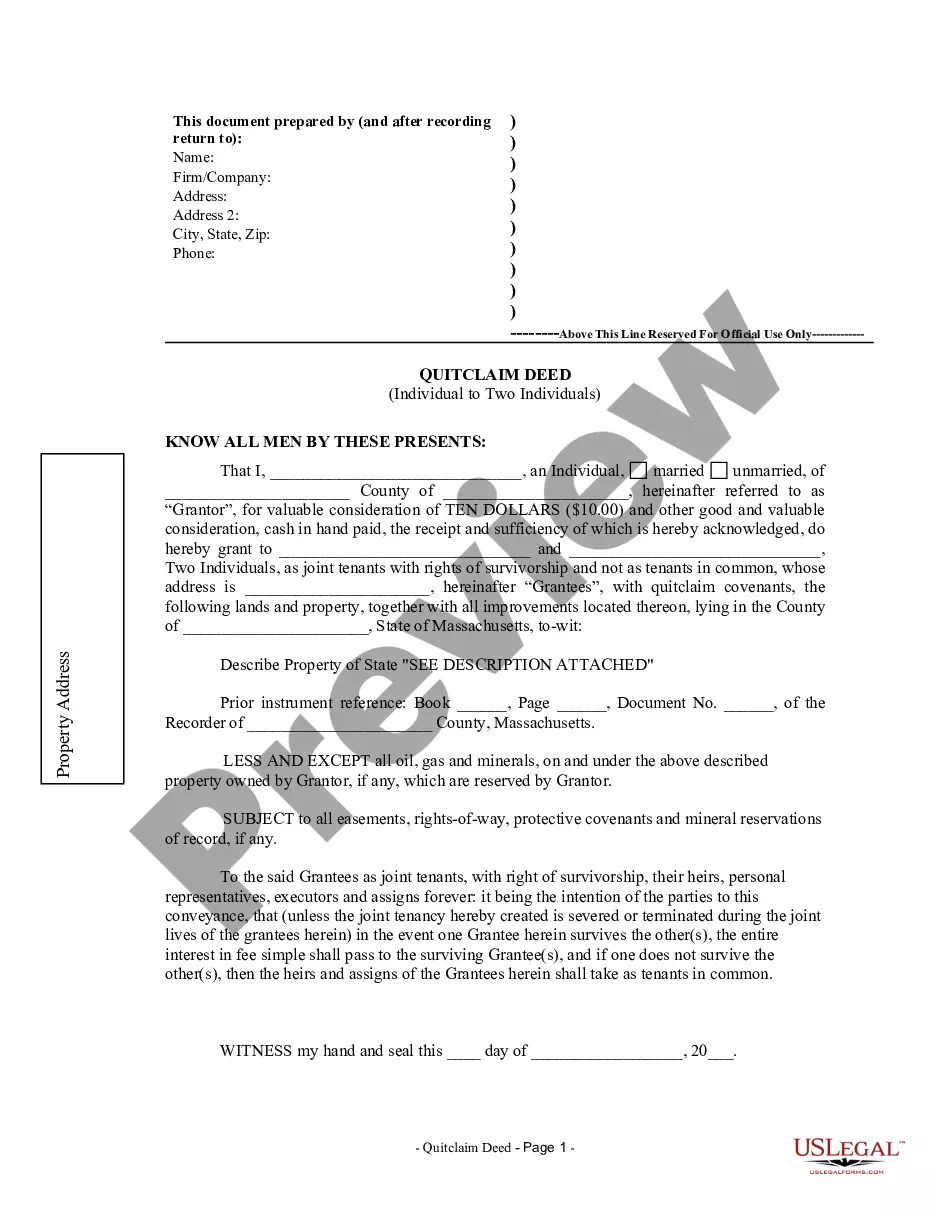
The Quitclaim Deed from Individual to Two Individuals in Joint Tenancy is a legal document that allows an individual (the Grantor) to transfer property ownership to two individuals (the Grantees) as joint tenants. This type of deed conveys the property without any warranty, meaning the Grantor transfers whatever interest they have in the property but does not guarantee clear title. This differs from a warranty deed, which provides more protection for the buyer. The joint tenancy aspect ensures that if one Grantee passes away, their ownership automatically transfers to the surviving Grantee, simplifying estate matters.
Key parts of this document
- Describes the property being transferred, including boundaries or specific references.
- Identifies the Grantor and the Grantees involved in the transaction.
- Includes a clause reserving oil, gas, and mineral rights, if applicable.
- Specifies the joint tenancy arrangement with the right of survivorship.
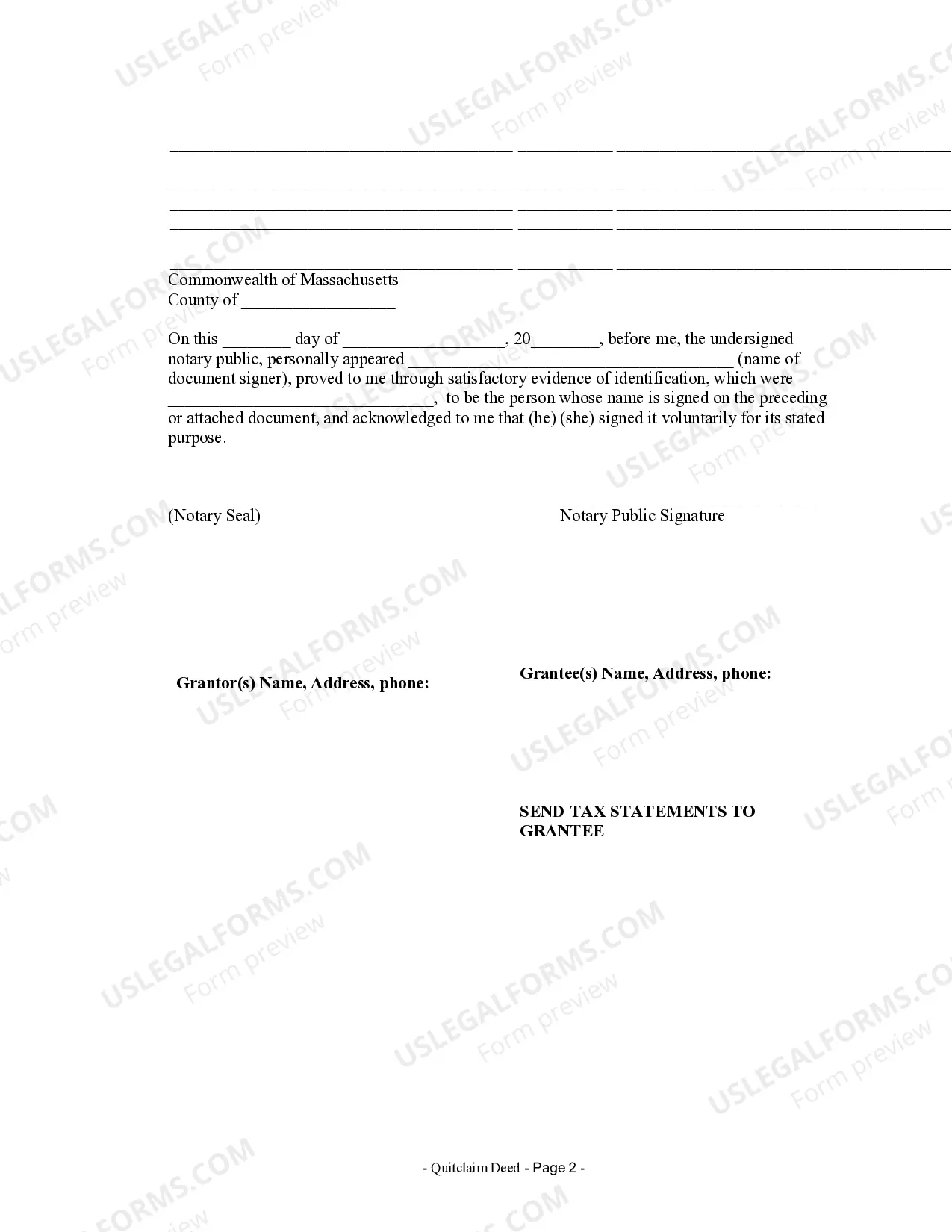
- Contains acknowledgment and signature lines for both the Grantor and a Notary Public.




When to use this form
This form is ideal when an individual wants to transfer real estate to two co-owners who will hold the property in joint tenancy. It is often used in family situations, such as when parents want to pass property to two children jointly. It is also suitable for partnerships or friends who purchase property together and wish to ensure that ownership seamlessly transfers to the remaining partner upon death.
Who should use this form
- Individuals transferring property to two other individuals.
- Couples or families who want to establish joint ownership of real estate.
- Business partners wishing to hold property jointly.
Completing this form step by step
- Identify the parties involved: Enter the Grantor's name and the names of both Grantees.
- Specify the property: Provide a complete description of the property being conveyed.
- Include references to prior instruments: Fill in the book and page numbers, as well as document numbers if applicable.
- Indicate oil, gas, and mineral reservations: Clearly state any rights being retained by the Grantor.
- Sign and date the form: The Grantor must sign in the presence of a Notary Public.
Notarization guidance
Notarization is required for this form to take effect. Our online notarization service, powered by Notarize, lets you verify and sign documents remotely through an encrypted video session, available 24/7.
Get your form ready online
Our built-in tools help you complete, sign, share, and store your documents in one place.
Make edits, fill in missing information, and update formatting in US Legal Forms—just like you would in MS Word.
Download a copy, print it, send it by email, or mail it via USPS—whatever works best for your next step.
Sign and collect signatures with our SignNow integration. Send to multiple recipients, set reminders, and more. Go Premium to unlock E-Sign.
If this form requires notarization, complete it online through a secure video call—no need to meet a notary in person or wait for an appointment.
We protect your documents and personal data by following strict security and privacy standards.

Make edits, fill in missing information, and update formatting in US Legal Forms—just like you would in MS Word.

Download a copy, print it, send it by email, or mail it via USPS—whatever works best for your next step.

Sign and collect signatures with our SignNow integration. Send to multiple recipients, set reminders, and more. Go Premium to unlock E-Sign.

If this form requires notarization, complete it online through a secure video call—no need to meet a notary in person or wait for an appointment.

We protect your documents and personal data by following strict security and privacy standards.
Avoid these common issues
- Not providing a complete property description, which can lead to legal disputes.
- Failing to include all necessary signatures, especially the Notary Public's.
- Not indicating any reservation of rights, which may impact future ownership issues.
Why complete this form online
- Convenient downloadable format saves time and effort.
- Editable templates ensure accuracy in entering specific property details.
- Access to attorney-drafted documents provides peace of mind regarding legal compliance.
Legal use & context
- This form transfers ownership without warranty, meaning the Grantees accept the property as is.
- It establishes joint tenancy, which can be an effective estate planning tool.
- Ensure to check local laws for additional requirements or potential restrictions.
Summary of main points
- The Quitclaim Deed transfers property to two individuals as joint tenants.
- The form is essential for ensuring the smooth transition of property ownership upon death.
- Ensure the form is properly completed and notarized for legal validity.
Looking for another form?
Form popularity
FAQ
Parents may own property with children as tenants-in-common.Parents often make the mistake of titling their residence with children as joint-tenants with rights of survivorship. This allows the property to pass to the surviving joint tenant upon the death of the first to die, without going through probate.
In California, most married couples hold real property (such as land and buildings) as joint tenants with right of survivorship.For instance, many married couples share real property as joint tenants. This way, upon the death of a spouse, the surviving spouse will own 100% share of the property.
In California, most married couples hold real property (such as land and buildings) as joint tenants with right of survivorship.For instance, many married couples share real property as joint tenants. This way, upon the death of a spouse, the surviving spouse will own 100% share of the property.
In estate law, joint tenancy is a special form of ownership by two or more persons of the same property. The individuals, who are called joint tenants, share equal ownership of the property and have the equal, undivided right to keep or dispose of the property. Joint tenancy creates a Right of Survivorship.
Here are some of the options: Joint Ownership. If mom, daughter, and (perhaps) son-in-law own the house as joint tenants with right of survivorship, when mom passes away the house will go to the other owners without going through probate.
If your son inherited a share, he would become a joint owner alongside you and your surviving parent. You would have to buy your son out only if he wanted to sell his share. As already stated, making wills makes no difference to what happens on the death of a joint owner to a property owned as joint tenants.
There are no lending rules against purchasing a home with someone who is not your spouse or family. Some common relationships that co-own a house together are as follows. An adult child buying with his or her father, mother, or step-parent.Two or more families buying a large home to live in together.
A tenancy by the entirety is a form of co-ownership that is available only if you and the other owner of the property are married.Each tenant in common will own half the property. Under Massachusetts law, a non-debtor spouse is protected when holding property in a tenancy by the entirety.
Equal and Undivided Ownership Each joint tenant has equal and undivided legal ownership of the property. The equal and undivided ownership gives the joint tenants each the legal right to dispose of or keep his share of ownership interest in the property while the joint tenancy is in effect.