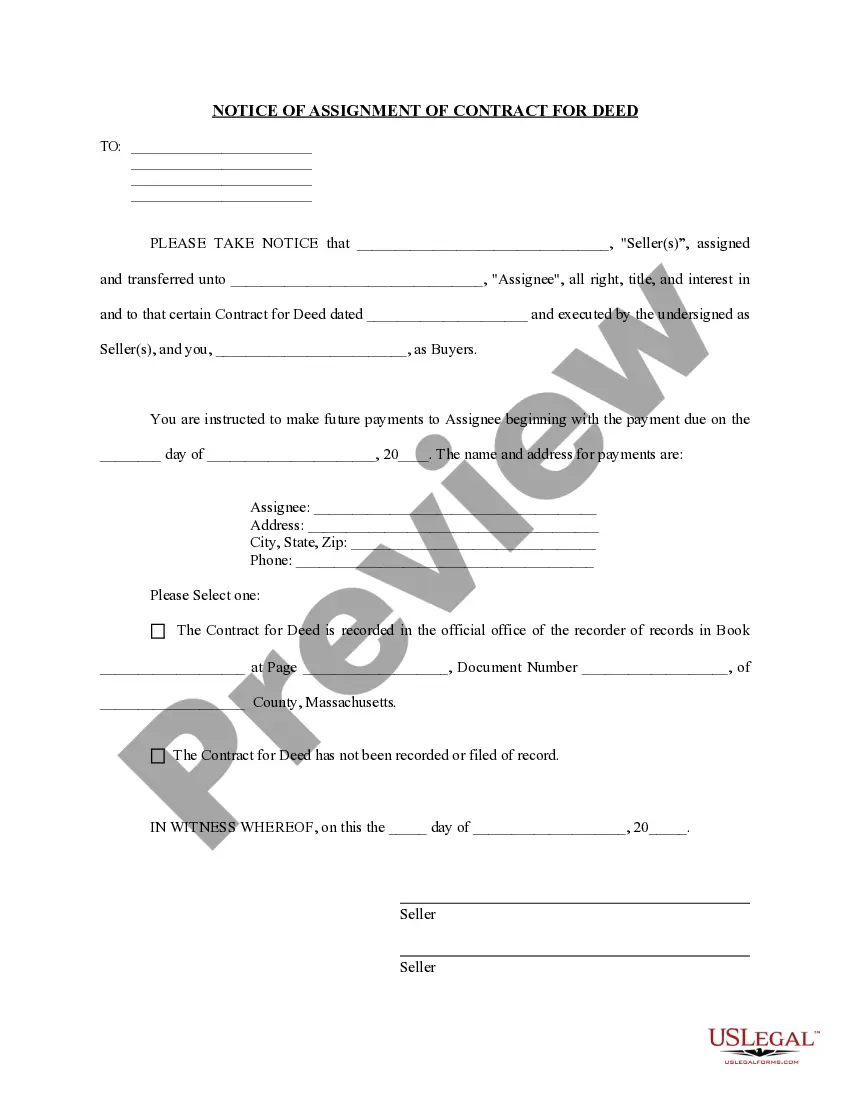
Massachusetts Notice of Assignment of Contract for Deed
What this document covers
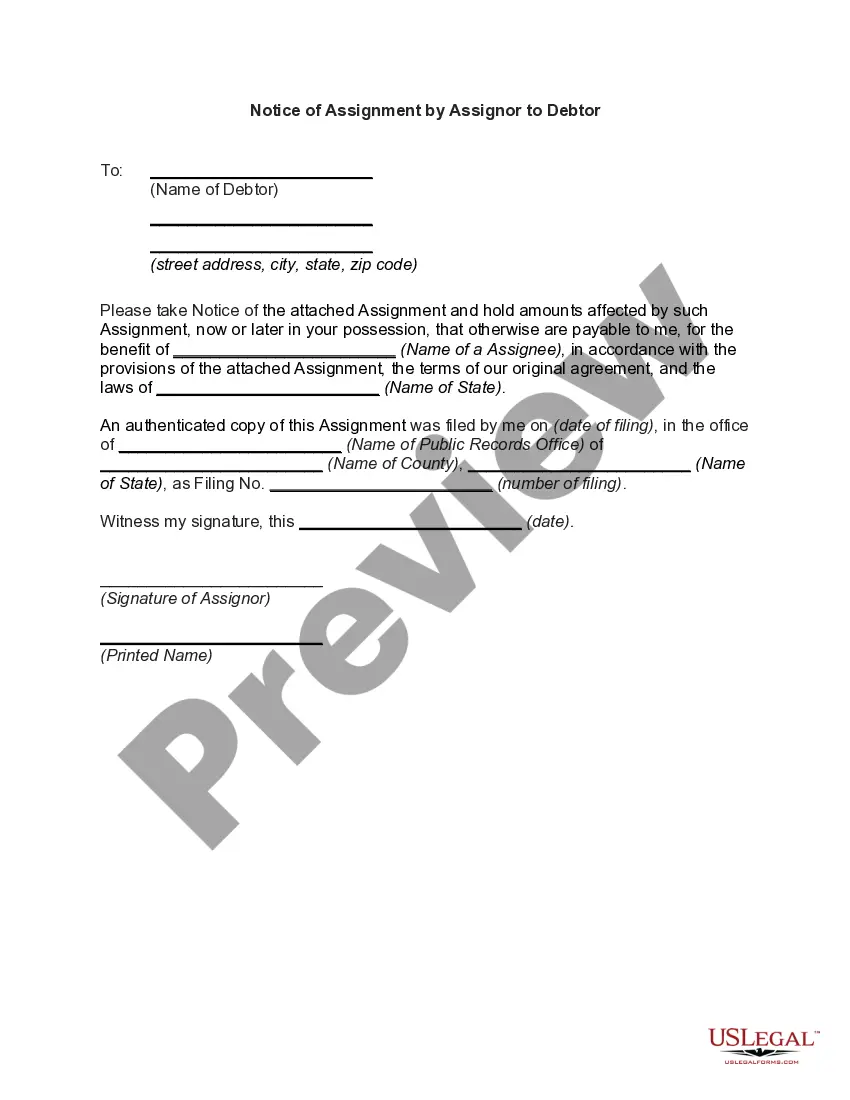
The Notice of Assignment of Contract for Deed is a legal document used by a Seller to notify the Buyer(s) that the Seller has assigned a contract for deed to a third party. This notice directs the Buyer(s) to make future payments to the assigned third party. Unlike a standard contract for deed form, this notice specifically clarifies the assignment of the contract and the obligation to pay a new entity.
Key parts of this document
- A statement regarding the assignment of the contract for deed.
- Space for the Seller's signature and date.
- Notarization section to validate the document.
- Declaration that the contract for deed has not been recorded.
When to use this form
This form is needed when a Seller has entered into a contract for deed with a Buyer but decides to assign their rights and obligations to another third party. It is commonly used in real estate transactions where the ownership or management of the property is changing hands without altering the original agreement terms.
Who needs this form
- Real estate Sellers who wish to assign their contract for deed to another party.
- Buyers who need to be informed of the assignment of their contract for deed.
- Attorneys or legal representatives assisting in real estate transactions involving contracts for deed.
How to complete this form
- Provide the date of the assignment.
- Enter the names of the Seller and Buyer(s) as per the contract for deed.
- Specify the name of the third party to whom the contract has been assigned.
- Have the Seller sign the form and date it as required.
- Arrange for the form to be notarized to ensure legal validity.
Notarization requirements for this form
This form needs to be notarized to ensure legal validity. US Legal Forms provides secure online notarization powered by Notarize, allowing you to complete the process through a verified video call, available anytime.
Get your form ready online
Our built-in tools help you complete, sign, share, and store your documents in one place.
Make edits, fill in missing information, and update formatting in US Legal Forms—just like you would in MS Word.
Download a copy, print it, send it by email, or mail it via USPS—whatever works best for your next step.
Sign and collect signatures with our SignNow integration. Send to multiple recipients, set reminders, and more. Go Premium to unlock E-Sign.
If this form requires notarization, complete it online through a secure video call—no need to meet a notary in person or wait for an appointment.
We protect your documents and personal data by following strict security and privacy standards.

Make edits, fill in missing information, and update formatting in US Legal Forms—just like you would in MS Word.

Download a copy, print it, send it by email, or mail it via USPS—whatever works best for your next step.

Sign and collect signatures with our SignNow integration. Send to multiple recipients, set reminders, and more. Go Premium to unlock E-Sign.

If this form requires notarization, complete it online through a secure video call—no need to meet a notary in person or wait for an appointment.

We protect your documents and personal data by following strict security and privacy standards.
Typical mistakes to avoid
- Failing to fill in the complete names of the parties involved.
- Not providing the correct date of the assignment.
- Omitting the notarization, which is critical for legal acceptance.
- Not specifying the third party accurately.
Benefits of using this form online
- Convenience of downloading and filling out the form at your own pace.
- Editable format allows you to ensure all information is accurate before submitting.
- Access to forms drafted by licensed attorneys to ensure legal compliance.
Key takeaways
- The Notice of Assignment of Contract for Deed informs Buyers of a new payment recipient.
- Proper identification of all parties is critical to avoid disputes.
- Notarization is required for legal validity.
- Using this form can streamline the process of transferring contracts for deed.
Looking for another form?
Form popularity
FAQ
A deed is a written instrument which is executed with the necessary formality and by which an interest, right or property passes or is confirmed, or an obligation binding on some person is created or confirmed.
A deed is a document containing the terms of an agreement, especially an agreement concerning the ownership of land or a building. law He asked if I had the deeds to his father's property. Synonyms: document, title, contract, title deed More Synonyms of deed. Quick word challenge.
1 : something that is done : act a brave deed. 2 : a legal document by which a person transfers land or buildings to another. deed. verb.
The general warranty deed is the standard instrument for home sales. Your notarized warranty deed is proof of ownership, and that the grantor transferred complete and clear title to you. A quitclaim deed also proves full land ownershipif the person who conveyed the interest to you had full ownership.
A deed is an official written document declaring a person's legal ownership of a property, while a title refers to the concept of ownership rights.
The Difference Between A Title And A Deed A deed is an official written document declaring a person's legal ownership of a property, while a title refers to the concept of ownership rights.A deed, on the other hand, can (and must!) be in your physical possession after you purchase property.
Title deeds are documents which prove ownership of land or property.This means a record of your ownership is not held centrally at Land Registry. Your deeds may be held by a solicitor, a mortgage lender or by you, at home, or perhaps lodged at your bank.
When you own a home, you own both the deed and title for that property. In real estate, title means you have ownership and a right to use the property.The deed is the physical legal document that transfers ownership. It shows who you bought your house from, and when you sell it, it shows who you sold it to.
The purpose of a deed is to transfer a title, a legal document proving ownership of a property or asset, to another person. For the document to be binding in a court of law, it must be filed in the public record by a local government official tasked with maintaining documents.