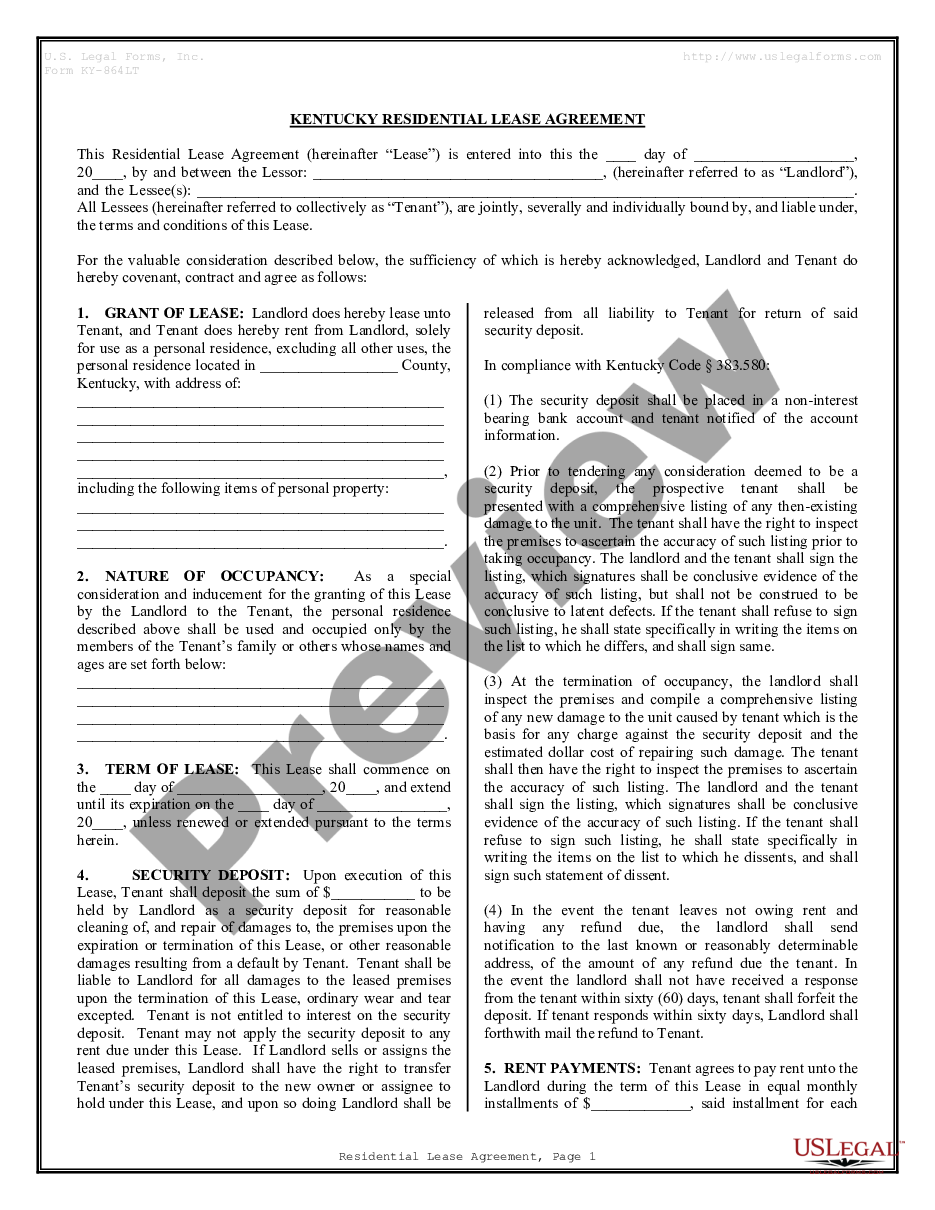
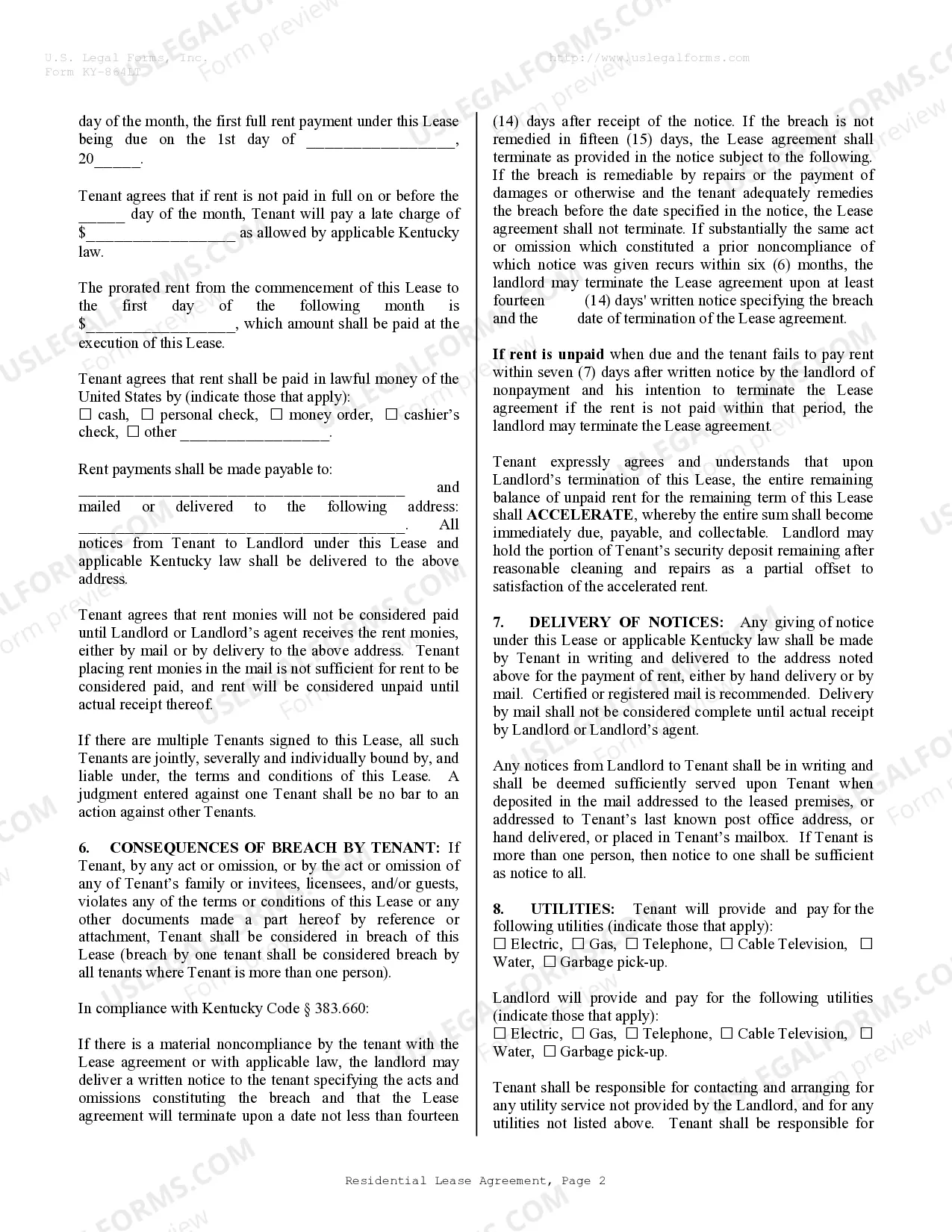
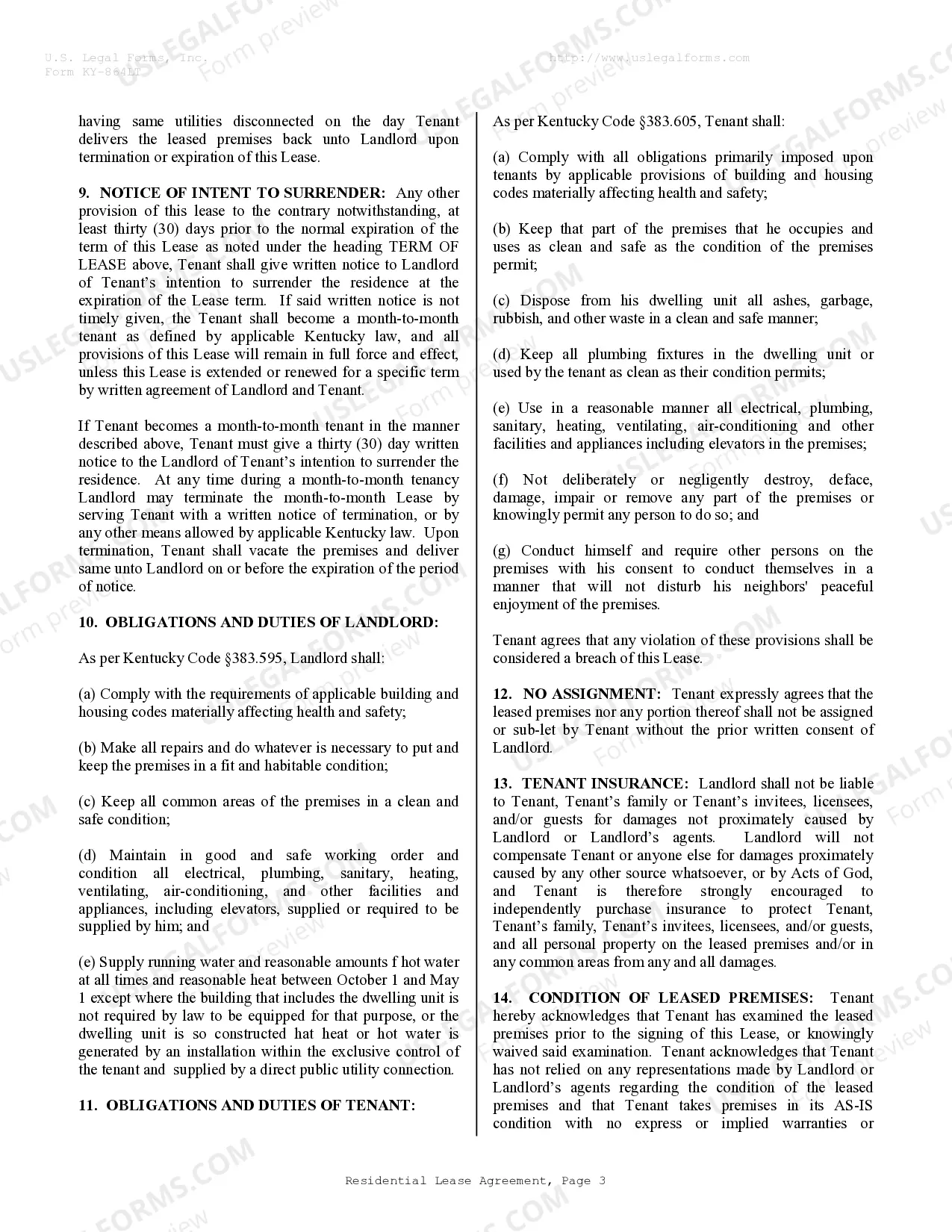
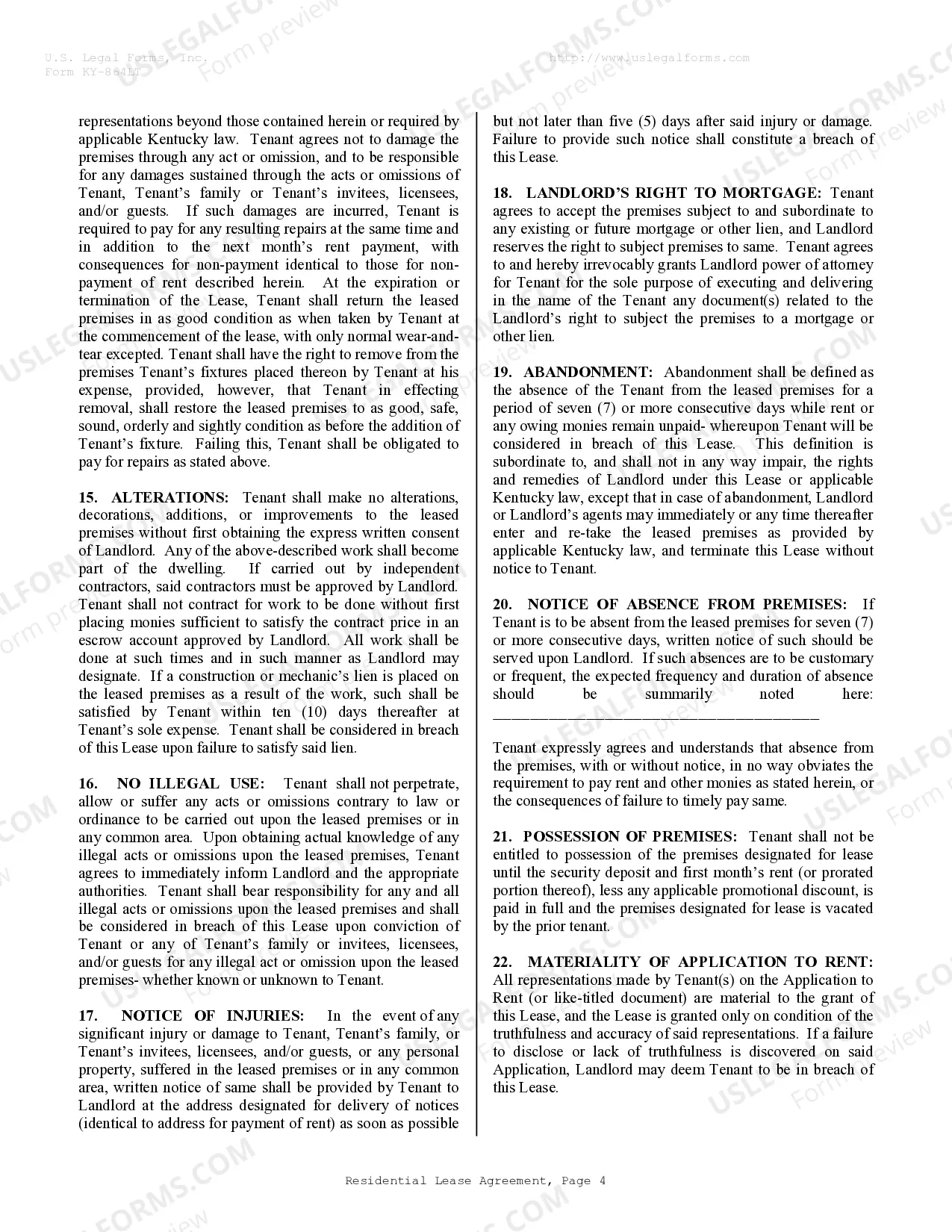
Residential Rental Lease Agreement
CHAPTER 383 LANDLORD AND TENANT
Recovery of rent -- Interest -- Persons entitled to and liable
for.
(1) Rent may be recovered by distress, attachment or action, and
shall bear six percent (6%) interest per annum from the time it is due.
(2) If the owner or holder alienates or assigns his estate, term
or the rent thereafter to fall due thereon, the alienee or assignee may
recover the rent that falls due thereafter.
(3) The personal representative of a person to whom any rent was
due and unpaid at the time of his death shall have the same remedy by action
or by distress, for the recovery of the arrears of such rent, that the
decedent would have had if living.
(4) A person entitled to rents depending upon the life of another
may, notwithstanding the death of the latter, have the same remedy, by
action or distress, for the rents in arrears, as he might have had if such
person were living.
(5) Rent may be recovered from the lessee or other person owing
it, or his assignee or undertenant, or the representative of either by
any of the remedies given in this chapter. But, the assignee or subtenant
shall be liable only for the rent accrued after his interest began.
(6) The same remedies to recover arrearages of rent due on a lease
for life or lives shall be allowed as if the lease were for years.
Chap. 383, §383.010
Effective: October 1, 1942
Property subject to distress or attachment for rent -- Damages
for illegal distraint, attachment, or wrongful removal.
(1) A distress warrant or attachment for rent shall bind, and may
be levied upon, any personal property of the original tenant found in the
county, and the personal property of the assignee or undertenant found
on the leased premises. If the tenant has removed his property to another
county, the distress or attachment may be directed to that county.
(2) If property is distrained for any rent not due, or attached
for any rent not due or accruing, or taken under any attachment sued out
without good cause, the owner of the property may, in an action against
the party suing out the warrant of distress or the attachment, recover
double damages for the wrongful seizure, and if the property is sold, for
double the value thereof.
(3) Any person who wrongfully takes or removes property distrained
or attached for rent, from any person having the legal custody of it, shall
be liable to the person aggrieved for treble damages, with costs. If the
property distrained, after the wrongful taking or removal, comes to the
possession of the owner by his wrongful procurement, he shall in like manner
be liable to the person aggrieved. Chap. 383, §383.020
Effective: October 1, 1942
Attachment for rent -- Procedure.
(1) If any person is liable for rent due not later than one year
thereafter, whether payable in money or some other thing, the person to
whom the rent is owing or his agent or attorney may file an affidavit in
the district court if the amount involved is less than $1,500 and otherwise
in the Circuit Court of the county in which the tenement lies, stating
that there are reasonable grounds for belief, and that he does believe,
that unless an attachment is issued he will lose his rent. The court shall
then issue an attachment for the rent against the personal property of
the person liable for the rent, to any county the person suing out the
attachment may desire. But the attachment shall not issue until the plaintiff
has given bond, with good surety, to indemnify the defendant should it
appear that the attachment has been wrongfully obtained.
(2) Attachments for rent issued shall be returned before the court
issuing the attachment. The proceedings thereon shall be the same as on
other attachments according to KRS Chapter 425 and the Rules of Civil Procedure.
(3) The defendant may deny the tenancy or his liability to pay rent,
as stated in the affidavit. He may repossess himself of the property by
executing bond in a manner similar to that prescribed in KRS Chapter 425,
subject to similar proceedings if forfeited, as is prescribed by KRS Chapter
425 and the Rules of Civil Procedure on such a bond. Chap. 383, §383.030
Effective: January 2, 1978
Lien for rent -- Priority of.
(1) A landlord renting premises for farming or coal mining purposes
shall have a lien on the produce of the premises rented and the fixtures,
household furniture, and other personal property owned by the tenant, or
undertenant, after possession is taken under the lease, but the lien shall
not be for more than one year's rent due and to become due, nor for any
rent which has been due for more than eleven months.
(2) Every other landlord shall have a lien on the fixtures, household
furniture, and other personal property of the tenant or undertenant, from
the time possession is taken under the lease, to secure the landlord in
the payment of four months' rent, due or to become due, but such lien shall
not be effective for any rent which is past due for more than one hundred
and twenty days.
(3) If sued out within one hundred and twenty days from the time
the rent is due, a distress or attachment for rent secured by a lien under
subsection (1) or subsection (2) shall, to the extent of four months' rent,
be superior to and satisfied before other liens upon the personal property
of a lessee, assignee or undertenant, created while the property is on
the leased premises, whether the rent accrued before or after the creation
of the other liens. If the rent is for premises leased for coal mining
purposes, the superiority given the lien by this subsection shall be to
the extent of one year's rent.
(4) If any property subject to a lien under this section is removed
openly from the leased premises, without fraudulent intent, and not returned,
the landlord's lien given by this section shall continue on the property
so removed only for fifteen days from the date of its removal. The landlord
may enforce his lien against the property wherever found. Chap. 383,
§383.070
Effective: October 1, 1942
Rights of other lienholders on property of tenant as against
landlord.
(1) If, after the commencement of any tenancy, a lien is created
on the property upon the leased premises liable for rent, the party making
or acquiring the lien may remove the property from the premises only after
paying to the person entitled to the rent so much as is in arrears, and
securing to him so much as is to become due; what is so paid and secured
not being more altogether than rent for the period of time for which the
landlord has a lien under KRS 383.070.
(2) If the property is taken under execution or attachment, the
officer shall, out of the proceeds of the property found on the leased
premises and levied on or taken by him, make payment of the rent payable
in money; in an amount equal to that for which the landlord has a lien
under KRS 383.070, unless a bond of indemnity is executed. The plaintiff
in the execution or attachment may compel a sale of the property under
his process by executing to the officer a bond of indemnity such as provided
for in KRS Ch. 425, and the remedy provided in KRS Ch. 425 and the Rules
of Civil Procedure, on a bond of indemnity, shall operate in favor of the
person to whom the rent is payable or other claimant of the property on
the bond.
(3) All valid liens upon the personal property of a lessee, assignee,
or undertenant, created before the property is carried upon the leased
premises, shall prevail against a distress warrant or attachment for rent.
Chap. 383, §383.080
Recovery of rent in absence of written contract.
If there is no written contract, a landlord
may, by action, recover reasonable satisfaction for the use and occupation
of his land. If on the trial a verbal contract reserving rent in a certain
amount is proven, the verbal contract shall be evidence of the amount recoverable.
Chap. 383, §383.090
Effective: October 1, 1942
Attornment -- When void -- When unnecessary.
(1) The attornment of a tenant to a stranger shall be void, unless
it be with the consent of the landlord, or pursuant to or in consequence
of the judgment of a court.
(2) A conveyance or devise of a rent, reversion or remainder shall
be valid without an attornment of the tenant, but no tenant who pays the
rent to the grantor before notice of the conveyance shall suffer any damage
thereby. Chap. 383, §383.100
Effective: October 1, 1942
Landlord's lien for money or supplies furnished -- Enforcement
of lien.
(1) A landlord shall have a superior lien, against which the tenant
shall not be entitled to any exemption, upon the whole crop of the tenant
raised upon the leased or rented premises to reimburse the landlord for
money or property furnished to the tenant to enable him to raise the crop,
or to subsist while carrying out his contract of tenancy. But, the lien
of the landlord shall not continue for more than one hundred and twenty
days after the expiration of the term. If the property upon which there
is a lien is removed openly from the leased premises, without fraudulent
intent, and not returned, the landlord shall have a superior lien upon
the property so removed for fifteen days from the date of its removal,
and may enforce his lien against the property wherever found.
(2) The landlord may enforce the lien given in subsection (1) of
this section by distress or attachment, in the manner provided in this
chapter for the collection of rent and subject to the same liability.
Chap. 383, §383.110
Effective: October 1, 1942
Contract for portion of crop for rent -- Rights of landlord --
Purchasers of crops.
(1) Contracts by which a landlord is to receive a portion of the
crop planted or to be planted, as compensation for the use or rent of the
land, shall vest in him the right to such a portion of the crop when planted
as he has contracted for, though the crop may be planted or raised by a
person other than the one contracted with or though a different kind of
crop than the one contracted for be planted. For the taking of or injury
to any of such crops, the landlord may recover damages against the wrongdoer.
The landlord may also have an injunction against any person to prevent the taking or injury of his portion of the crops.
(2) This section does not bar the landlord from his right to the
damages against the person contracted with that he may sustain by reason
of the land being planted without his assent in a crop other than that
contracted for, or not planted at all, or for failure to cultivate the
crop in a proper manner.
(3) This section includes a purchaser without notice of a growing
crop remaining on the premises, though severed from the land, but does
not apply to a purchaser in good faith without notice of a crop, after
it has been removed for twenty days from the rented premises on which it
was planted. Chap. 383, §383.120
Effective: October 1, 1942
Tenancy under contract to labor forfeited by breach.
When a tenant enters or holds premises by virtue
of a contract in which it is stipulated that he is to labor for his landlord,
and he fails to begin to labor, or if, having begun, without good cause
fails to comply with his contract, his right to the premises shall at once
cease, and he shall abandon them without demand or notice. Chap. 383, §383.130
Effective: October 1, 1942
Holding over beyond term -- Tenancy created by -- Rights of parties.
(1) If, by contract, a term or tenancy for a year or more is to
expire on a certain day, the tenant shall abandon the premises on that
day, unless by express contract he secures the right to remain longer.
If without such contract the tenant shall hold over, he shall not thereby
acquire any right to hold or remain on the premises for ninety days after
said day, and possession may be recovered without demand or notice if proceedings
are instituted within that time. But, if proceedings are not instituted
within ninety days after the day of expiration, then none shall be allowed
until the expiration of one year from the day the term or tenancy expired.
At the end of that year the tenant shall abandon the premises without demand
or notice, or stand in the same relation to his landlord that he did at
the expiration of the term or tenancy aforesaid; and so from year to year,
until he abandons the premises, is turned out of possession, or makes a
new contract.
(2) If by contract a tenancy for less than a year is to expire on
a certain day, the tenant shall abandon the premises on that day unless
by express contract he secures the right to remain longer. If without such
contract the tenant shall hold over he shall not thereby acquire any right
to hold or remain on the premises for thirty days after said day, and the
possession may be recovered without demand or notice if proceedings are
instituted within that time. But, if proceedings are not instituted within
thirty days after the day of expiration, then none shall be allowed until
the expiration of sixty days from the day the tenancy expired. At the end
of that sixty days the tenant shall abandon the premises without demand
or notice, or stand in the same relation to his landlord that he did at
the expiration of the tenancy aforesaid; and so on from time to time until
he abandons the premises, is turned out of possession, or makes a new contract.
Chap. 383, §383.160
Effective: October 1, 1942
Buildings destroyed without fault of tenant -- Replacement of,
and rent on.
Unless the contrary is expressly provided for
in the written contract, the agreement of a lessee that he will repair
or leave the premises in repair shall not bind him to erect similar buildings
if, without his fault or neglect, the buildings are destroyed by fire or
other casualty. A tenant, unless he otherwise contracts, shall not be liable
for the rent for the remainder of his term of any building leased by him,
and destroyed during the term by fire or other casualty without his fault
or neglect. Chap. 383, §383.170
Effective: October 1, 1942
Conveyance of greater estate than owned, and assignment of tenancy
-- Effect.
(1) A conveyance made by a tenant for years, purporting to grant
a greater estate than he has, shall not work a forfeiture of his estate,
but shall pass to the grantee all the estate which the tenant could lawfully
convey.
(2) Unless the landlord consents thereto in writing, every assignment,
or transfer of his term or interests in the premises, or any portion thereof,
by a tenant at will or by sufferance, or one who has a term less than two
years, shall operate as a forfeiture to the landlord. The landlord, after
having given the occupant ten days' written notice to quit, may reenter
and take possession, or may, by writ of forcible entry or detainer, or
the proper procedure, recover possession of the premises from any occupant.
Chap. 383, §383.180
Effective: October 1, 1942
Death of tenant for life -- Effect on lease of tenant for year.
If a tenant for life lets the land to another
for the year and dies after March 1, the lessee shall hold the land until
December 31 following, but shall pay a reasonable rent from the death of
the tenant for life. Chap. 383, §383.190
Effective: October 1, 1942
Termination of tenancy at will or by sufferance.
In those jurisdictions where the Uniform Residential
Landlord and Tenant Act is not in effect, a tenancy at will or by sufferance
may be terminated by the landlord giving one (1) month's notice, in writing,
to the tenant requiring him to remove. Chap. 383, §383.195
Effective: July 13, 1984
Definitions of forcible entry and detainer.
(1) The words "possession," "entry," "detainer," in KRS 383.200
to 383.285, refer to lands and tenants.
(2) A forcible entry is:
(a) An entry without the consent of the person having the actual
possession;
(b) As to landlord, an entry upon the possession of his tenant at
will or by sufferance, whether with or without the tenant's consent.
(3) A forcible detainer is:
(a) The refusal of a tenant to give possession to his landlord
after the expiration of his term; or of a tenant at will or by sufferance
to give possession to the landlord after the determination of his will;
(b) The refusal of a tenant of a person who has made a forcible
entry to give possession, on demand, to the person upon whose possession
the forcible entry was made;
(c) The refusal of a person who has made a forcible entry upon the
possession of one who acquired it by a forcible entry to give possession,
on demand, to him upon whose possession the first forcible entry was made;
(d) The refusal of a person who has made a forcible entry upon the
possession of a tenant for a term to deliver possession to the landlord,
upon demand, after the term expires; and, if the term expires whilst a
writ of forcible entry sued out by the tenant is pending, the landlord
may, at his cost and for his benefit, prosecute it in the name of the tenant.
Chap. 383, §383.200
Effective: July 1, 1953
Time when tenancy created immaterial.
It is not material whether the tenant shall
have received possession from his landlord or have become his tenant after
obtaining possession. Chap. 383, §383.205
Effective: July 1, 1953
Issual and form of warrant -- Jury not summoned unless demanded.
(1) Upon complaint by a person aggrieved by a forcible entry or
detainer to the District Court of the county in which the land or tenement,
or a principal part thereof, lies, a warrant shall issue to the sheriff
or any constable, in substance as follows: "The Commonwealth of Kentucky
to the sheriff (or any constable) of .... county:
Whereas, A B hath made complaint that C D and E F did, on the ....
day of ...., forcibly enter into (or forcibly detain from the said A B)
one (1) house and field on the waters of ...., in the county aforesaid
(or other general description of the lands or tenements), which were in
the peaceable possession of A B (or which the said C D and E F, tenants
of the said A B, now hold against him): You are, therefore, commanded to
summon a good and lawful jury of your county to meet on the premises, or
at a place convenient thereto, on the .... day of ...., to inquire into
the forcible entry (or forcible detainer) aforesaid; and give to the said
C D and E F at least three (3) days' notice of the time and place of the
meeting of the jury; and have then there this writ. Witness, etc."
(2) In the trial of writs of forcible entry, forcible detainer
or forcible entry and detainer, if neither party, in person or by agent
or attorney, demand a jury, the trial thereof shall be by the court. No
such writ shall hereafter direct the summoning of a jury, and the sheriff
or other officer to whose hands such writ may come to do execution thereof
shall not summon a jury in such proceedings, unless he be by either party
notified in writing that a jury is demanded. At the calling of the cause
for trial either party may demand a jury. Chap. 383, §383.210
Effective: January 2, 1978
Execution of warrant.
The officer shall give to each defendant notice,
according to the directions of the warrant, and no inquiry shall be made
against any defendant who has not been notified as aforesaid. If, however,
the notice have been given to a defendant, but not three days before the
day of the meeting of the jury, the inquest shall, on his motion, be adjourned
until the expiration of the three days. Chap. 383, §383.215
Effective: July 1, 1953
Return of warrant -- Jury -- Oath.
At the time for holding the inquisition, the
officer shall return the warrant to the court with an indorsement stating
when and upon whom it was executed and the place designated by the officer
for holding the inquisition, together with a panel of the jury; whereupon,
the clerk, whether the defendant is present or not, shall administer an
oath to the jurors in substance as follows: "You, and each of you, shall
well and truly inquire into and return whether or not the defendant (or
defendants) is (or are) guilty of the forcible entry (or detainer) complained
of in the warrant in this cause: so help you God." Chap. 383, §383.220
Effective: January 2, 1978
Witnesses, subpoenas and coercion of attendance.
The court may issue subpoenas for witnesses
at the request of either party, and their attendance and testifying may
be coerced by the court which conducts the inquest. Chap. 383, §383.230
Effective: June 17, 1978
Verdict -- Procedure in case of disagreement.
The jurors, after hearing the evidence, shall,
by their inquest, say whether the defendants, or either of them, be guilty
or not guilty of the forcible entry or detainer complained of; and shall
return their inquest, signed by one of their body, to the court. If the
jury do not agree, it may be discharged, and another be ordered to be summoned
to meet, either immediately or at some future day to be then and there
fixed and indorsed on the warrant; and this proceeding shall be continued
until a jury agree. Chap. 383, §383.235
Effective: January 2, 1978
Form of judgment.
Upon the return of the inquest the court shall
enter a judgment according to the
inquisition, either for the plaintiff, in substance, that he have
restitution of the premises aforesaid, and recover of the defendants his
costs in this behalf expended; or for the defendants, in substance, that
they recover of the plaintiff their costs in this behalf expended; or for
the plaintiff against some of the defendants, and for the other defendants
against the plaintiff, if some be found guilty and others not guilty. Chap.
383, §383.240
Effective: January 2, 1978
Proceedings upon failure to file appeal -- Form and issual of
warrant of restitution.
If the party against whom the inquisition is
found fails to file an appeal of the inquisition with the court, on or
before the seventh day after the finding of the inquest, the court shall,
on request, issue execution for the costs; and, if the inquisition be in
favor of the plaintiff, it shall also issue a warrant of restitution in
substance as follows:
".... County.
To the sheriff (or any constable) of .... county, Whereas, C D
and E F have been found guilty of a forcible entry in (or detainer of)
one house and field, lying on the waters of ...., in the county aforesaid
(or other general description of the possessions), to the injury of A B:
You are, therefore, in the name of the Commonwealth of Kentucky, commanded
that, with the power of the county if necessary, you put the said A B in
the possession of said premises; and make return within .... days, how
you have executed this warrant. Given under my hand this .... day of ....
............................................District Judge"
Chap. 383, §383.245
Effective: January 2, 1978
Preservation of papers, records and proceedings -- Transcript.
The clerk of the court shall carefully preserve
all papers, records and proceedings, relating to the cause; and shall deliver,
to any person requiring it, a transcript thereof. Chap. 383, §383.250
Effective: January 2, 1978
Time for filing appeal -- Deposit of money with clerk -- Return
of papers or transcript to circuit court.
(1) If either party conceive himself aggrieved by the judgment
of the court, he may file an appeal within seven (7) days next after the
finding aforesaid, and shall deposit with the circuit court clerk the amount
of rent owing and due from the onset of the forcible entry and detainer
proceedings as well as the amount of all future rents, as it becomes owing
and due in each succeeding month during the pendency of the appeal. The
rental moneys collected in this account shall be distributed by court order at the conclusion of an appeal.
(2) Upon the aggrieved party perfecting his appeal by the payment
of moneys into court pursuant to subsection (1) of this section the court
shall stay all further proceedings on the inquisition, and return the whole
of the papers and proceedings, or a fair transcript thereof, to the office
of the circuit court of said county, within ten days thereafter.
Chap. 383, §383.255
Effective: January 2, 1978
Recovery of damages and expenses.
Upon this deposit, if the appellant fails to
prosecute his appeal, he and his surety shall be liable for the damages
for withholding the possession which the appellee may be entitled to recover
against the appellant, during the pendency of the appeal, either in the
Circuit Court or Court of Appeals, as well as the reasonable expenses of
the appellee in defending the appeal. Chap. 383, §383.260
Effective: June 17, 1978
Proceedings on judgments of circuit court.
After a cause is returned to the circuit court,
execution for cost, or for restitution, shall issue from the office of
that court, according to the judgment in the cause. Chap. 383, §383.270
Effective: July 1, 1953
Restraint of waste.
The court before whom such cause may be pending
may restrain waste or destruction of the premises, and may enforce its
order by fine and imprisonment or either. Chap. 383, §383.275
Effective: January 2, 1978
Actions for trespass, waste, rent or profits not barred.
The proceedings under a writ of forcible entry
or detainer shall not bar an action for trespass or waste or rent or mesne
profits. Chap. 383, §383.280
Effective: July 1, 1953
Limitation of action.
No inquisition of forcible entry or forcible
detainer shall be taken at any time after two (2) years from the forcible
entry or detainer complained of. Chap. 383, §383.285
Effective: July 1, 1953
Local governments authorized to adopt provisions of the Uniform
Residential Landlord and Tenant Act in their entirety and without amendment.
The General Assembly hereby authorizes cities,
counties and urban-county governments to enact the provisions of the Uniform
Residential Landlord and Tenant Act as set forth in KRS 383.505 to 383.705.
If adopted, these provisions shall be adopted in their entirety and without
amendment. No other ordinance shall be enacted by a city, county or urban-county
government which relates to the subjects embraced in KRS 383.505 to 383.705.
Chap. 383, §383.500
Purposes -- Policies.
(1) KRS 383.505 to 383.715 shall be liberally construed and applied
to promote its underlying purposes and policies.
(2) Underlying purposes and policies of KRS 383.505 to 383.715 are:
(a) To encourage landlords and tenants to maintain and improve
the quality of housing; and
(b) To make uniform the law with respect to the subject of KRS 383.505
to 383.715 among those states which enact it. Chap. 383, §383.505
Effective: July 13, 1984
Principles of law and equity.
Unless displaced by the provisions of KRS 383.505
to 383.715, the principles of law and equity, including the law relating
to capacity to contract, mutuality of obligations, principal and agent,
real property, public health, safety and fire prevention, estoppel, fraud,
misrepresentation, duress, coercion, mistake, bankruptcy, or other validating
or invalidating cause supplement its provisions. Chap. 383, §383.510
Effective: July 13, 1984
Construction.
KRS 383.505 to 383.715 being a general act intended
as a unified coverage of its subject matter, no part of it is to be construed
as impliedly repealed by subsequent legislation if that construction can
reasonably be avoided. Chap. 383, §383.515
Effective: July 13, 1984
Administration of remedies -- Enforcement.
(1) The remedies provided by KRS 383.505 to 383.715 shall be so
administered that an aggrieved party may recover appropriate damages. The
aggrieved party has a duty to mitigate damages.
(2) Any right or obligation declared by KRS 383.505 to 383.715 is
enforceable by action unless the provision declaring it specifies a different
and limited effect. Chap. 383, §383.520
Effective: July 13, 1984
Settlement of disputed claim or right.
A claim or right arising under KRS 383.505 to
383.715 or on a rental agreement, if disputed in good faith, may be settled
by agreement. Chap. 383, §383.525
Effective: July 13. 1984
Exclusions from application.
The following arrangements are not governed by KRS 383.505 to 383.715:
(1) Residence at an institution, public or private, if incidental
to detention or the provision of medical, geriatric, educational counseling,
religious, or similar service.
(2) Occupancy under a contract of sale of a dwelling unit or the
property of which it is a part, if the occupant is the purchaser or a person
who succeeds to his interest.
(3) Occupancy by a member of a fraternal or social organization
in the portion of a structure operated for the benefit of the organization.
(4) Transient occupancy in a hotel, or motel, or lodgings subject
to state transient lodgings or room occupancy excise tax act.
(5) Occupancy by an employee of a landlord whose right to occupancy
is conditional upon employment in and about the premises.
(6) Occupancy by an owner of a condominium unit or a holder of a
proprietary lease in a cooperative.
(7) Occupancy of a dwelling unit located on land devoted to the
production of livestock, livestock products, poultry, poultry products
or the growing of tobacco or other crops including timber. Chap. 383, §383.535
Jurisdiction -- Service of process.
(1) The District Courts of this state may exercise jurisdiction
over any landlord or tenant with respect to any conduct in this state governed
by KRS 383.505 to 383.715 or with respect to any claim arising from a transaction
subject to KRS 383.505 to 383.715. In addition to any other method provided
by rule or by statute, personal jurisdiction over a landlord or tenant
may be acquired in a civil action or proceeding instituted in the court
by the service of process in the manner provided by this section.
(2) If a landlord is not a resident of this state or is a corporation
not authorized to do business in this state and engages in any conduct
in this state governed by KRS 383.505 to 383.715, or engages in a transaction
subject to KRS 383.505 to 383.715, he may designate an agent upon whom
service of process may be made in this state. The agent shall be a resident
of this state or a corporation authorized to do business in this state.
The designation shall be in writing and filed with the Secretary of State.
If no designation is made and filed or if process cannot be served in this
state upon the designated agent, process may be served upon the Secretary
of State, but service upon him is not effective unless the plaintiff or
petitioner forthwith mails a copy of the process and pleading by registered
or certified mail to the defendant or respondent at his last reasonably
ascertainable address. An affidavit of compliance with this section shall
be filed with the clerk of the court on or before the return day of the
process, if any, or within any further time the court allows. Chap. 383,
§383.540
Effective: July 13, 1984
History: Repealed and reenacted 1984 Ky. Acts ch. 176, sec. 8,
effective July 13, 1984. -- Amended 1976 (1st Extra. Sess.) Ky. Acts ch.
14, sec. 322. -- Created 1974 Ky. Acts ch. 378, sec. 9.
Definitions.
Subject to additional definitions contained
in subsequent sections of KRS 383.505 to 383.715 which apply to specific
sections or paragraphs thereof, and unless the context otherwise requires:
(1) "Action" includes recoupment, counterclaim, set-off suit in
equity, and any other proceeding in which rights are determined, including
an action for possession.
(2) "Building and housing codes" include any law, ordinance, or
governmental regulation concerning fitness for habitation, or the construction,
maintenance, operation, occupancy, use, or appearance of any premises or
dwelling unit.
(3) "Dwelling unit" means a structure or the part of a structure
that is used as a home, residence, or sleeping place by one (1) person
who maintains a household or by two (2) or more persons who maintain a
common household.
(4) "Good faith" means honesty in fact in the conduct of the transaction
concerned.
(5) "Landlord" means the owners, lessor, or sublessor of the dwelling
unit or the building of which it is a part, and it also means a manager
of the premises who fails to disclose as required by KRS 383.585.
(6) "Organization" includes a corporation, government, governmental
subdivision or agency, business trust, estate, trust, partnership or association,
two (2) or more persons having a joint or common interest, and any other
legal or commercial entity.
(7) "Owner" means one (1) or more persons, jointly or severally,
in whom is vested all or part of the legal title to property or all or
part of the beneficial ownership and a right to present use and enjoyment
of the premises. The term includes a mortgagee in possession.
(8) "Person" includes an individual or organization.
(9) "Premises" means a dwelling unit and the structure of which
it is a part and facilities and appurtenances therein and grounds, areas,
and facilities held out for the use of tenants generally or whose use is
promised to the tenant.
(10) "Rent" means all payments except a security deposit as defined
in this section to be made to the landlord under the rental agreement.
(11) "Rental agreement" means all agreements, written or oral, and
valid rules and regulations adopted under KRS 383.610 embodying the terms
and conditions concerning the use and occupancy of a dwelling unit and
premises.
(12) "Roomer" or "boarder" means a tenant occupying a dwelling unit:
(a) Which lacks at least one (1) major bathroom facility or kitchen
facility, such as a toilet, refrigerator, or a stove; and
(b) In a building where one (1) or more such major facilities are
supplied to be used in common by the occupants of the tenant's dwelling
unit and by the occupants of one (1) or more other dwelling units; and
(c) In a building in which the landlord resides.
(13) "Security deposit" means an escrow payment made to the landlord
under the rental agreement for the purpose of securing the landlord against
financial loss due to 383.550 "Good faith" obligation. Chap. 383,
§383.545 Every duty under KRS 383.505 to 383.715 and every act which
must be performed as a condition precedent to the exercise of a right or
remedy under KRS 383.505 to 383.715
imposes an obligation of good faith in its performance or enforcement.
Effective: July 13, 1984
Unconscionability.
(1) If the court, as a matter of law, finds:
(a) A rental agreement or any provision thereof was unconscionable
when made, the court may refuse to enforce the agreement, enforce the remainder
of the agreement without the unconscionable provision, or limit the application
of any unconscionable provision to avoid an unconscionable result; or
(b) A settlement in which a party waives or agrees to forego a claim
or right under KRS 383.505 to 383.715 or under a rental agreement was unconscionable
when made, the court may refuse to enforce the settlement, enforce the
remainder of the settlement without the unconscionable provision, or limit
the application of any unconscionable provision to avoid an unconscionable
result.
(2) If unconscionability is put into issue by a party or by the
court upon its own motion, the parties shall be afforded a reasonable opportunity
to present evidence as to the setting, purpose, and effect of the rental
agreement or settlement to aid the court in making the determination.
Chap. 383, §383.555
Effective: July 13, 1984
Notice.
(1) A person has notice of a fact if:
(a) He has actual knowledge of it;
(b) He has received a notice or notification of it; or
(c) From all the facts and circumstances known to him at the time
in question he has reason to know that it exists.
(2) A person knows or has knowledge of a fact if he has actual
knowledge of it.
(3) A person notifies or gives a notice or notification to another
person by taking steps reasonably calculated to inform the other in ordinary
course whether or not the other actually comes to know of it. A person
receives a notice or notification when:
(a) It comes to his attention; or
(b) In the case of the landlord, it is delivered in writing at the
place of business of the landlord through which the rental agreement was
made or at any place held out by him as the place for receipt of the communications,or
mailed by certified mail to him at his place of business or at any place
held out by him as the place for receipt of any communication;
(c) In the case of the tenant, it is delivered in hand to the tenant
or mailed by registered or certified mail to him at the place held out
by him as the place for receipt of the communication, or in the absence
of such designation, to his last known place of residence.
(4) Notice, knowledge or a notice or notification received by an
organization if effective for a particular transaction from the time it
is brought to the attention of the individual conducting that transaction,
and in any event from the time it would have been brought to his attention
if the organization had exercised reasonable diligence. Chap. 383, §383.560