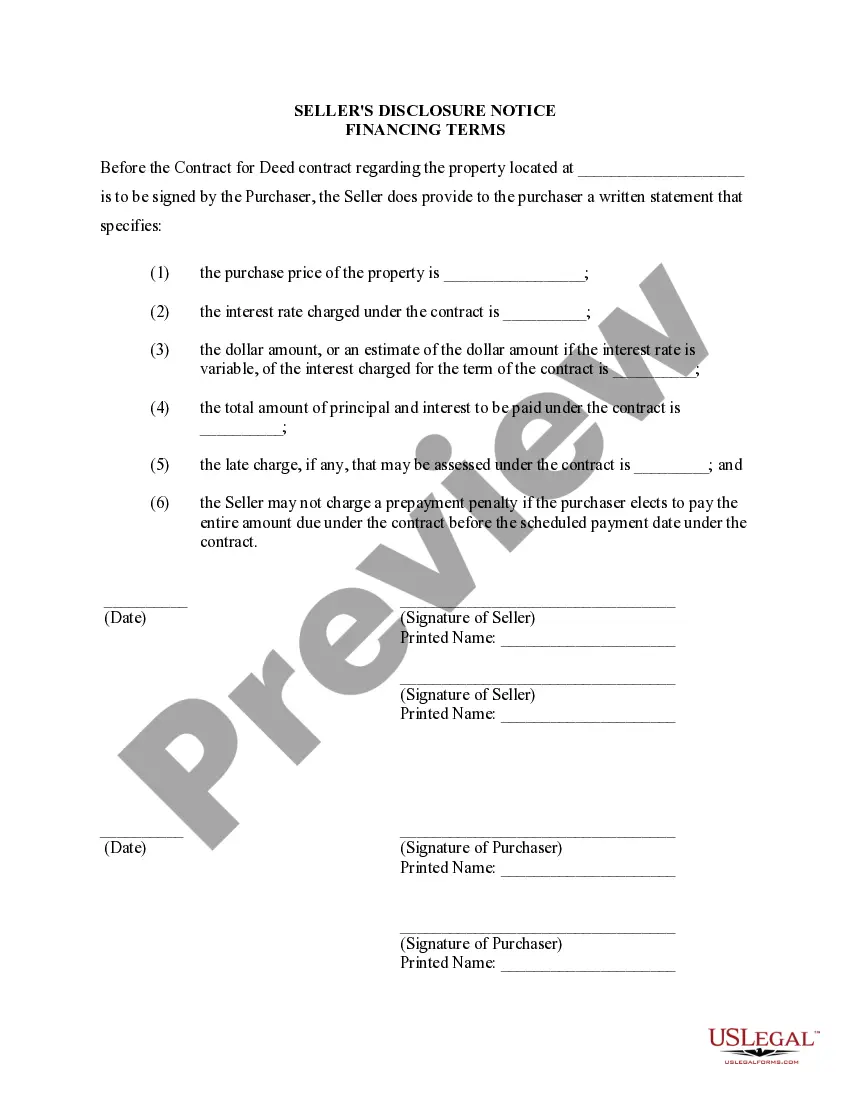
Kentucky Seller's Disclosure of Financing Terms for Residential Property in connection with Contract or Agreement for Deed a/k/a Land Contract
Understanding this form
The Seller's Disclosure of Financing Terms for Residential Property, commonly known as the Seller's Disclosure Notice of Financing Terms Contract for Deed, serves to inform the purchaser about essential financing details related to a residential property transaction. This form outlines the purchase price, payment structure, interest rates, and any late charges applicable. It is specifically designed for sellers to provide clear financing terms to buyers before the execution of a contract for deed, ensuring transparency and clarity in the transaction process.
Key components of this form
- Purchase price of the property
- Payment schedule and amounts
- Interest rates applicable to the financing
- Details on late charges and penalties
- Contact information for the seller
Situations where this form applies
This form should be used in situations where a seller is entering into a contract for deed, also known as a land contract, for a residential property. It helps both parties understand the financial obligations involved in the sale. Typical scenarios include private sales where financing is being offered by the seller rather than through a traditional mortgage lender, or when the buyer requires alternative financing due to credit issues.
Who should use this form
- Sellers of residential property entering into a contract for deed
- Purchasers who are considering financing options directly with the seller
- Real estate agents facilitating negotiations between buyers and sellers
- Attorneys representing either party during the contract negotiation
Steps to complete this form
- Identify the parties involved: seller and purchaser
- Specify the purchase price of the property clearly
- Detail the payment terms, including amounts and due dates
- Include the applicable interest rates and any late payment fees
- Provide contact information for the seller for further inquiries
Does this form need to be notarized?
Notarization is required for this form to take effect. Our online notarization service, powered by Notarize, lets you verify and sign documents remotely through an encrypted video session, available 24/7.
Get your form ready online
Our built-in tools help you complete, sign, share, and store your documents in one place.
Make edits, fill in missing information, and update formatting in US Legal Forms—just like you would in MS Word.
Download a copy, print it, send it by email, or mail it via USPS—whatever works best for your next step.
Sign and collect signatures with our SignNow integration. Send to multiple recipients, set reminders, and more. Go Premium to unlock E-Sign.
If this form requires notarization, complete it online through a secure video call—no need to meet a notary in person or wait for an appointment.
We protect your documents and personal data by following strict security and privacy standards.
Make edits, fill in missing information, and update formatting in US Legal Forms—just like you would in MS Word.
Download a copy, print it, send it by email, or mail it via USPS—whatever works best for your next step.
Sign and collect signatures with our SignNow integration. Send to multiple recipients, set reminders, and more. Go Premium to unlock E-Sign.

If this form requires notarization, complete it online through a secure video call—no need to meet a notary in person or wait for an appointment.
We protect your documents and personal data by following strict security and privacy standards.
Mistakes to watch out for
- Failing to include all financing terms clearly
- Omitting the interest rate or payment schedule
- Not providing accurate contact information for follow-up
Advantages of online completion
- Convenient access from anywhere without the need for in-person appointments
- Editable format allows easy adjustments to terms as needed
- Reliability with forms drafted by licensed attorneys ensuring legal compliance
Key takeaways
- Use this form to clarify financing terms in a contract for deed
- Ensure both parties understand their financial obligations
- Complete all sections accurately to avoid misunderstandings
Looking for another form?

Form popularity
FAQ
Interest rates on land contracts can vary dramatically, and buyers and sellers ultimately call the shots on the loan's rate. That said, interest rates typically stay under 12%, Smith said.
Interest rates on land contracts can vary dramatically, and buyers and sellers ultimately call the shots on the loan's rate. That said, interest rates typically stay under 12%, Smith said. Federal loan regulations, as well as state usury laws, restrict sellers from overcharging interest fees.
One of the biggest negatives that can occur with a land contract is when a buyer purchases a property on which the seller is still making mortgage payments.
A land contract should spell out the purchase price, down payment, payment schedule, installment amount, interest rate, loan term and balloon payment amount, if applicable. Responsible party for home repairs. The buyer and seller agree upfront on who will make and pay for home repairs.
Land contracts are useful instruments for sellers who are selling a home and contemplating carrying the financing for a buyer. It gives sellers a built-in income and generally a better interest rate than rates offered on money market accounts or certificates of deposit.
A land contract carries purchase obligations as the buyer had already committed into a financing agreement for the full purchase. On the other hand, a rent to own contract involves less obligations whereby the buyer has the option, but is not obligated to buy the property after the contract period.
With a land contract, the Buyer does not pay for the property all at once, but in payments.The Seller must hold a foreclosure sale and, if the property sells for more than the debt remaining on the property (plus sale expenses) the Buyer must be given the difference.