Kansas Quitclaim Deed from Two Individual Grantors to One Individual Grantee
What this document covers
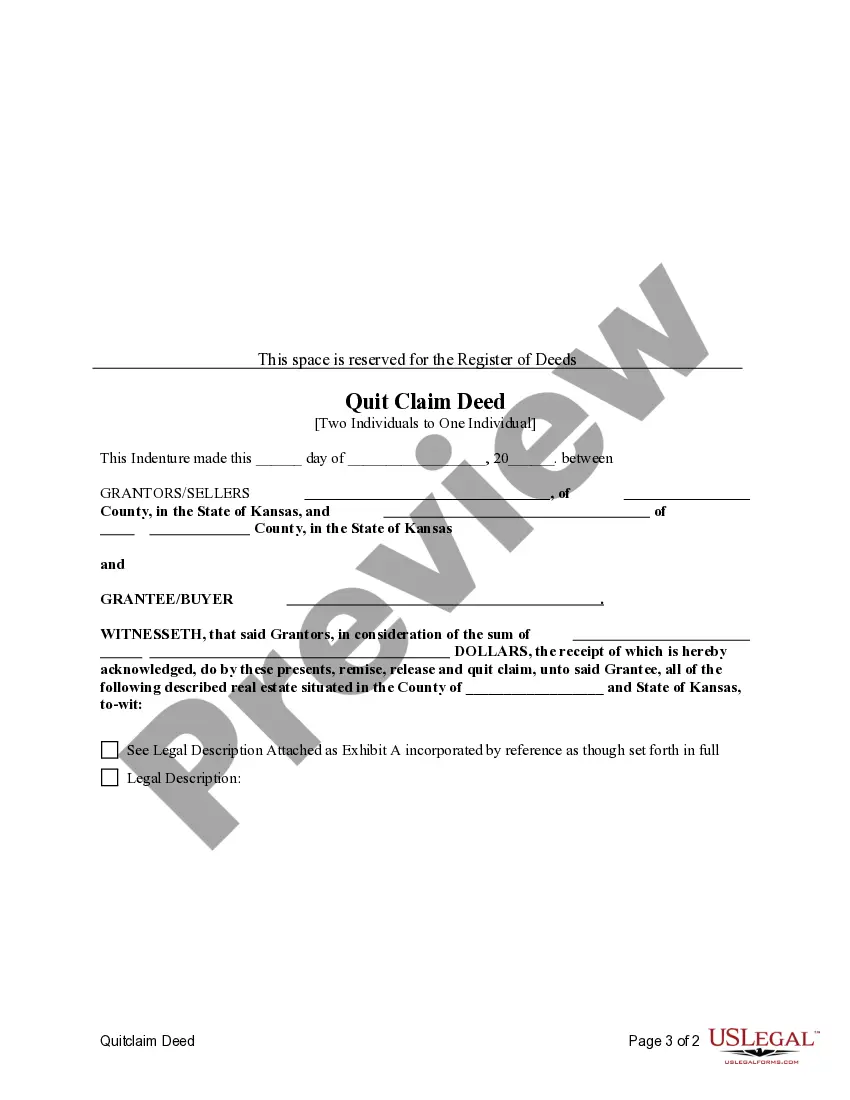
This form is a Quitclaim Deed that allows two individual Grantors to convey property to one individual Grantee. Unlike other deeds, such as warranty deeds, a quitclaim deed transfers the interest in the property without guaranteeing that the Grantors hold clear title. This simplicity makes it useful for transactions between familiar parties or to clarify property ownership without extensive legal procedures.
Form components explained
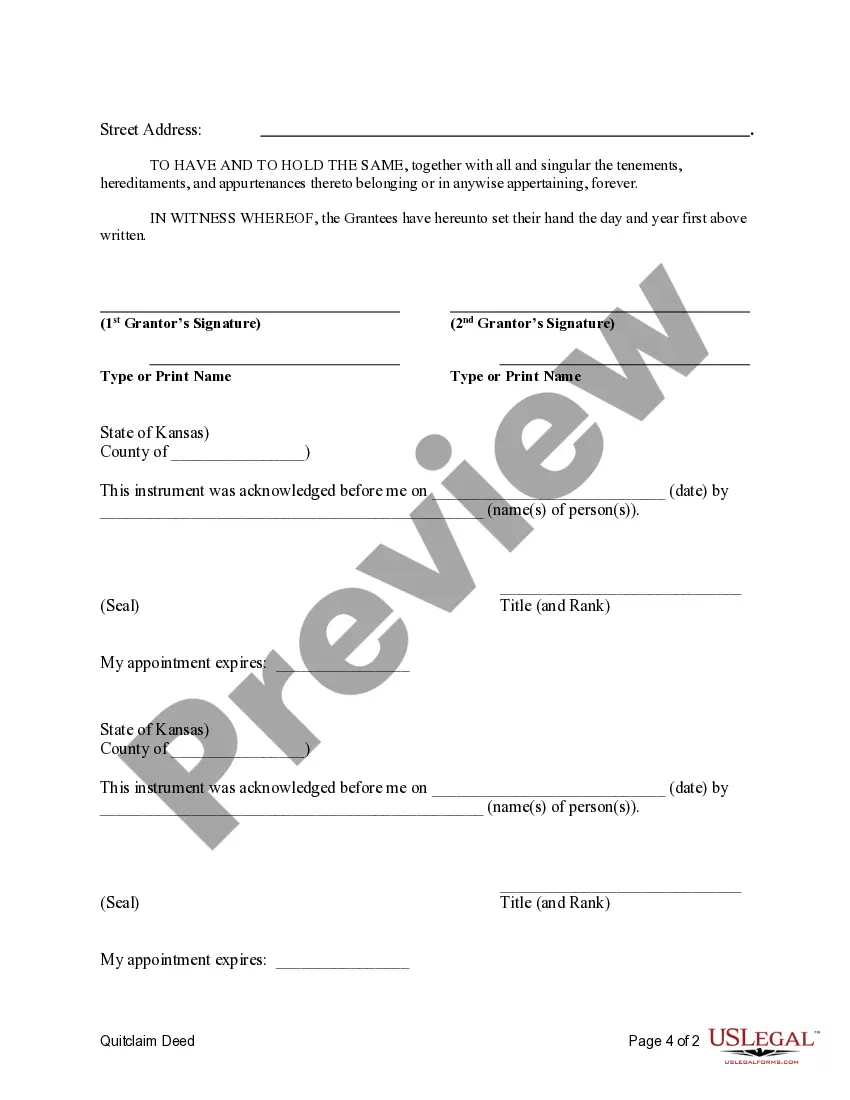
- Identification of Grantors and Grantee: Clearly states the names of the individuals involved.
- Legal description of the property: Provides details of the property being transferred.
- Date of execution: Specified date indicating when the transfer takes effect.
- Acknowledgment section: Includes area for notarization and affirmation of the partiesâ identities.
- Seal and title: Space for the notary's seal to validate the document legally.







Common use cases
This form is typically used when two individuals wish to transfer their interest in property to another individual. Common scenarios include family members transferring property between themselves, co-owners wanting to consolidate ownership, or when handling estate matters where property needs to be allocated. It is an efficient way to clarify ownership without lengthy legal processes.
Who this form is for
- Homeowners looking to transfer property between themselves.
- Individuals involved in a divorce settlement needing to allocate property.
- Persons managing family estate distributions.
- Co-owners of property wanting to consolidate ownership under one name.
How to complete this form
- Identify the Grantors: Provide the full names of both individuals conveying the property.
- Specify the Grantee: Enter the name of the individual receiving the property.
- Describe the property: Include the legal description and address of the property being conveyed.
- Enter the date: Fill in the date when the deed is executed.
- Notarize the document: Ensure the deed is signed in the presence of a notary public and affix the notary seal.
Is notarization required?
Yes, this form must be notarized to be legally valid. Notarization protects all parties involved by verifying their identities and ensuring that the document is signed voluntarily. U.S. Legal Forms offers integrated online notarization services, allowing you to complete this process securely via video call without the need for travel.
Get your form ready online
Our built-in tools help you complete, sign, share, and store your documents in one place.
Make edits, fill in missing information, and update formatting in US Legal Forms—just like you would in MS Word.
Download a copy, print it, send it by email, or mail it via USPS—whatever works best for your next step.
Sign and collect signatures with our SignNow integration. Send to multiple recipients, set reminders, and more. Go Premium to unlock E-Sign.
If this form requires notarization, complete it online through a secure video call—no need to meet a notary in person or wait for an appointment.
We protect your documents and personal data by following strict security and privacy standards.

Make edits, fill in missing information, and update formatting in US Legal Forms—just like you would in MS Word.

Download a copy, print it, send it by email, or mail it via USPS—whatever works best for your next step.

Sign and collect signatures with our SignNow integration. Send to multiple recipients, set reminders, and more. Go Premium to unlock E-Sign.

If this form requires notarization, complete it online through a secure video call—no need to meet a notary in person or wait for an appointment.

We protect your documents and personal data by following strict security and privacy standards.
Common mistakes to avoid
- Leaving the property description incomplete or inaccurate.
- Forgetting to sign and date the document.
- Failing to have the deed notarized, if required.
- Not checking for any outstanding liens or titles before transferring property.
Benefits of using this form online
- Immediate access: Download the form instantly without waiting for paper copies.
- Editability: Fill out and modify the form directly on your computer.
- User-friendly interface: Form fields help guide you through the completion process.
- Compliance with legal standards: Forms are drafted by licensed attorneys ensuring adherence to state laws.
Looking for another form?

Form popularity
FAQ
The best way to obtain a Kansas quitclaim deed from two individual grantors to one individual grantee is through a reliable online service like US Legal Forms. They provide tailored documents and guidance that simplify the process. You can fill out the necessary forms securely and ensure they comply with Kansas law. With this approach, you save time and reduce mistakes.
If the quitclaim deed requires the signature of all co-owners, the deed is invalid unless all co-owners have signed it and the deed is then delivered to the grantee.If one individual owns real estate and desires to add a co-owner such as a spouse, a quitclaim deed might be used.
After the closing, your deed will be recorded with the local municipality, making it part of the official record. The best time to mention the names you want on the deed is well before closing.However, you can add an owner to the deed after closing, as long as you understand the risks associated with it.
Yes, you can prepare.
They are commonly used to add/remove someone to/from real estate title or deed (divorce, name changes, family and trust transfers). The quitclaim deed is a legal document (deed) used to transfer interest in real estate from one person or entity (grantor) to another (grantee).
Recording A quitclaim deed must be filed with the County Recorder's Office where the real estate is located. Go to your County Website to locate the office nearest you. Signing (§ 58-2205) A quitclaim deed is required to be authorized with a notary public present.
A person who signs a quitclaim deed to transfer property they do not own results in no title at all being transferred since there is no actual ownership interest. The quitclaim deed only transfers the type of title you own.
A Quitclaim Deed must be notarized by a notary public or attorney in order to be valid.Consideration in a Quitclaim Deed is what the Grantee will pay to the Grantor for the interest in the property.
But you might be wondering if an owner can transfer a deed to another person without a real estate lawyer. The answer is yes. Parties to a transaction are always free to prepare their own deeds.A quitclaim deed, for example, is far simpler than a warranty deed.