Kansas Warranty Deed from Corporation to Two Individuals
Overview of this form
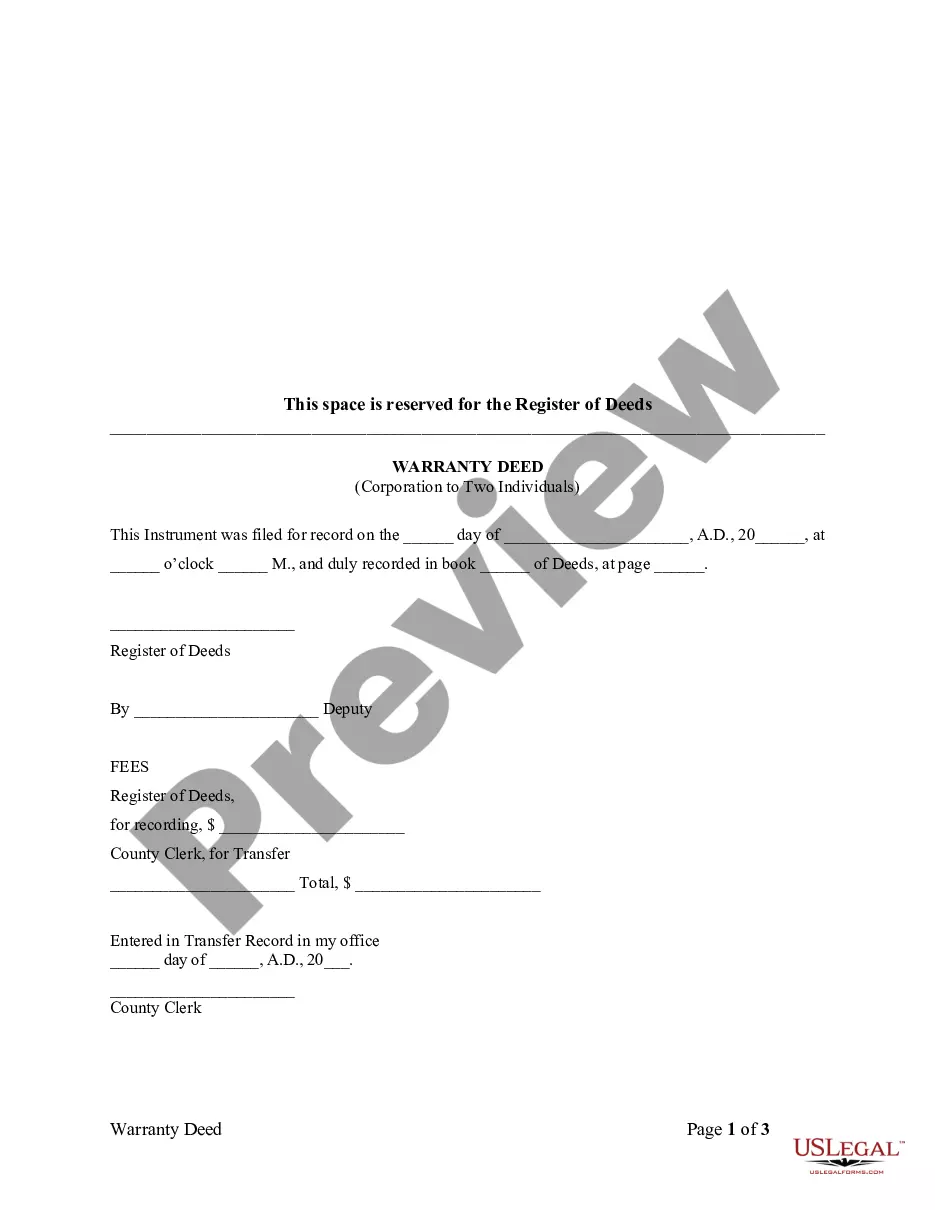
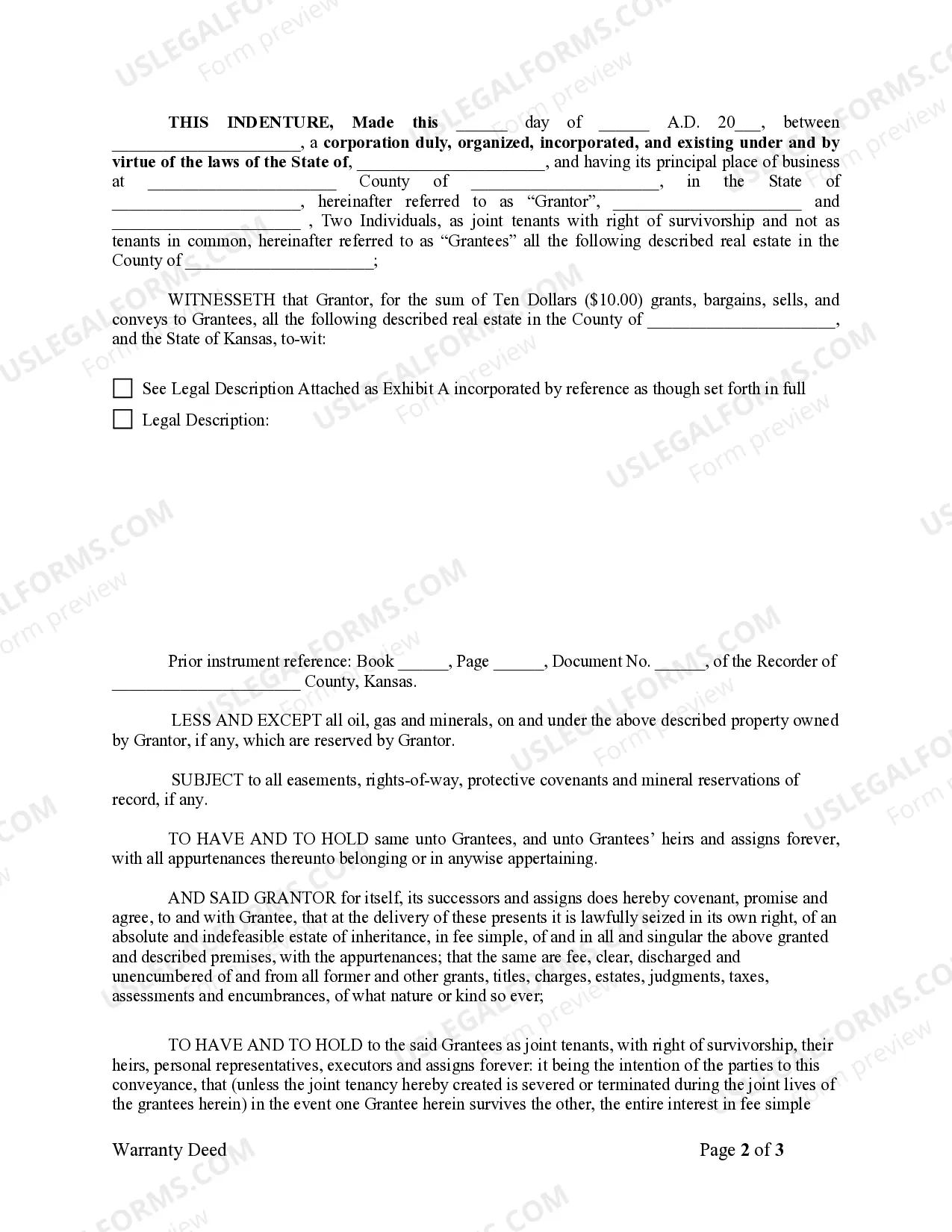
This Warranty Deed from Corporation to Two Individuals is a legal document used to transfer ownership of real estate from a corporation (the Grantor) to two individuals (the Grantees). This form ensures that the Grantees receive the property with warranty protection, confirming that the corporation has clear title to the property and the right to convey it. Unlike other deeds, this warranty deed includes a provision for joint tenancy with the right of survivorship, making it suitable for co-owners who wish to inherit each other's share upon death.
Main sections of this form
- Parties Involved: Identifies the Grantor (corporation) and the Grantees (two individuals).
- Property Description: Clearly describes the real estate being conveyed.
- Joint Tenancy Clause: Specifies that Grantees hold property as joint tenants with survivorship rights.
- Reservations: States any reservations regarding oil, gas, and minerals owned by the Grantor.
- Covenant of Warranty: Guarantees that the Grantor holds clear title and the property is free of encumbrances.





Situations where this form applies
This form should be used when a corporation is transferring real estate to two individuals. It is particularly useful in situations where the individuals wish to co-own the property with rights of survivorship, ensuring that ownership passes to the surviving individual in the event of one party's death. Suitable scenarios include family property transfers, investment partnerships, or when multiple parties wish to jointly acquire a property from a corporation.
Who needs this form
- Corporations transferring property to individuals.
- Individuals purchasing real estate from a corporation together.
- Real estate professionals assisting clients with corporate property transfers.
- Anyone wishing to establish joint ownership with survivorship rights.
Completing this form step by step
- Identify the Grantor and provide the corporation's name and business address.
- List the names of the two Grantees, ensuring they are identified as joint tenants.
- Accurately describe the property being conveyed, including any legal descriptions.
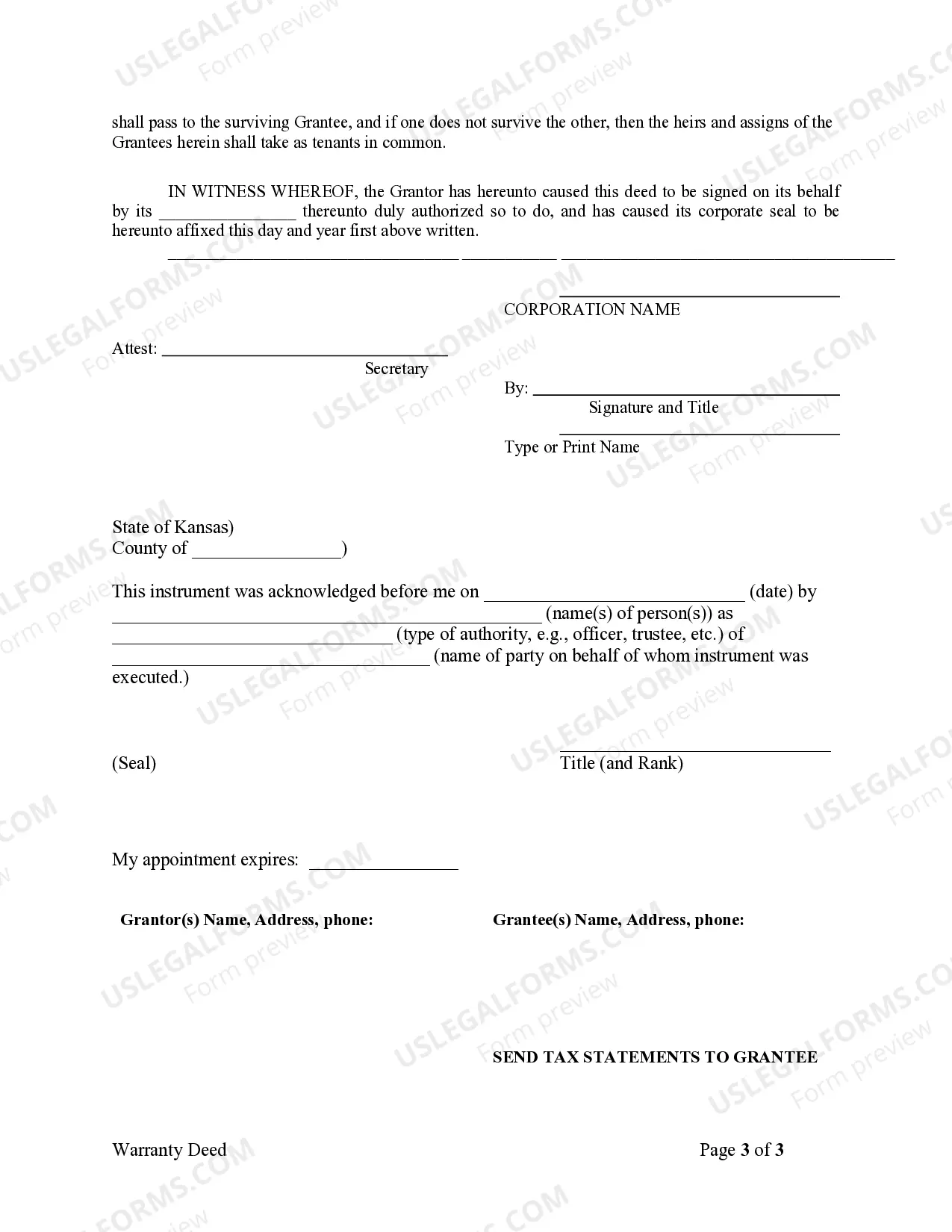
- Specify the date of the transaction and ensure appropriate signatures are affixed from the authorized corporation representative.
- Complete any required recording information as specified by the local Register of Deeds.
Is notarization required?
This form needs to be notarized to ensure legal validity. US Legal Forms provides secure online notarization powered by Notarize, allowing you to complete the process through a verified video call, available anytime.
Get your form ready online
Our built-in tools help you complete, sign, share, and store your documents in one place.
Make edits, fill in missing information, and update formatting in US Legal Forms—just like you would in MS Word.
Download a copy, print it, send it by email, or mail it via USPS—whatever works best for your next step.
Sign and collect signatures with our SignNow integration. Send to multiple recipients, set reminders, and more. Go Premium to unlock E-Sign.
If this form requires notarization, complete it online through a secure video call—no need to meet a notary in person or wait for an appointment.
We protect your documents and personal data by following strict security and privacy standards.
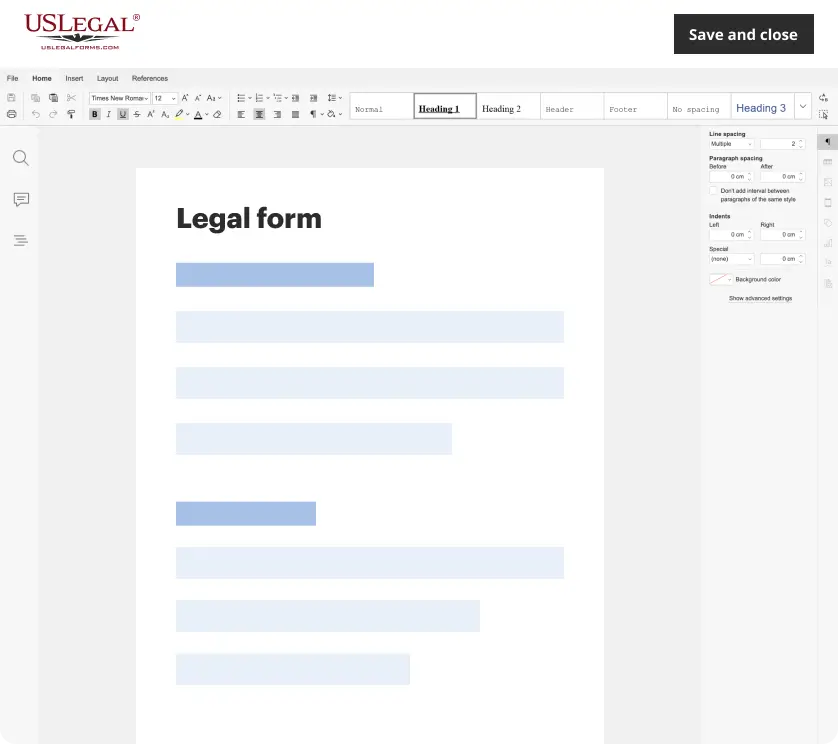
Make edits, fill in missing information, and update formatting in US Legal Forms—just like you would in MS Word.
Download a copy, print it, send it by email, or mail it via USPS—whatever works best for your next step.
Sign and collect signatures with our SignNow integration. Send to multiple recipients, set reminders, and more. Go Premium to unlock E-Sign.

If this form requires notarization, complete it online through a secure video call—no need to meet a notary in person or wait for an appointment.
We protect your documents and personal data by following strict security and privacy standards.
Common mistakes to avoid
- Failing to accurately describe the property can lead to disputes or invalidation of the deed.
- Not signing the form or having the wrong party sign it may render the deed ineffective.
- Omitting to include necessary reservations, like oil and gas rights, can lead to future legal issues.
Advantages of online completion
- Convenience of immediate download and use at any time.
- Editability allows you to tailor the form to specific needs easily.
- Support from licensed attorneys ensures that the deed meets legal standards.
Looking for another form?

Form popularity
FAQ
If you've recently married and already own a home or other real estate, you may want to add your new spouse to the deed for your property so the two of you own it jointly. To add a spouse to a deed, all you have to do is literally fill out, sign and record a new deed in your county recorder's office.
Special warranties allow the transfer of property title between seller and buyer. The purchase of title insurance can mitigate the risk of prior claims to the special warranty deed.
Adding someone to your house deed requires the filing of a legal form known as a quitclaim deed. When executed and notarized, the quitclaim deed legally overrides the current deed to your home. By filing the quitclaim deed, you can add someone to the title of your home, in effect transferring a share of ownership.
Yes you can. This is called a transfer of equity but you will need the permission of your lender. If you are not married or in a civil partnership you may wish to consider creating a deed of trust and a living together agreement which we can explain to you.
Contrary to normal expectations, the Deed DOES NOT have to be recorded to be effective or to show delivery, and because of that, the Deed DOES NOT have to be signed in front of a Notary Public. However, if you plan to record it, then it does have to be notarized as that is a County Recorder requirement.
Typically, the lender will provide you with a copy of the deed of trust after the closing. The original warranty deeds are often mailed to the grantee after they are recorded. These are your original copies and should be kept in a safe place, such as a fireproof lockbox or a safe deposit box at a financial institution.
To add a co-owner, the bank would have to create a new home loan agreement, which must be registered after paying the due stamp duty and registration charges. The bank would also insist on making the co-owner a co-borrower in the home loan applicable.
Failure to record a deed effectively makes it impossible for the public to know about the transfer of a property. That means the legal owner of the property appears to be someone other than the buyer, a situation that can generate serious ramifications.
It is possible to be named on the title deed of a home without being on the mortgage. However, doing so assumes risks of ownership because the title is not free and clear of liens and possible other encumbrances. Free and clear means that no one else has rights to the title above the owner.