Indiana Transfer on Death Deed - Husband and Wife to Two Individuals
Overview of this form
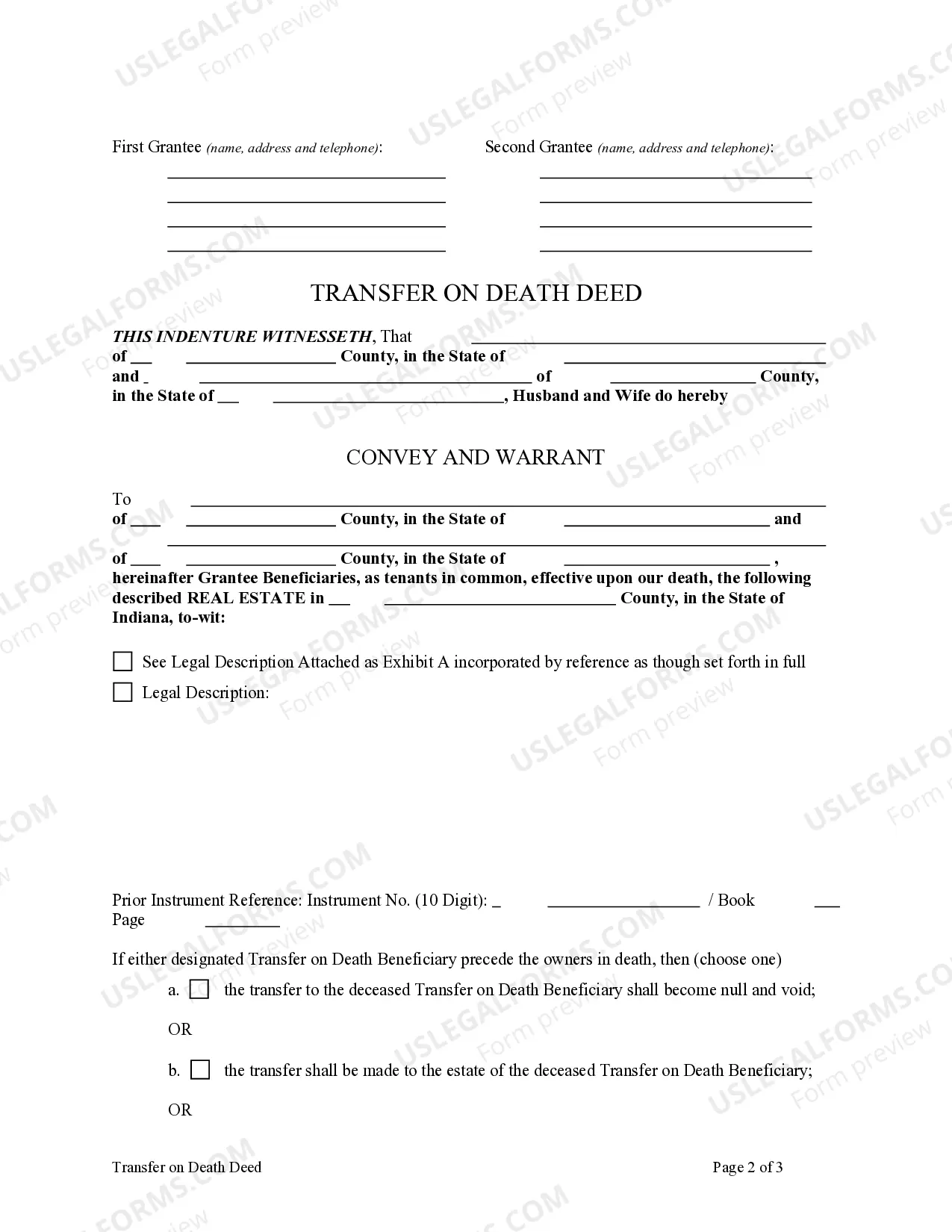
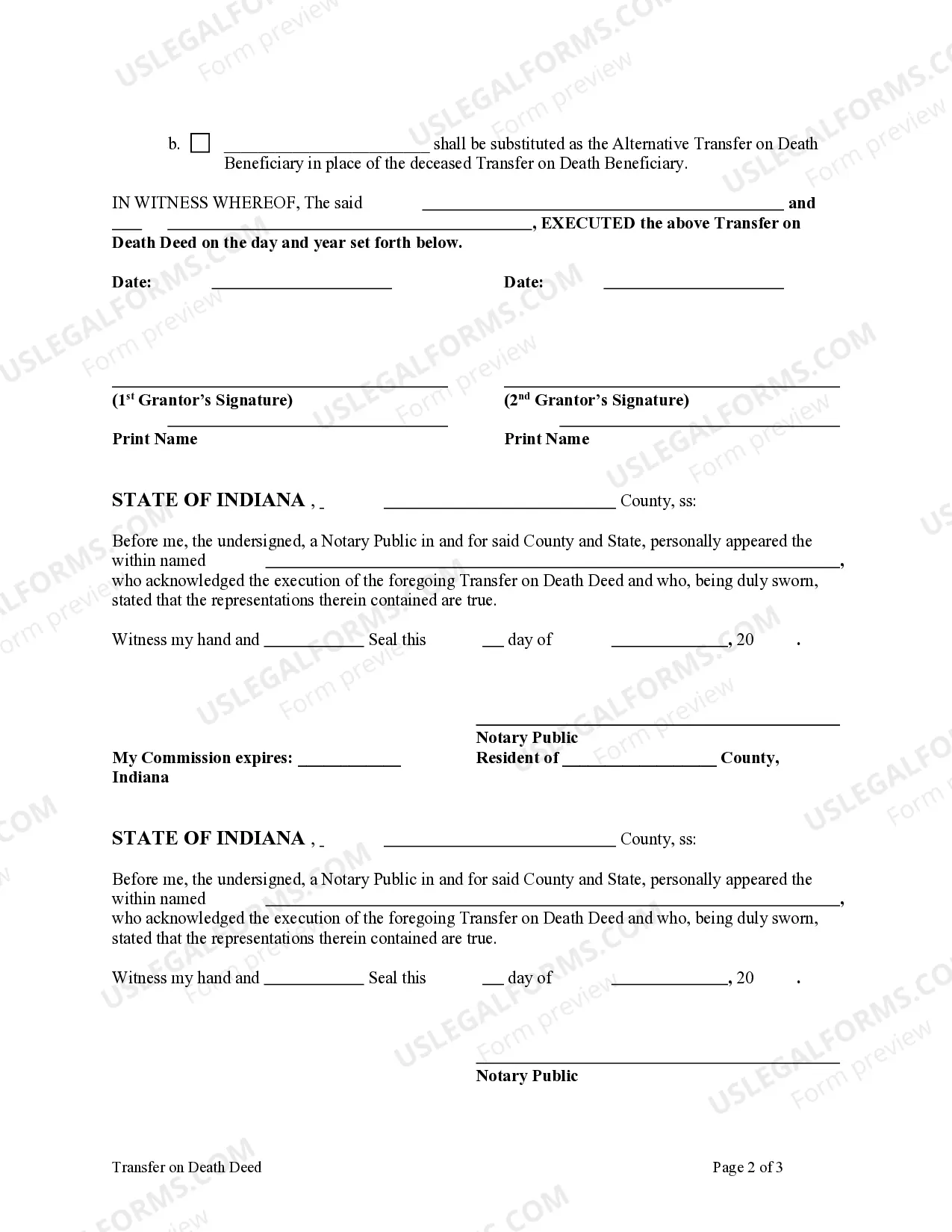
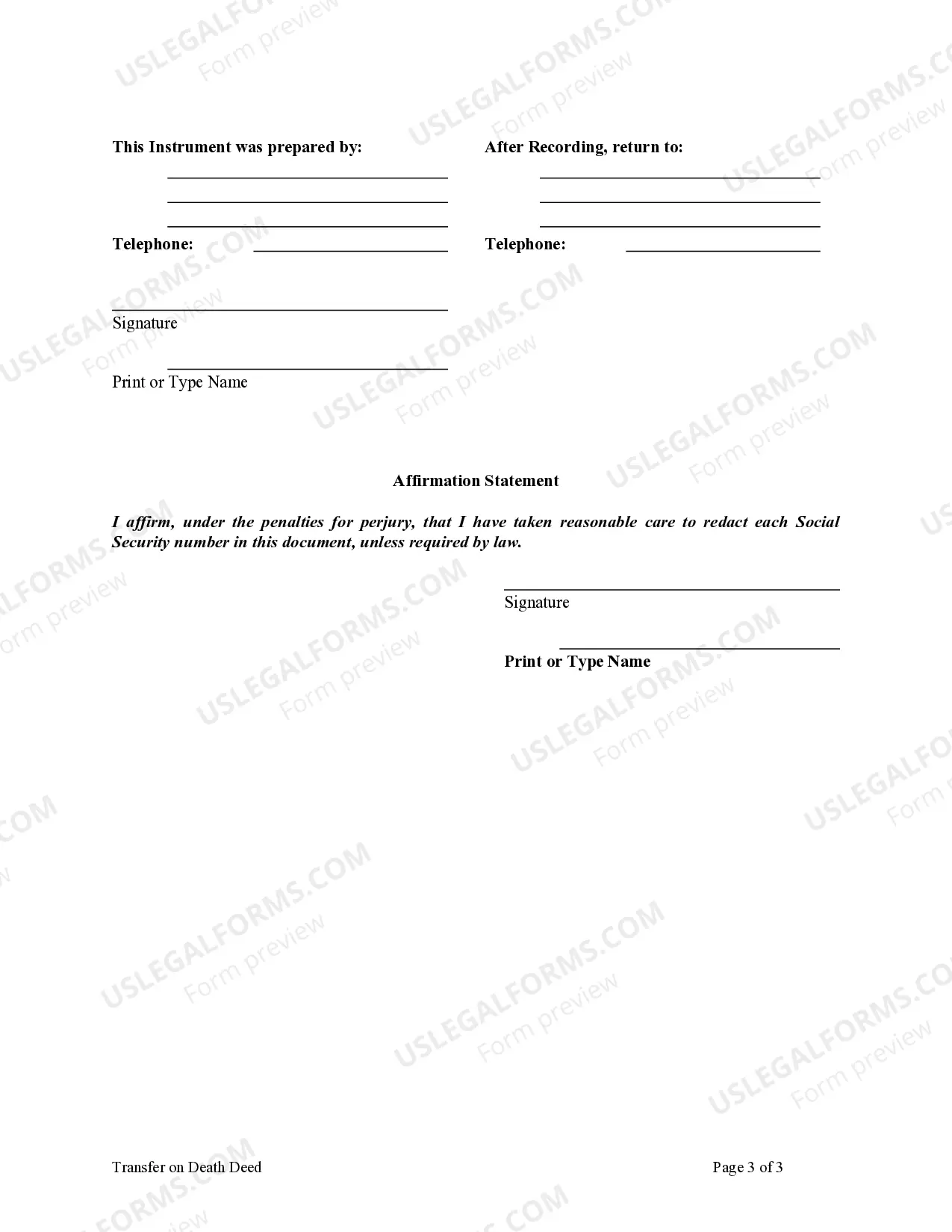
The Transfer on Death Deed - Husband and Wife to Two Individuals is a legal document that allows a married couple (the Grantors) to designate two individuals (the Grantees) to inherit their property upon the death of the last surviving Grantor. This form is revocable, meaning that either Grantor can change their mind at any time before their death. This type of deed is distinct from traditional wills, as it avoids probate and takes effect immediately upon the death of the final Grantor.
Form components explained
- Identification of Grantors: Names and details of the husband and wife transferring the property.
- Designation of Grantees: Names and details of the two individuals who will receive the property.
- Property Description: A detailed description of the property being transferred.
- Revocability Clause: A statement clarifying that the transfer can be revoked by either Grantor.
- Effective Date: Specifies that the transfer will take effect upon the death of the last surviving Grantor.
- Tenancy Arrangement: States that the Grantees will own the property as tenants in common.





Common use cases
This form is useful when a husband and wife wish to transfer their property to two individuals after their deaths. It can be particularly beneficial for estate planning to ensure that the property passes directly to the intended beneficiaries without the need for probate, simplifying the process for the Grantees during a difficult time.
Intended users of this form
This form is appropriate for the following parties:
- Married couples looking to plan their estate and simplify the transfer of property.
- Individuals intending to designate specific people as beneficiaries of their property.
- Those who want to avoid probate proceedings for their real estate after death.
How to prepare this document
- Identify the parties: Include the names and details of both Grantors (husband and wife).
- Specify the property: Provide a clear and detailed description of the property being transferred.
- Enter Grantee information: List the names and information for the two individuals receiving the property.
- Review the terms: Ensure all clauses, including the revocability and tenancy arrangements, are present.
- Sign and date: Both Grantors must sign and date the document for it to be valid.
Does this document require notarization?
This document requires notarization to meet legal standards. US Legal Forms provides secure online notarization powered by Notarize, allowing you to complete the process through a verified video call, available 24/7.
Get your form ready online
Our built-in tools help you complete, sign, share, and store your documents in one place.
Make edits, fill in missing information, and update formatting in US Legal Forms—just like you would in MS Word.
Download a copy, print it, send it by email, or mail it via USPS—whatever works best for your next step.
Sign and collect signatures with our SignNow integration. Send to multiple recipients, set reminders, and more. Go Premium to unlock E-Sign.
If this form requires notarization, complete it online through a secure video call—no need to meet a notary in person or wait for an appointment.
We protect your documents and personal data by following strict security and privacy standards.
Make edits, fill in missing information, and update formatting in US Legal Forms—just like you would in MS Word.
Download a copy, print it, send it by email, or mail it via USPS—whatever works best for your next step.
Sign and collect signatures with our SignNow integration. Send to multiple recipients, set reminders, and more. Go Premium to unlock E-Sign.

If this form requires notarization, complete it online through a secure video call—no need to meet a notary in person or wait for an appointment.

We protect your documents and personal data by following strict security and privacy standards.
Mistakes to watch out for
- Failing to clearly describe the property.
- Not including all necessary parties in the document.
- Omitting the signature or date from either Grantor.
- Overlooking state-specific regulations about transfer on death deeds.
Advantages of online completion
- Convenience: Easily complete and download the form from the comfort of your home.
- Editability: Fill out the form at your own pace, making any necessary changes.
- Reliability: The form is crafted by licensed attorneys to ensure compliance with current laws.
Looking for another form?
Form popularity
FAQ
To transfer property title to a family member in Indiana, consider using the Indiana Transfer on Death Deed - Husband and Wife to Two Individuals. This approach allows you to designate the new owner while retaining control until your passing. It simplifies the title transfer and ensures that your wishes are honored after your death.
Discuss the terms of the deed with the new owners. Hire a real estate attorney to prepare the deed. Review the deed. Sign the deed in front of a notary public, with witnesses present. File the deed on public record.
When someone who owns real property dies, the property goes into probate or it automatically passes, by operation of law, to surviving co-owners. Often, surviving co-owners do nothing with the title for as long as they own the property. Yet the best practice is to remove the deceased owner's name from the title.
Joint property, shares and bank accounts In most cases, you don't have to pay any Stamp Duty or tax when you inherit property, shares or the money in joint bank accounts you owned with the deceased.
TOD becomes effective for joint accounts if both owners pass away simultaneously. Joint and TOD registration generally allow an account to pass outside the probate estate, enabling the surviving owner or beneficiaries to avoid the time and expense of that process for this account.
If one co-owner dies, their interest in the property automatically passes to the surviving co-owner(s), whether or not they have a will. As tenants in common, co-owners own specific shares of the property. Each owner can leave their share of the property to whoever they choose.
If you own an account jointly with someone else, then after one of you dies, in most cases the surviving co-owner will automatically become the account's sole owner. The account will not need to go through probate before it can be transferred to the survivor.
Will bank accounts be frozen?You will need a tax release, death certificate, and Letters of Authority from probate court to have access to the account. A joint account with a surviving spouse will not be frozen and will remain fully and immediately available to the surviving spouse.
They are shorthand for transfer on death and joint tenancy with right of survivorship two designations that permit automatic transfer of assets from a deceased individual to a surviving individual.In some states, a TOD or JTWROS beneficiary designation is even allowed for real property.
In most cases, the surviving owner or heir obtains the title to the home, the former owner's death certificate, a notarized affidavit of death, and a preliminary change of ownership report form. When all these are gathered, the transfer gets recorded, the fees are paid, and the county issues a new title deed.