Illinois Affidavit of Occupancy and Financial Status
What this document covers
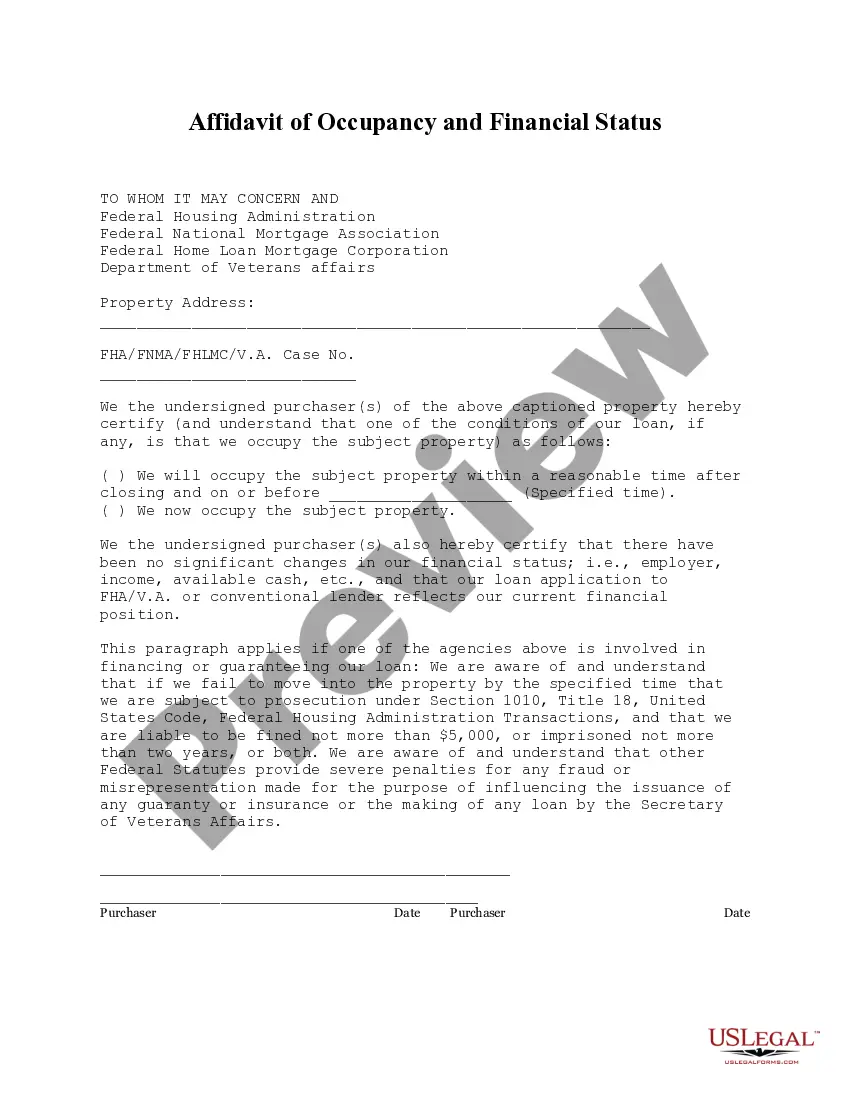
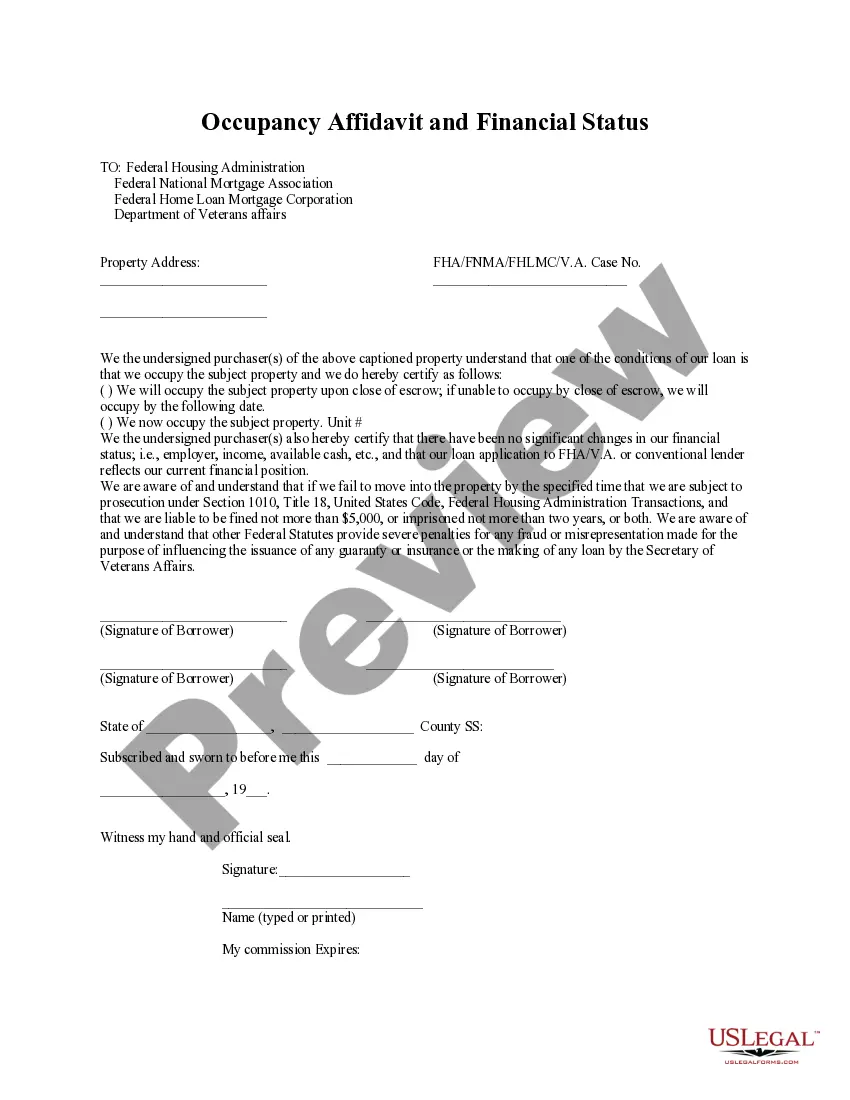
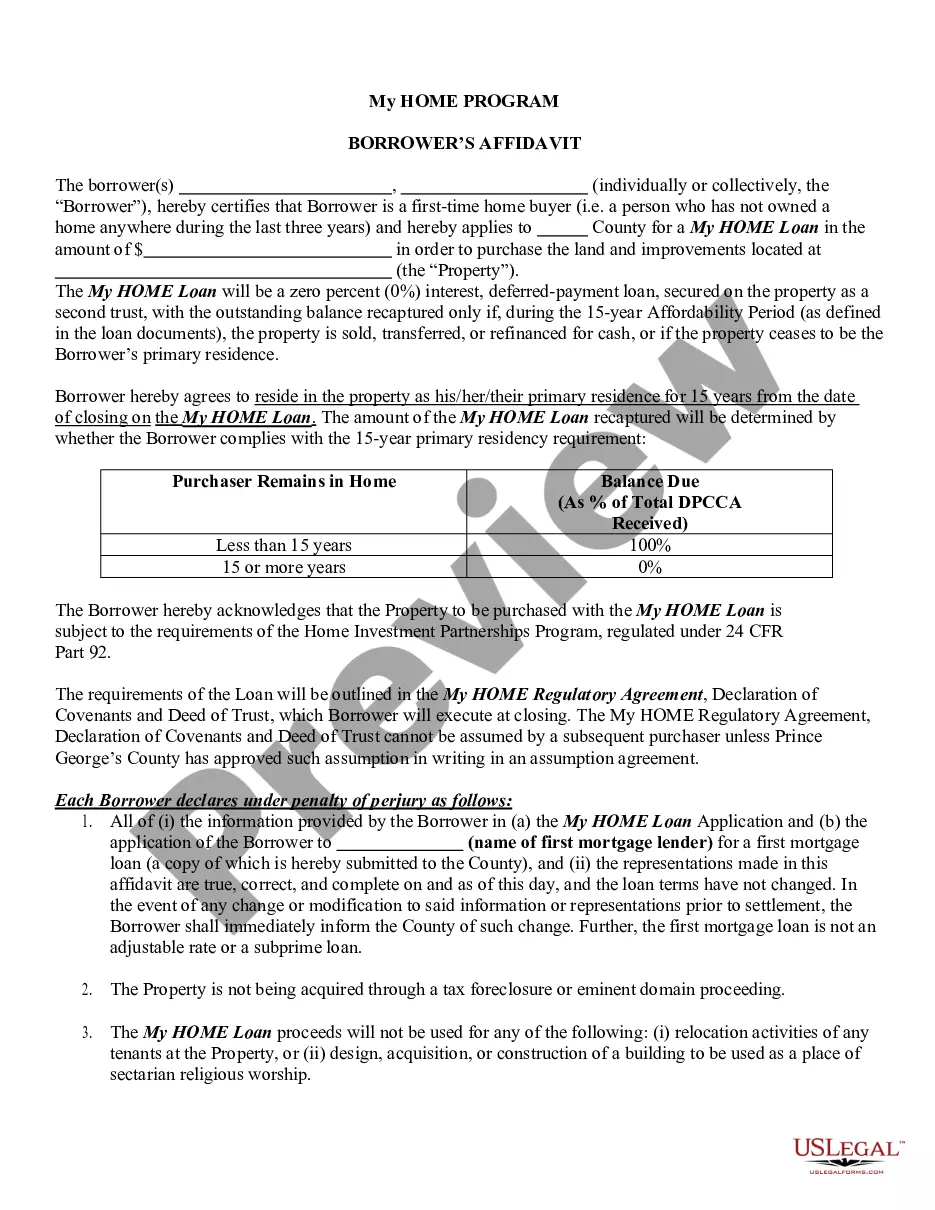
The Affidavit of Occupancy and Financial Status is a legal document used by buyers to confirm they will occupy the purchased property as their primary residence. This form also ensures that there have been no significant changes in the buyer's financial status since the loan application was submitted. It serves to protect lenders and government agencies by verifying the buyer's intentions and financial consistency at the time of closing.
Main sections of this form
- Property address: The specific location of the property being purchased.
- Loan case number: Identifying number for the loan application.
- Occupancy certification: Declaration of intention to occupy the property after closing.
- Financial status verification: Confirmation that the buyer's financial situation remains unchanged since applying for the loan.
- Legal warning: Statement of potential penalties for misrepresentation regarding occupancy.
- Signature fields: Places for purchasers to sign and date the document.

Common use cases
This form should be used during the closing process of a real estate transaction. It is required when a buyer must certify their intent to occupy the property as a primary residence and when lenders or government entities need assurance that the buyer's financial status is consistent with the application submitted. It's particularly important in situations involving FHA, FNMA, FHLMC, or VA loans.
Who should use this form
The following individuals should consider using the Affidavit of Occupancy and Financial Status:
- Real estate buyers purchasing property with a mortgage.
- Individuals who are applying for FHA, VA, or other government-backed loans.
- Buyers who need to confirm their occupancy intentions at the time of closing.
- Individuals with no significant changes in their financial situation since the loan application.
How to complete this form
- Identify the parties involved: Fill in the names of the purchasers.
- Specify the property: Enter the complete address of the property being purchased.
- Provide the loan case number: Include the relevant identification number from your loan application.
- Indicate your occupancy intentions: Check the appropriate box stating when you will occupy the property.
- Certify your financial status: Confirm that there have been no changes to your financial situation.
- Sign and date the affidavit: Ensure all purchasers provide their signatures along with the date of signing.
Notarization guidance
This form needs to be notarized to ensure legal validity. US Legal Forms provides secure online notarization powered by Notarize, allowing you to complete the process through a verified video call, available anytime.
Get your form ready online
Our built-in tools help you complete, sign, share, and store your documents in one place.
Make edits, fill in missing information, and update formatting in US Legal Forms—just like you would in MS Word.
Download a copy, print it, send it by email, or mail it via USPS—whatever works best for your next step.
Sign and collect signatures with our SignNow integration. Send to multiple recipients, set reminders, and more. Go Premium to unlock E-Sign.
If this form requires notarization, complete it online through a secure video call—no need to meet a notary in person or wait for an appointment.
We protect your documents and personal data by following strict security and privacy standards.

Make edits, fill in missing information, and update formatting in US Legal Forms—just like you would in MS Word.

Download a copy, print it, send it by email, or mail it via USPS—whatever works best for your next step.

Sign and collect signatures with our SignNow integration. Send to multiple recipients, set reminders, and more. Go Premium to unlock E-Sign.

If this form requires notarization, complete it online through a secure video call—no need to meet a notary in person or wait for an appointment.

We protect your documents and personal data by following strict security and privacy standards.
Typical mistakes to avoid
- Failing to sign or date the document, rendering it invalid.
- Not accurately reporting any changes in financial status.
- Incorrectly completing the property address or loan case number.
- Assuming occupancy requirements are the same across all loans.
Benefits of using this form online
- Convenience: Download and fill out the form from anywhere at any time.
- Editability: Easily make changes to your information before finalizing the document.
- Reliability: Access trusted templates created by licensed attorneys.
Looking for another form?

Form popularity
FAQ
A financial affidavit is a statement of a party's income, expenses, assets, and liabilities.
In its simplest sense, fair market value (FMV) is the price that an asset would sell for on the open market.
For example, in Illinois, the rules generally require an affidavit be notarized, though there are specific types of affidavits to which the requirement does not apply, such as affidavits being filed in support of a motion for summary judgment or a motion for involuntary dismissal.
The main purpose of a financial affidavit is to provide the court with an explanation of a party's financial circumstances. Without this information, the court would be unable to make financial orders or orders concerning property distribution.
A financial affidavit, which has different names in each state, is a statement showing your income, expenses, debts and assets. It allows a court to figure out how much spousal support and child support it should award.
Docket number and name of the case, including names of both parties. Your income from all sources, including overtime, bonuses, social security, tips, interest, other spousal support, and commissions.
Form I-864, Affidavit of Support under Section 213A of the INA, is a contract an individual signs agreeing to use their financial resources to support the intending immigrant named on the affidavit.The sponsor is usually the petitioner who filed an immigrant petition on behalf of the intending immigrant.
If you lie on this document, you are lying to the court.Depending on how serious your untruth, lying on a financial affidavit could mean that your spouse is awarded a larger portion of the marital assets, something that could negatively impact your financial situation for many years to come.