Illinois Contractor's Notice to Owner about Disclosure of Labor and Materials - Mechanic Liens - Individual
Understanding this form
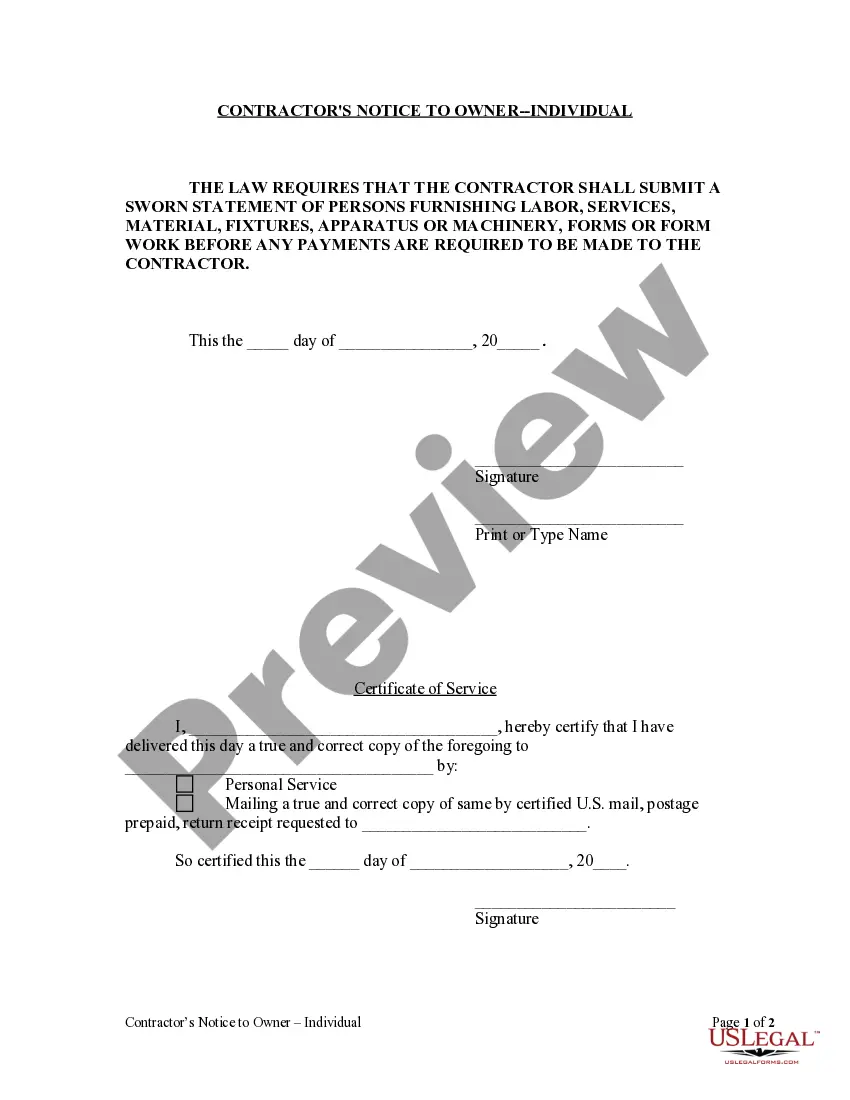
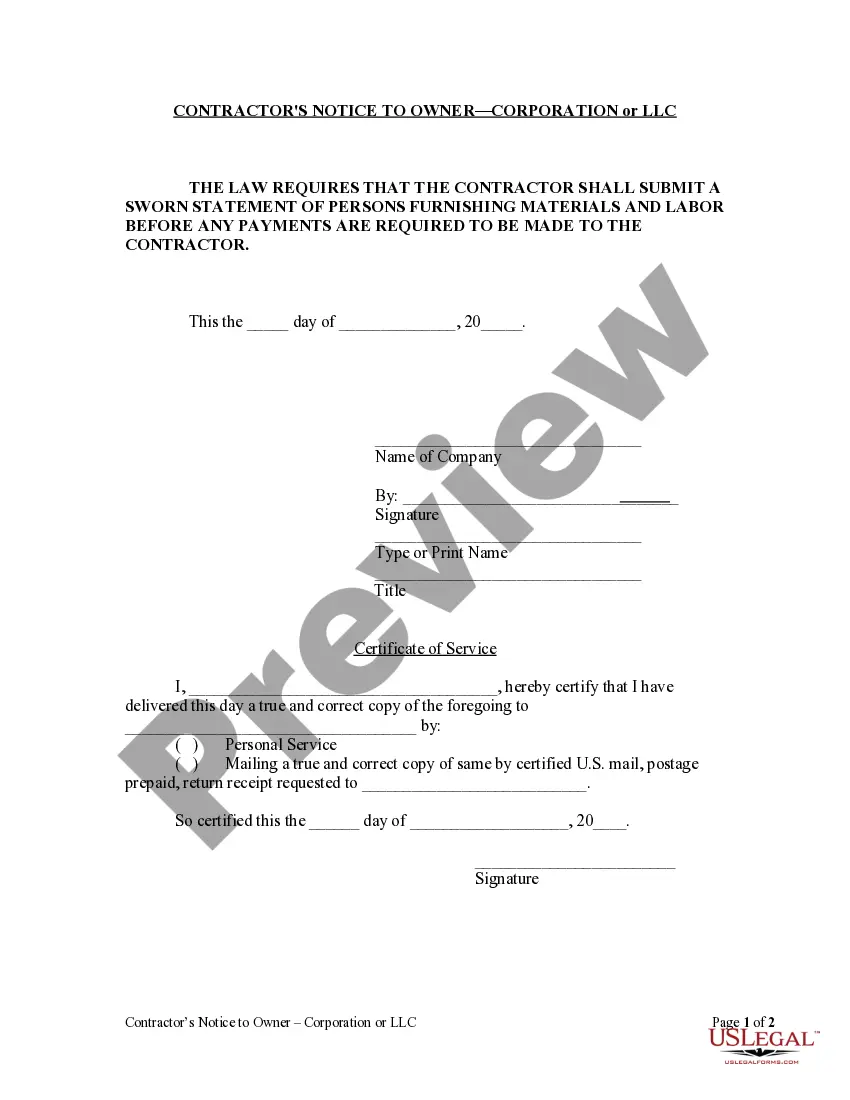
The Contractor's Notice to Owner about Disclosure of Labor and Materials is a legal document required in Illinois for contractors. This form serves to notify property owners that a sworn statement detailing the labor and materials used on a project must be submitted before payments are made to the contractor. It is essential for protecting the rights of subcontractors and suppliers, ensuring that they are compensated for their work and materials. Unlike general construction contracts, this specific notice outlines the legal obligations of contractors regarding payment disclosures.
Main sections of this form
- Date of the notice issuance.
- Signature of the contractor, affirming the submission of the sworn statement.
- Space for the contractor's name and contact information.
- Certificate of service section to document how the notice was delivered to the owner.
- Fields for the recipient's name and delivery method (personal service or mail).

When this form is needed
This form should be used by contractors in Illinois whenever they begin a construction project and need to ensure compliance with legal requirements regarding payment disclosures. It is particularly important before any payments are made, as it protects the contractor's ability to claim payment from the owner. Use this form whenever subcontractors or material suppliers are involved in the project, and their labor or materials need to be properly documented.
Intended users of this form
- Contractors working on construction projects in Illinois.
- Subcontractors or suppliers requiring assurance of payment.
- Property owners needing confirmation of labor and materials disclosed by contractors.
How to prepare this document
- Enter the date when the notice is issued.
- Signature of the contractor is required to indicate acknowledgement of the sworn statement.
- Print or type the contractor's name in the designated field.
- Complete the certificate of service by naming the individual who received the notice.
- Indicate how the notice was delivered (via personal service or certified mail).
Does this form need to be notarized?
This form must be notarized to be legally valid. US Legal Forms provides secure online notarization powered by Notarize, allowing you to complete the process through a verified video call.
Get your form ready online
Our built-in tools help you complete, sign, share, and store your documents in one place.
Make edits, fill in missing information, and update formatting in US Legal Forms—just like you would in MS Word.
Download a copy, print it, send it by email, or mail it via USPS—whatever works best for your next step.
Sign and collect signatures with our SignNow integration. Send to multiple recipients, set reminders, and more. Go Premium to unlock E-Sign.
If this form requires notarization, complete it online through a secure video call—no need to meet a notary in person or wait for an appointment.
We protect your documents and personal data by following strict security and privacy standards.

Make edits, fill in missing information, and update formatting in US Legal Forms—just like you would in MS Word.

Download a copy, print it, send it by email, or mail it via USPS—whatever works best for your next step.

Sign and collect signatures with our SignNow integration. Send to multiple recipients, set reminders, and more. Go Premium to unlock E-Sign.

If this form requires notarization, complete it online through a secure video call—no need to meet a notary in person or wait for an appointment.

We protect your documents and personal data by following strict security and privacy standards.
Common mistakes
- Failing to sign the form, which invalidates the notice.
- Not specifying the delivery method, which could cause issues in verifying service.
- Omitting the date, leading to confusion about compliance timelines.
Advantages of online completion
- Easy access to download and complete the form at your convenience.
- Editable fields allow for customization to meet your specific project needs.
- Online availability ensures you have the latest legal form version according to state regulations.
Summary of main points
- The Contractor's Notice to Owner is crucial for legal compliance in construction projects in Illinois.
- Proper completion and delivery of this form safeguard the contractor's rights to payment.
- Utilizing this form can help avoid common pitfalls related to payment disclosures.
Looking for another form?
Form popularity
FAQ
In Illinois, a mechanics lien must be filed within 4 months after completion of work to be effective against subsequent property owners. If the lien is filed after 4 months but before 2 years after completion of work, it will still be effective against the original owner.
In Alberta, for example, your lien is valid for 180 days from the date the lien was placed. In Ontario, liens are only valid for 90 days from the date of last on site working.
Under Illinois law, any mechanics lien should be filed in the County Recorder of Deeds where the property being liened is located. This is crucial as the lien must be filed not only in the correct county but the correct office as well. The fees and specific document formatting vary depending on your county.
The simplest way to prevent liens and ensure that subcontractors and suppliers are paid is to pay with joint checks. This is when both parties endorse the check. Compare the contractor's materials or labor bill to the schedule of payments in your contract and the Preliminary Notices.
WHAT MUST I DO BEFORE I FILE MY LIEN? Usually there is at least one notice that you must mail before you can file your lien. These notices are sometimes called notices of intent to file lien. Illinois Document Preparation fee of $165 includes all required notices of intent.
The people who can file mechanic's liens are identified by state law. A subcontractor or supplier to a subcontractor may not be able to file a lien. Also, unlicensed contractors are often barred from filing a mechanic's lien.
Negotiate with the contractor who placed the lien (the "lienor" to remove it. Obtain a lien bond to discharge the lien, or. File a lawsuit to vacate the lien.
In order to enforce a lien, the contractor, subcontractor or supplier must file a lawsuit. The deadline to file a lawsuit is two years from the last date work was performed or materials were supplied. A recorded lien is valid for these two years, but a failure to sue within that time frame voids the lien.
The deadline for contractors and subcontractors to file their statement of mechanic's lien is four months (not 120 days) from the last date of work (exclusive of warranty work or other work performed free of charge), or from the last date that materials were supplied to the project.