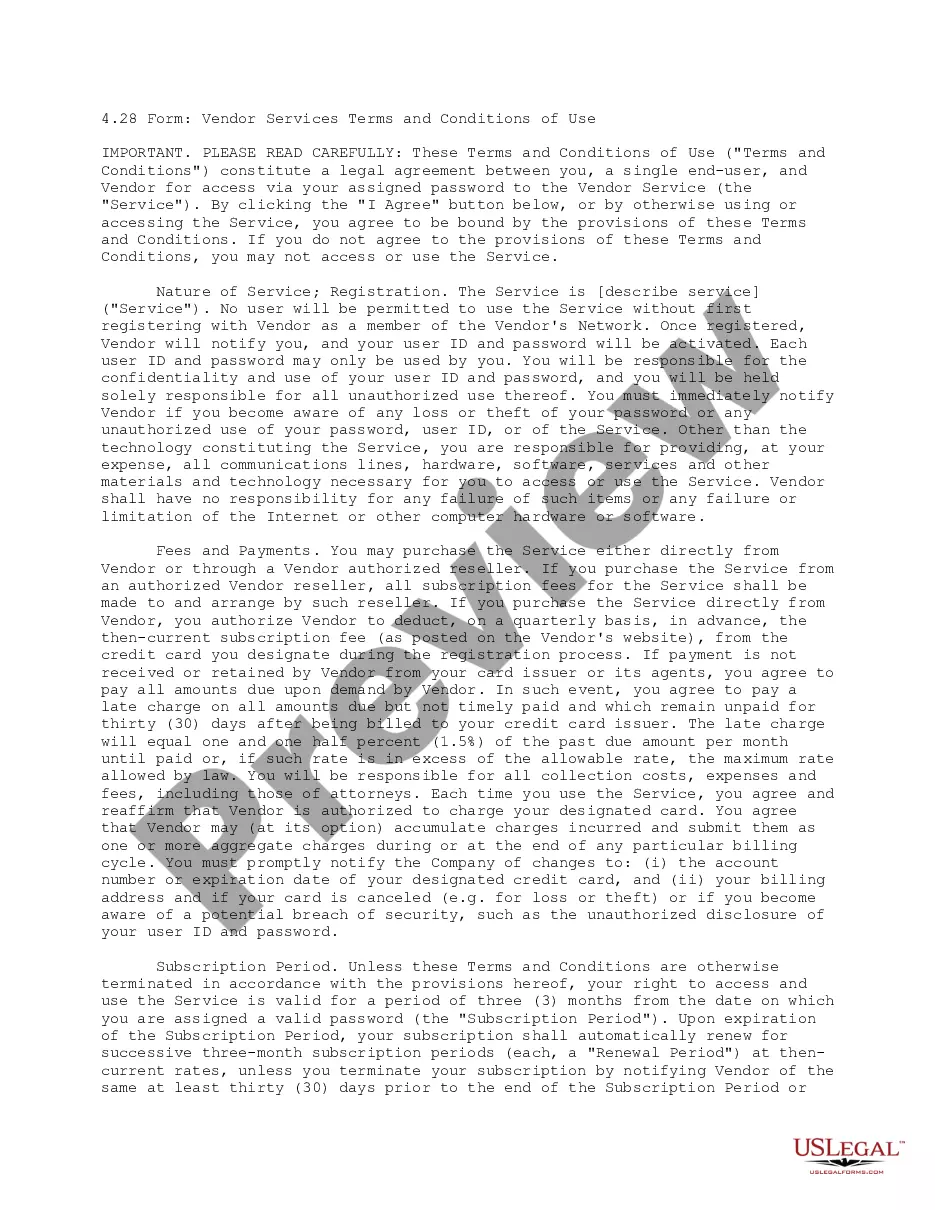
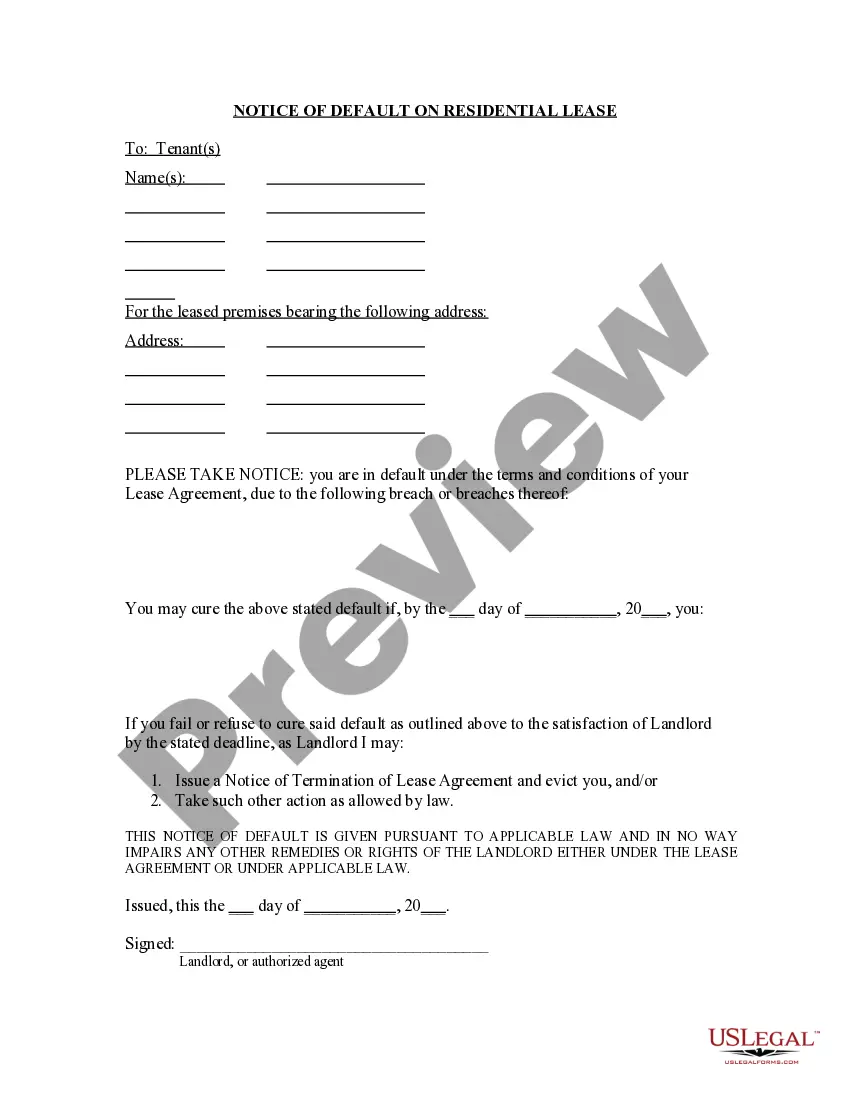
Hawaii Notice of Default on Residential Lease
Understanding this form
The Notice of Default on Residential Lease is a legal document that informs a tenant of their failure to comply with the terms of their lease, particularly concerning rent payments. This form serves a crucial purpose in the landlord-tenant relationship, officially notifying the tenant of the specific reasons for default and providing a deadline to remedy the situation. Unlike other communication methods, this formal notice sets the stage for potential eviction and further legal action if the tenant does not resolve the default by the specified date.
Key parts of this document
- Identification details of the landlord and the tenant
- Specific reasons for the default, typically including non-payment of rent
- A defined deadline by which the tenant must cure the default
- Instructions on the potential consequences if the tenant fails to remedy the situation
- Signature line for the landlord or authorized agent



When to use this document
This form should be used when a tenant has failed to pay rent on time or has violated other significant terms of a residential lease agreement. It is essential for landlords to formally document the default and allow the tenant an opportunity to rectify the situation before pursuing eviction or other legal remedies. This notice acts as a crucial step in the legal process, ensuring compliance with state laws regarding landlord-tenant communications.
Who this form is for
This form is intended for use by:
- Landlords who are managing residential rental properties
- Property management companies acting on behalf of landlords
- Any stakeholders involved in a landlord-tenant agreement experiencing payment issues
Instructions for completing this form
- Identify the landlord and tenant by filling in their names and addresses.
- Clearly state the reasons for the default, such as non-payment of rent.
- Specify the deadline date by which the tenant must remedy the default.
- Include a clear statement regarding the potential consequences of failing to cure the default.
- Sign the form as the landlord or authorized agent, including the date of issuance.
Is notarization required?
This form does not typically require notarization unless specified by local law. It is important to check your stateâs regulations for any notarization requirements that may apply in your area.
Get your form ready online
Our built-in tools help you complete, sign, share, and store your documents in one place.
Make edits, fill in missing information, and update formatting in US Legal Forms—just like you would in MS Word.
Download a copy, print it, send it by email, or mail it via USPS—whatever works best for your next step.
Sign and collect signatures with our SignNow integration. Send to multiple recipients, set reminders, and more. Go Premium to unlock E-Sign.
If this form requires notarization, complete it online through a secure video call—no need to meet a notary in person or wait for an appointment.
We protect your documents and personal data by following strict security and privacy standards.

Make edits, fill in missing information, and update formatting in US Legal Forms—just like you would in MS Word.

Download a copy, print it, send it by email, or mail it via USPS—whatever works best for your next step.

Sign and collect signatures with our SignNow integration. Send to multiple recipients, set reminders, and more. Go Premium to unlock E-Sign.

If this form requires notarization, complete it online through a secure video call—no need to meet a notary in person or wait for an appointment.

We protect your documents and personal data by following strict security and privacy standards.
Common mistakes
- Failing to specify the exact reasons for the default.
- Not providing a clear deadline to cure the default.
- Omitting signatures or dates, which can render the notice ineffective.
- Not retaining a copy for personal records or future reference.
Benefits of using this form online
- Immediate access to a comprehensive, legally vetted document.
- Easy customization to fit specific landlord-tenant situations.
- Allows for quick editing and downloading, ensuring timely communication.
- Reduction of guesswork by providing clear instructions for completion.
Looking for another form?
Form popularity
FAQ
Defaulting on a lease occurs when a tenant fails to meet the terms of the lease agreement, which often includes not paying rent or violating rental policies. It’s essential to understand that defaulting can lead to legal consequences, including eviction. To prevent a default situation, stay in communication with your landlord and resolve payment issues as soon as they arise. For a better understanding of these terms, US Legal offers valuable resources related to Hawaii Notice of Default on Residential Lease.
Renters' rights in Hawaii include the right to habitable housing, protection against unlawful eviction, and the return of security deposits within a specific timeframe. Tenants also have the right to privacy and must receive proper notice before landlords enter their property. Understanding these rights can help you avoid situations leading to a Hawaii Notice of Default on Residential Lease. Resources from US Legal can provide in-depth information about your rights and duties.
In Hawaii, there is no statewide limit on how much a landlord can raise rent; however, landlords must give tenants reasonable notice. Typically, the notice should be at least 45 days for increases, ensuring tenants have time to adjust or seek new housing. Consider reviewing your lease terms and the local ordinances to fully understand your rights, especially in relation to a Hawaii Notice of Default on Residential Lease. The US Legal forms can assist with rental agreements and modifications.
A 30 day notice to vacate in Hawaii is a formal announcement from the tenant to the landlord, indicating the intent to vacate the rental property in 30 days. This notice must be in writing and delivered following the terms of the lease agreement. It's a crucial step in ensuring a smooth transition and minimizing issues related to the Hawaii Notice of Default on Residential Lease. Utilizing services like US Legal can streamline this process.
Failing to provide a 30 day notice to your landlord may lead to consequences like losing your security deposit or facing legal action. In Hawaii, not adhering to the notice period can result in complications during the lease termination. It’s important to understand your responsibilities under the lease to avoid a Hawaii Notice of Default on Residential Lease situation. Always communicate openly with your landlord to prevent misunderstandings.
Filling out a residential lease application involves several key steps. First, gather your personal information, including your Social Security number and employment details. Next, provide references and financial information, ensuring you demonstrate reliability. For an effective process, consider using the US Legal platform, which offers templates and guidance specifically for Hawaii Notice of Default on Residential Lease.
Hawaii maintains a balanced approach, offering protections to both landlords and tenants. While tenants have rights regarding notices, such as the Hawaii Notice of Default on Residential Lease, landlords also retain rights to protect their property investments. Understanding these aspects helps both parties maintain a harmonious rental relationship. For more information on your rights as a landlord or tenant, platforms like uslegalforms can provide valuable resources.
In general, landlords in Hawaii cannot enter a rental unit without the tenant's permission. They must provide advance notice, typically 24 hours, unless there's an emergency. Not adhering to this rule can lead to disputes. For landlords, knowing how to serve a Hawaii Notice of Default on Residential Lease properly can prevent unnecessary conflicts.
States like California and New York are often considered the most tenant-friendly in the U.S. These states have strong tenant protection laws, similar to those requiring a Hawaii Notice of Default on Residential Lease. They offer various rights and protections that benefit tenants. However, each state has unique laws, and it's essential to research local regulations.
Hawaii has laws that protect tenants' rights, making it somewhat tenant-friendly. For example, landlords must provide a Hawaii Notice of Default on Residential Lease before taking further eviction actions. However, landlords also have rights to ensure their properties are respected and maintained. Therefore, both tenants and landlords need to understand their rights and obligations.