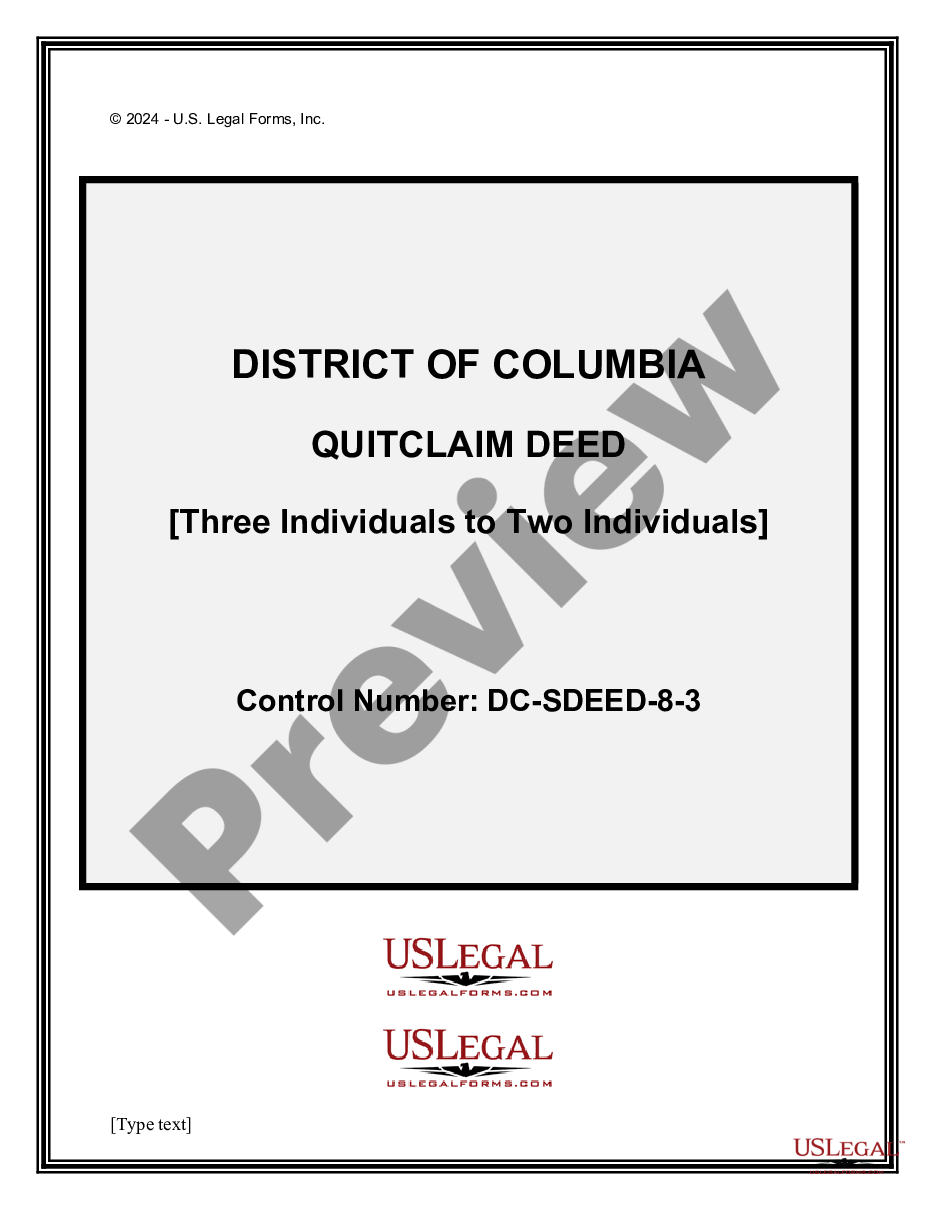
District of Columbia Quitclaim Deed from Three Individuals to Two Individuals
Understanding this form
The Quitclaim Deed from Three Individuals to Two Individuals is a legal document that transfers ownership of property from three grantors to two grantees. Unlike a warranty deed, a quitclaim deed does not guarantee that the grantors own the property free and clear of any liabilities. This form enables the grantees to take ownership as tenants in common or joint tenants with the right of survivorship. It is important for facilitating property transactions where the grantors wish to relinquish their claim to the property without warranties.
Main sections of this form
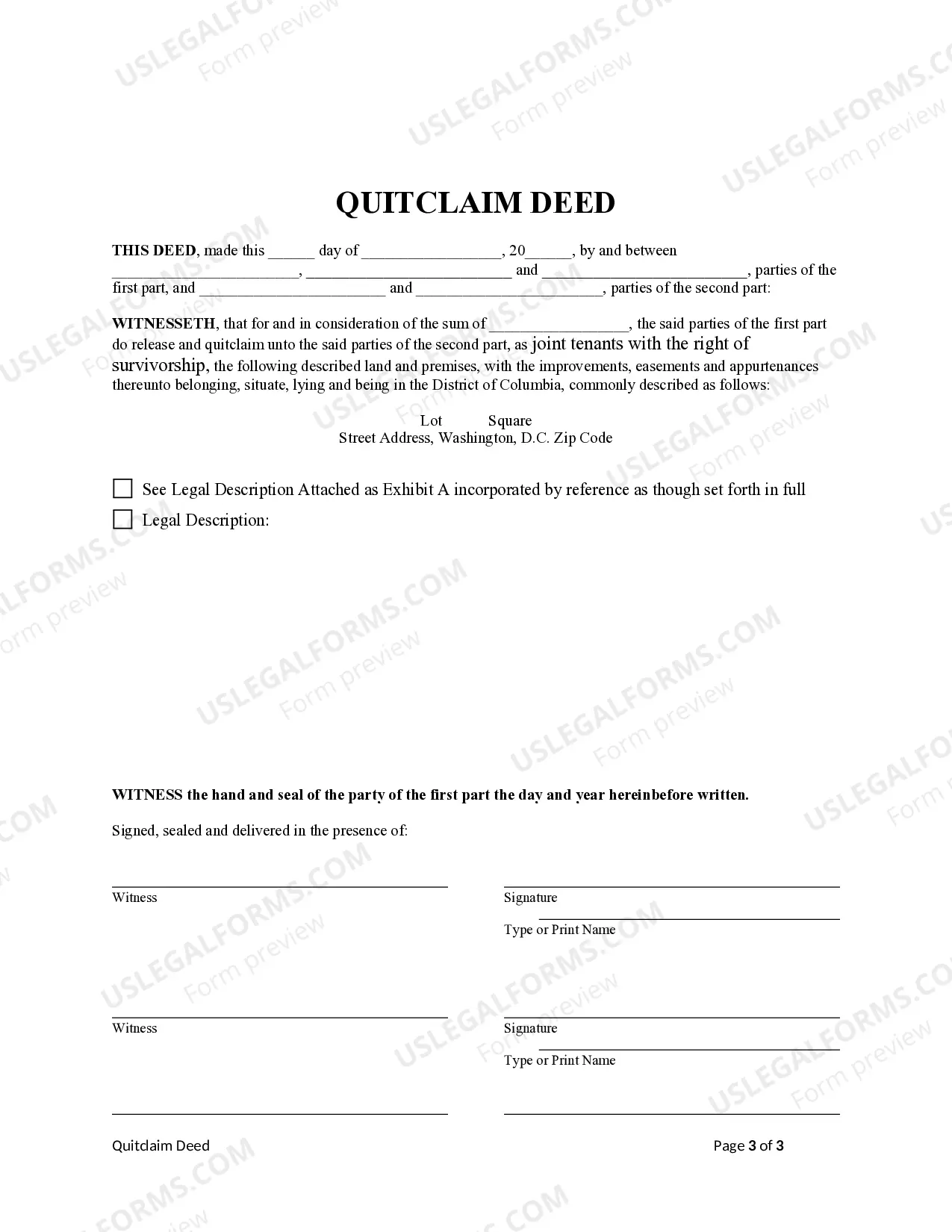
- Parties involved: Names and addresses of grantors and grantees.
- Property description: Detailed description of the property being transferred.
- Consideration: The amount of money or value exchanged for the property.
- Signatures: Required signatures of the grantors, confirming the transfer.
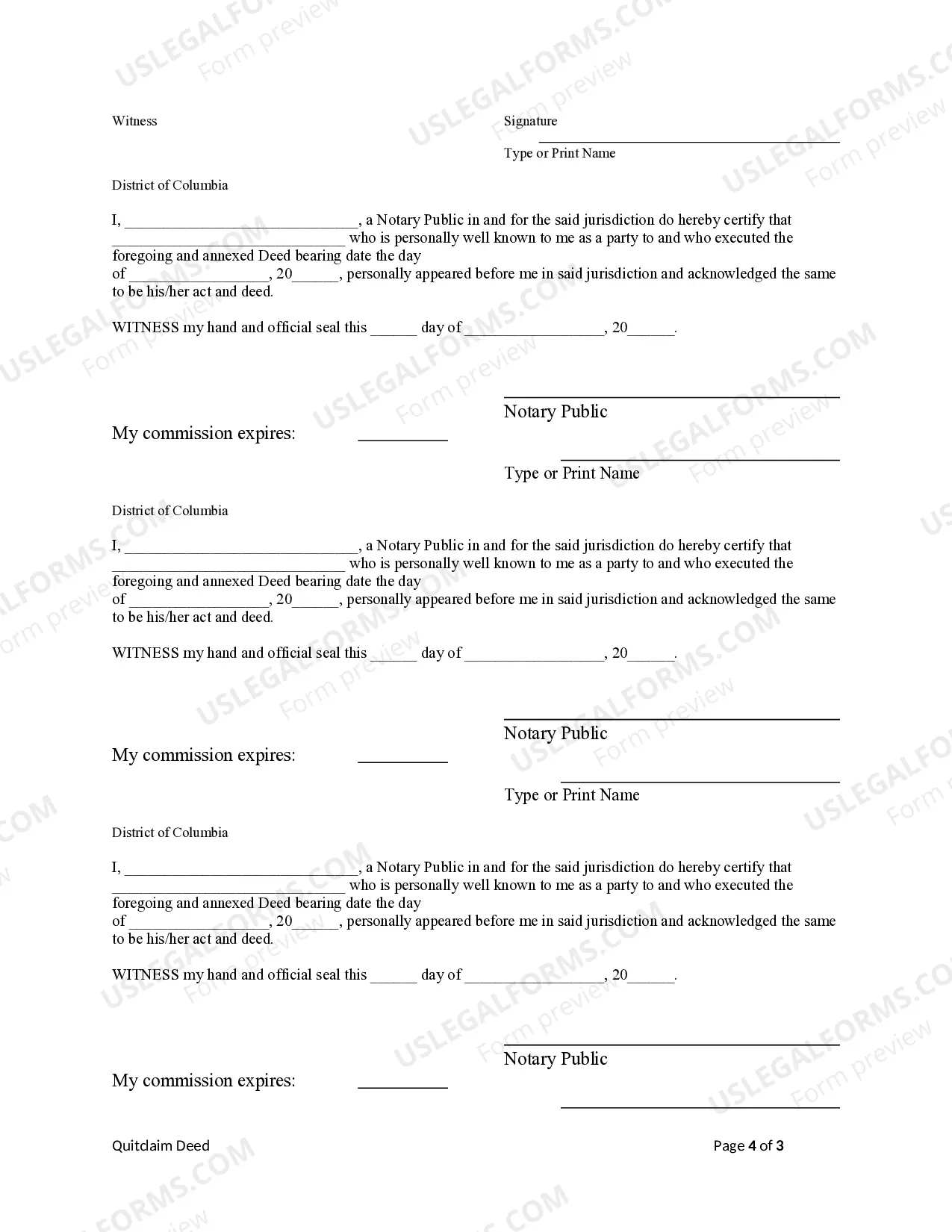
- Notary public acknowledgement: Certification by a notary to validate the deed.





When to use this document
This quitclaim deed form should be used when three individuals seek to transfer their interests in a property to two other individuals. Common scenarios include familial property transfers, estate settlements, or when co-owners decide to consolidate ownership. It is particularly useful when the grantors do not want to assert any claims or ensure the title is clear.
Who can use this document
- Individuals involved in a property transfer where multiple grantors are conveying their interests.
- Co-owners looking to transfer ownership among family members or friends.
- Anyone who needs a fast and simple method to transfer property rights without title guarantees.
Steps to complete this form
- Identify the parties: Enter the full names and addresses of the three grantors and the two grantees.
- Specify the property: Provide a detailed legal description of the property being transferred.
- Enter the consideration amount: Indicate the value exchanged for the property.
- Obtain signatures: Ensure all grantors sign the deed in the appropriate sections.
- Notarize the document: Arrange for a notary public to acknowledge the signatures to validate the deed.
Does this form need to be notarized?
This document requires notarization to meet legal standards. US Legal Forms provides secure online notarization powered by Notarize, allowing you to complete the process through a verified video call, available 24/7.
Get your form ready online
Our built-in tools help you complete, sign, share, and store your documents in one place.
Make edits, fill in missing information, and update formatting in US Legal Forms—just like you would in MS Word.
Download a copy, print it, send it by email, or mail it via USPS—whatever works best for your next step.
Sign and collect signatures with our SignNow integration. Send to multiple recipients, set reminders, and more. Go Premium to unlock E-Sign.
If this form requires notarization, complete it online through a secure video call—no need to meet a notary in person or wait for an appointment.
We protect your documents and personal data by following strict security and privacy standards.

Make edits, fill in missing information, and update formatting in US Legal Forms—just like you would in MS Word.

Download a copy, print it, send it by email, or mail it via USPS—whatever works best for your next step.

Sign and collect signatures with our SignNow integration. Send to multiple recipients, set reminders, and more. Go Premium to unlock E-Sign.

If this form requires notarization, complete it online through a secure video call—no need to meet a notary in person or wait for an appointment.

We protect your documents and personal data by following strict security and privacy standards.
Common mistakes
- Failing to accurately describe the property, which may lead to ambiguity in ownership.
- Not obtaining all required signatures from the grantors.
- Neglecting the notarization requirement, which can invalidate the deed.
Why use this form online
- Convenience: Access the form anytime and from anywhere, with immediate downloading options.
- Editability: Fill out the form digitally for clarity and accuracy, eliminating handwritten errors.
- Reliability: Forms are drafted by licensed attorneys, ensuring compliance with legal standards.
Main things to remember
- This Quitclaim Deed enables the transfer of property from three Grantors to two Grantees.
- It is important to ensure proper notarization for legal validity.
- Use this form for family transactions, business partnerships, or estate planning.
- Review state-specific requirements before completing the deed.
Looking for another form?

Form popularity
FAQ
Yes, you can add a third person to your property deed. To do this, you may need to create a new District of Columbia Quitclaim Deed from Three Individuals to Two Individuals that includes the new individual as a grantor or grantee. It is crucial to follow the correct legal process to ensure that the ownership rights are clearly defined. Using a legal service like uslegalforms can help you navigate this process smoothly.
Filling out a District of Columbia Quitclaim Deed from Three Individuals to Two Individuals involves several clear steps. First, identify the grantors and grantees accurately, ensuring all names match legal documents. Next, provide the legal description of the property in detail, including the parcel number if available. Finally, make sure to sign the deed in the presence of a notary public to validate the document.
A quitclaim deed in the District of Columbia is a legal document used to transfer ownership of property from one party to another. This specific type of deed is often utilized when three individuals wish to transfer their interests in a property to two individuals, making it a convenient option for family or partnership transactions. While it relinquishes any claim the grantors have, it does not guarantee that the title is clear. Hence, understanding the implications of using a District of Columbia Quitclaim Deed from Three Individuals to Two Individuals is crucial for both parties involved.
Yes, it is perfectly acceptable to list three names on a deed, provided that all parties have a legal interest in the property. This allows for various ownership arrangements and is a common scenario in transactions like a District of Columbia Quitclaim Deed from Three Individuals to Two Individuals. Just ensure all names are properly documented to prevent any future disputes.
Removing an individual from a deed typically requires another deed, often a quitclaim deed, to convey their interest to the remaining parties. This formal process ensures legal clarity and protects all parties involved. For a smooth transaction, ensure the new District of Columbia Quitclaim Deed from Three Individuals to Two Individuals reflects the new arrangement accurately.
Similar to other deeds, a quitclaim deed does not limit the number of individuals it can register. Each person must demonstrate their legal interest and sign the document. When managing a District of Columbia Quitclaim Deed from Three Individuals to Two Individuals, clarity with names and their roles is crucial.
A quitclaim deed can include as many individuals as necessary, provided that all parties are willing to sign and execute the document. This flexibility allows for unique arrangements, such as a District of Columbia Quitclaim Deed from Three Individuals to Two Individuals. Ensure that all names are correctly stated to avoid confusion later.
Generally, there is no strict limit to the number of names that can appear on a deed. However, local laws may dictate certain guidelines that need consideration. In a District of Columbia Quitclaim Deed from Three Individuals to Two Individuals, clarity in naming the individuals can prevent future disputes.
One significant disadvantage is that a quitclaim deed offers no guarantees about the property’s title, leaving grantees open to potential disputes. Furthermore, it does not provide any recourse if hidden liens emerge after the transfer. For those involved in a District of Columbia Quitclaim Deed from Three Individuals to Two Individuals, understanding these risks is crucial.
A quitclaim deed may be voided if it does not adhere to legal requirements, such as proper execution or notarization. Additionally, if the grantor lacked legal capacity at the time of signing, this can invalidate the deed. It is essential to ensure that all processes follow the legal guidelines for a District of Columbia Quitclaim Deed from Three Individuals to Two Individuals to prevent issues.