Connecticut Quitclaim Deed from an Individual to a Trust
A Quitclaim Deed from an Individual to a Trust is a legal document used to transfer ownership of real estate from an individual (the Grantor) to a trust (the Grantee). This form allows for the conveyance of property rights without any warranties, meaning the Grantor does not guarantee the status of the title. This form is particularly useful when property ownership is being transferred to a trust for estate planning purposes or asset management.
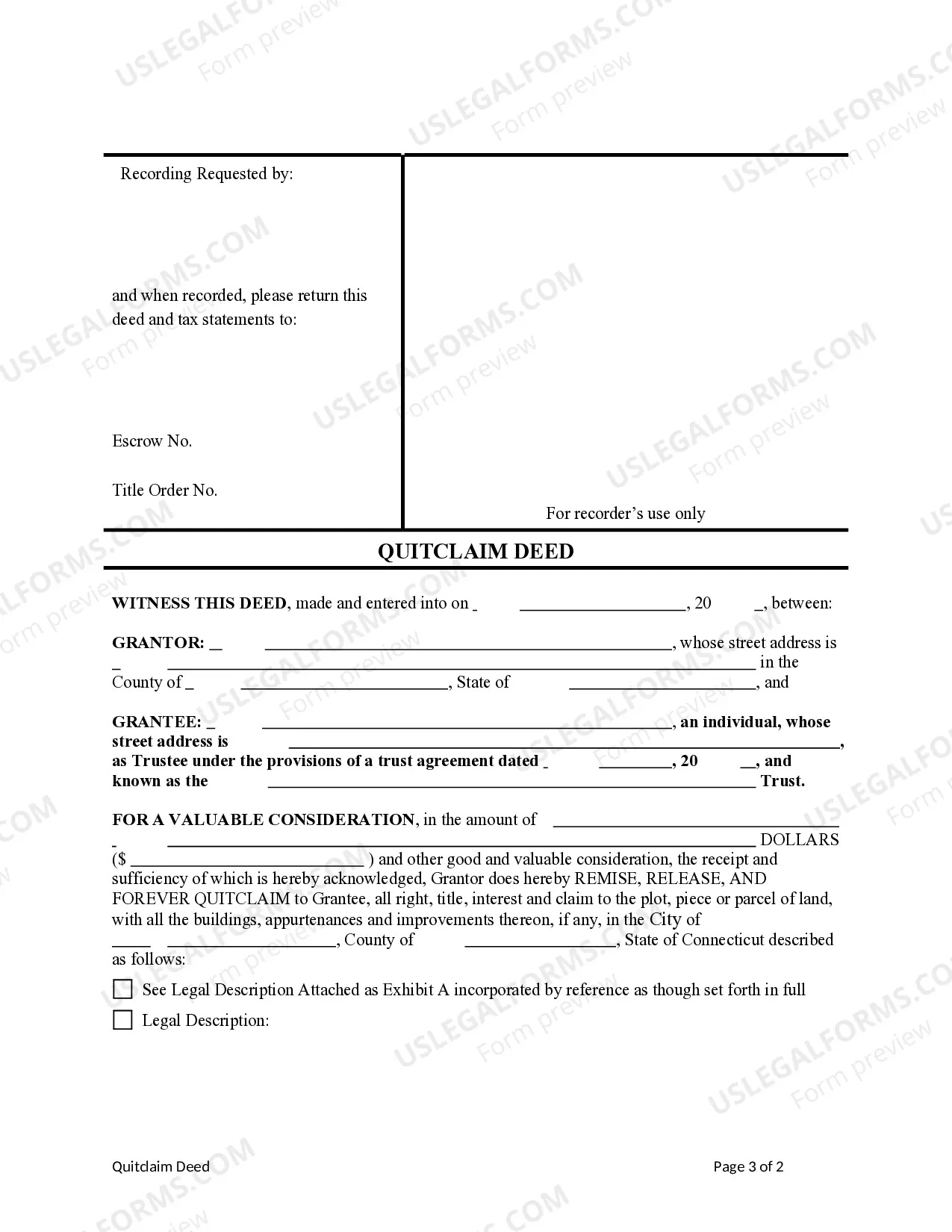
- Grantor: The individual who is transferring ownership of the property.
- Grantee: The trust receiving the property.
- Property Description: A detailed description of the property being transferred, including boundaries and location.
- Effective Date: The date when the transfer of ownership takes effect.
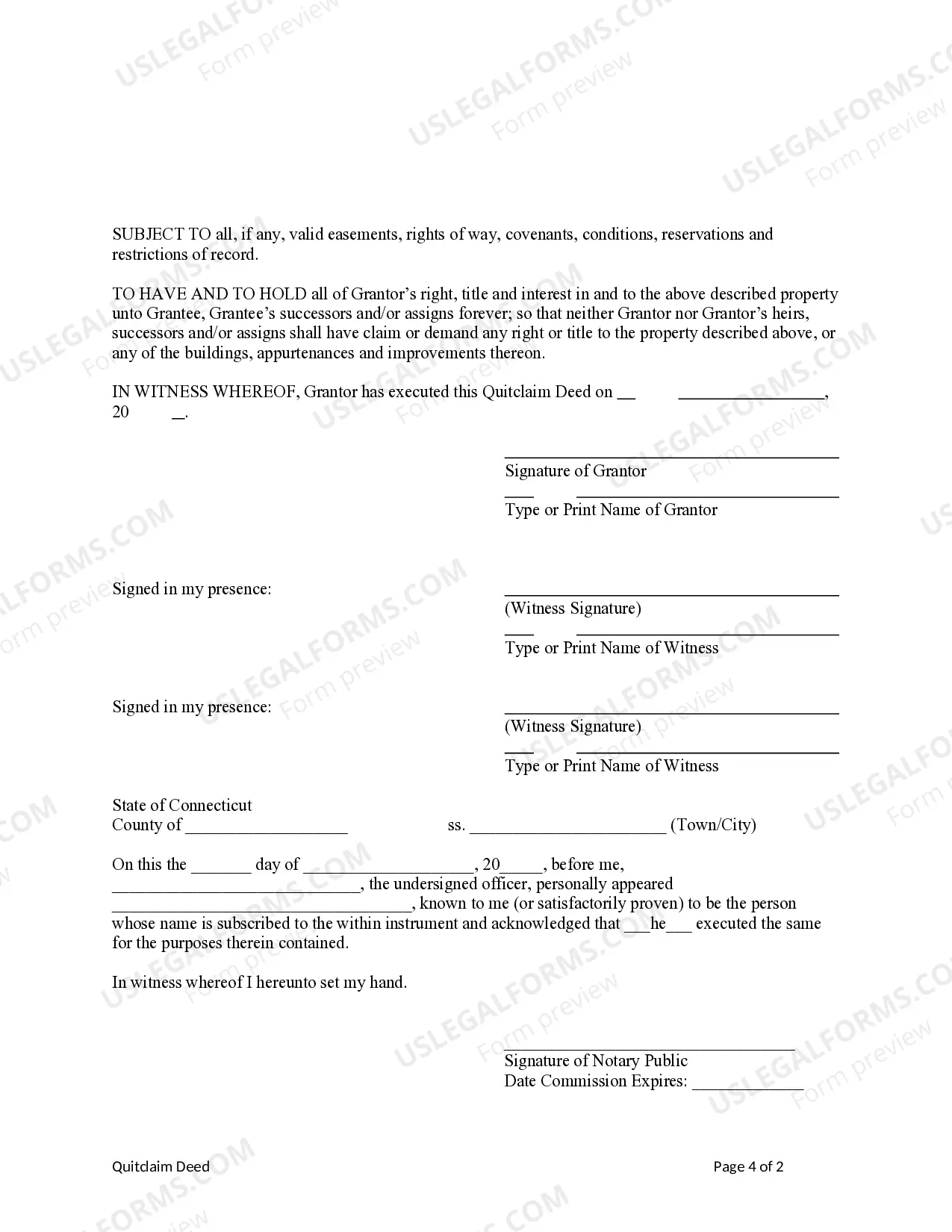
- Signatures: Signatures of the Grantor and possibly a witness or notary, depending on state requirements.
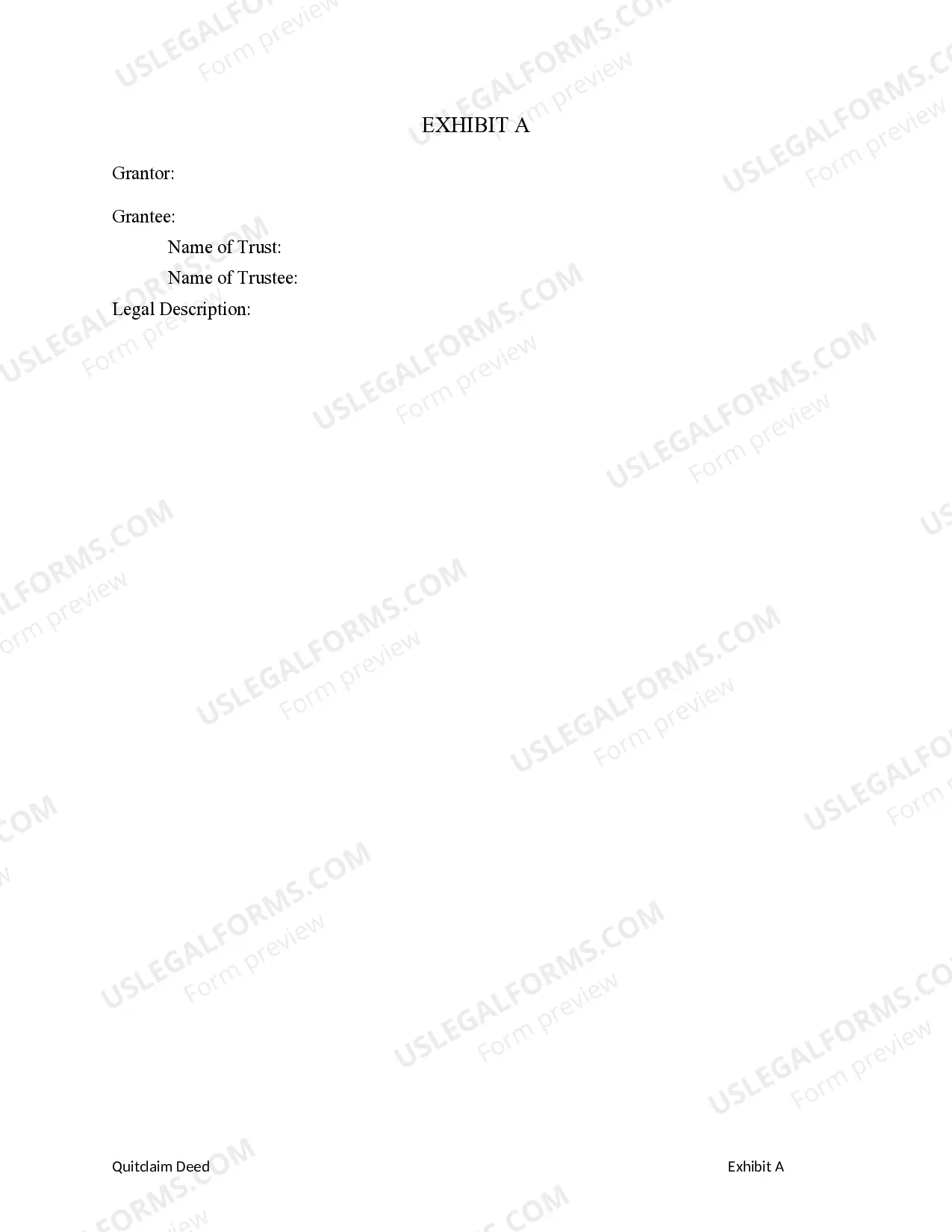
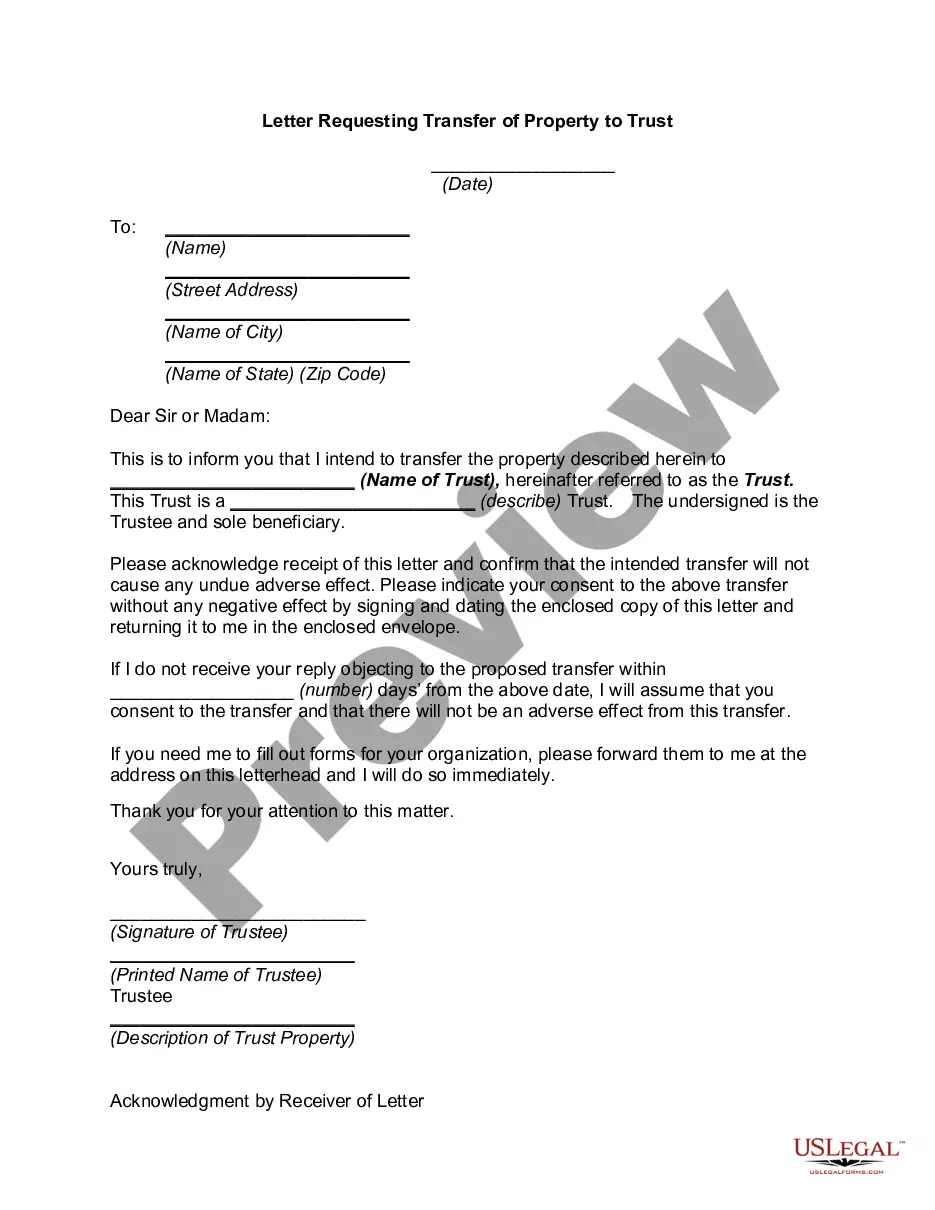

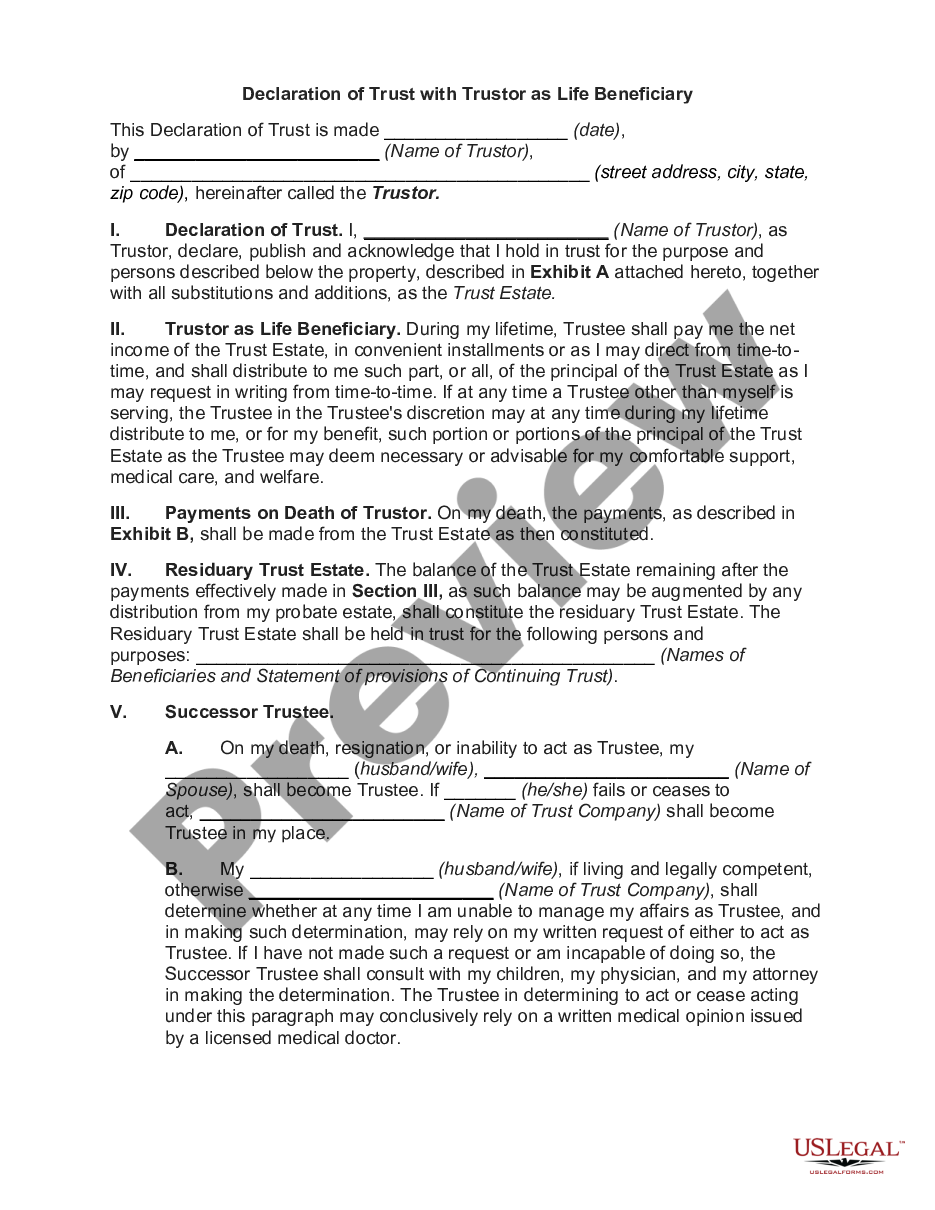
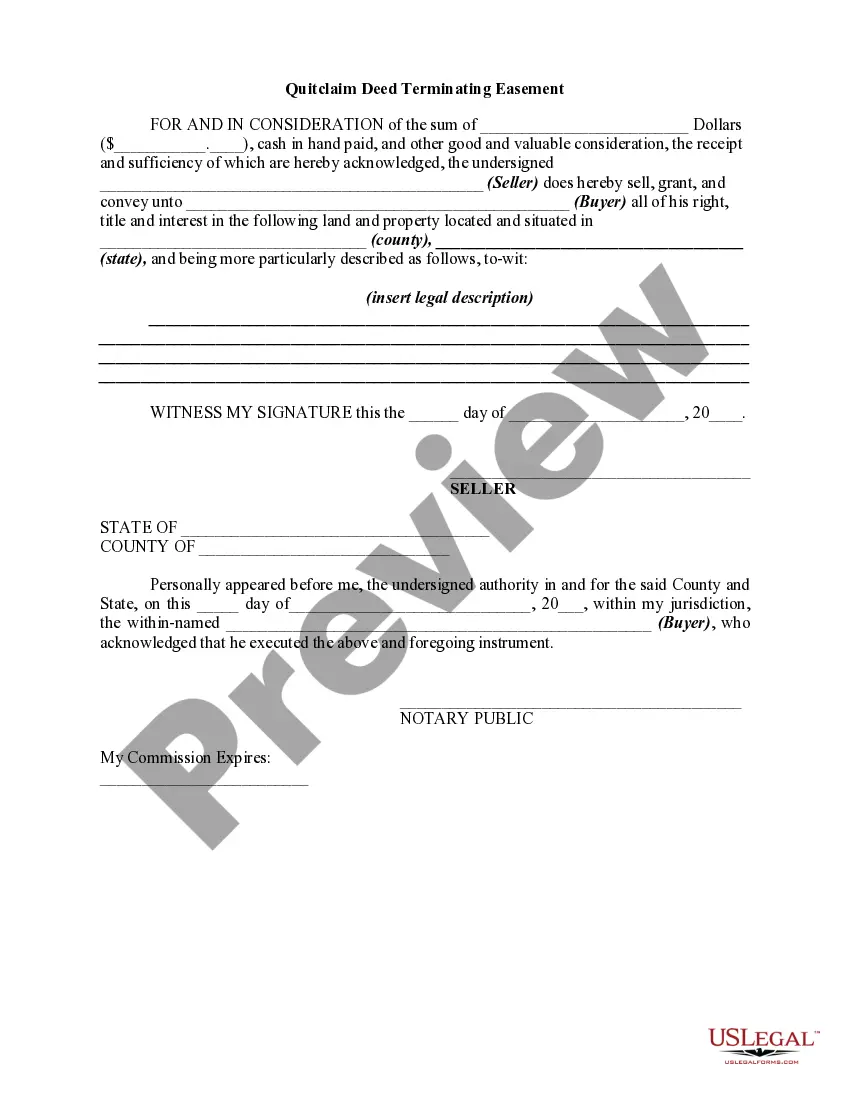

This Quitclaim Deed is typically used when an individual wants to transfer property to a trust. Common scenarios include estate planning, where an individual places their property into a trust for the benefit of heirs, or when real estate is being managed under a trust for tax or legal reasons. It's also relevant in divorce settlements where one party transfers property to a trust following asset division.
This form is ideal for:
- Individuals looking to transfer property to a trust.
- Trustees managing property on behalf of beneficiaries.
- People involved in estate planning or asset protection.
- Anyone needing to clarify property ownership without altering title warranties.
To complete this Quitclaim Deed, follow these steps:
- Identify the parties involved, including full legal names of the Grantor and the trust.
- Specify the property being transferred, including a detailed description and legal address.
- Enter the effective date of the transfer.
- Provide the signature of the Grantor and any required witnesses or notaries.
- File the completed deed with the appropriate county office if required by local law.
Is notarization required?
This form must be notarized to be legally valid. US Legal Forms provides secure online notarization powered by Notarize, allowing you to complete the process through a verified video call.
Get your form ready online
Our built-in tools help you complete, sign, share, and store your documents in one place.
Make edits, fill in missing information, and update formatting in US Legal Forms—just like you would in MS Word.
Download a copy, print it, send it by email, or mail it via USPS—whatever works best for your next step.
Sign and collect signatures with our SignNow integration. Send to multiple recipients, set reminders, and more. Go Premium to unlock E-Sign.
If this form requires notarization, complete it online through a secure video call—no need to meet a notary in person or wait for an appointment.
We protect your documents and personal data by following strict security and privacy standards.
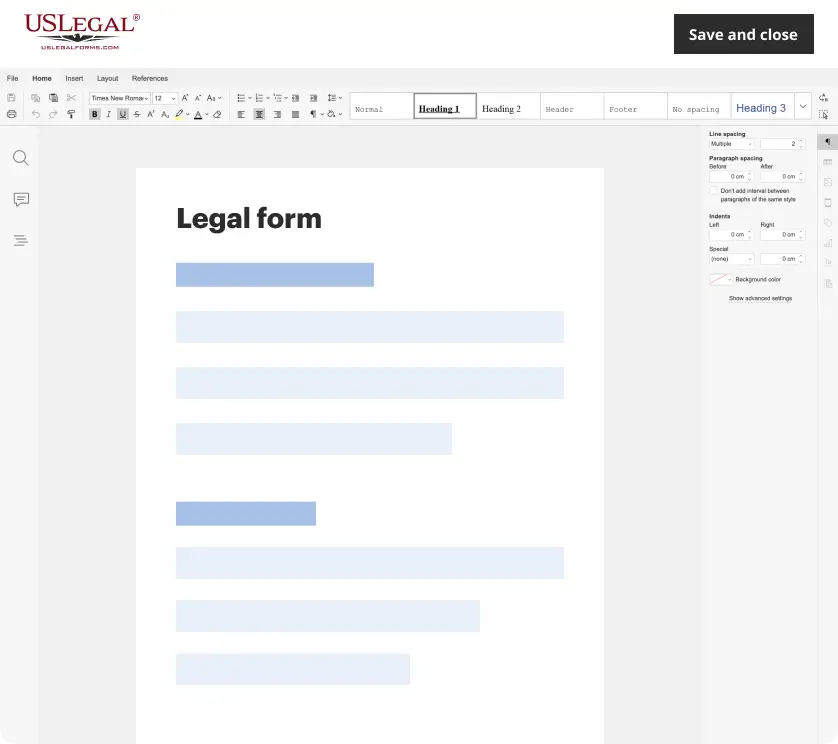
Make edits, fill in missing information, and update formatting in US Legal Forms—just like you would in MS Word.
Download a copy, print it, send it by email, or mail it via USPS—whatever works best for your next step.
Sign and collect signatures with our SignNow integration. Send to multiple recipients, set reminders, and more. Go Premium to unlock E-Sign.

If this form requires notarization, complete it online through a secure video call—no need to meet a notary in person or wait for an appointment.
We protect your documents and personal data by following strict security and privacy standards.
- Failing to properly identify the property or including insufficient details in the property description.
- Not signing the deed or missing required witness signatures.
- Overlooking state-specific filing requirements after the deed is completed.
- Assuming the Quitclaim Deed provides warranty of title, which it does not.
- Convenience of completing the form online and downloading it immediately.
- Editability allows users to input information easily before printing.
- Access to templates that comply with state laws, ensuring legal validity.
- Time-saving as the form can be filled out at the user's convenience.
- Provides a clear record of property transfer to the trust, which can assist in future legal matters.
- Is enforceable in courts, making it a valid legal document for ownership rights.
- Is useful in various scenarios, including estate planning and asset management.
- A Quitclaim Deed is a straightforward way to transfer property to a trust without warranties.
- This form is commonly used in estate planning and asset management strategies.
- Ensure all details are completed accurately to avoid common mistakes.
- Check local requirements to verify if notarization is necessary for your transfer.
Looking for another form?
Form popularity
FAQ
A Connecticut Quitclaim Deed from an Individual to a Trust should not be used in business transactions requiring extensive due diligence or in situations involving properties with multiple owners without their consent. It is also inappropriate for transferring property as part of a divorce settlement if the other spouse has equitable claims. In such circumstances, consider alternative legal documentation for comprehensive coverage.
A Connecticut Quitclaim Deed from an Individual to a Trust becomes invalid if it lacks essential elements such as signatures, a legal description of the property, or if it fails to be recorded with the appropriate county office. Additionally, if the grantor was not legally competent at the time of signing, the deed is void. To ensure your deed is valid, utilize solutions like uslegalforms for guidance on completing this process correctly.
Choosing a quitclaim deed may not be advisable if you require a guarantee of clear ownership and title. Since a Connecticut Quitclaim Deed from an Individual to a Trust transfers whatever interest the grantor has, it does not uncover any existing liens or claims against the property. Therefore, if you are uncertain about the title status, it's wise to consult with legal professionals or consider other deed types for added protection.
A Connecticut Quitclaim Deed from an Individual to a Trust cannot be used to settle debts, transfer ownership in exchange for compensation, or change ownership of property encumbered by liens without the consent of all lienholders. Also, it is not suitable for transactions requiring a full title examination, such as sales in a real estate market. For those cases, a warranty deed is often the better option.
A Connecticut Quitclaim Deed from an Individual to a Trust is most appropriate when you need to transfer property ownership quickly and without a title guarantee. This type of deed works best during inter-family transfers, such as when parents transfer their home into a trust for their children. Additionally, it's useful when the parties involved have a high level of trust in one another, as it does not require a title search or insurance.
Filing the Connecticut Quitclaim Deed from an Individual to a Trust involves a few simple steps. First, you must complete the deed form accurately and ensure all necessary information is included. Once completed, you should submit the form to the local town clerk's office or registry of deeds where the property is located. If you want to streamline this process, explore the services offered by US Legal Forms for filing assistance and additional resources.
To fill out the Connecticut Quitclaim Deed from an Individual to a Trust, start by entering the names of the grantor and the trust in the appropriate sections. Ensure that you specify the property being transferred with clear and accurate descriptions. Next, include any additional information required, such as the consideration amount and the date of transfer. If you seek a straightforward way to access the proper forms and guidance, consider using the US Legal Forms platform.
To file a Connecticut Quitclaim Deed from an Individual to a Trust, first prepare the deed according to state specifications. Next, you must sign and notarize the document, which is a crucial step. Afterward, you will submit the deed to the town clerk’s office in the municipality where the property is located. Utilizing US Legal Forms can simplify this process, providing templates and resources to ensure your filing adheres to all local laws.
People often use a Connecticut Quitclaim Deed from an Individual to a Trust to transfer property ownership without a sale. This method is commonly used for estate planning, simplifying property transfer between family members, or transferring assets into a trust for management purposes. By employing a quitclaim deed, individuals can ensure swift and clear ownership rights with minimal complications. It’s an effective solution for managing your estate.
Yes, you can fill out a Connecticut Quitclaim Deed from an Individual to a Trust on your own. This process is quite straightforward, as long as you understand the required information. However, for accuracy and legal compliance, using a reliable service like US Legal Forms can provide guidance and templates tailored for your situation. Remember, a well-prepared deed helps ensure that your property's transfer is properly documented.