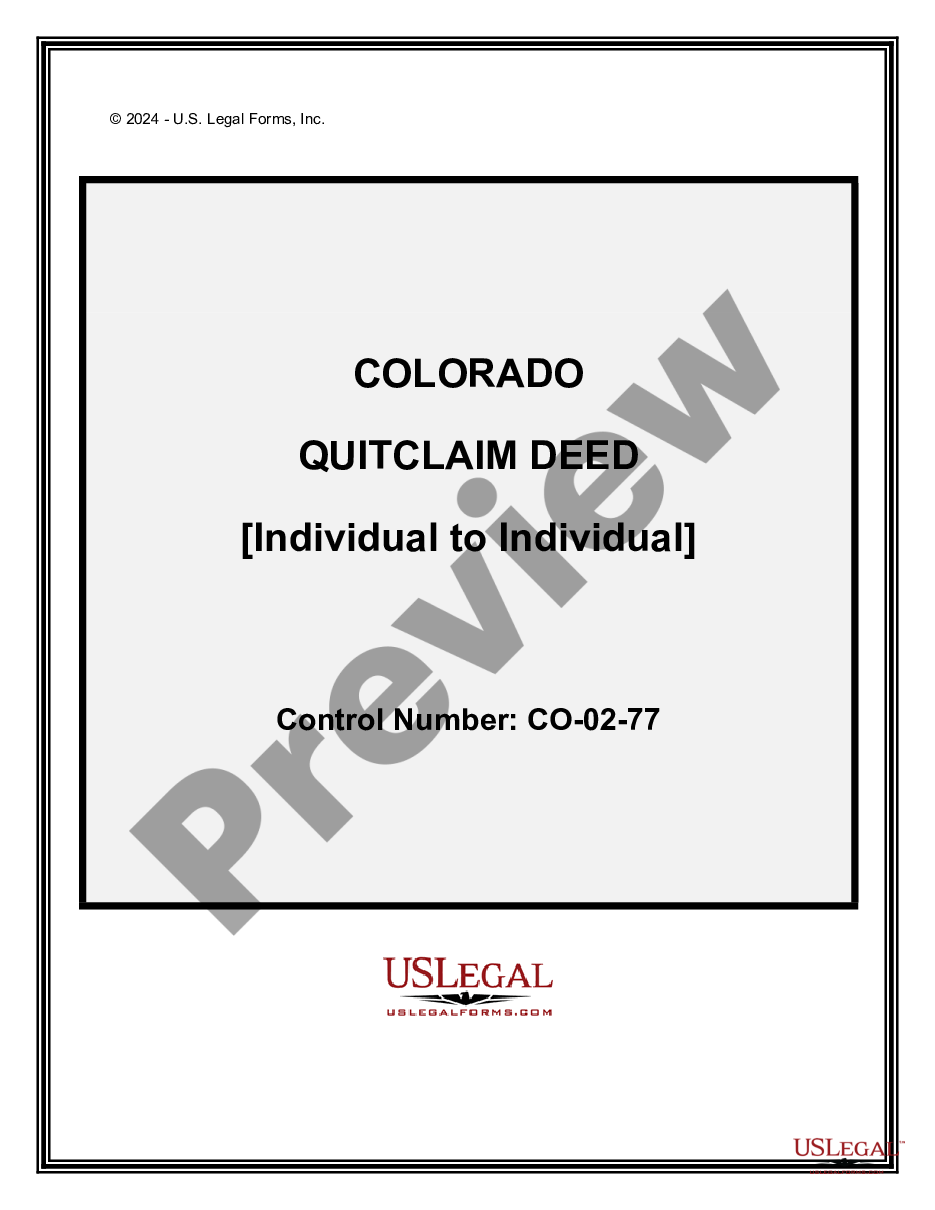
Colorado Quitclaim Deed - Individual to Individual
Understanding this form
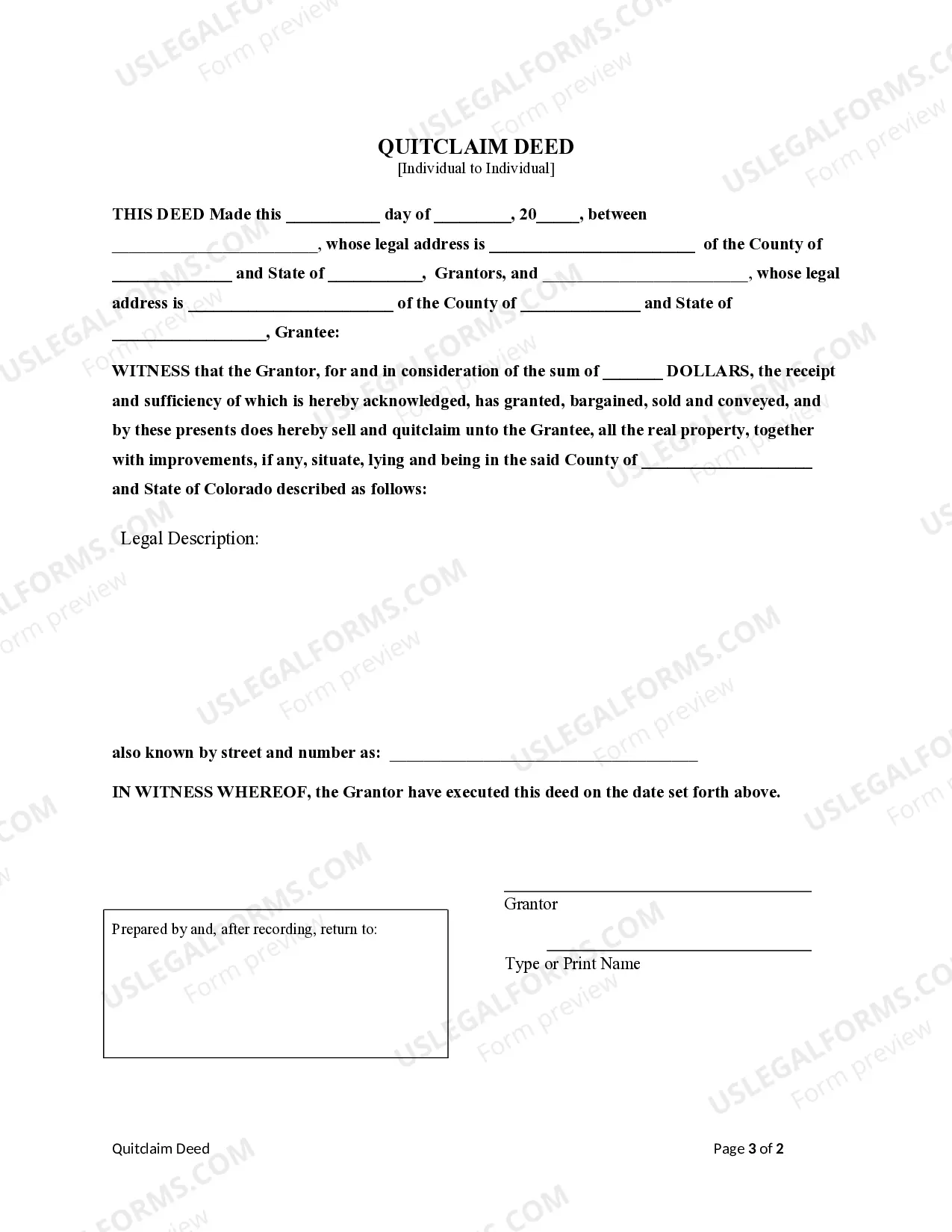
The Quitclaim Deed - Individual to Individual is a legal document that allows one individual (the grantor) to transfer their interest in a property to another individual (the grantee) without any warranties or guarantees. This form is particularly useful in situations where the grantor does not want to be held liable for any potential claims against the property. Unlike a warranty deed, a quitclaim deed does not affirm that the grantor holds clear title to the property, making it essential for specific contexts, such as transferring property among family members or in divorce settlements.
Main sections of this form
- Grantor's and grantee's names and legal addresses.
- The date the deed is executed.
- The consideration amount (payment) for the property transfer.
- A clear description of the property being transferred.
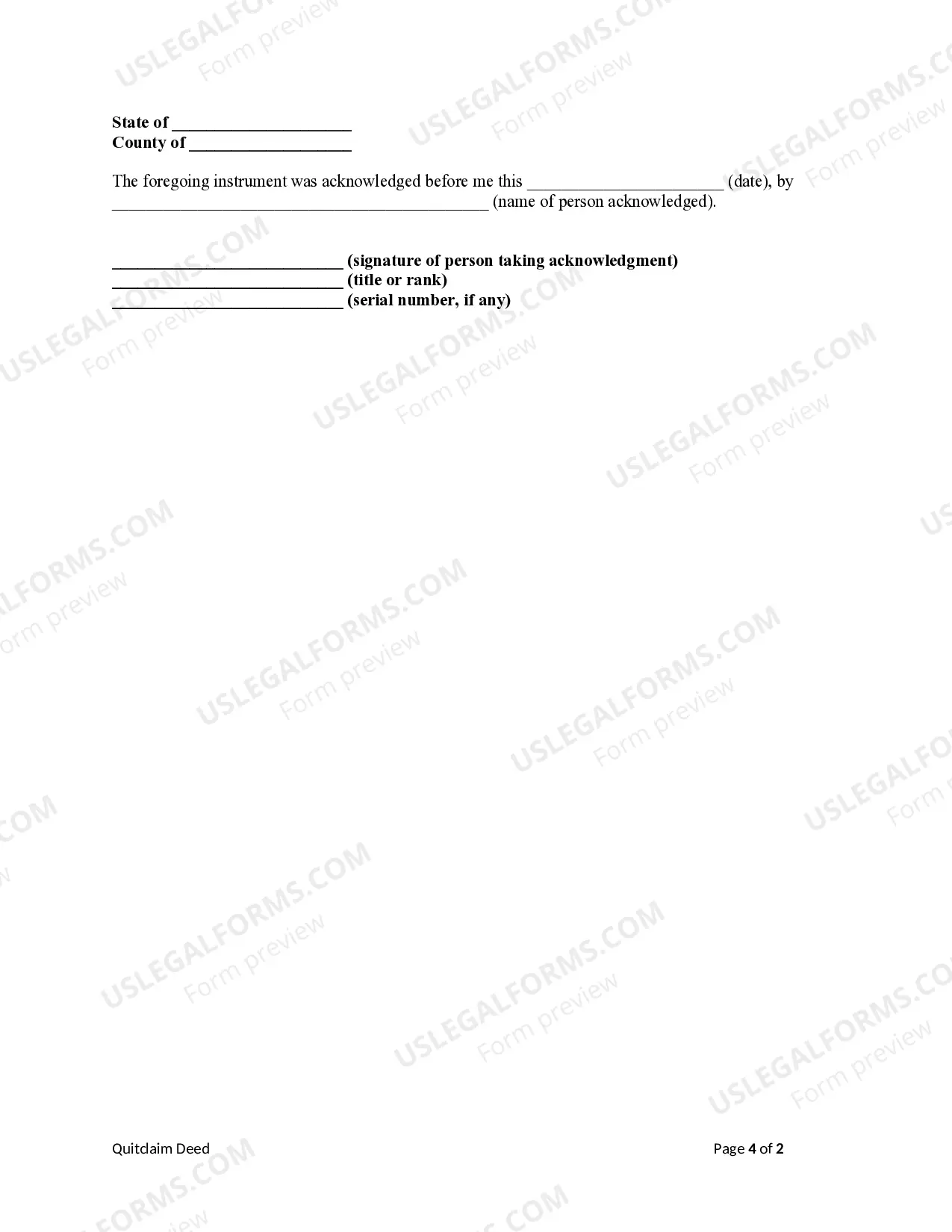
- Spaces for signatures of the grantor and witnesses, if required.



When to use this form
This form should be used when an individual wants to transfer their interest in a property to another individual, especially when the transfer is informal and may not involve a sale. Common scenarios include transferring property between family members, executing a spousal transfer during divorce, or gifting property. It is ideal for situations where the grantor does not wish to make any warranties regarding the property's title.
Who should use this form
- Individuals transferring property to family members or friends.
- Couples going through a divorce who wish to transfer ownership of joint property.
- Anyone gifting property without the exchange of money.
Steps to complete this form
- Identify the grantor and the grantee by entering their full names and legal addresses.
- Input the date on which the quitclaim deed is being executed.
- Specify the consideration amount, the payment or value exchanged for the property.
- Provide a detailed description of the property being transferred, including its address and any identifying information.
- Have the grantor sign the document, and include any required witness signatures or notarization as per state requirements.
Notarization requirements for this form
This document requires notarization to meet legal standards. US Legal Forms provides secure online notarization powered by Notarize, allowing you to complete the process through a verified video call, available 24/7.
Get your form ready online
Our built-in tools help you complete, sign, share, and store your documents in one place.
Make edits, fill in missing information, and update formatting in US Legal Forms—just like you would in MS Word.
Download a copy, print it, send it by email, or mail it via USPS—whatever works best for your next step.
Sign and collect signatures with our SignNow integration. Send to multiple recipients, set reminders, and more. Go Premium to unlock E-Sign.
If this form requires notarization, complete it online through a secure video call—no need to meet a notary in person or wait for an appointment.
We protect your documents and personal data by following strict security and privacy standards.

Make edits, fill in missing information, and update formatting in US Legal Forms—just like you would in MS Word.

Download a copy, print it, send it by email, or mail it via USPS—whatever works best for your next step.

Sign and collect signatures with our SignNow integration. Send to multiple recipients, set reminders, and more. Go Premium to unlock E-Sign.

If this form requires notarization, complete it online through a secure video call—no need to meet a notary in person or wait for an appointment.

We protect your documents and personal data by following strict security and privacy standards.
Common mistakes to avoid
- Failing to adequately describe the property transferred, which can lead to confusion or disputes.
- Not including the consideration amount, as this may invalidate the deed in some jurisdictions.
- Omitting signatures from the grantor or witnesses, which may result in the deed being unenforceable.
Why use this form online
- Convenience of filling out the form from any device at your own pace.
- Editability allows you to easily correct any mistakes before finalizing.
- Security and reliability of obtaining legally compliant forms quickly and efficiently.
Summary of main points
- The Quitclaim Deed allows for straightforward property transfers without warranties.
- It is ideal for transactions based on trust, often between family and friends.
- Ensure all fields are accurate and complete to prevent legal issues.
- Consult local laws to understand any notarization requirements for your situation.
Looking for another form?

Form popularity
FAQ
Filing a quitclaim deed in Colorado involves a few important steps. First, prepare the Colorado Quitclaim Deed - Individual to Individual, ensuring that all necessary details are accurate. Next, sign the document in front of a notary public. Finally, file the quitclaim deed with the county clerk and recorder’s office where the property is located. Once filed, this document will officially update the ownership records.
To remove someone's name from a property deed, you can use a Colorado Quitclaim Deed - Individual to Individual. This deed allows the current owner to transfer their interest in the property to the other person. To complete the process, fill out the quitclaim deed, ensuring it reflects the correct information, and record it at your local county clerk’s office. This legally removes their name from the property title.
To change the name on your property title deed in Colorado, you need to execute a Colorado Quitclaim Deed - Individual to Individual. This form transfers your ownership interest from one person to another without warranty. After completing the form, file it with your county clerk and recorder's office. Make sure to include the necessary information, such as the legal description of the property and signatures from both parties.
To remove someone from a deed in Colorado, you can execute a Colorado Quitclaim Deed - Individual to Individual that transfers their interest out of the property. It requires the agreement of the person being removed, as both parties must sign the quitclaim deed. Following this, you must file the deed with the county clerk’s office to finalize the process. For efficient handling of the paperwork and legal requirements, consider using USLegalForms.
Yes, you can create a Colorado Quitclaim Deed - Individual to Individual yourself without needing an attorney. However, it is advisable to use USLegalForms for a streamlined process that ensures your deed meets all legal requirements. This platform offers templates and guidance, helping you avoid mistakes that could cause issues later. While DIY is an option, using a professional service can provide peace of mind.
Using a Colorado Quitclaim Deed - Individual to Individual can be risky for buyers, as it provides no guarantees about the property's title. This means if there are existing liens or claims against the property, the buyer assumes that risk without recourse. Additionally, it may make it harder to sell the property later, as potential buyers might be wary of the deed's lack of assurances. Therefore, it's essential to approach this option with caution and preferably consult a legal expert.
The Colorado Quitclaim Deed - Individual to Individual primarily benefits those who want to transfer property rights quickly and easily. This method is often used among family members, friends, or partners who trust each other. Because there is no warranty of title, this deed simplifies the process when both parties understand the property’s legal status. It's particularly beneficial in divorce situations or for settling estates.
To transfer a property title to a family member in Colorado, you can use a Colorado Quitclaim Deed - Individual to Individual. This deed allows you to convey your interest in the property without the usual formalities of sale. Be sure to provide accurate property information and have the deed notarized to fulfill legal requirements. Consulting a dedicated platform like USLegalForms can simplify the process.
Yes, a quitclaim deed must be notarized in Colorado to be legally binding. This step is crucial for validating the transaction and ensuring that both parties' signatures are authentic. By using a Colorado Quitclaim Deed - Individual to Individual, you can clearly outline the transfer of property, but remember that notarization is an essential step.
Quitclaims are often viewed with caution due to their nature of transferring property without warranties. When using a Colorado Quitclaim Deed - Individual to Individual, the grantor does not guarantee that the title is clear or that there are no liens. This can lead to potential risks for the grantee, making them less favorable in many transactions.