Agreement with Manager to Plan Events for Expositions and Similar Events
Overview of this form
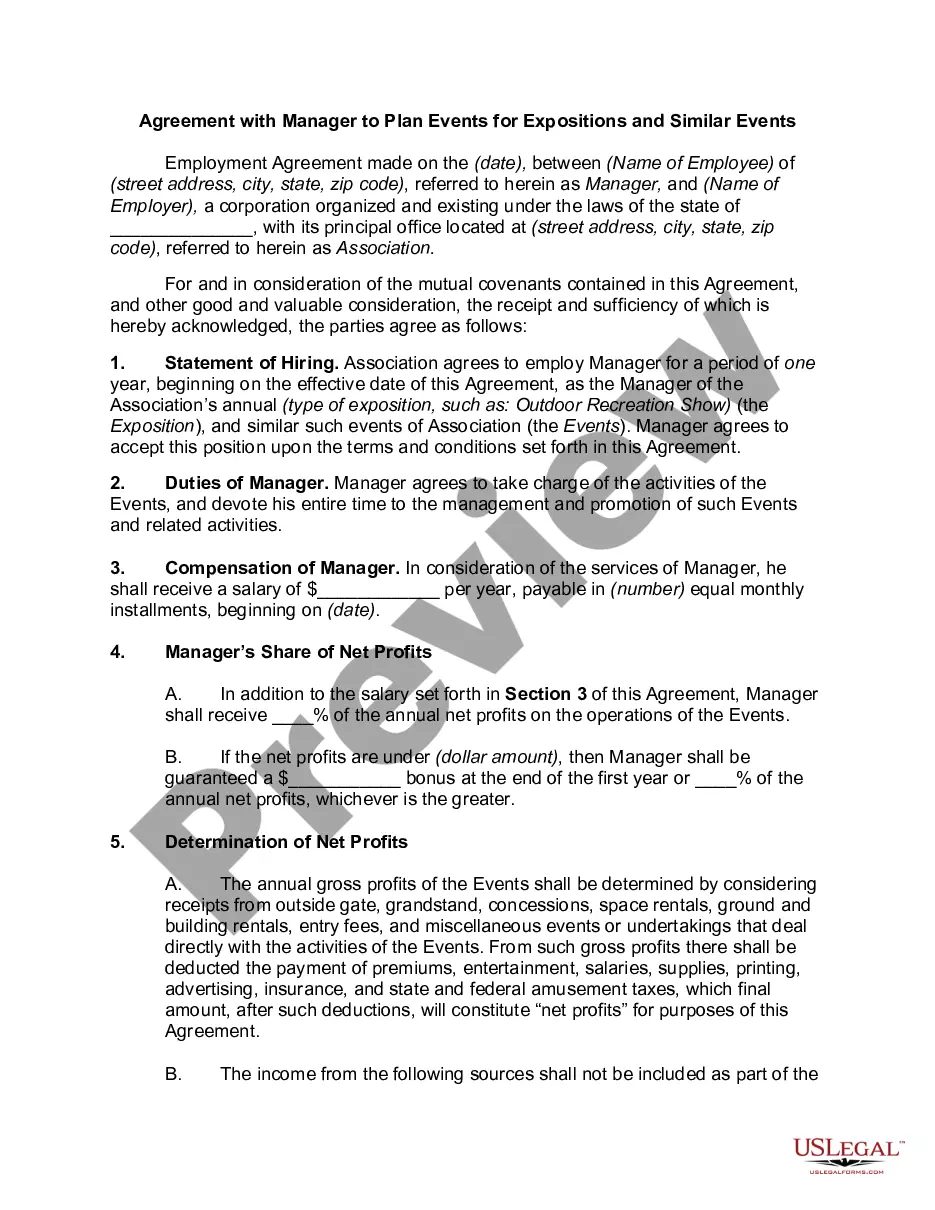
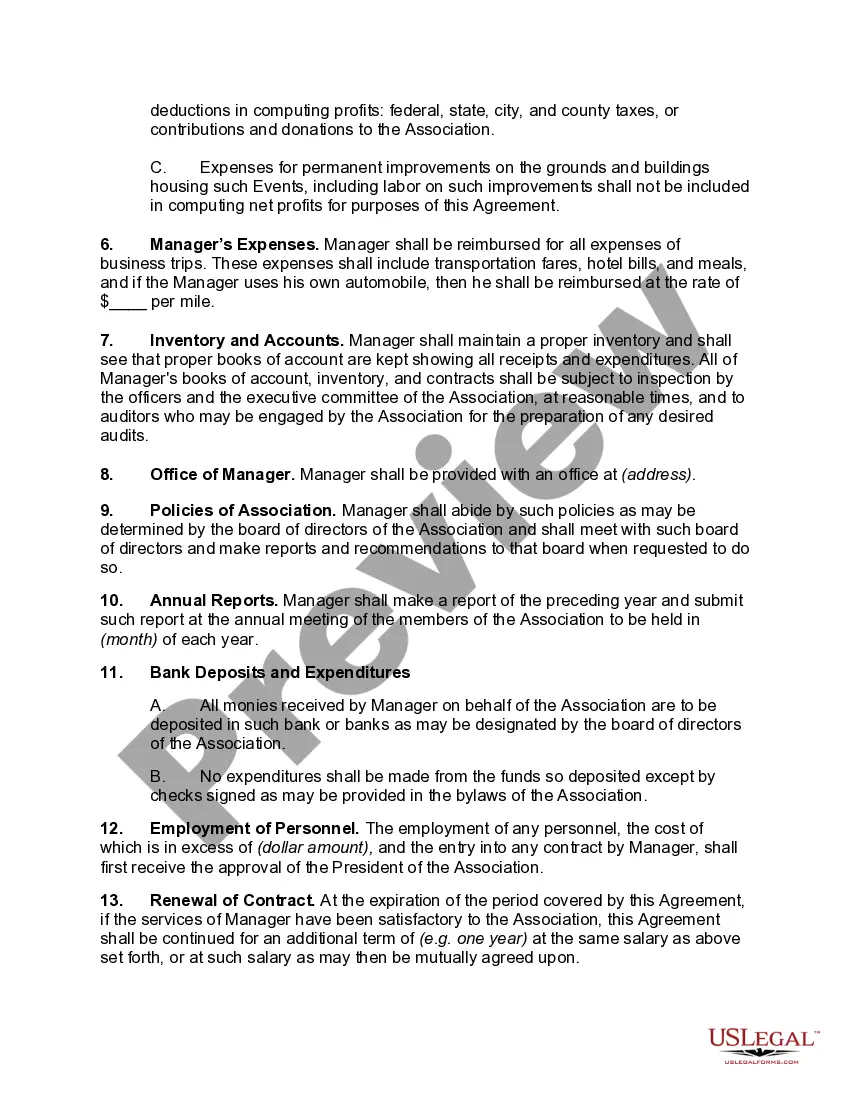
The Agreement with Manager to Plan Events for Expositions and Similar Events is a legal document outlining the relationship between an association and a manager hired to oversee and promote an exposition or trade fair. This form is distinct because it not only establishes the managerial role but also details duties, compensation structures, and profit-sharing arrangements, making it suitable for various similar events.
Main sections of this form
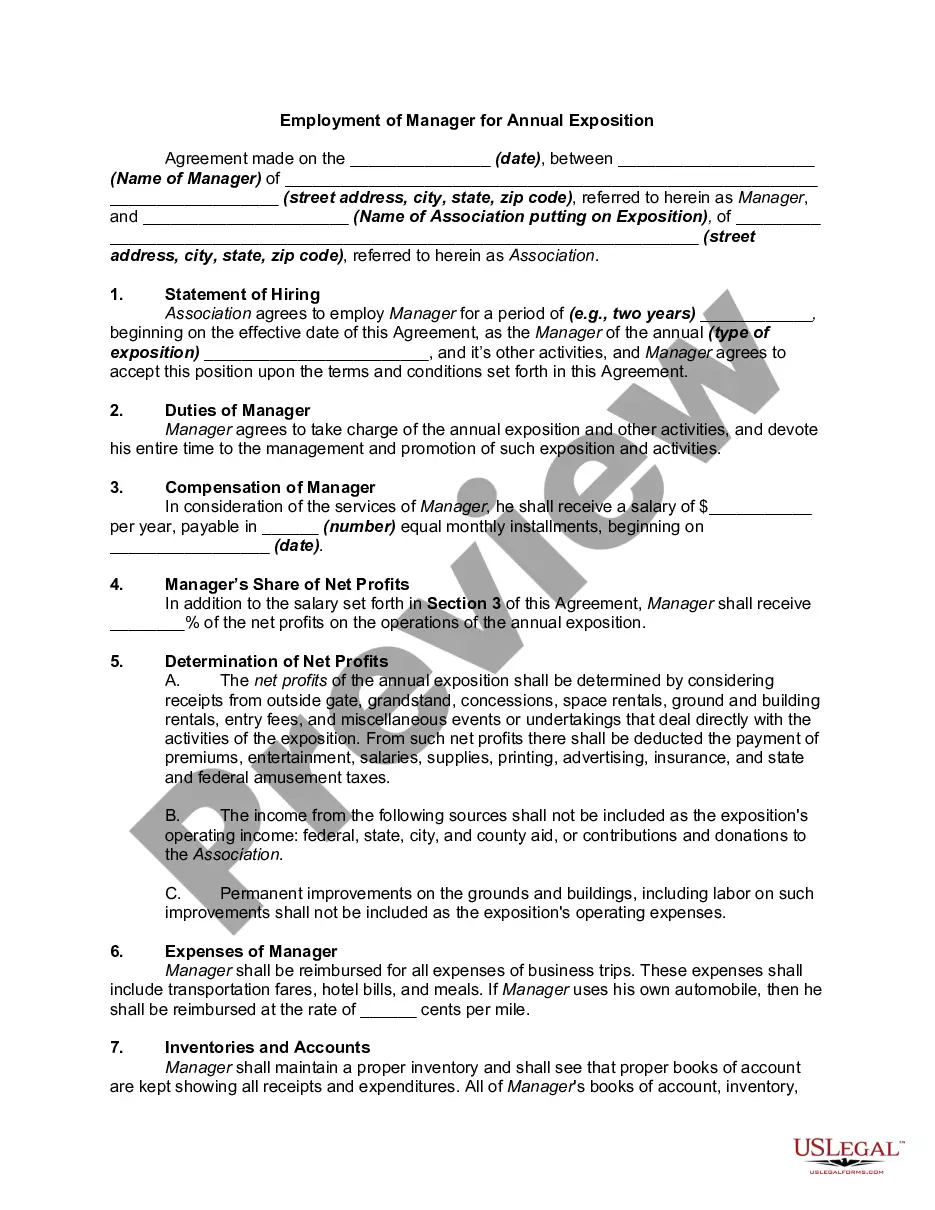
- Statement of Hiring: Confirms the manager's employment for one year.
- Duties of Manager: Specifies the responsibilities related to managing the events.
- Compensation: Outlines salary and profit-sharing terms.
- Determination of Net Profits: Describes how net profits will be calculated.
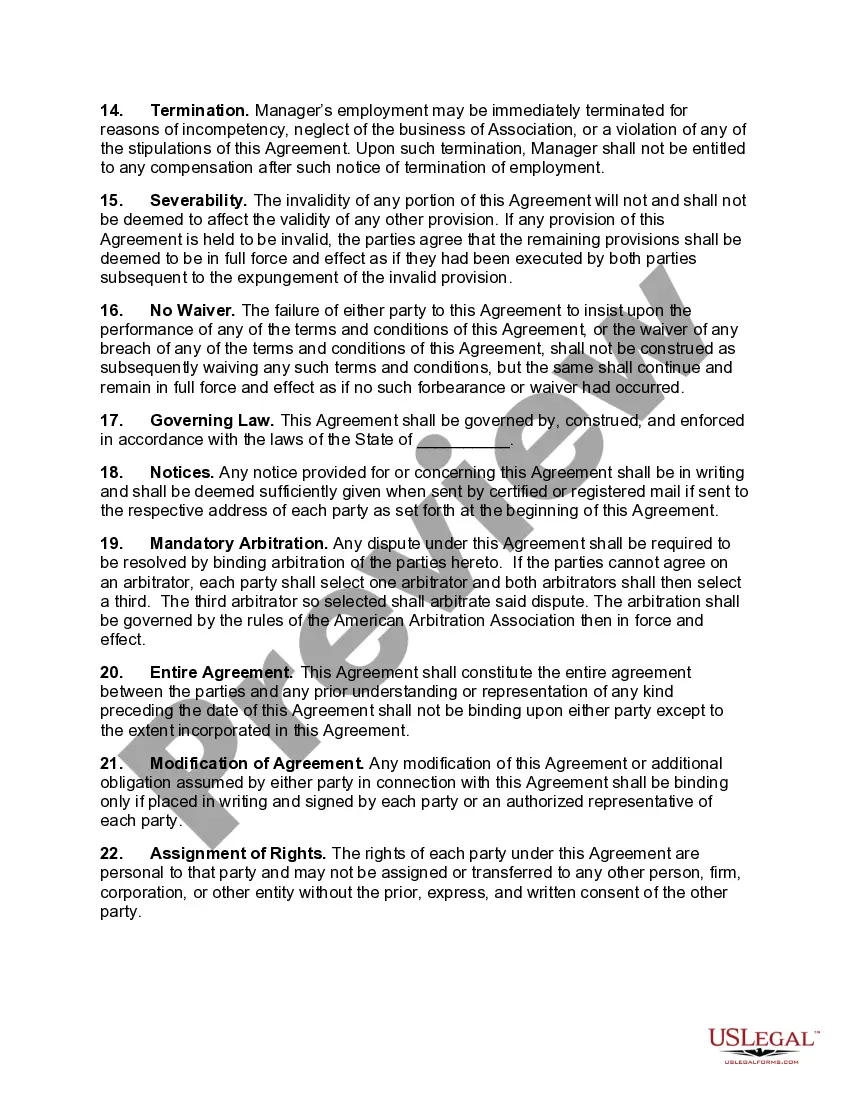
- Termination Clause: Details the grounds for terminating the manager's employment.
- Mandatory Arbitration: Establishes the process for resolving disputes under the agreement.

When to use this form
This form is ideal for use when a business or organization is planning to host an exposition or trade fair and requires a dedicated manager to oversee event logistics and marketing. Use this agreement to ensure that both parties understand their roles, responsibilities, and financial arrangements, particularly in scenarios where multiple similar events may take place.
Who this form is for
- Businesses or associations planning to organize expositions or trade fairs.
- Individuals being hired as managers for such events.
- Event planning committees looking for a structured management agreement.
Steps to complete this form
- Identify the parties involved: the manager and the association.
- Specify the duration of employment and the type of event to be managed.
- Fill in the compensation details, including salary and profit-sharing percentages.
- Outline the duties and responsibilities of the manager clearly.
- Ensure all parties sign the agreement to validate the terms outlined.
Is notarization required?
This form does not typically require notarization unless specified by local law. Users should review local regulations to ensure compliance with any notarization requirements.
Common mistakes to avoid
- Failing to specify clear metrics for profit sharing.
- Not including termination conditions.
- Omitting details about reimbursements for expenses.
- Overlooking the need for signatures from all parties involved.
Why complete this form online
- Easy access to a professionally drafted agreement anytime.
- Editable fields allow customization to fit specific needs.
- No need to navigate complex legal jargonâplain language is used.
- Reduces paperwork errors by providing a clear structure for completion.
Legal use & context
- This Agreement creates legally binding obligations between the Manager and the Association.
- It is enforceable in court as long as both parties have agreed to its terms and it is signed.
- Any misunderstanding in the agreement might result in disputes, emphasizing the need for clear terms.
Summary of main points
- The Agreement with Manager to Plan Events is essential for defining roles and responsibilities in event management.
- Proper completion of this agreement ensures clarity in compensation and performance expectations.
- Consulting legal guidance may be beneficial for compliance with local employment laws.
Form popularity
FAQ
Introduce yourself and the project. Begin with a brief introduction to you and your event planning business. Write an attractive event description. List all services provided. Show your previous work. Incorporate monetary information throughout.
A list of services being provided. The agreement should contain clear expectations as to what services are provided and what those services are. Payment schedule. Cancellation terms. Termination clause. Indemnification clause. Cancelation-by-you clause.
Get it in writing. Keep it simple. Deal with the right person. Identify each party correctly. Spell out all of the details. Specify payment obligations. Agree on circumstances that terminate the contract. Agree on a way to resolve disputes.
Create an executive summary. Compose your company description. Summarize market research and potential. Conduct competitive analysis. Describe your product or service. Develop a marketing and sales strategy. Compile your business financials.
Basic information: What the event is and when and where it will take place. Your mission: The event's purpose and how will it benefit the stakeholders. Your background: Information about you (the event creator) and anyone else involved. Budget: An estimated event income and expenditure.
Introduce yourself and the project. Begin with a brief introduction to you and your event planning business. Write an attractive event description. List all services provided. Show your previous work. Incorporate monetary information throughout.
Hourly Rate. Ask yourself what you think you are worth and decide on a set hourly rate. Flat Fee. Charging a flat fee is the most common and preferred method of billing your client. Percentage of the Event. Day-of Coordination. Vendor Commission.
Define goals and objectives. Establish an event budget. Build your events team. Pick your venue and date. Develop event branding. Plan your program. Confirm sponsors, exhibitors, and speakers. Identify and select your tech tools.
Mission statement. Business structure. Products and services. Target market and marketing plan. Finances.