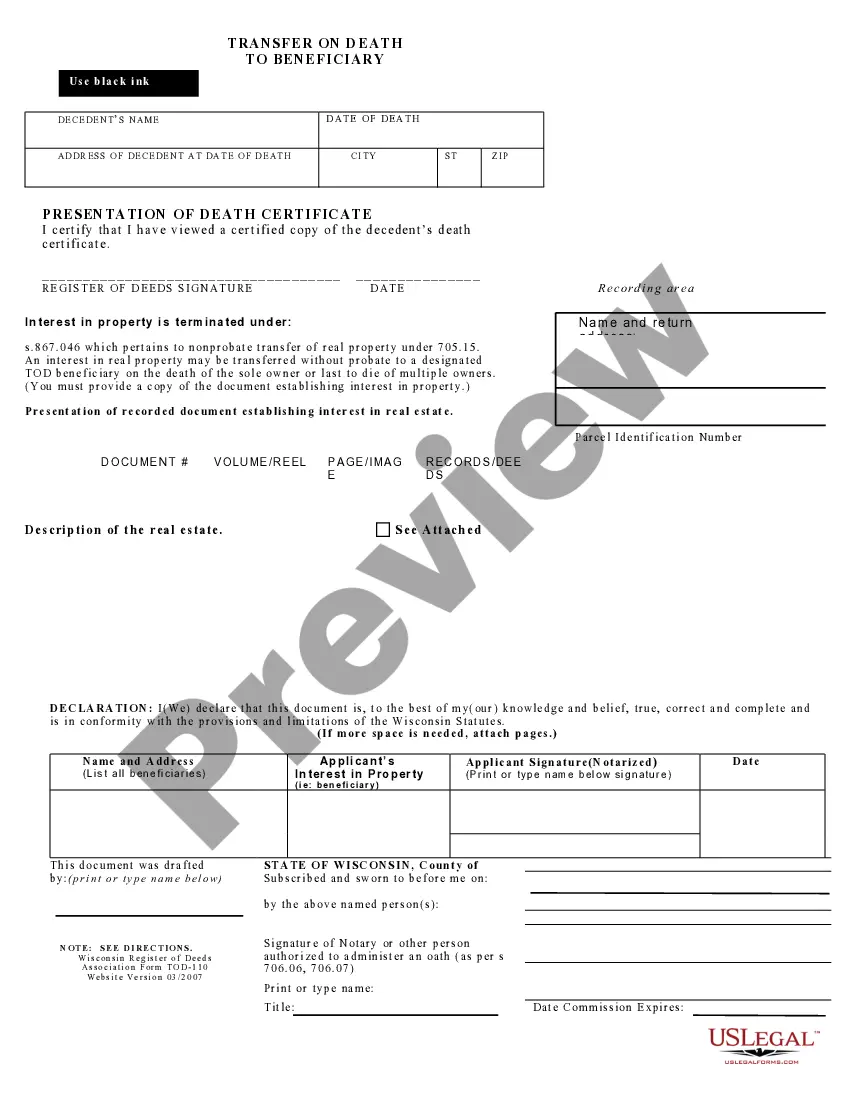
Tod Form For Property
Description

Get your form ready online
Our built-in tools help you complete, sign, share, and store your documents in one place.
Make edits, fill in missing information, and update formatting in US Legal Forms—just like you would in MS Word.
Download a copy, print it, send it by email, or mail it via USPS—whatever works best for your next step.
Sign and collect signatures with our SignNow integration. Send to multiple recipients, set reminders, and more. Go Premium to unlock E-Sign.
If this form requires notarization, complete it online through a secure video call—no need to meet a notary in person or wait for an appointment.
We protect your documents and personal data by following strict security and privacy standards.

Make edits, fill in missing information, and update formatting in US Legal Forms—just like you would in MS Word.

Download a copy, print it, send it by email, or mail it via USPS—whatever works best for your next step.

Sign and collect signatures with our SignNow integration. Send to multiple recipients, set reminders, and more. Go Premium to unlock E-Sign.

If this form requires notarization, complete it online through a secure video call—no need to meet a notary in person or wait for an appointment.

We protect your documents and personal data by following strict security and privacy standards.
Looking for another form?









How to fill out Wisconsin Transfer On Death Or TOD To Beneficiary - Official Form Used To Record Beneficiary's Interest Following Death Of Grantor?
- If you are a returning user, log in to your account and download the required TOD form by clicking the Download button. Ensure your subscription remains active, or renew it if necessary.
- For first-time users, start by reviewing the Preview mode and description of the TOD form. Confirm it matches your needs and aligns with your local jurisdiction's requirements.
- If adjustments are necessary, utilize the Search feature to find the appropriate template. Once suitable, proceed to the following step.
- Select and purchase the document. Click the Buy Now button, choose your preferred subscription plan, and create an account for full library access.
- Complete your transaction by entering your payment details, either via credit card or PayPal.
- Download your TOD form to your device. You'll also find it listed in the My Forms section of your account at any time.
In conclusion, US Legal Forms provides a user-friendly experience to obtain necessary legal documents quickly and reliably. With their extensive collection and expert assistance, you can ensure your TOD forms are filled out accurately.
Get started today by visiting US Legal Forms and empower yourself with the right legal tools!
Form popularity
FAQ
You can obtain a TOD form for property in Ohio through various means. First, check your local county recorder's office, as they often provide the necessary forms. Additionally, you can visit the US Legal Forms website, where you can easily find and download the appropriate TOD form for property tailored to Ohio's requirements. This online resource streamlines the process, ensuring you have the right documentation to complete your property transfer smoothly.
In Texas, a Tod form for property must be filed with the county clerk where the property is located. The deed must clearly name the beneficiaries, and there can be multiple recipients. It's important to note that the beneficiaries do not have ownership rights until your passing. Understanding the specific rules and requirements can help ensure your property transfers smoothly.
A Tod form for property may lack certain protections that other estate planning tools offer. For instance, it does not accommodate conditions or stipulations for the property transfer. Additionally, it does not allow for distribution of assets if you pass away with debts. Thus, it is crucial to consider these limitations when planning your estate.
While you do not necessarily need a lawyer to create a Tod form for property, consulting one can be beneficial. Legal expertise ensures that the form is filled out correctly, complies with state laws, and meets your specific needs. Platforms like US Legal Forms provide user-friendly templates that can simplify the process, making it easier for you to manage without a lawyer. However, complex situations may still warrant legal assistance.
A Tod form for property serves a similar purpose as a will by transferring ownership upon your death. However, it bypasses the probate process, making it quicker and often less costly than a will. While it can be a good option for many, it may not cover all your wishes or needs. Users should consider their specific circumstances to determine which option is best.
The drawbacks of transfer on death include potential challenges in changing beneficiaries and limitations on transferring properties with liens. A Tod form for property may not cover all scenarios, particularly for complex estates. It is important to assess your particular situation and consider various options, including wills and trusts, to ensure your wishes are upheld.
The best way to leave property upon death varies based on individual circumstances, but using a Tod form for property is often recommended for its simplicity. This method allows for quick transfer without the burden of probate. However, it's essential to discuss your options with a legal expert to choose the strategy that aligns best with your goals.
A Tod form for property does not inherently avoid capital gains tax; however, it may allow for a step-up in basis. This means that the property's value is reassessed at the time of death, reducing potential capital gains taxes for the heirs when they sell it. Consulting with a tax professional can provide clarity on this aspect.
The disadvantage of a Tod deed is that it cannot be easily altered once it is executed, potentially leading to unintended consequences. Additionally, if the beneficiary designated in the Tod form for property passes away before the owner, the property may become part of the owner's estate again, complicating matters for surviving heirs. Understanding these nuances is essential for effective estate planning.
A transfer on death form for property is a legal document that allows you to designate a beneficiary who will receive your property upon your death. This process bypasses probate, providing a simple way to transfer assets. It ensures that your wishes are fulfilled without the lengthy legal processes typically involved in estate planning.