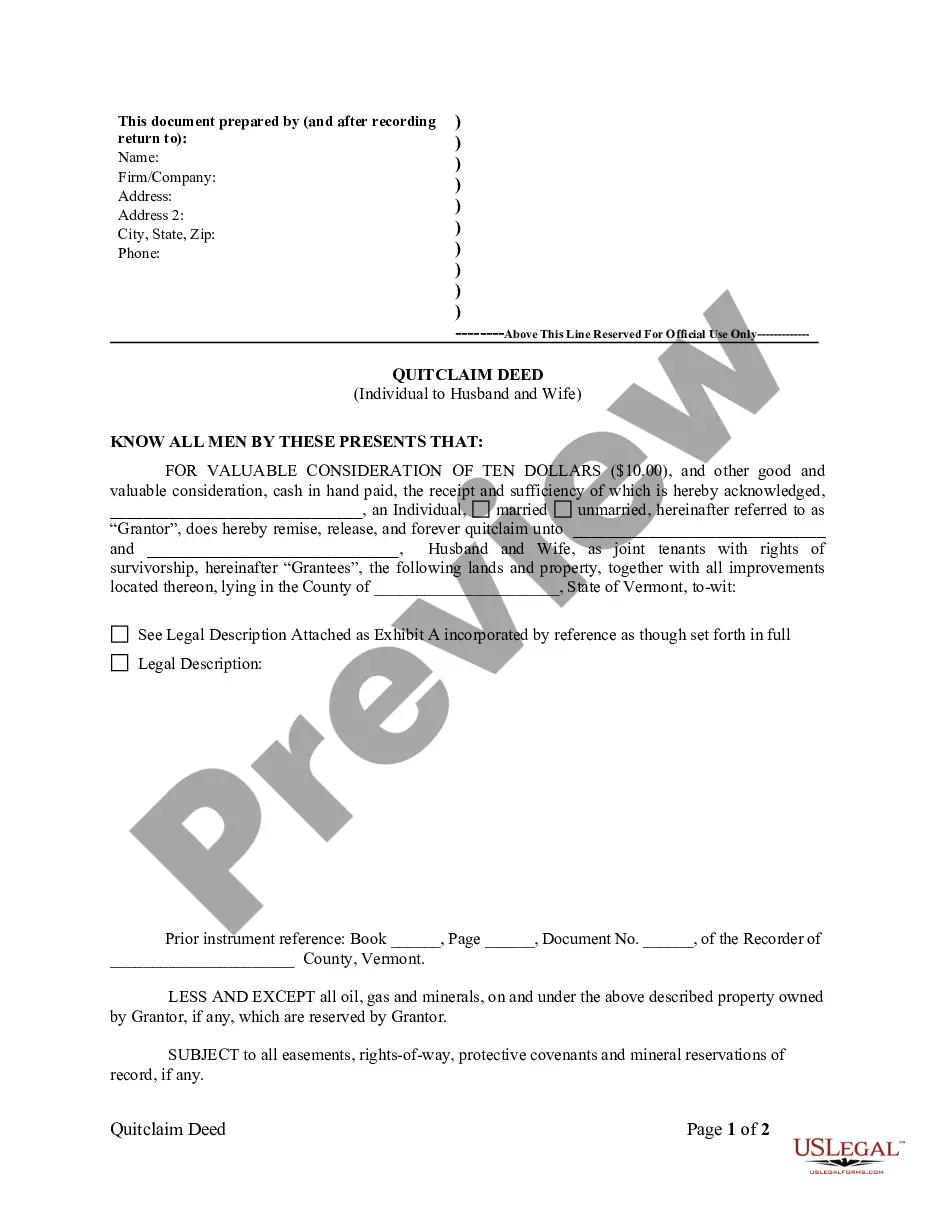
Quit Claim Deed Form Vermont With Living Trust
Description

Get your form ready online
Our built-in tools help you complete, sign, share, and store your documents in one place.
Make edits, fill in missing information, and update formatting in US Legal Forms—just like you would in MS Word.
Download a copy, print it, send it by email, or mail it via USPS—whatever works best for your next step.
Sign and collect signatures with our SignNow integration. Send to multiple recipients, set reminders, and more. Go Premium to unlock E-Sign.
If this form requires notarization, complete it online through a secure video call—no need to meet a notary in person or wait for an appointment.
We protect your documents and personal data by following strict security and privacy standards.

Make edits, fill in missing information, and update formatting in US Legal Forms—just like you would in MS Word.

Download a copy, print it, send it by email, or mail it via USPS—whatever works best for your next step.

Sign and collect signatures with our SignNow integration. Send to multiple recipients, set reminders, and more. Go Premium to unlock E-Sign.

If this form requires notarization, complete it online through a secure video call—no need to meet a notary in person or wait for an appointment.

We protect your documents and personal data by following strict security and privacy standards.
Looking for another form?



How to fill out Vermont Quitclaim Deed From Individual To Husband And Wife?
Administration necessitates exactness and correctness.
If you do not engage in completing documents like Quit Claim Deed Form Vermont With Living Trust every day, it may result in some misunderstanding.
Selecting the proper template from the outset will ensure that your file submission will proceed smoothly and avert any hassles of re-submitting a document or repeating the same task from scratch.
If you are not a registered user, finding the desired template will require a few extra steps.
- You can always acquire the suitable template for your documentation at US Legal Forms.
- US Legal Forms is the largest online collection of forms, providing more than 85 thousand templates across various fields.
- You can access the latest and most pertinent version of the Quit Claim Deed Form Vermont With Living Trust by simply searching it on the site.
- Find, store, and download templates in your account or refer to the description to confirm you have the correct one available.
- With an account at US Legal Forms, it is simple to gather, keep in one location, and search through the templates you have saved to retrieve them with just a few clicks.
- When on the website, click the Log In button to authenticate.
- Then, navigate to the My documents page, where the history of your documents is maintained.
- Review the descriptions of the documents and download those you need at any time.
Form popularity
FAQ
The usual reason for using a quitclaim deed is to transfer property between family members or in the context of a living trust. It is often utilized in situations like estate planning, where simplicity and speed are priorities. By employing the quit claim deed form Vermont with living trust, individuals can smoothly facilitate ownership transfers without complicated legal hurdles. This method can be particularly useful for expedient property transactions.
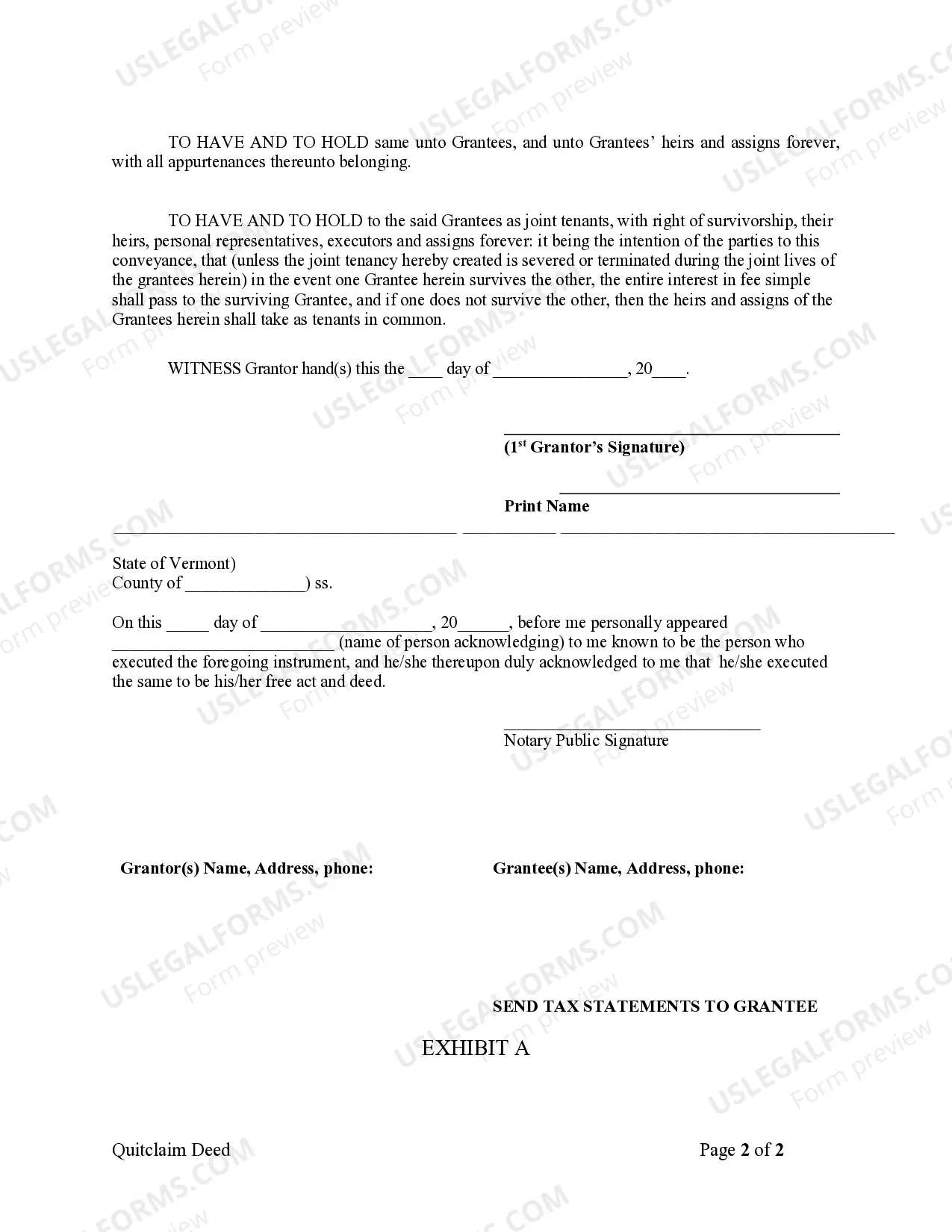
Filing a quitclaim deed in Vermont involves filling out the quit claim deed form Vermont with living trust. Once you complete the form, you must sign it in the presence of a notary. After notarization, submit the deed to your local town clerk’s office for official recording. This step is essential to ensure that the transfer of property rights is valid.
A warranty deed is a type of legal document that provides a guarantee that the property title is clear from any claims. Unlike a quit claim deed form Vermont with living trust, which does not offer such guarantees, a warranty deed assures the buyer that the seller holds valid title and has the right to sell the property. This protection can be vital in real estate transactions, providing peace of mind to both parties.
Yes, you can prepare your own quit claim deed. However, using a quit claim deed form Vermont with living trust can help ensure that you cover all legal requirements and avoid potential issues. You might find it beneficial to use templates or services that offer guidance in drafting these documents. This approach can provide peace of mind and clarity in your property transfer.
To transfer a deed in Vermont, you need to complete a quit claim deed form that accurately reflects the property details and the parties involved. It is essential to ensure the document is properly signed and notarized to validate the transfer. Once completed, you must file the quit claim deed with the local town clerk's office to make the transfer official. By using a quit claim deed form in Vermont with living trust provisions, you can facilitate a smooth and legally recognized transfer of property ownership.
Joint tenancy with the right of survivorship allows two or more people to own property together, where ownership automatically passes to the surviving tenants upon one owner’s death. This arrangement avoids probate and provides smoother property transitions. If you’re considering the Quit claim deed form Vermont with living trust, understanding these rights can help you make informed decisions about property ownership and succession planning.
A life estate deed allows a property owner to retain the right to live in the property for their lifetime while transferring ownership to another party after their death. This arrangement provides a secure living situation for the current occupant while ensuring property succession. If you're interested in the Quit claim deed form Vermont with living trust, you might explore how these options interact regarding estate planning and property rights.
The best deed to transfer property often depends on the situation. For maximum protection, a warranty deed is recommended, while a quitclaim deed is ideal for straightforward transfers among known parties. Considering the Quit claim deed form Vermont with living trust can streamline the process, especially for family-related transfers, making it a practical choice in many circumstances.
To record a deed in Vermont, you must submit the deed to the town clerk’s office in the municipality where the property is located. Ensure that all parties involved have signed the deed, and include any required documents such as a transfer tax return. Using the Quit claim deed form Vermont with living trust can simplify this process, as it clearly details property interests. Recording keeps the transaction public and ensures legal validity.
Quitclaim deeds are most often used for transferring property among family members, resolving disputes, or adding a family member to a property title. They provide a quick and easy way to transfer interest in property without the need for extensive legal work. If you're considering the Quit claim deed form Vermont with living trust, it's an excellent option for straightforward property transactions. However, be cautious of what you agree to.
