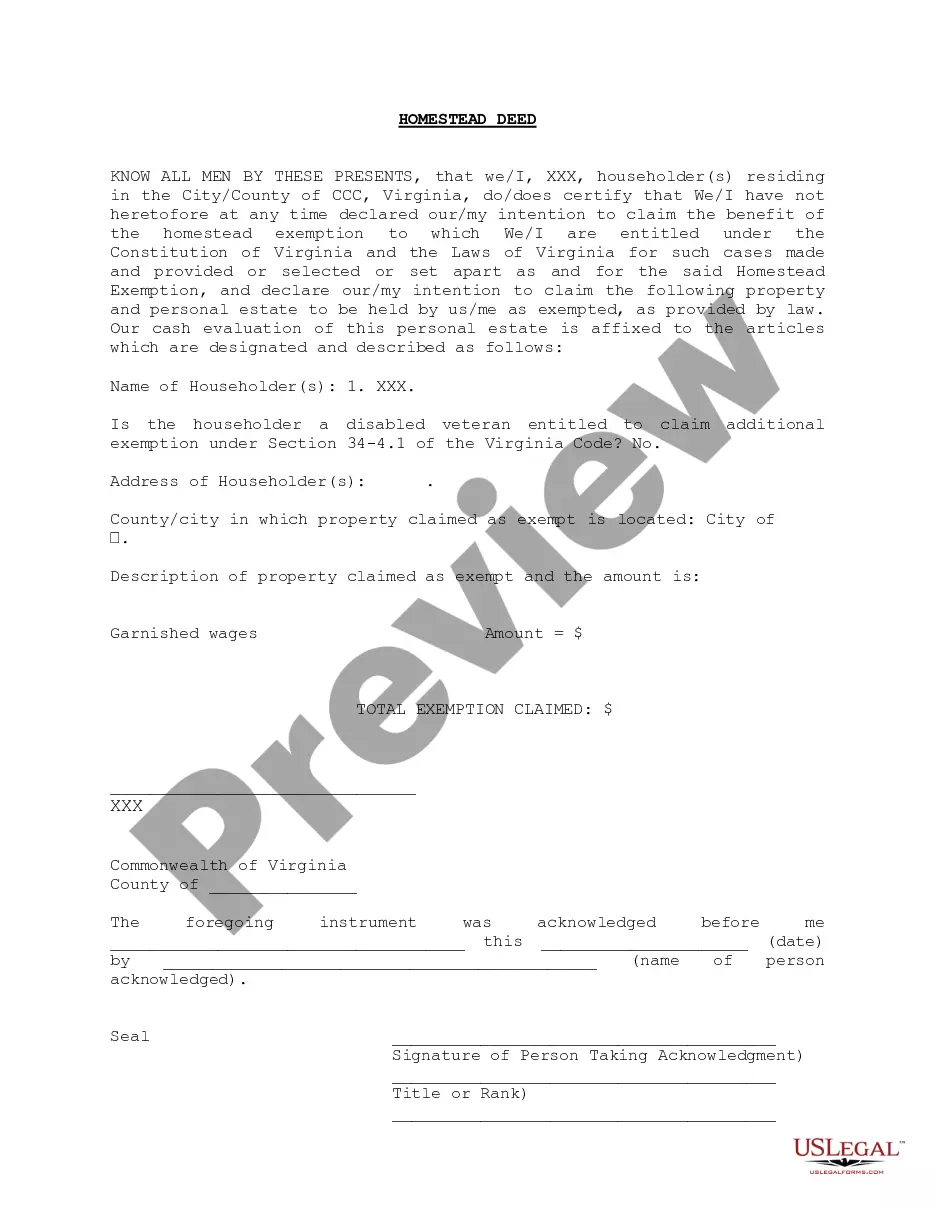
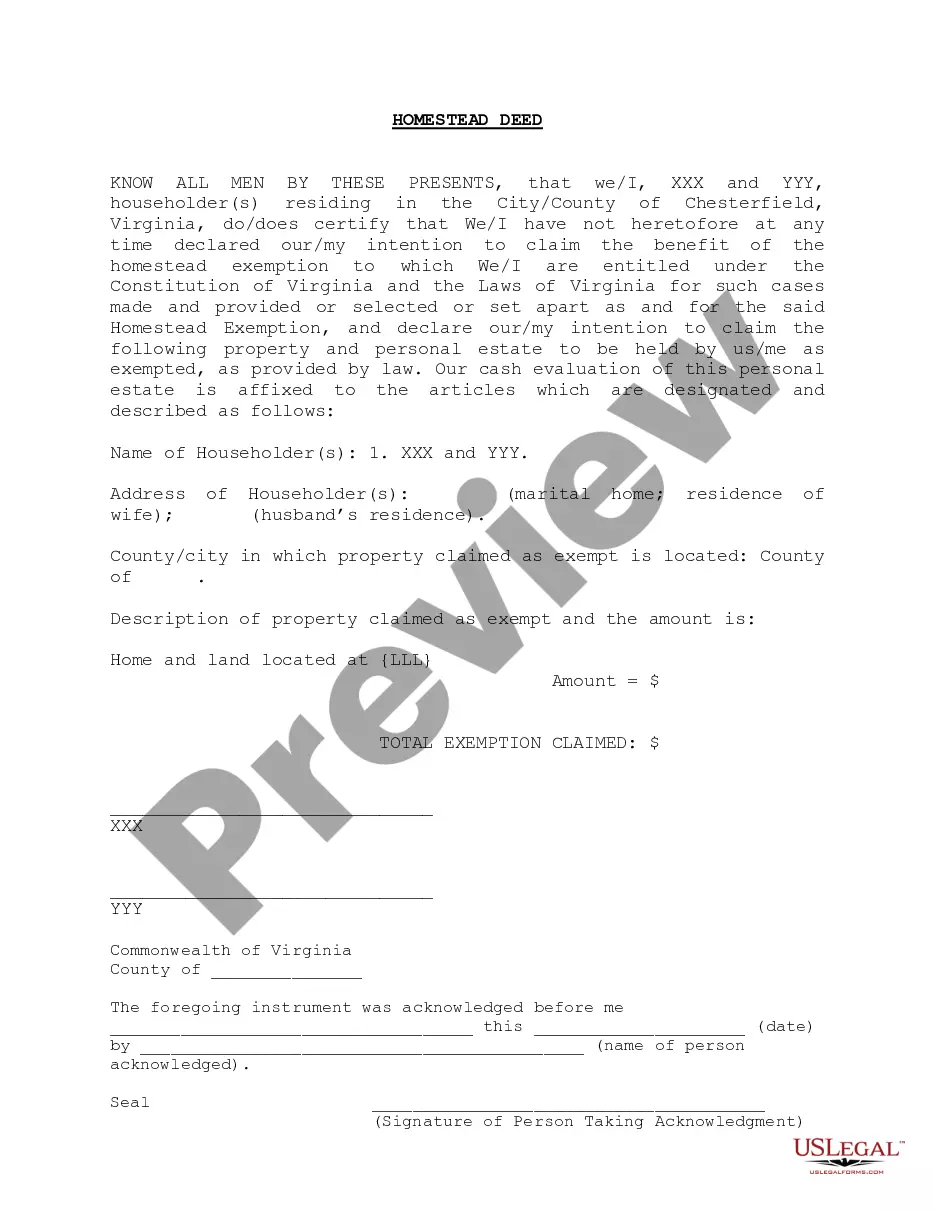
Exempt Person Homestead Foreign
Description

Get your form ready online
Our built-in tools help you complete, sign, share, and store your documents in one place.
Make edits, fill in missing information, and update formatting in US Legal Forms—just like you would in MS Word.
Download a copy, print it, send it by email, or mail it via USPS—whatever works best for your next step.
Sign and collect signatures with our SignNow integration. Send to multiple recipients, set reminders, and more. Go Premium to unlock E-Sign.
If this form requires notarization, complete it online through a secure video call—no need to meet a notary in person or wait for an appointment.
We protect your documents and personal data by following strict security and privacy standards.

Make edits, fill in missing information, and update formatting in US Legal Forms—just like you would in MS Word.

Download a copy, print it, send it by email, or mail it via USPS—whatever works best for your next step.

Sign and collect signatures with our SignNow integration. Send to multiple recipients, set reminders, and more. Go Premium to unlock E-Sign.

If this form requires notarization, complete it online through a secure video call—no need to meet a notary in person or wait for an appointment.

We protect your documents and personal data by following strict security and privacy standards.
Looking for another form?








How to fill out Virginia Homestead Deed For Single - Home?
Whether for commercial reasons or for personal affairs, everyone eventually has to deal with legal issues at some point in their lives.
Filling out legal paperwork requires meticulous attention, starting from choosing the appropriate template.
Once downloaded, you can fill out the form using editing software or print it and complete it by hand. With an extensive US Legal Forms library available, you don’t need to waste time searching for the suitable sample across the internet. Utilize the catalog's straightforward navigation to find the appropriate form for any circumstance.
- For example, if you select an incorrect variant of an Exempt Person Homestead Foreign, it will be declined upon submission.
- Thus, it is crucial to have a dependable source for legal documents such as US Legal Forms.
- If you need to obtain a sample of Exempt Person Homestead Foreign, follow these straightforward steps.
- Find the template you require using the search feature or catalog browsing.
- Review the form's description to confirm it fits your case, jurisdiction, and locality.
- Click on the form's preview to view it.
- If it is the wrong form, return to the search tool to find the Exempt Person Homestead Foreign sample you need.
- Obtain the file if it corresponds with your specifications.
- If you already possess a US Legal Forms account, simply click Log in to access previously saved documents in My documents.
- If you do not yet have an account, you can download the template by clicking Buy now.
- Choose the correct pricing option.
- Complete the profile registration form.
- Select your payment method: you can utilize a credit card or PayPal account.
- Choose the document format you desire and download the Exempt Person Homestead Foreign.
Form popularity
FAQ
Eligibility for the homestead exemption varies by state, but generally, it includes homeowners who use their property as their primary residence. Some states may have additional requirements regarding age, disability, or income. If you are an exempt person homestead foreign, it’s crucial to understand your state's specific guidelines to ensure you qualify.
In Louisiana, homeowners can qualify for homestead exemption if they occupy their property as their primary residence. The property must not exceed a certain assessed value, and it must be owned by the applicant. If you identify as an exempt person homestead foreign, ensure that you review Louisiana's regulations to determine your eligibility.
Ohio's homestead exemption allows eligible homeowners to reduce the taxable value of their primary residence. This exemption applies to those who are 65 years or older, permanently disabled, or meet certain income criteria. If you are an exempt person homestead foreign, check if you meet Ohio's specific requirements to take advantage of this beneficial exemption.
In Alabama, a homestead must be a single-family residence that you occupy. The property must be used exclusively for residential purposes, and certain size and value limits may apply. If you are an exempt person homestead foreign, you might still qualify if you meet the residency criteria outlined by the state.
Certain individuals may be excluded from the homestead Act, including those who do not occupy the property as their primary residence. Additionally, property owners who hold their property as a business or investment may not qualify. If you are an exempt person homestead foreign, be sure to confirm your status because some exemptions may apply differently based on state laws.
Eligibility for homestead exemption typically includes homeowners who occupy their property as their primary residence. Generally, states require that you are a resident and meet specific legal criteria. In many cases, an exempt person homestead foreign may also qualify if they meet the residency requirements set by the state. It’s important to check local laws for specific details.
Obtaining a homestead exemption form is straightforward. You can visit your local tax authority's website or contact them directly to request the form. Additionally, platforms like USLegalForms provide easy access to these forms, along with helpful resources to assist you in completing your application as an exempt person homestead foreign.
To claim the foreign income exclusion, you must file Form 2555 along with your tax return. This form allows you to exclude a certain amount of foreign earned income if you qualify as an exempt person homestead foreign. Ensure that you meet the necessary criteria, such as the physical presence test or the bona fide residence test, to take advantage of this exclusion.
The IRS defines a foreign person as an individual who is not a U.S. citizen or a U.S. resident alien. This definition plays a crucial role in determining your tax obligations and eligibility for certain exemptions, including the exempt person homestead foreign. Understanding this classification can help you navigate your tax responsibilities effectively.
To apply for a homestead exemption, you typically need to complete the appropriate form provided by your local tax authority. This form usually requires basic information about your property and your status as an exempt person homestead foreign. You can easily find the necessary form on the website of your local government or through platforms like USLegalForms, which can guide you through the process.