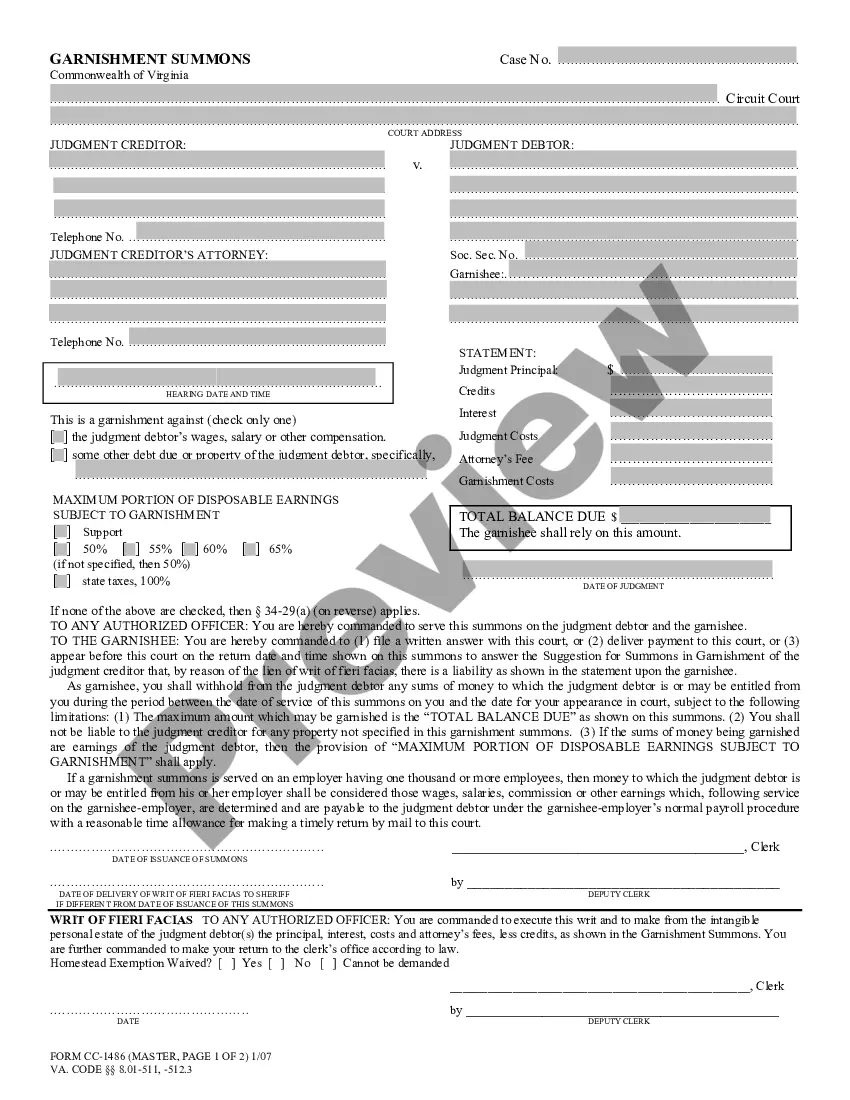
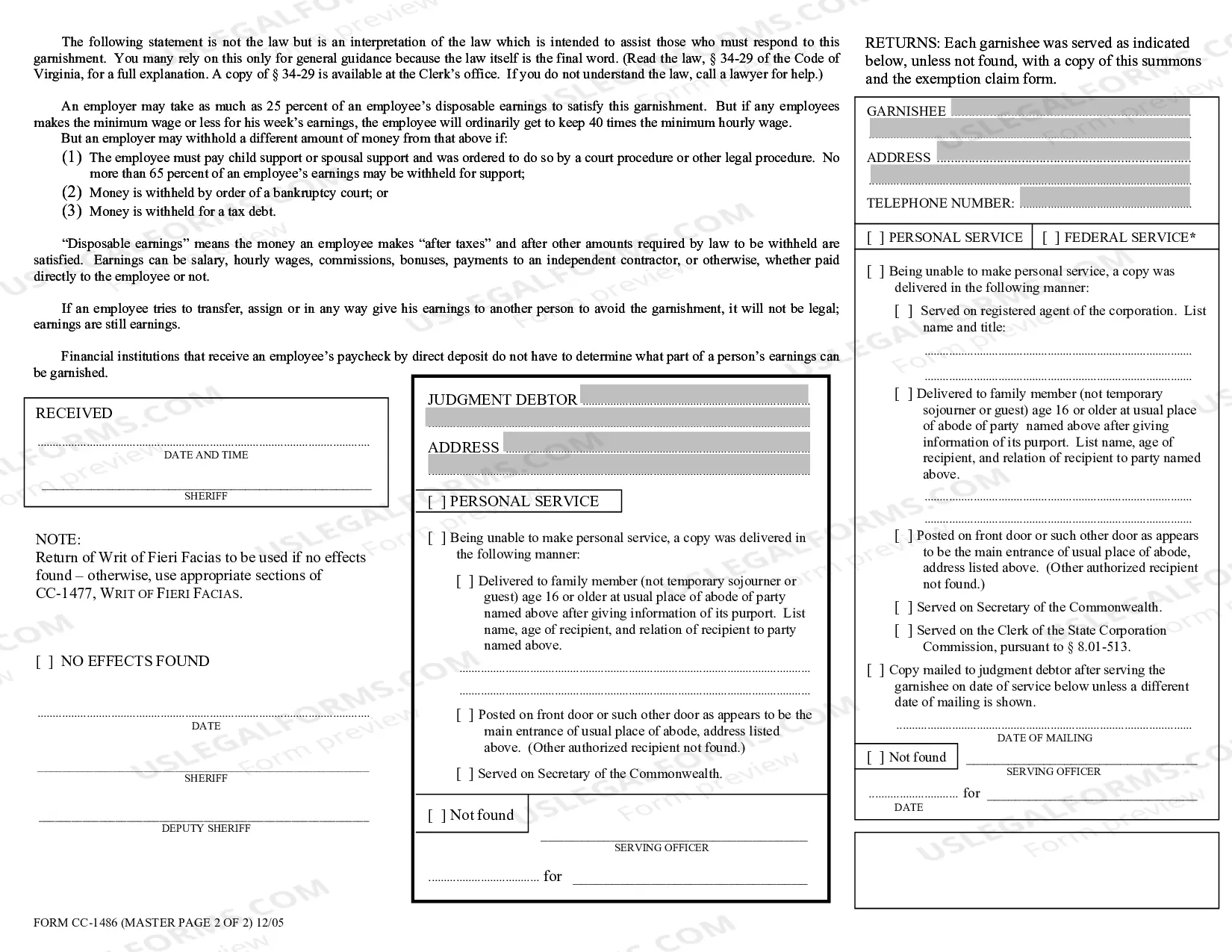
This is an official form from the Virginia Judicial System, which complies with all applicable laws and statutes. USLF amends and updates the forms as is required by Virginia statutes and law.
Garnishee Summons Form Alberta
Instant download
This website is not affiliated with any governmental entity
Public form
Description
Free preview
Get your form ready online
Our built-in tools help you complete, sign, share, and store your documents in one place.
Built-in online Word editor
Make edits, fill in missing information, and update formatting in US Legal Forms—just like you would in MS Word.
Export easily
Download a copy, print it, send it by email, or mail it via USPS—whatever works best for your next step.
E-sign your document
Sign and collect signatures with our SignNow integration. Send to multiple recipients, set reminders, and more. Go Premium to unlock E-Sign.
Notarize online 24/7
If this form requires notarization, complete it online through a secure video call—no need to meet a notary in person or wait for an appointment.
Store your document securely
We protect your documents and personal data by following strict security and privacy standards.

Make edits, fill in missing information, and update formatting in US Legal Forms—just like you would in MS Word.

Download a copy, print it, send it by email, or mail it via USPS—whatever works best for your next step.

Sign and collect signatures with our SignNow integration. Send to multiple recipients, set reminders, and more. Go Premium to unlock E-Sign.

If this form requires notarization, complete it online through a secure video call—no need to meet a notary in person or wait for an appointment.

We protect your documents and personal data by following strict security and privacy standards.
Looking for another form?









How to fill out Virginia Garnishment Summons?
Regardless of whether it's for professional reasons or personal issues, everyone must confront legal matters at some stage in their life.
Completing legal paperwork requires meticulous attention, starting with choosing the appropriate form template.
With a comprehensive US Legal Forms catalog available, you won't need to waste time searching for the appropriate template online. Utilize the library’s easy navigation to find the right template for any circumstance.
- For instance, if you choose an incorrect version of the Garnishee Summons Form Alberta, it will be turned down when submitted.
- Thus, it's crucial to obtain a trustworthy source of legal documents like US Legal Forms.
- To acquire a Garnishee Summons Form Alberta template, adhere to these straightforward steps.
- Retrieve the template you need by using the search field or browsing the catalog.
- Review the form’s description to ensure it aligns with your situation, state, and region.
- Click on the form’s preview to examine it.
- If it's the wrong form, return to the search feature to find the Garnishee Summons Form Alberta sample you need.
- Download the template once it fits your requirements.
- If you already possess a US Legal Forms account, simply click Log in to access previously saved documents in My documents.
- In case you don’t have an account yet, you can download the form by clicking Buy now.
- Choose the correct pricing option.
- Fill out the account registration form.
- Select your payment method: you can utilize a credit card or PayPal account.
- Choose the file format you desire and download the Garnishee Summons Form Alberta.
- Once saved, you can fill out the form using editing tools or print it and complete it by hand.
Form popularity
FAQ
Garnishment is legal for a creditor after the court grants a judgment against you. The creditor must go to court and establish that a debt is owed. If they establish that a debt is owed, the creditor gets a judgment against you as the debtor. And then, the court issues a summons.
Garnishee Process ? A process where the enforcement creditor obtains authority pursuant to the Civil Enforcement Act to have a third party (e.g. an employer or bank) pay monies into court to pay off the debt of an enforcement debtor. Indemnity ? Security or guaranteed compensation for damage or loss.
Once the Summons has been received, the garnishee has 15 days to serve a copy of the Summons upon the debtor, either personally or by mail. The garnishee must also, within 15 days, deliver a response to the court clerk along with the funds or a statement denying that the garnishee has any obligation to the debtor.
In Alberta, the first $800 of your monthly salary is exempt from garnishment. Creditors can take up to 50% of amounts between $800 and $2400, and 100% of amounts above $2400. There is no maximum garnishment amount ? but the process will, of course, end when the debt is repaid.
The Garnishee Summons is addressed to the Garnishee (person or business owing money to the debtor) and directs that the money be paid into court rather than to the debtor. A Garnishee Summons is in effect for two years from the date of issuance in all instances except where a bank account is garnisheed.