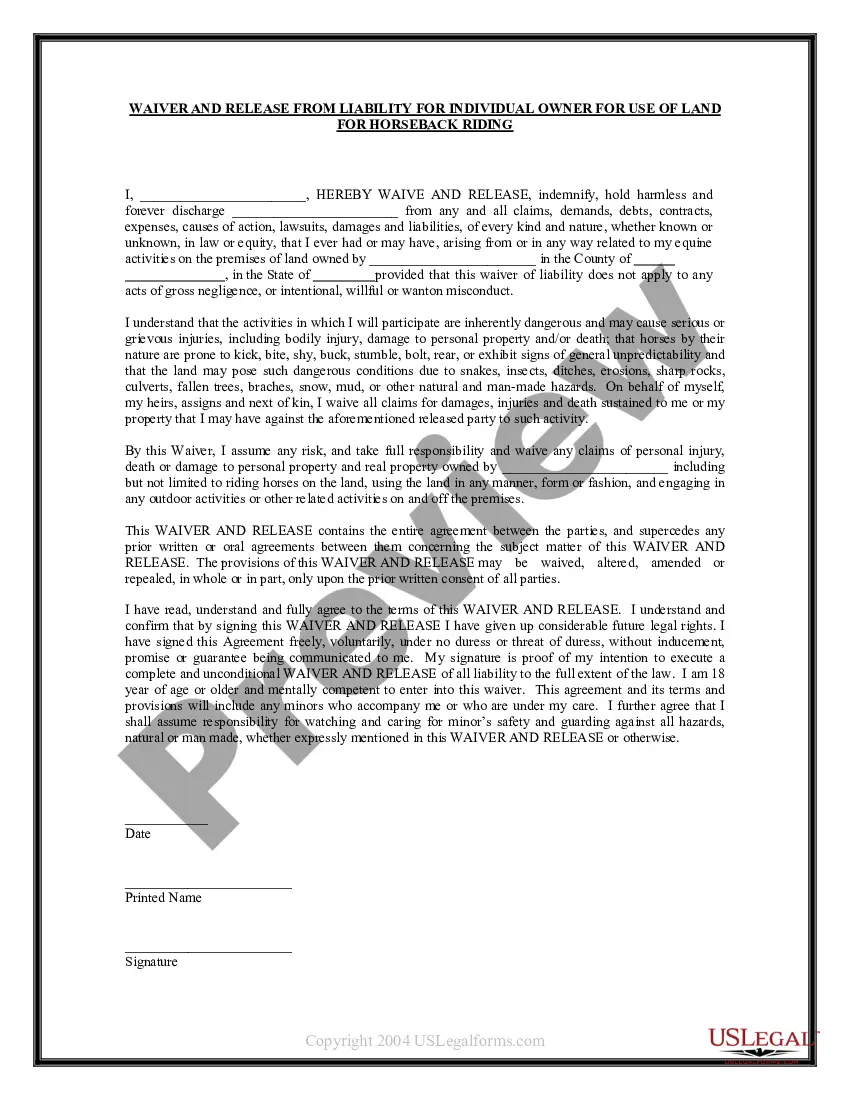
Waiver Release Form With Answer
Description
Get your form ready online
Our built-in tools help you complete, sign, share, and store your documents in one place.
Make edits, fill in missing information, and update formatting in US Legal Forms—just like you would in MS Word.
Download a copy, print it, send it by email, or mail it via USPS—whatever works best for your next step.
Sign and collect signatures with our SignNow integration. Send to multiple recipients, set reminders, and more. Go Premium to unlock E-Sign.
If this form requires notarization, complete it online through a secure video call—no need to meet a notary in person or wait for an appointment.
We protect your documents and personal data by following strict security and privacy standards.

Make edits, fill in missing information, and update formatting in US Legal Forms—just like you would in MS Word.

Download a copy, print it, send it by email, or mail it via USPS—whatever works best for your next step.

Sign and collect signatures with our SignNow integration. Send to multiple recipients, set reminders, and more. Go Premium to unlock E-Sign.

If this form requires notarization, complete it online through a secure video call—no need to meet a notary in person or wait for an appointment.

We protect your documents and personal data by following strict security and privacy standards.
Looking for another form?








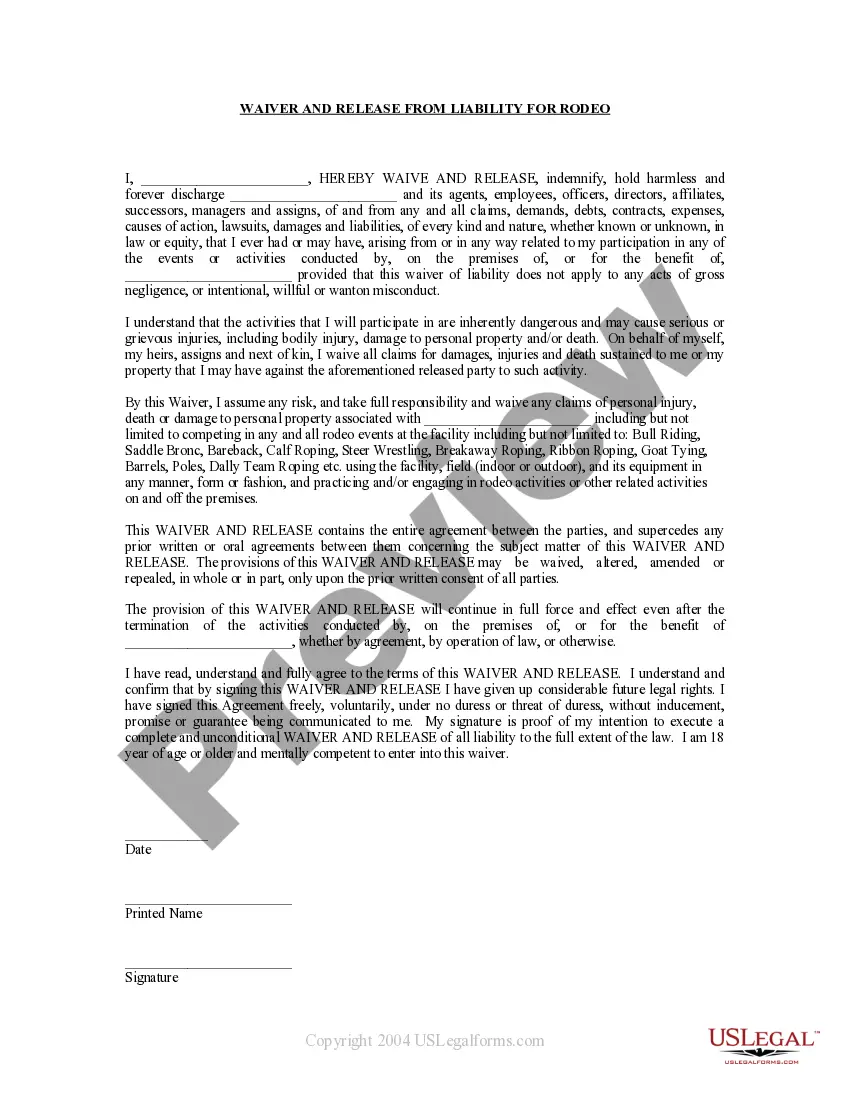
How to fill out Waiver And Release From Liability For Adult For Rodeo?
Regardless of whether you regularly handle documents or occasionally need to send a legal report, it is crucial to access a valuable resource where all the samples are interconnected and current.
The first step you should take with a Waiver Release Form With Answer is to ensure it is the latest version, as this determines its eligibility for submission.
If you want to simplify your search for the most recent document examples, look for them on US Legal Forms.
Avoid the hassle of dealing with legal documents. All your templates will be organized and validated with an account at US Legal Forms.
- US Legal Forms is a repository of legal forms that includes nearly any document example you may need.
- Search for the required templates, assess their relevance immediately, and learn more about their application.
- With US Legal Forms, you have access to over 85,000 document templates across a broad range of areas.
- Locate the Waiver Release Form With Answer examples in just a few clicks and save them anytime in your profile.
- Having a US Legal Forms profile will provide you with easier access to all the samples you need with added convenience and less hassle.
- Simply click Log In in the website header and access the My documents section where all the forms you need are at your fingertips, eliminating the need to spend time searching for the appropriate template or verifying its credibility.
- To acquire a form without an account, follow these steps.
Form popularity
FAQ
Release Versus Waiver The main difference between releases and waivers is the transferring of ownership. When rights are released, they are transferred to another party. When rights are waived, they are gone altogether.
Types of WaiversWaiver of Liability. A waiver of liability is a provision in a contract by which any person participating in an activity forfeits the right to sue the organization.Waiver of Premium.Waiver of Subrogation.Loan Waiver.
A waiver is not complete until it includes the signatures of both the event host and business owner and that of the participant. The date should also be included alongside the signatures. You may also include a signature line for a witness if necessary.
Examples of waivers include the waiving of parental rights, waiving liability, tangible goods waivers, and waivers for grounds of inadmissibility. Waivers are common when finalizing lawsuits, as one party does not want the other pursuing them after a settlement is transferred.
A waiver is a formal statement giving up a right. If you go on a school trip, your mom might sign a waiver saying that the school is not responsible if you get hurt on the trip. When you sign a waiver, you're voluntarily giving up a privilege or legal right.