Law Sex Information With Third Parties
Description
Get your form ready online
Our built-in tools help you complete, sign, share, and store your documents in one place.
Make edits, fill in missing information, and update formatting in US Legal Forms—just like you would in MS Word.
Download a copy, print it, send it by email, or mail it via USPS—whatever works best for your next step.
Sign and collect signatures with our SignNow integration. Send to multiple recipients, set reminders, and more. Go Premium to unlock E-Sign.
If this form requires notarization, complete it online through a secure video call—no need to meet a notary in person or wait for an appointment.
We protect your documents and personal data by following strict security and privacy standards.

Make edits, fill in missing information, and update formatting in US Legal Forms—just like you would in MS Word.

Download a copy, print it, send it by email, or mail it via USPS—whatever works best for your next step.

Sign and collect signatures with our SignNow integration. Send to multiple recipients, set reminders, and more. Go Premium to unlock E-Sign.

If this form requires notarization, complete it online through a secure video call—no need to meet a notary in person or wait for an appointment.

We protect your documents and personal data by following strict security and privacy standards.
Looking for another form?





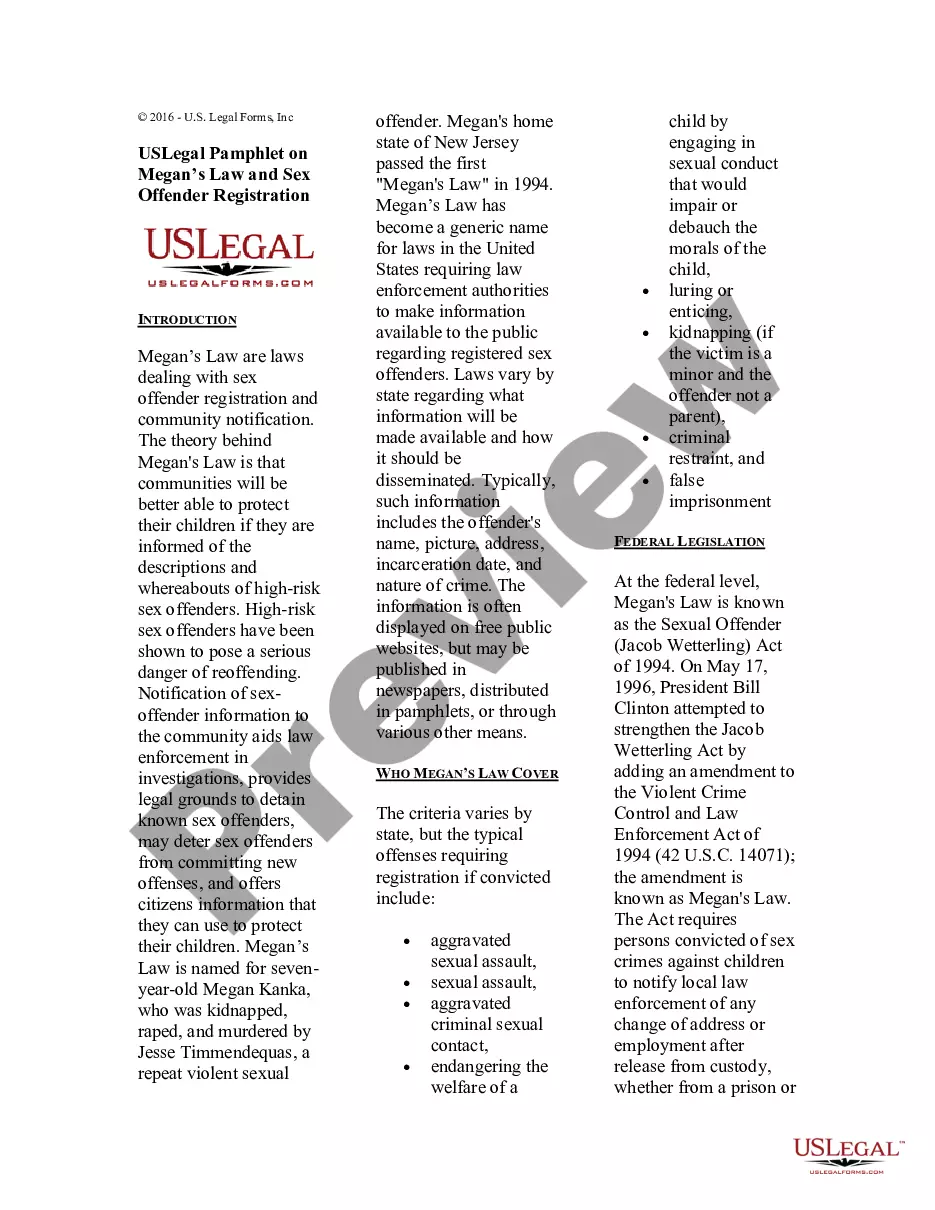
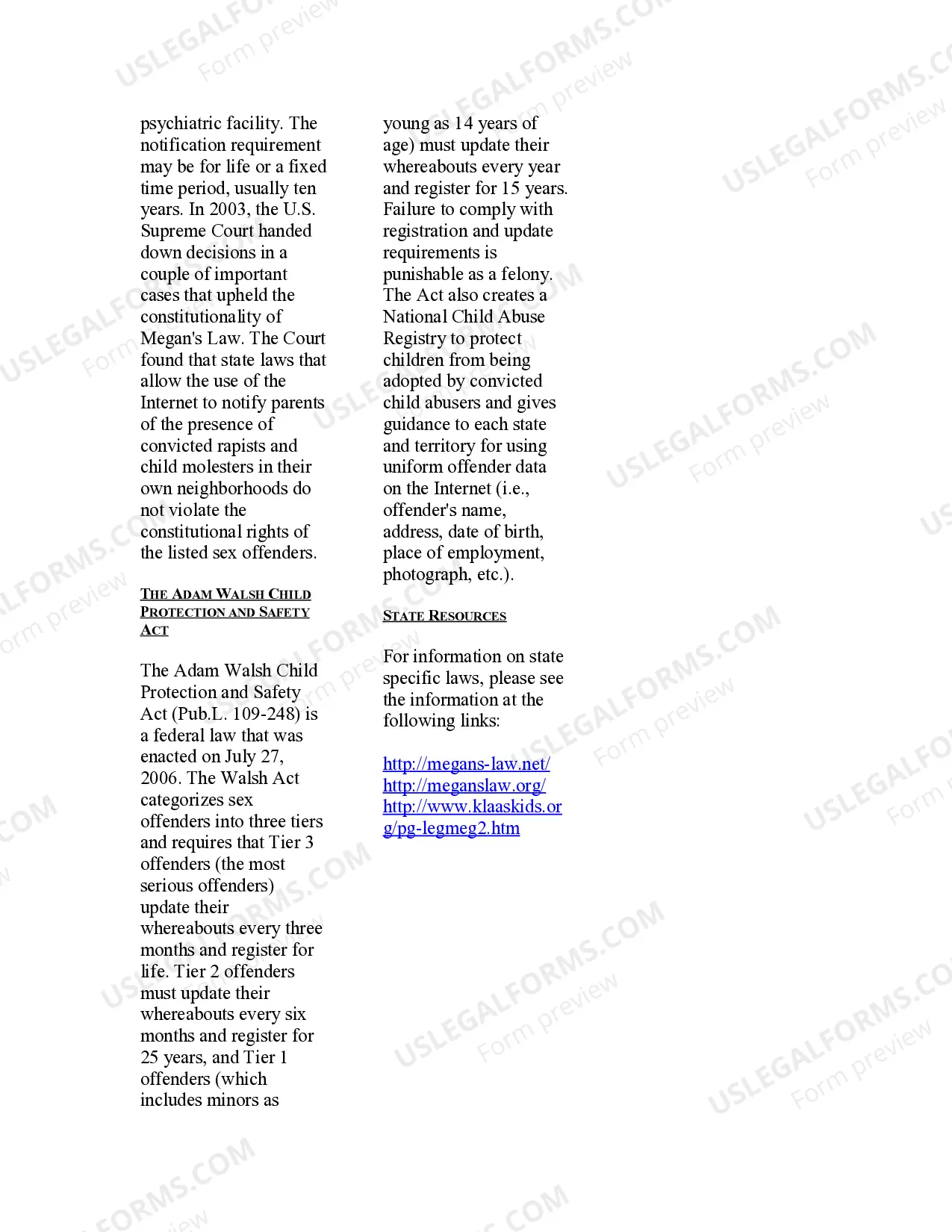
How to fill out USLegal Pamphlet On Megan's Law And Sex Offender Registration?
Dealing with legal paperwork and processes can be a lengthy addition to your schedule.
Law Sex Information With Third Parties and similar forms generally require you to locate them and comprehend how to fill them out accurately.
Therefore, if you are managing financial, legal, or personal issues, having an exhaustive and accessible online directory of forms available when needed will be of great help.
US Legal Forms is the premier online platform for legal templates, boasting over 85,000 state-specific forms and an array of tools to facilitate the completion of your documents with ease.
Is this your first time using US Legal Forms? Sign up and create your account in just a few minutes to access the form directory and Law Sex Information With Third Parties. Then, follow the steps outlined below to fill out your form: Ensure you have identified the correct form by utilizing the Review feature and examining the form details. Select Buy Now when prepared, and choose the monthly subscription plan that suits you best. Click Download then fill out, eSign, and print the form. US Legal Forms has 25 years of expertise in helping users manage their legal documents. Find the form you need today and streamline any process effortlessly.
- Browse the collection of relevant documents accessible to you with just one click.
- US Legal Forms provides state- and county-specific forms that can be downloaded at any time.
- Secure your document management tasks by utilizing a high-quality service that enables you to prepare any form in minutes without any extra or concealed fees.
- Simply Log In to your account, locate Law Sex Information With Third Parties and obtain it instantly from the My documents section.
- You can also retrieve previously stored forms.
Form popularity
FAQ
Third Party Requests may include valid search warrants, court orders, or subpoenas, or any other request for which there is written consent from End Users permitting a disclosure.
Specifically, there are two types of legal claims that relate to unauthorized publication of personal and private information: Publication of Private Facts: The legal claim known as "publication of private facts" is a species of invasion of privacy.
To put it simply, a third-party subpoena request (or as it's formally known, a ?subpoena duces tecum?) is a court order outlining evidentiary documents to produce on behalf of a party or parties outside your organization.
What is a Third-Party Record? A third-party record is a document or other record that has personal information about the victim or another witness. It's something that the victim could reasonably expect to be kept private. This means that it's something the victim never thought would be seen by other people.
Conditions of Disclosure to Third Parties. The general rule under the Privacy Act is that an agency cannot disclose a record contained in a system of records unless the individual to whom the record pertains gives prior written consent to the disclosure. There are twelve exceptions to this general rule.