Joint Tenancy For Bank Account
Description

Get your form ready online
Our built-in tools help you complete, sign, share, and store your documents in one place.
Make edits, fill in missing information, and update formatting in US Legal Forms—just like you would in MS Word.
Download a copy, print it, send it by email, or mail it via USPS—whatever works best for your next step.
Sign and collect signatures with our SignNow integration. Send to multiple recipients, set reminders, and more. Go Premium to unlock E-Sign.
If this form requires notarization, complete it online through a secure video call—no need to meet a notary in person or wait for an appointment.
We protect your documents and personal data by following strict security and privacy standards.

Make edits, fill in missing information, and update formatting in US Legal Forms—just like you would in MS Word.

Download a copy, print it, send it by email, or mail it via USPS—whatever works best for your next step.

Sign and collect signatures with our SignNow integration. Send to multiple recipients, set reminders, and more. Go Premium to unlock E-Sign.

If this form requires notarization, complete it online through a secure video call—no need to meet a notary in person or wait for an appointment.

We protect your documents and personal data by following strict security and privacy standards.
Looking for another form?



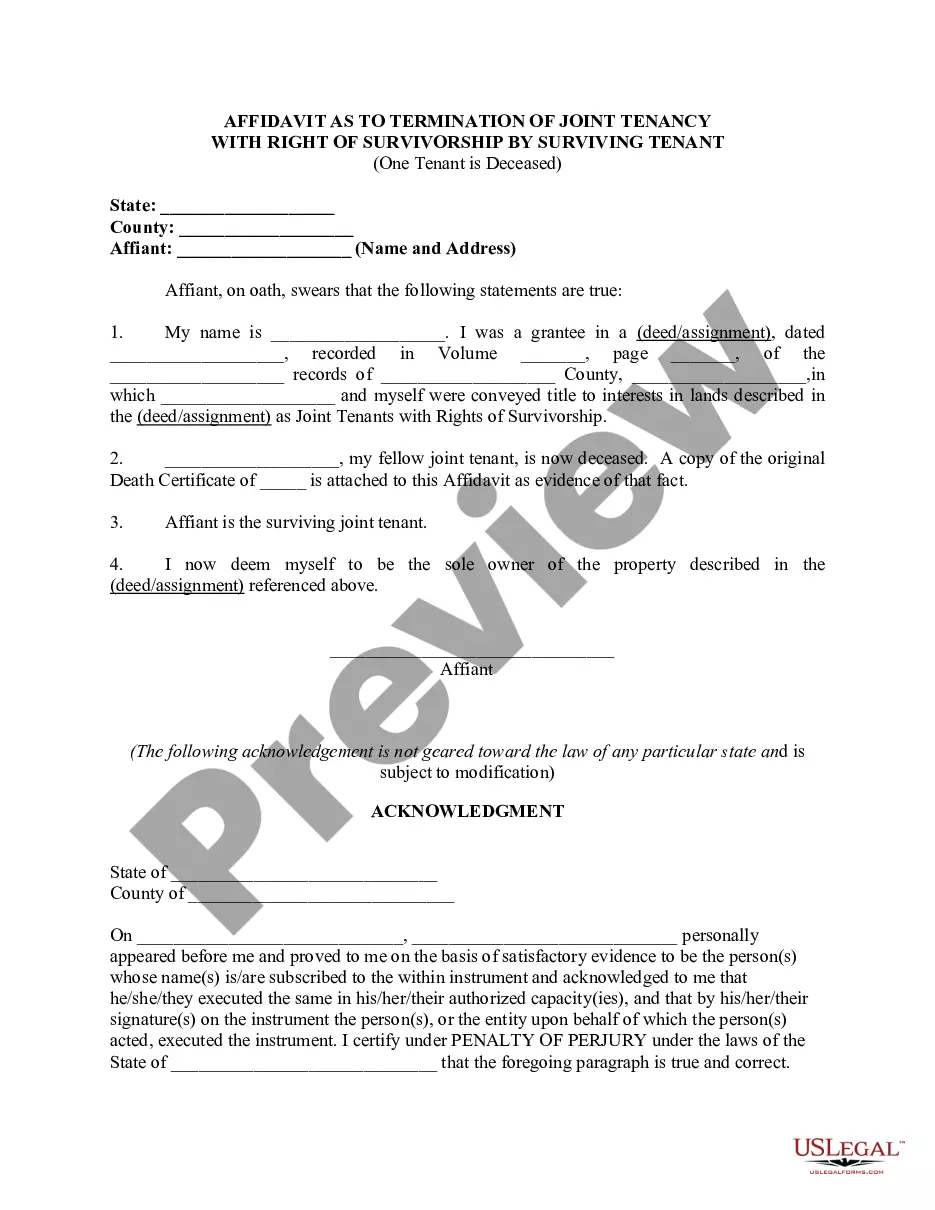
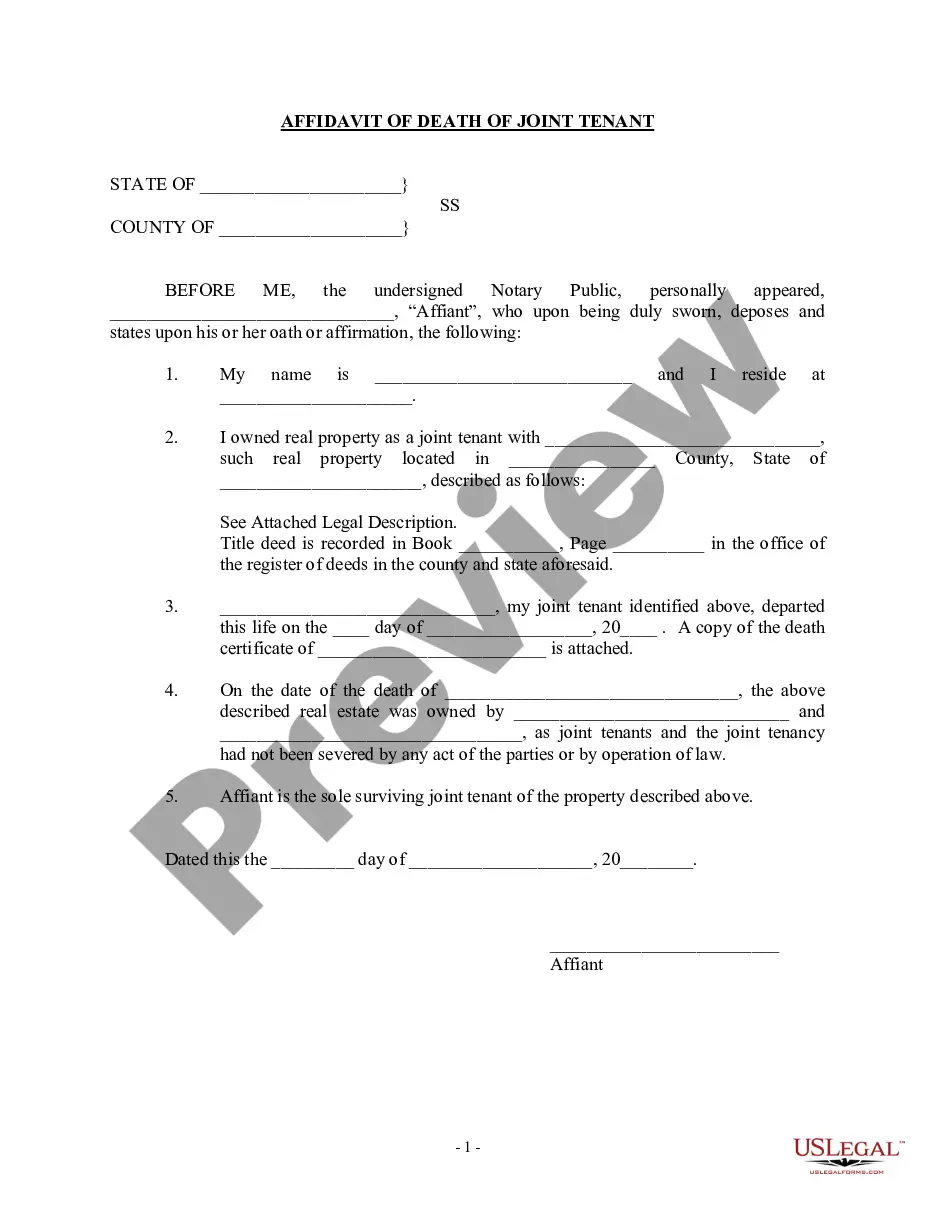
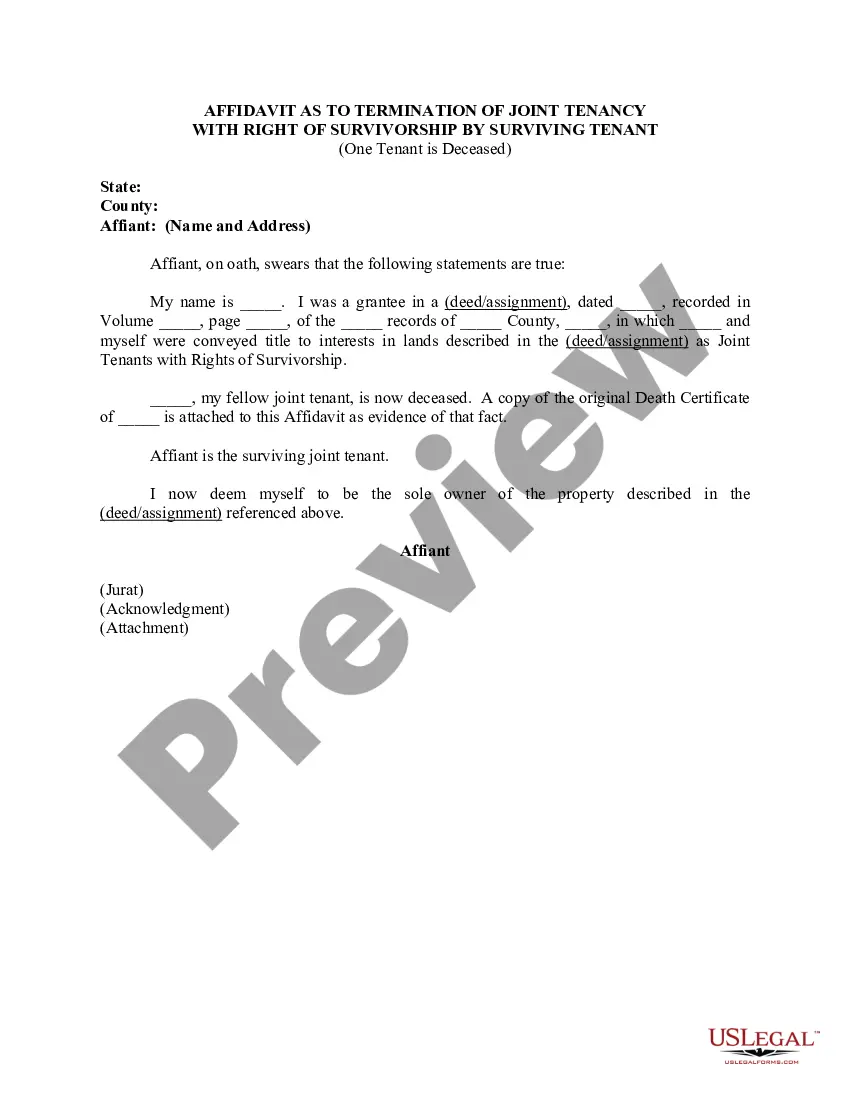
How to fill out Affidavit For Transferring Property After Death In Joint Tenancy With Right Of Survivorship By Surviving Tenant When One Tenant Is Deceased?
Regardless of whether it is for corporate endeavors or personal issues, individuals must deal with legal circumstances at some point in their lives.
Completing legal documentation requires meticulous focus, starting with selecting the appropriate form template.
With an extensive collection at US Legal Forms available, you won’t need to waste time searching for the appropriate template online. Utilize the library’s easy navigation to secure the correct form for any situation.
- For example, if you choose an incorrect version of a Joint Tenancy For Bank Account, it will be rejected upon submission.
- Thus, it is crucial to have a trustworthy provider of legal documents like US Legal Forms.
- To acquire a Joint Tenancy For Bank Account template, follow these straightforward steps.
- 1. Locate the necessary template by using the search bar or browsing the catalog.
- 2. Review the form’s description to confirm it fits your needs, state, and county.
- 3. Click on the form’s preview to examine it.
- 4. If it is not the right form, return to the search feature to find the Joint Tenancy For Bank Account sample you require.
- 5. Download the document when it meets your specifications.
- 6. If you already possess a US Legal Forms account, simply click Log in to access any previously saved templates in My documents.
- 7. If you do not yet have an account, you can download the form by clicking Buy now.
- 8. Choose the appropriate pricing option.
- 9. Complete the profile registration form.
- 10. Select your payment method: you may use a credit card or PayPal account.
- 11. Pick the document format you prefer and download the Joint Tenancy For Bank Account.
- 12. After downloading, you can fill out the form using editing software or print it and complete it by hand.
Form popularity
FAQ
If the bank account was a joint account, the wife will have access to the funds after her husband's death through the right of survivorship. However, if the account was solely in the husband's name and without a designated beneficiary, the wife may need to go through probate to access the funds. Knowing the type of account can help clarify the rules around access during such emotional times.
A disadvantage of joint tenancy ownership is the potential for disagreements between account holders. If one owner mismanages the account or withdraws funds without consent, it can lead to conflicts. It's crucial to establish trust and clear communication when entering joint tenancy for bank account arrangements.
A joint bank account generally does go to the surviving spouse, thanks to the right of survivorship inherent in joint tenancy. This means that when one partner dies, the other automatically gains full control of the account and its assets. It is vital, however, to understand the specific terms set by the financial institution to ensure this outcome.
Joint tenancy on a bank account refers to a shared ownership structure where two or more individuals hold the account together. Each account holder has equal rights to the funds, and importantly, upon the death of one owner, the account balance automatically transfers to the surviving owner. This feature of joint tenancy for bank account is designed to streamline financial transitions among partners.
Yes, joint bank accounts typically pass by survivorship if they are set up with this feature. This means that upon one account holder's death, the other holder automatically assumes full ownership. This aspect of joint tenancy for bank account can help simplify the transfer of assets, allowing for easier financial management.
A joint account does not automatically imply the right of survivorship unless explicitly stated. When opening a joint bank account, it is essential to clarify the account type with the bank. If the account includes right of survivorship, the remaining account holder will inherit the deceased's share of the account.
When one spouse passes away, the remaining spouse typically retains full access to the joint bank account. This is because joint tenancy for bank account often includes the right of survivorship. Essentially, the surviving spouse automatically becomes the sole owner of the account, and the deceased spouse's interest is extinguished.
Yes, a joint bank account usually supersedes a will in terms of who inherits the funds. When one account holder passes away, the remaining account holder immediately assumes full ownership of the account due to joint tenancy for a bank account. This means that the funds in the account will not be subject to probate or distributed based on the will. To clarify any concerns, consider consulting resources on joint tenancy and estate planning.
When establishing joint tenancy for a bank account, the order of names on the account can impact perception but does not affect ownership rights. Both parties typically share equal access and rights over the funds, regardless of who is listed first. Therefore, it is important to discuss this arrangement openly with your joint account holder. Understanding these details can strengthen your financial relationship.
In a joint bank account, both account holders legally share ownership. This means that each person has equal rights to the funds within the account. If you consider joint tenancy for a bank account, both parties should understand the shared responsibilities regarding financial decisions and management. It is wise to clarify these aspects to avoid potential disputes in the future.