Abuso Violencia Withholding
Description
Get your form ready online
Our built-in tools help you complete, sign, share, and store your documents in one place.
Make edits, fill in missing information, and update formatting in US Legal Forms—just like you would in MS Word.
Download a copy, print it, send it by email, or mail it via USPS—whatever works best for your next step.
Sign and collect signatures with our SignNow integration. Send to multiple recipients, set reminders, and more. Go Premium to unlock E-Sign.
If this form requires notarization, complete it online through a secure video call—no need to meet a notary in person or wait for an appointment.
We protect your documents and personal data by following strict security and privacy standards.

Make edits, fill in missing information, and update formatting in US Legal Forms—just like you would in MS Word.

Download a copy, print it, send it by email, or mail it via USPS—whatever works best for your next step.

Sign and collect signatures with our SignNow integration. Send to multiple recipients, set reminders, and more. Go Premium to unlock E-Sign.

If this form requires notarization, complete it online through a secure video call—no need to meet a notary in person or wait for an appointment.

We protect your documents and personal data by following strict security and privacy standards.
Looking for another form?







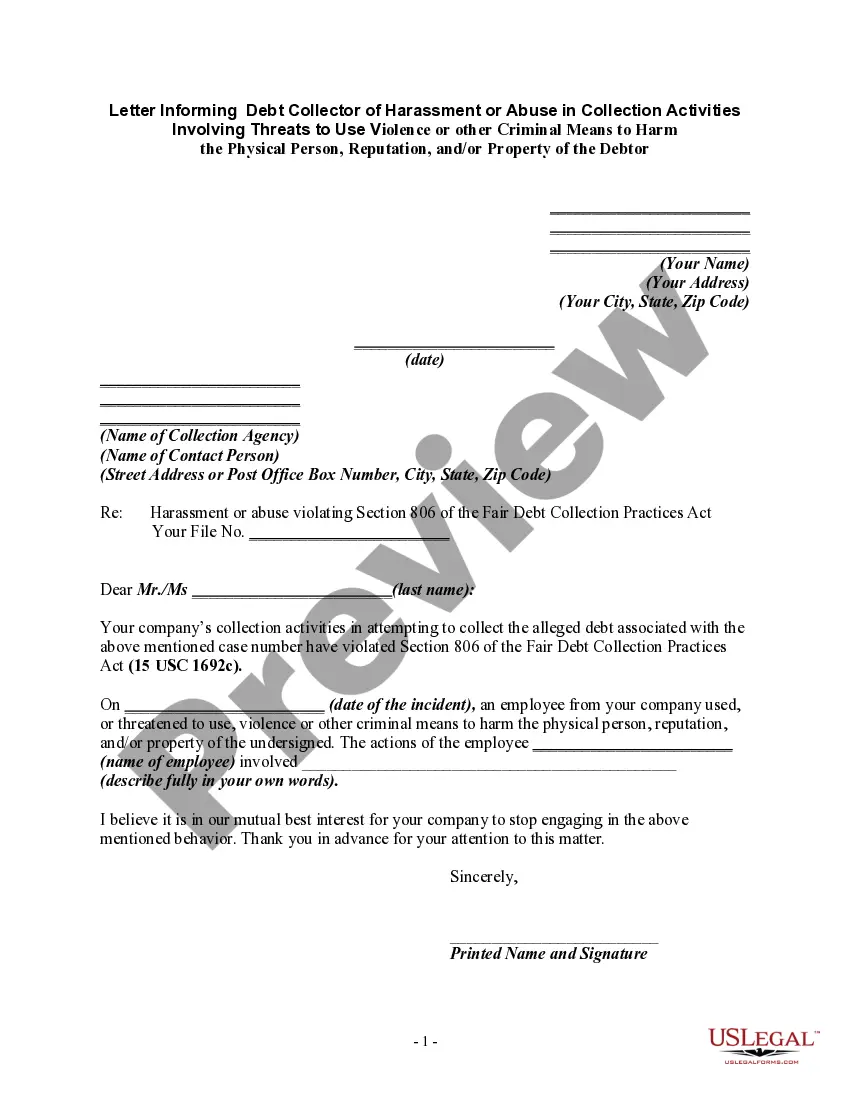
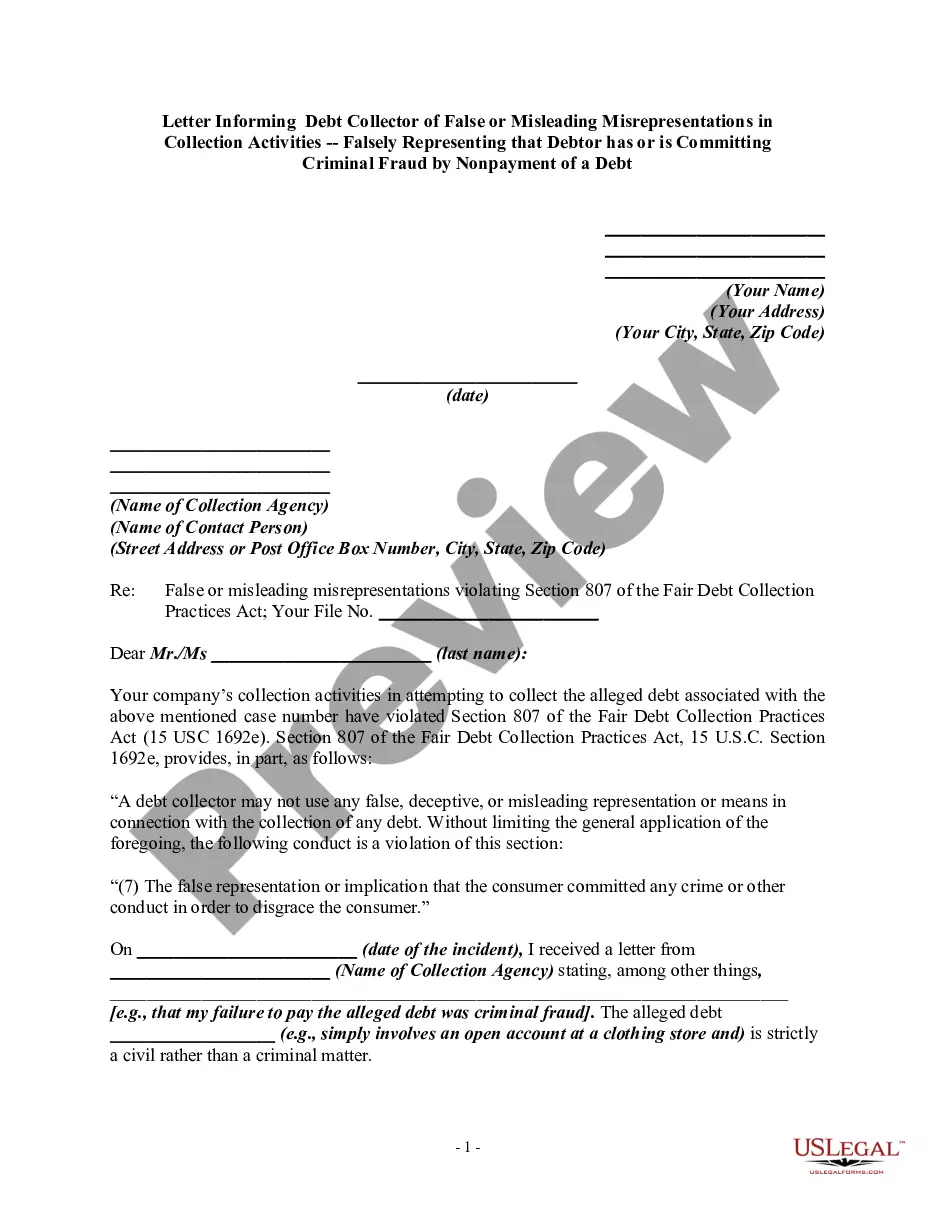
How to fill out Letter Informing Debt Collector Of Harassment Or Abuse In Collection Activities Involving Threats To Use Violence Or Other Criminal Means To Harm The Physical Person, Reputation, And/or Property Of The Debtor?
Creating legal documents from the ground up can occasionally be daunting.
Certain situations may require extensive research and significant financial investment.
If you’re looking for a more straightforward and cost-effective method of drafting Abuso Violencia Withholding or any other paperwork without unnecessary complications, US Legal Forms is readily available.
Our digital repository of over 85,000 current legal forms covers nearly every facet of your financial, legal, and personal concerns. With just a few clicks, you can quickly obtain state- and county-specific documents meticulously prepared by our legal professionals.
Review the document preview and descriptions to ensure you have located the document you require. Verify that the form you select aligns with the stipulations of your state and county. Choose the appropriate subscription option to obtain the Abuso Violencia Withholding. Download the document, then complete, verify, and print it. US Legal Forms enjoys a solid reputation and more than 25 years of expertise. Join us now and simplify your form completion process!
- Utilize our platform whenever you require dependable and trustworthy services to easily locate and download the Abuso Violencia Withholding.
- If you’re familiar with our site and have previously established an account with us, simply Log In to your account, find the template, and download it instantly or re-download it later from the My documents section.
- Don’t have an account? No worries. It takes only a few minutes to sign up and explore the catalog.
- Before diving into downloading Abuso Violencia Withholding, please adhere to these suggestions.
Form popularity
FAQ
Certain crimes can indeed prevent you from obtaining U.S. citizenship, particularly those involving moral turpitude, aggravated felonies, or cases of abuso violencia withholding. A history of violence or severe offenses could raise red flags during the naturalization process. To better understand your situation and explore possibilities, consider consulting resources like uslegalforms, which can offer guidance and support.
Yes, you may still become a U.S. citizen even if you have a domestic violence case on your record. However, the process can be complex, and it's essential to navigate it carefully to avoid potential issues related to negativo impacto and abuso violencia withholding. Consulting with an immigration attorney or a service that specializes in such matters can greatly increase your chances of success.
The W-4 status that typically withholds the most is when you claim 0 allowances. This choice means that your employer will withhold a larger portion of your paycheck for taxes, which can help you avoid underpayment penalties as you navigate your financial responsibilities. Knowing how your W-4 status ties into Abuso violencia withholding can ensure you are prepared for tax season. Always consult with a tax professional if you're unsure which option suits your needs best.
Claiming 0 on your W-4 usually results in more withholding, which could be beneficial if you want to avoid owing taxes at the end of the year. On the other hand, claiming 1 may suit you if you anticipate having a lower tax obligation. It's essential to consider your financial situation and future tax liabilities when deciding between these options. Understanding how this relates to Abuso violencia withholding can help you make an informed choice.
To fill out the W-4V form for voluntary withholding, first, ensure that you have your personal identification details ready. Indicate the amount you wish to have withheld, which can be a specific percentage or a flat amount. It is essential to clearly write your name, Social Security number, and the payer's information as well. By properly completing this form, you can better manage your taxes, especially in cases involving Abuso violencia withholding.
5 Signs of Emotional Abuse They are Hyper-Critical or Judgmental Towards You. ... They Ignore Boundaries or Invade Your Privacy. ... They are Possessive and/or Controlling. ... They are Manipulative. ... They Often Dismiss You and Your Feelings.
What are the signs of psychological abuse? Helplessness. Hesitation to talk openly. Implausible stories. Confusion or disorientation. Anger without apparent cause. Sudden change in behaviour. Emotionally upset or agitated. Unusual behaviour (sucking, biting, or rocking).
Emotional Abuse Signs - Observable Behaviors: rocking, sucking on clothes, hands, hair, biting self or others. crying. avoids eye contact. overly aggressive, destructive or cruel to others.
Types of Emotional Abuse Accusations of cheating or other signs of jealousy and possessiveness. Constant checking on or attempting to control the other person's behavior. Constantly arguing or opposing. Criticizing. Gaslighting. Isolating the individual from their family and friends. Name-calling and verbal abuse.
Red flags and warning signs of an abuser include but are not limited to: Extreme jealousy. Possessiveness. Unpredictability.