What Is A Phantom Stock Plan
Description

Get your form ready online
Our built-in tools help you complete, sign, share, and store your documents in one place.
Make edits, fill in missing information, and update formatting in US Legal Forms—just like you would in MS Word.
Download a copy, print it, send it by email, or mail it via USPS—whatever works best for your next step.
Sign and collect signatures with our SignNow integration. Send to multiple recipients, set reminders, and more. Go Premium to unlock E-Sign.
If this form requires notarization, complete it online through a secure video call—no need to meet a notary in person or wait for an appointment.
We protect your documents and personal data by following strict security and privacy standards.

Make edits, fill in missing information, and update formatting in US Legal Forms—just like you would in MS Word.

Download a copy, print it, send it by email, or mail it via USPS—whatever works best for your next step.

Sign and collect signatures with our SignNow integration. Send to multiple recipients, set reminders, and more. Go Premium to unlock E-Sign.

If this form requires notarization, complete it online through a secure video call—no need to meet a notary in person or wait for an appointment.

We protect your documents and personal data by following strict security and privacy standards.
Looking for another form?



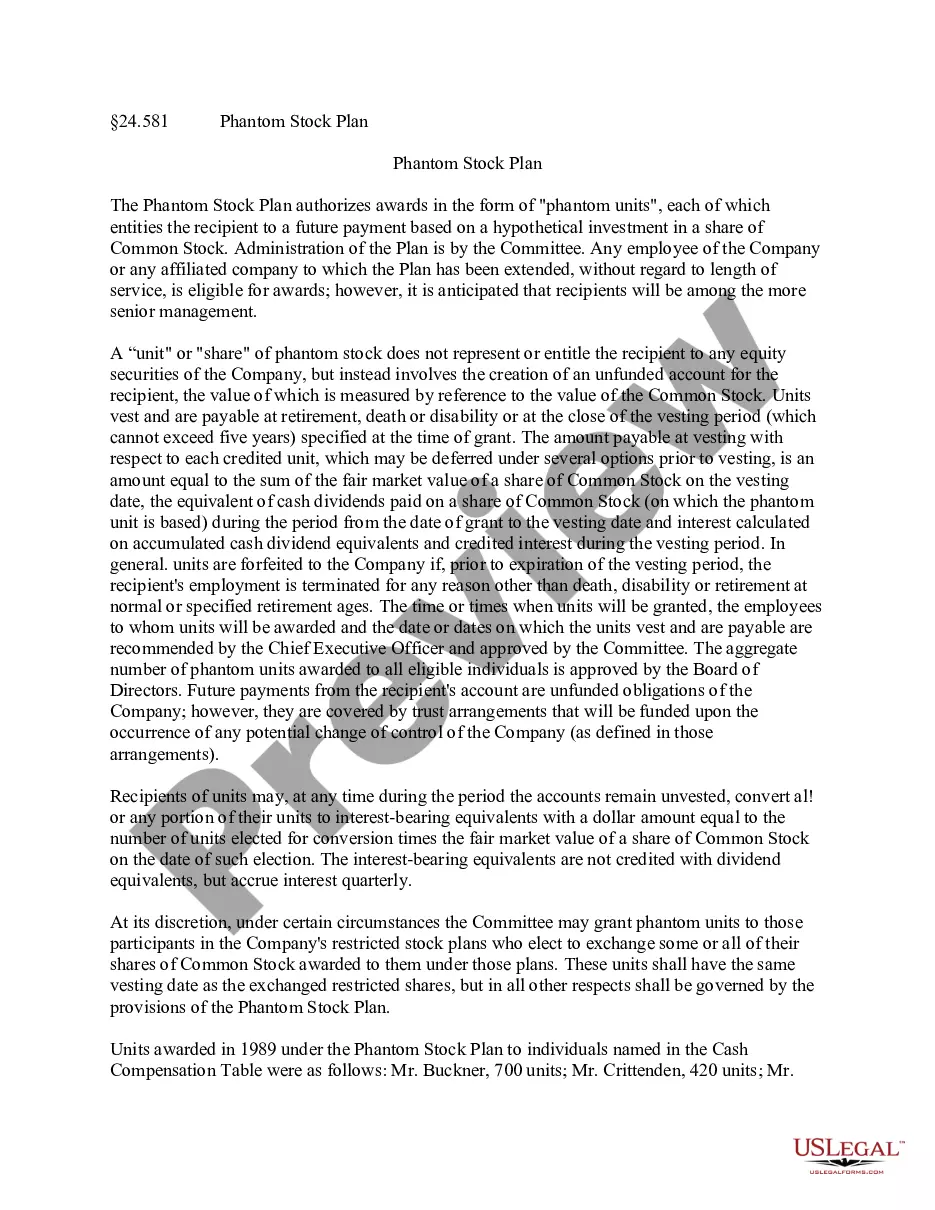
How to fill out Phantom Stock Plan Of Hercules, Inc.?
- If you're a returning user, log into your account and visit the Download section to access the needed form template. Ensure your subscription is active; if it has lapsed, renew it as per your payment plan.
- For first-time users, start by checking the Preview mode and form descriptions. Confirm that the selected document meets your needs and complies with local laws.
- If necessary, use the Search tab to find any alternate templates that better fit your requirements.
- Once your desired document is located, click on the Buy Now button and choose your preferred subscription plan. You'll need to create an account for library access.
- Complete your purchase by entering your credit card information or using your PayPal account.
- Download the form to your device, enabling you to complete it and store it under the My Forms section for future reference.
US Legal Forms empowers both individuals and lawyers to efficiently generate legal documents through a vast library of over 85,000 fillable and editable forms. This extensive collection surpasses competitors, offering a cost-effective solution for all your legal needs.
Ensure your legal documents are accurate and compliant by engaging with premium experts available through US Legal Forms. Get started today to streamline your legal documentation process!
Form popularity
FAQ
The purpose of phantom stock is to incentivize employees by linking their rewards to the company's performance. This form of compensation aligns the interests of employees with those of the shareholders, encouraging a strong commitment to the company's growth. Furthermore, phantom stock can help attract and retain top talent without the need for immediate equity transfers. By exploring what a phantom stock plan can offer, companies can enhance their employee engagement and overall satisfaction.
Reiterating an earlier point, phantom stock plans and ESOPs differ mainly in equity participation. While phantom stock plans mimic the benefits of stock without actual share ownership, ESOPs grant real shares, offering employees equity in the company. Consequently, employees in an ESOP have voting rights and can participate in the company’s governance, unlike those in a phantom stock plan.
In a phantom stock plan, companies grant employees 'units' that represent the value of actual company shares. As the company's stock value increases, so does the value of these phantom units. At a predetermined time or under specific conditions, employees receive the monetary equivalent of their phantom stock's value, rewarding their loyalty and performance without diluting actual stock ownership.
Setting up a phantom stock plan begins with defining the specific objectives you aim to achieve, such as retention or performance incentives. Next, you should outline the plan's terms, including vesting schedules, valuation methods, and payout options. It's essential to ensure that the plan complies with relevant laws and aligns with your company's goals. As you navigate this process, uslegalforms provides resources that can simplify the legal requirements of creating what a phantom stock plan entails.
Phantom stock can be a beneficial arrangement for both employers and employees. It aligns employee interests with company performance, which can enhance motivation and reduce turnover. Moreover, employees may appreciate the potential financial gain without the burdens of stock ownership, making it an attractive option. For a thorough understanding of what a phantom stock plan offers, reviewing its pros and cons can help you make an informed decision.
In general, phantom stock plans can be modified or terminated by the company at any time, depending on the plan's terms and conditions. However, if the plan is well-structured, it typically outlines specific vesting schedules and conditions under which benefits are secured. Therefore, while there is a possibility for changes, employees generally receive clear communications regarding any alterations. Understanding what a phantom stock plan entails is crucial for employees to navigate any risks associated with their investment.
Yes, phantom stock is classified as deferred compensation since employees do not receive any benefits until specific conditions are met, usually at vesting. This arrangement allows employees to benefit from the company's growth while deferring tax liabilities until they receive the payout. Understanding this classification can help in planning both personal tax strategies and company financial considerations.
Valuing phantom stock involves determining the fair market value of the company's shares periodically or at the time of payout. Companies often use recent stock valuations or appraisals to establish this value. Ensuring accurate valuations is critical, as they directly impact how much employees receive when the phantom stock is redeemed.
To account for phantom stock, you must recognize the expense over the vesting period and update the liability as the valuation of the stock changes. This process requires periodic assessments of the stock value to ensure accurate reporting. Engaging with accounting professionals or platforms like USLegalForms can provide clarity on best practices for managing these entries.
Accounting for phantom stock involves recording a liability on the balance sheet, reflecting the future payout obligation. The expense related to the phantom stock is recognized over the vesting period, impacting the company's financial statements. Properly accounting for phantom stock ensures accurate financial reporting, which can also involve consulting platforms like USLegalForms for guidelines.