Employer Regarding Withholding Tax
Description

Get your form ready online
Our built-in tools help you complete, sign, share, and store your documents in one place.
Make edits, fill in missing information, and update formatting in US Legal Forms—just like you would in MS Word.
Download a copy, print it, send it by email, or mail it via USPS—whatever works best for your next step.
Sign and collect signatures with our SignNow integration. Send to multiple recipients, set reminders, and more. Go Premium to unlock E-Sign.
If this form requires notarization, complete it online through a secure video call—no need to meet a notary in person or wait for an appointment.
We protect your documents and personal data by following strict security and privacy standards.

Make edits, fill in missing information, and update formatting in US Legal Forms—just like you would in MS Word.

Download a copy, print it, send it by email, or mail it via USPS—whatever works best for your next step.

Sign and collect signatures with our SignNow integration. Send to multiple recipients, set reminders, and more. Go Premium to unlock E-Sign.

If this form requires notarization, complete it online through a secure video call—no need to meet a notary in person or wait for an appointment.

We protect your documents and personal data by following strict security and privacy standards.
Looking for another form?

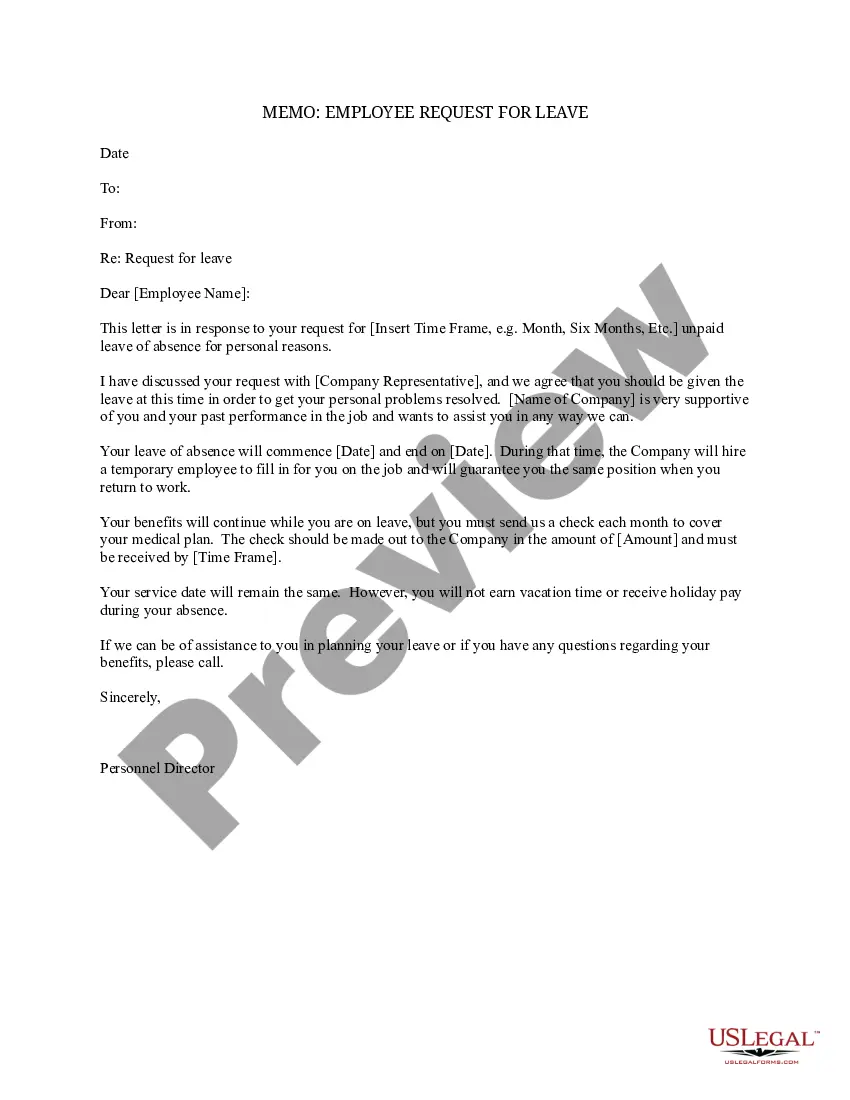
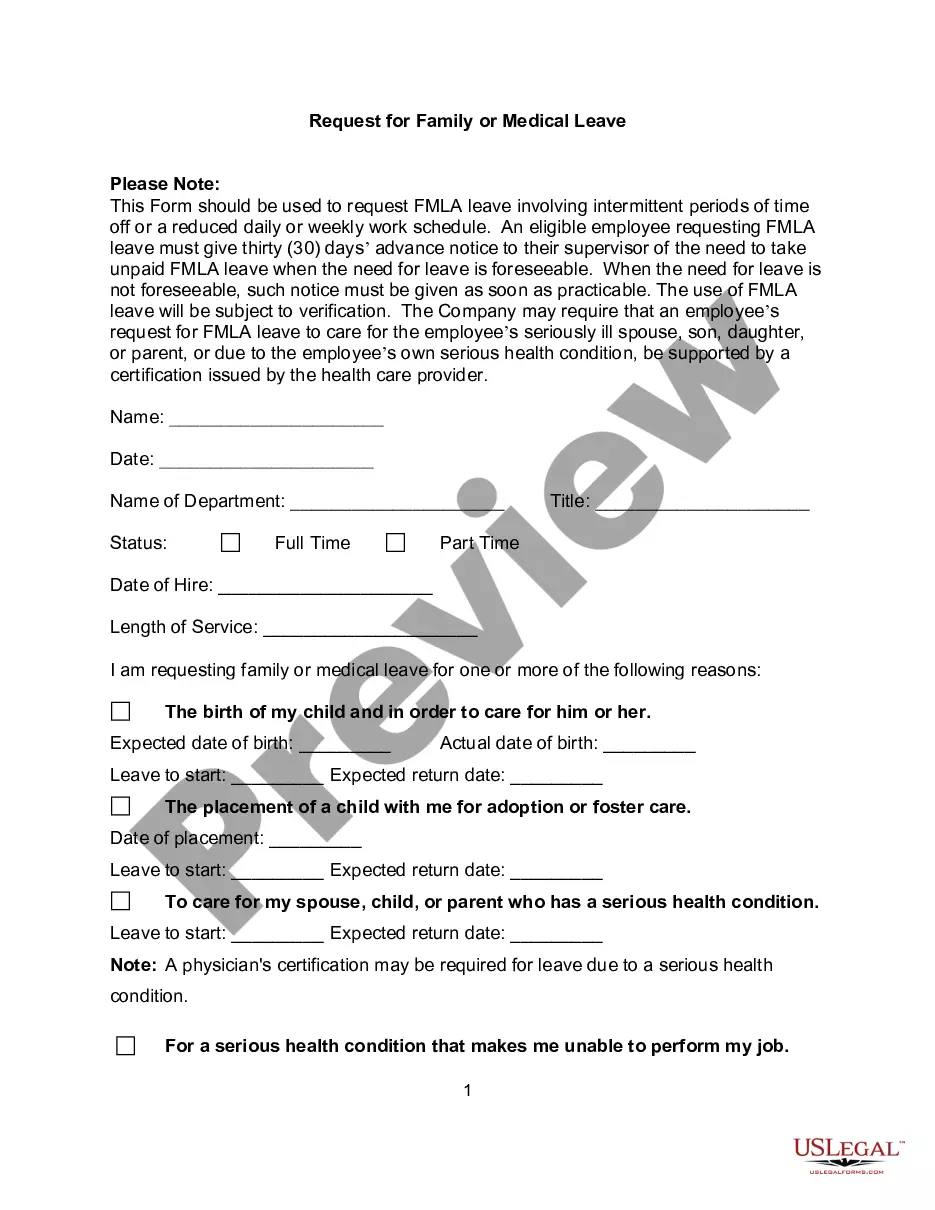
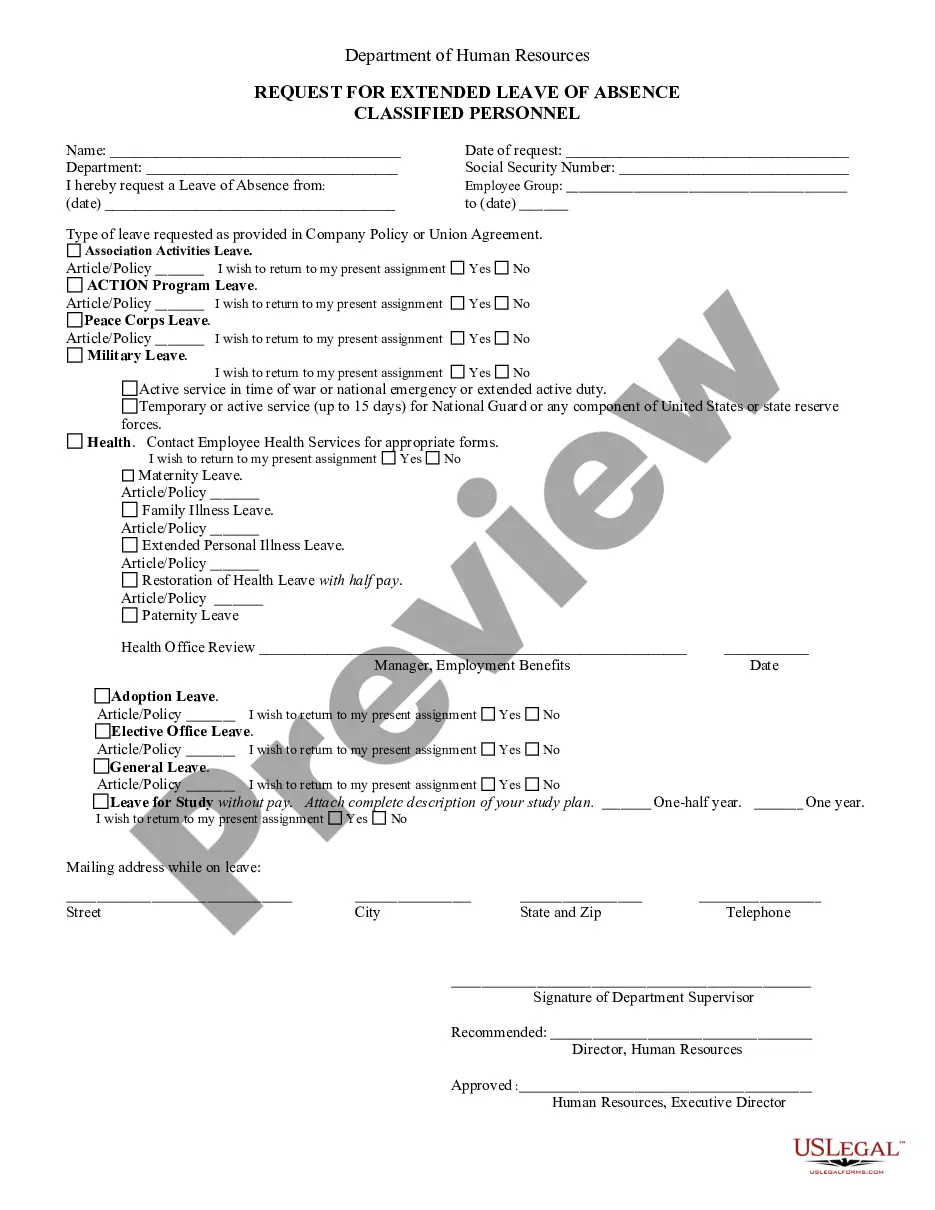
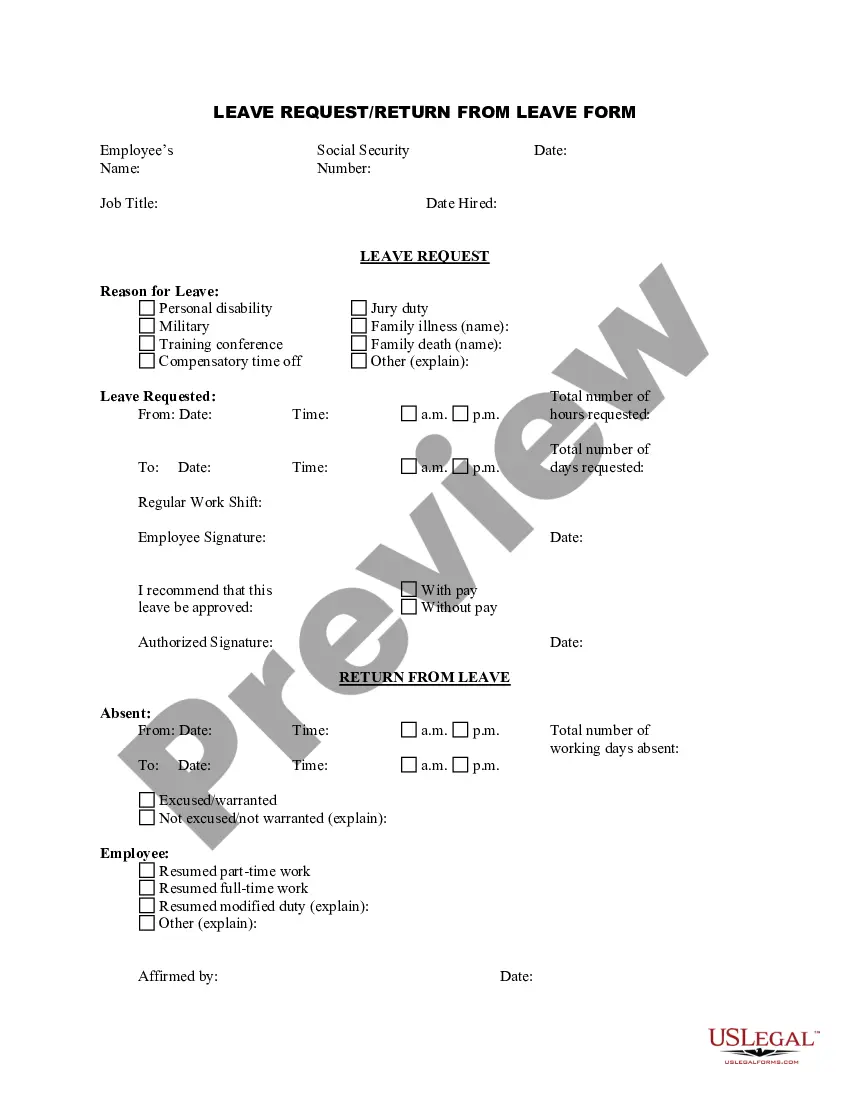
How to fill out Memo From Employer Regarding Employee Request For Leave?
Creating legal documents from the ground up can occasionally be quite daunting.
Certain situations may require extensive research and significant expenses.
If you’re looking for a simpler and more affordable approach to generating Employer Regarding Withholding Tax or any other forms without unnecessary complications, US Legal Forms is always available to assist you.
Don't have an account? No worries. Registering takes only minutes, allowing you to browse the catalog. However, before proceeding to download the Employer Regarding Withholding Tax, consider these suggestions.
- Explore our virtual repository of over 85,000 current legal documents that cover almost every dimension of your financial, legal, and personal affairs.
- With only a few clicks, you can rapidly obtain state- and county-compliant forms meticulously prepared for you by our legal professionals.
- Utilize our service whenever you require a dependable and trustworthy platform that allows you to easily find and download the Employer Regarding Withholding Tax.
- If you're a returning user with an established account, simply Log In, find the template, and download it right away or retrieve it later in the My documents section.
Form popularity
FAQ
If your W-2 does not show local taxes withheld, it may be due to your employer not being required to withhold these taxes, or possibly an issue with payroll processing. Sometimes, employees may not be subject to local tax based on their work location or residency status. It is advisable to discuss this with your employer to clarify the situation. Keeping track of your local tax withholding is important for your financial planning.
To fill out your W-4 to claim 0, begin by providing your personal information at the top of the form. In Step 1(c), write '0' to designate that you are not claiming any allowances. This form informs your employer regarding withholding tax to take out the maximum amount from your paycheck. Ensure you complete and submit the form to your employer promptly to comply with tax regulations.
To fill out your W-4 to claim 0, start by entering your name, address, and Social Security number at the top. In Step 1(c), enter '0' in the box where it asks for the number of allowances. This indicates to your employer regarding withholding tax that you are not claiming any exemptions. Finally, ensure you sign and date the form to validate it before submitting it to your employer.
Complete Form W-4 so that your employer can withhold the correct federal income tax from your pay.
Claiming 1 reduces the amount of taxes that are withheld from weekly paychecks, so you get more money now with a smaller refund. Claiming 0 allowances may be a better option if you'd rather receive a larger lump sum of money in the form of your tax refund.
You must make your request in writing and attach evidence to support your application. Complete the application form online (it can be saved to your computer). When you have completed the application, you can lodge it online by logging into Online services for business.
?Should I declare myself exempt from withholding?? No, it's not a good idea to claim you're exempt simply in order to get a bigger paycheck. By certifying you are exempt, your employer wouldn't withhold any federal income tax amounts during the year, and that would result in a large tax bill due in April.
By placing a ?0? on line 5, you are indicating that you want the most amount of tax taken out of your pay each pay period. If you wish to claim 1 for yourself instead, then less tax is taken out of your pay each pay period. 2. You can choose to have no taxes taken out of your tax and claim Exemption (see Example 2).