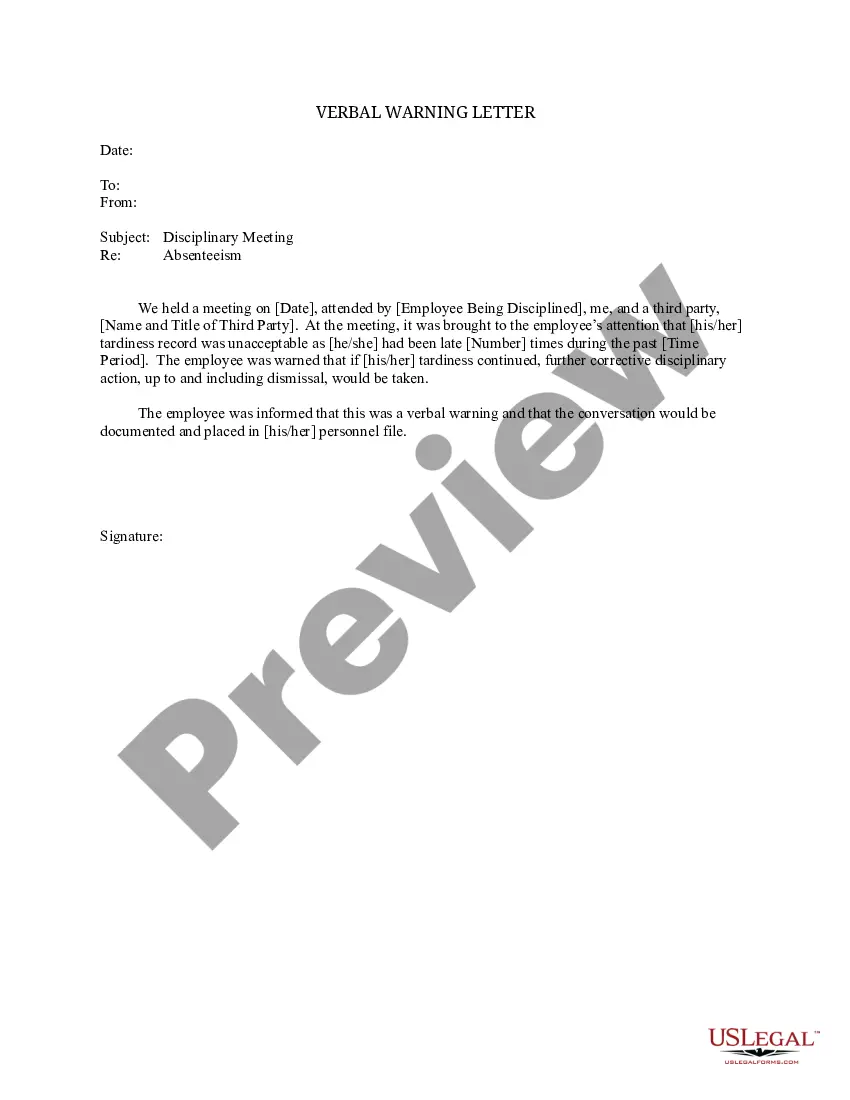
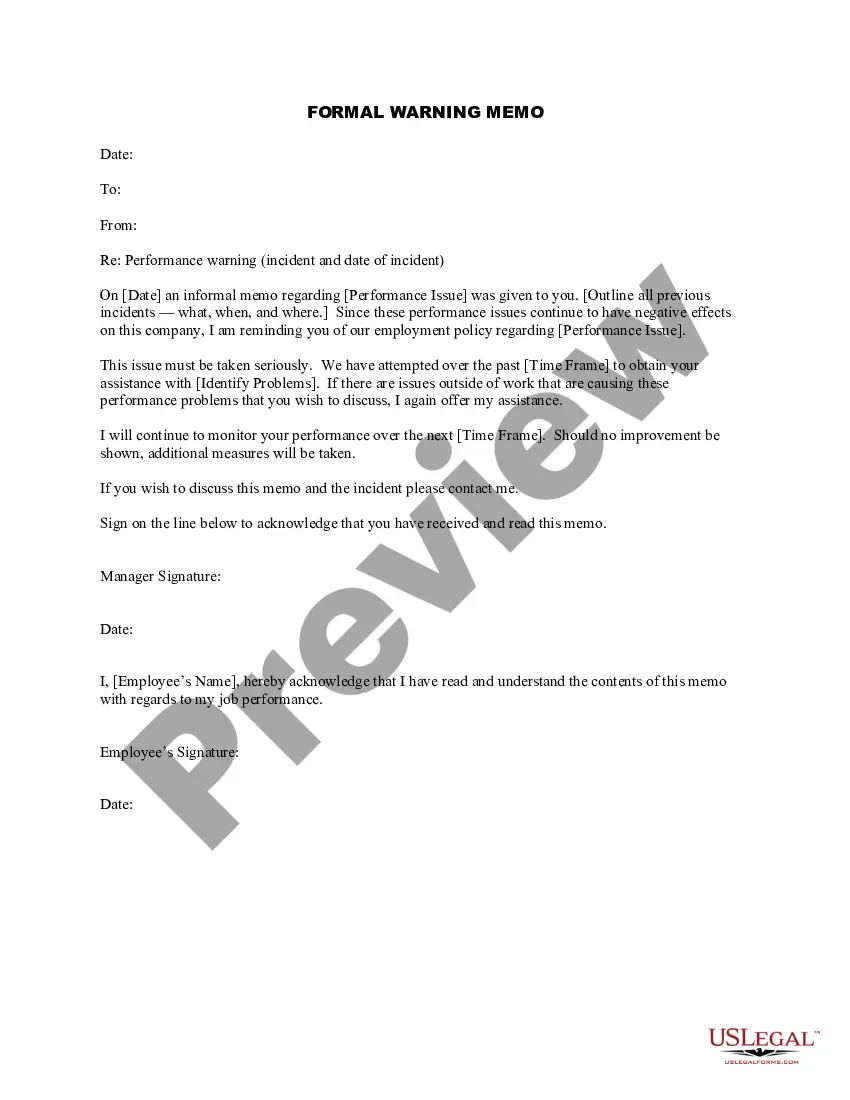
Sample Verbal Warning Letter For Misconduct
Description
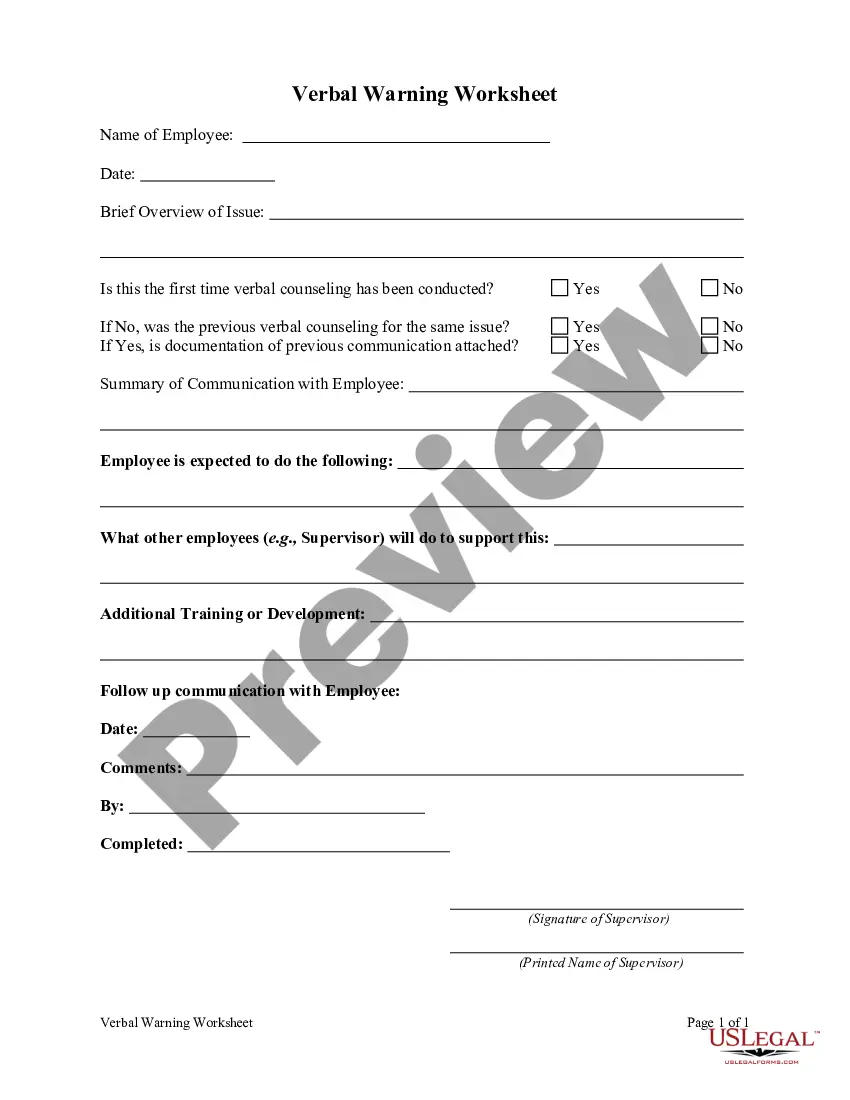
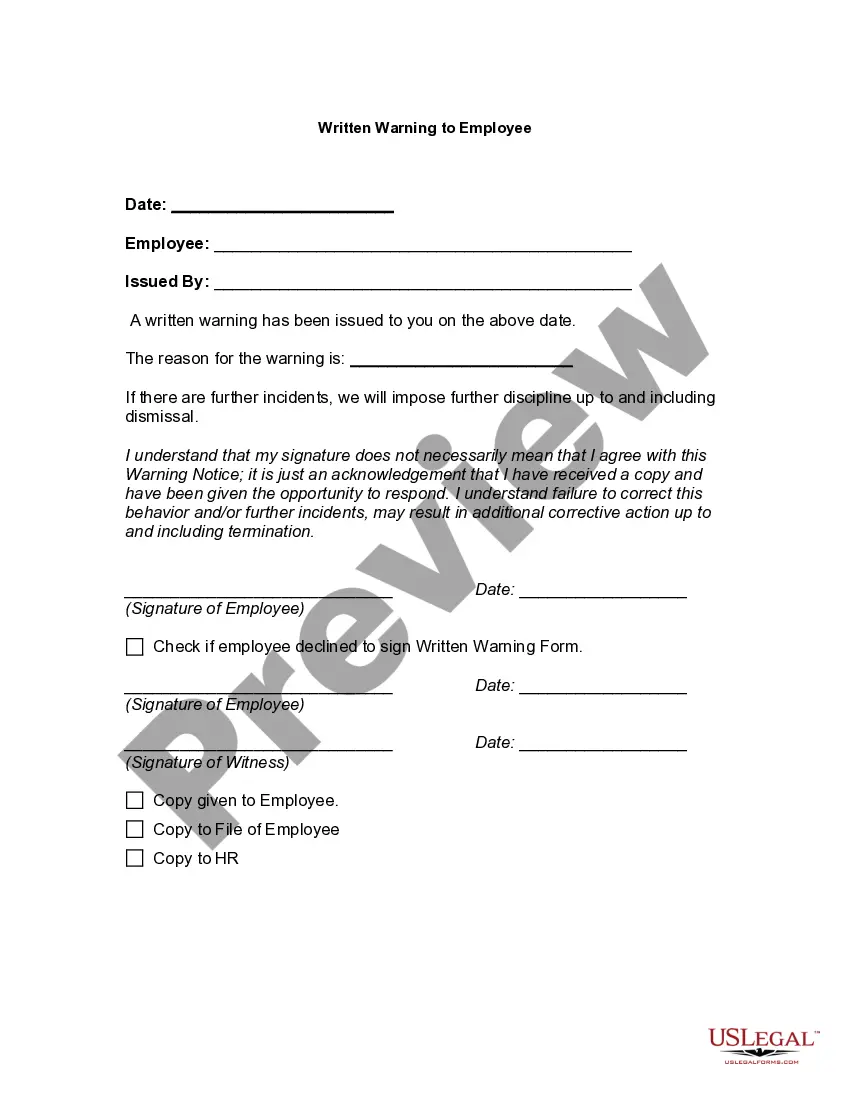
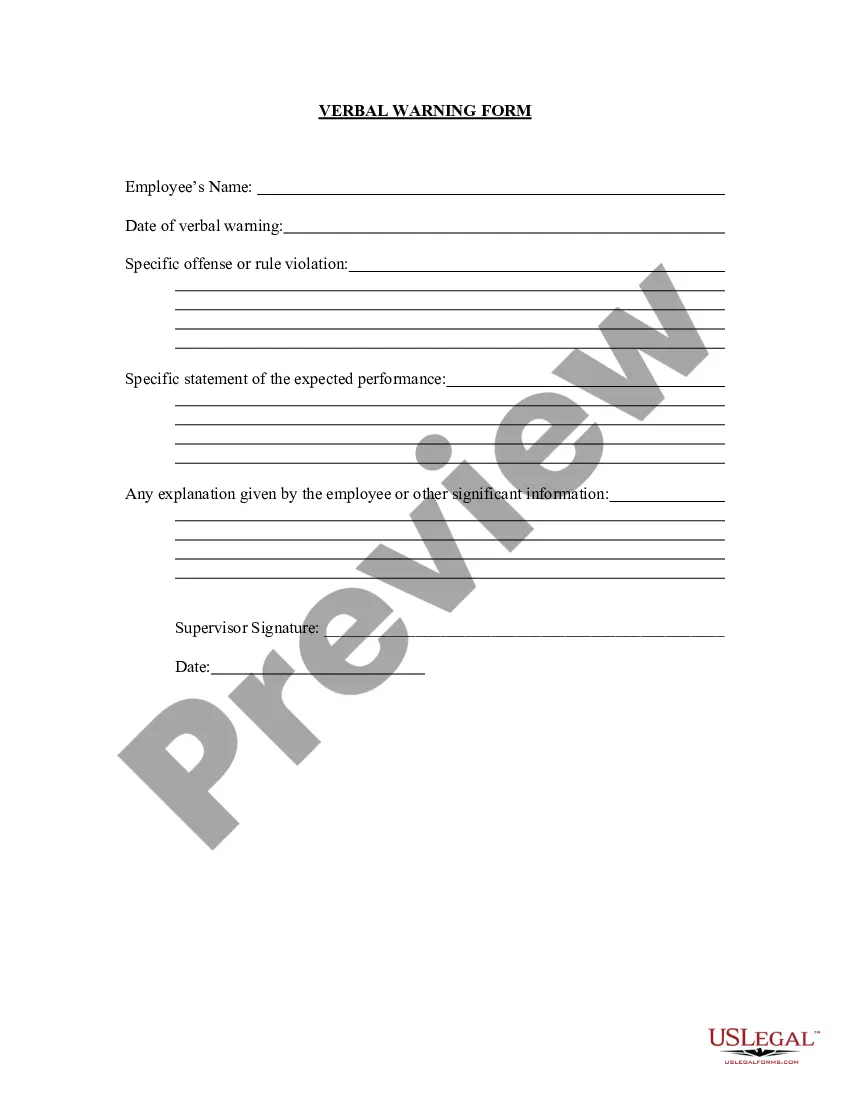
Get your form ready online
Our built-in tools help you complete, sign, share, and store your documents in one place.
Make edits, fill in missing information, and update formatting in US Legal Forms—just like you would in MS Word.
Download a copy, print it, send it by email, or mail it via USPS—whatever works best for your next step.
Sign and collect signatures with our SignNow integration. Send to multiple recipients, set reminders, and more. Go Premium to unlock E-Sign.
If this form requires notarization, complete it online through a secure video call—no need to meet a notary in person or wait for an appointment.
We protect your documents and personal data by following strict security and privacy standards.

Make edits, fill in missing information, and update formatting in US Legal Forms—just like you would in MS Word.

Download a copy, print it, send it by email, or mail it via USPS—whatever works best for your next step.

Sign and collect signatures with our SignNow integration. Send to multiple recipients, set reminders, and more. Go Premium to unlock E-Sign.

If this form requires notarization, complete it online through a secure video call—no need to meet a notary in person or wait for an appointment.

We protect your documents and personal data by following strict security and privacy standards.
Looking for another form?

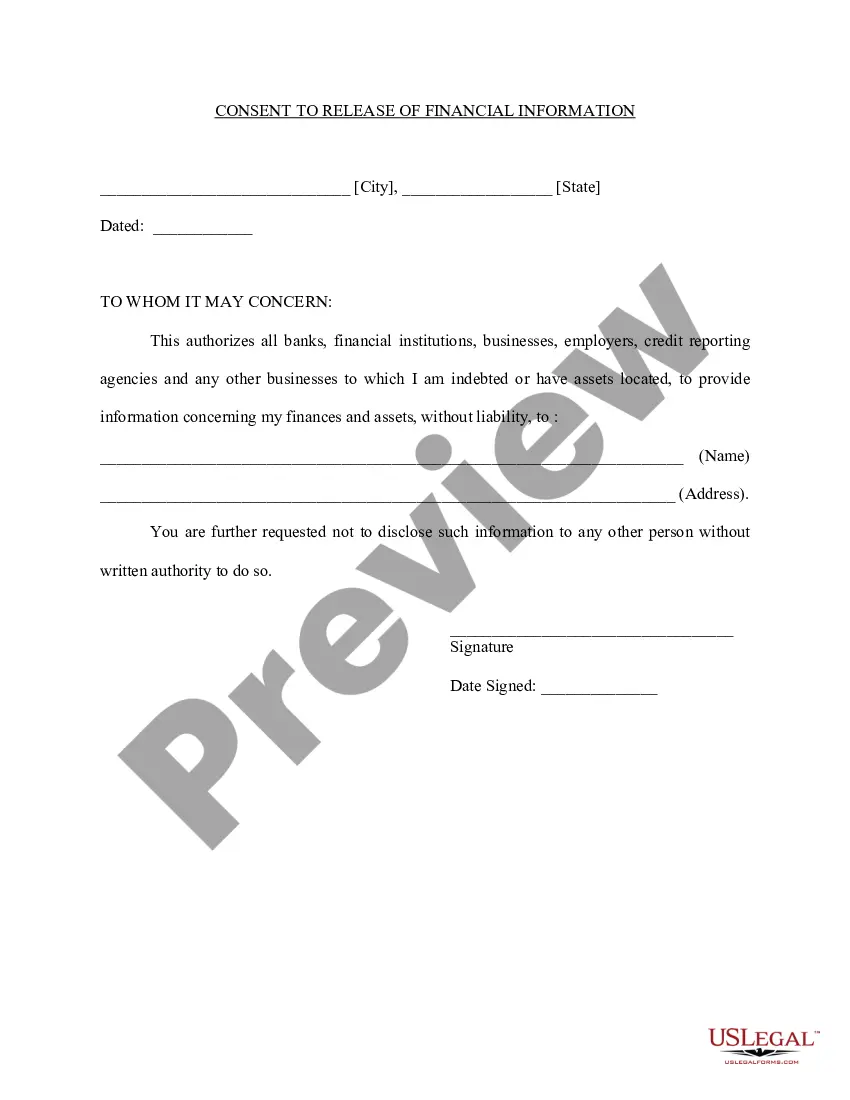







How to fill out Verbal Warning Letter Or Memo?
It’s a well-known fact that you cannot become a legal authority instantly, nor can you determine how to swiftly draft a Sample Verbal Warning Letter For Misconduct without possessing specialized knowledge.
Producing legal documents is an extended process that requires specific training and expertise. Therefore, why not entrust the crafting of the Sample Verbal Warning Letter For Misconduct to the specialists.
With US Legal Forms, one of the most extensive collections of legal templates, you can discover anything from court documents to templates for internal company communication. We recognize the significance of complying with federal and local laws and regulations.
Sign up for a free account and select a subscription plan to acquire the template.
Click Buy now. Once the transaction is complete, you can obtain the Sample Verbal Warning Letter For Misconduct, fill it in, print it, and send or deliver it to the appropriate recipients or organizations.
- That’s why, on our platform, all forms are location-specific and current.
- Begin by visiting our website to obtain the document you require within minutes.
- Use the search bar at the top of the page to find the form you need.
- If available, preview it and review the accompanying description to see if the Sample Verbal Warning Letter For Misconduct is what you are looking for.
- If you require a different template, restart your search.
Form popularity
FAQ
A revocable trust and living trust are separate terms that describe the same thing: a trust in which the terms can be changed at any time. An irrevocable trust describes a trust that cannot be modified after it is created without the beneficiaries' consent.
How to Write ( Fill Out ) a Living Trust Form Step 1: Fill out the grantor information. ... Step 2: Indicate the purpose of the trust. ... Step 3: Include trustee information. ... Step 4: List beneficiaries and make specific gifts. ... Step 5: Sign and notarize the completed document.
If you are interested in creating a living trust in North Dakota, you will create a written trust agreement and sign it in front of a notary public. To make the trust effective, you must then transfer assets into it. Living trusts provide a variety of benefits. Consider whether these benefits appeal to you.
Limitations: Requires adherence to trust document's instructions on asset assignments. Joint assets, including certain IRAs and retirement plans, cannot be placed into a one-person trust. No complete tax avoidance: Total avoidance of taxes is rarely possible with living trusts, though there may be ways to reduce them.
A living trust can help you manage and pass on a variety of assets. However, there are a few asset types that generally shouldn't go in a living trust, including retirement accounts, health savings accounts, life insurance policies, UTMA or UGMA accounts and vehicles.
The two basic types of trusts are a revocable trust, also known as a revocable living trust or simply a living trust, and an irrevocable trust. The owner of a revocable trust may change its terms at any time.
The Disadvantage of a Revocable Living Trust Expansive: Creating a revocable living trust can be more expensive than a simple will due to legal fees and document preparation. Complexity: Managing a trust requires ongoing paperwork and record-keeping, which can be burdensome and time-consuming.
A living trust, unlike a will, can keep your assets out of probate proceedings. A trustor names a trustee to manage the assets of the trust indefinitely. Wills name an executor to manage the assets of the probate estate only until probate closes. Trusts tend to be more expensive and more complex to maintain than wills.