Employee Final Pay With 1099
Description
Get your form ready online
Our built-in tools help you complete, sign, share, and store your documents in one place.
Make edits, fill in missing information, and update formatting in US Legal Forms—just like you would in MS Word.
Download a copy, print it, send it by email, or mail it via USPS—whatever works best for your next step.
Sign and collect signatures with our SignNow integration. Send to multiple recipients, set reminders, and more. Go Premium to unlock E-Sign.
If this form requires notarization, complete it online through a secure video call—no need to meet a notary in person or wait for an appointment.
We protect your documents and personal data by following strict security and privacy standards.

Make edits, fill in missing information, and update formatting in US Legal Forms—just like you would in MS Word.

Download a copy, print it, send it by email, or mail it via USPS—whatever works best for your next step.

Sign and collect signatures with our SignNow integration. Send to multiple recipients, set reminders, and more. Go Premium to unlock E-Sign.

If this form requires notarization, complete it online through a secure video call—no need to meet a notary in person or wait for an appointment.

We protect your documents and personal data by following strict security and privacy standards.
Looking for another form?

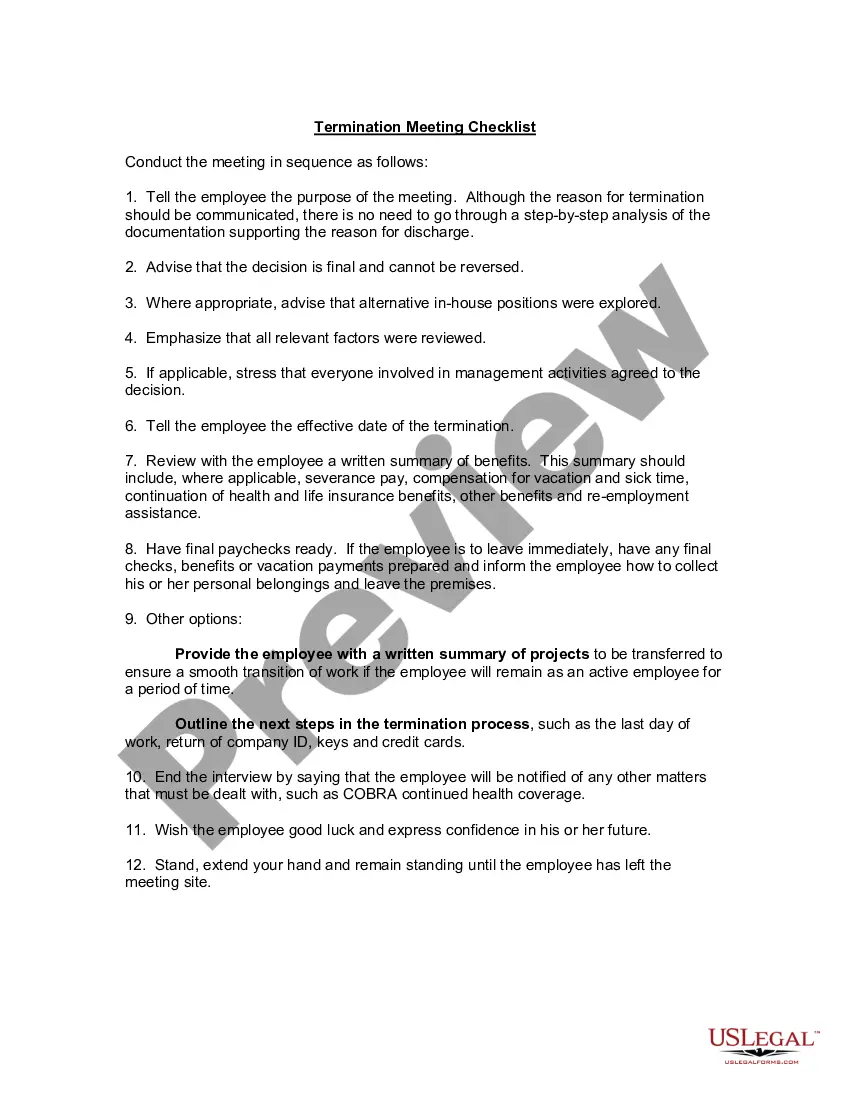
How to fill out Termination Meeting Checklist?
Identifying a reliable source to obtain the latest and suitable legal templates is a significant part of navigating bureaucratic processes.
Finding the correct legal documents requires precision and meticulousness, which underscores the necessity of acquiring samples of Employee Final Pay With 1099 exclusively from trustworthy providers, such as US Legal Forms. A faulty template could squander your time and delay your proceedings. With US Legal Forms, your concerns are minimal.
Eliminate the complexities associated with your legal paperwork. Explore the extensive US Legal Forms library where you can discover legal samples, evaluate their pertinence to your situation, and download them instantly.
- Use the catalog search or search bar to find your template.
- Examine the form’s details to confirm it aligns with the stipulations of your state and locality.
- Check the form preview, if available, to ensure the template is indeed what you need.
- Revert to the search and seek the proper document if the Employee Final Pay With 1099 does not correspond to your needs.
- If you are confident about the form's applicability, download it.
- If you are a registered user, click Log in to verify and access your selected templates in My documents.
- If you do not possess an account yet, click Buy now to acquire the form.
- Select the pricing option that meets your requirements.
- Proceed to registration to complete your purchase.
- Finalize your purchase by selecting a payment method (credit card or PayPal).
- Choose the file format for downloading Employee Final Pay With 1099.
- Once you have the template on your device, you can modify it using the editor or print it out and complete it manually.
Form popularity
FAQ
To maximize your experience as a 1099 employee, start by keeping organized records of your income and expenses. This practice will help you better understand your financial situation and prepare for your employee final pay with 1099. Additionally, take advantage of tax deductions available to self-employed individuals, such as home office expenses and business-related costs. Lastly, consider using platforms like US Legal Forms to access essential forms and documents that simplify your tax filing and overall management of your freelance work.
Typically, if your total income includes payments reported on a 1099 that exceed $400, you must file a tax return. Regardless of 1099 amounts, meeting minimum income thresholds is critical for compliance. Establishing employee final pay with 1099 properly can help in this calculation. Always keep thorough records and consider leveraging resources from USLegalForms for assistance.
Yes, the 1099-NEC form reflects earned income for non-employees. This means that if you receive a 1099-NEC, those earnings are subject to income tax just like regular wages. For those managing employee final pay with 1099, understanding this classification is essential for accurate tax reporting. It’s always wise to consult with a tax professional for guidance.
The $600 rule states that businesses must issue a 1099 form if they pay $600 or more to a non-employee for services rendered. This is applicable for freelancers and independent contractors. Properly following this rule helps clarify employee final pay with 1099 and addresses tax obligations. Be sure to keep accurate records that support your payments.
Yes, you do need to send a 1099 to the IRS under specific conditions. If you pay someone $600 or more in a calendar year for services, you must file a 1099. This process helps in correctly documenting employee final pay with 1099, ensuring that both you and the contractors meet IRS guidelines.
If you neglect to send a 1099 to the IRS, you may face significant penalties. These penalties can include fines and increased scrutiny from the IRS regarding your tax filings. To prevent issues, it's crucial to manage employee final pay with 1099 diligently. Using tools like USLegalForms can simplify this process.
Yes, you must send your 1099 to the IRS when you report payments made to non-employees. This includes contractor fees and freelance work exceeding certain thresholds. Handling employee final pay with 1099 correctly ensures compliance with IRS regulations. Make sure to check specific due dates to avoid penalties.
A 1099 form is used to report various types of income other than wages, salaries, and tips. This includes nonemployee compensation, rent payments, dividends, and interest. Specifically, if you are handling employee final pay with 1099, the amount you report can significantly impact tax obligations, so accuracy is key. For clarity and support in navigating this process, our US Legal Forms platform offers helpful resources.
When preparing your 1099 form to report nonemployee compensation, you should place the total amount in Box 7. This section specifically captures payments made to independent contractors or freelancers for their services. Remember, it's essential to accurately report this income as part of your employee final pay with 1099 to avoid discrepancies with the IRS. If you're unsure about the details, consider using our US Legal Forms platform for step-by-step guidance.
When you are classified as a 1099 employee, you typically receive a form known as a 1099-MISC or 1099-NEC to report your income for tax purposes. Unlike W-2 employees, you do not have taxes withheld from your payments, which means you may face a higher tax bill at the end of the year. It's essential to keep track of your earnings and expenses, as you may need to pay quarterly taxes. Understanding your employee final pay with 1099 is crucial to avoid surprises during tax season, and using resources like USLegalForms can help streamline your reporting process.