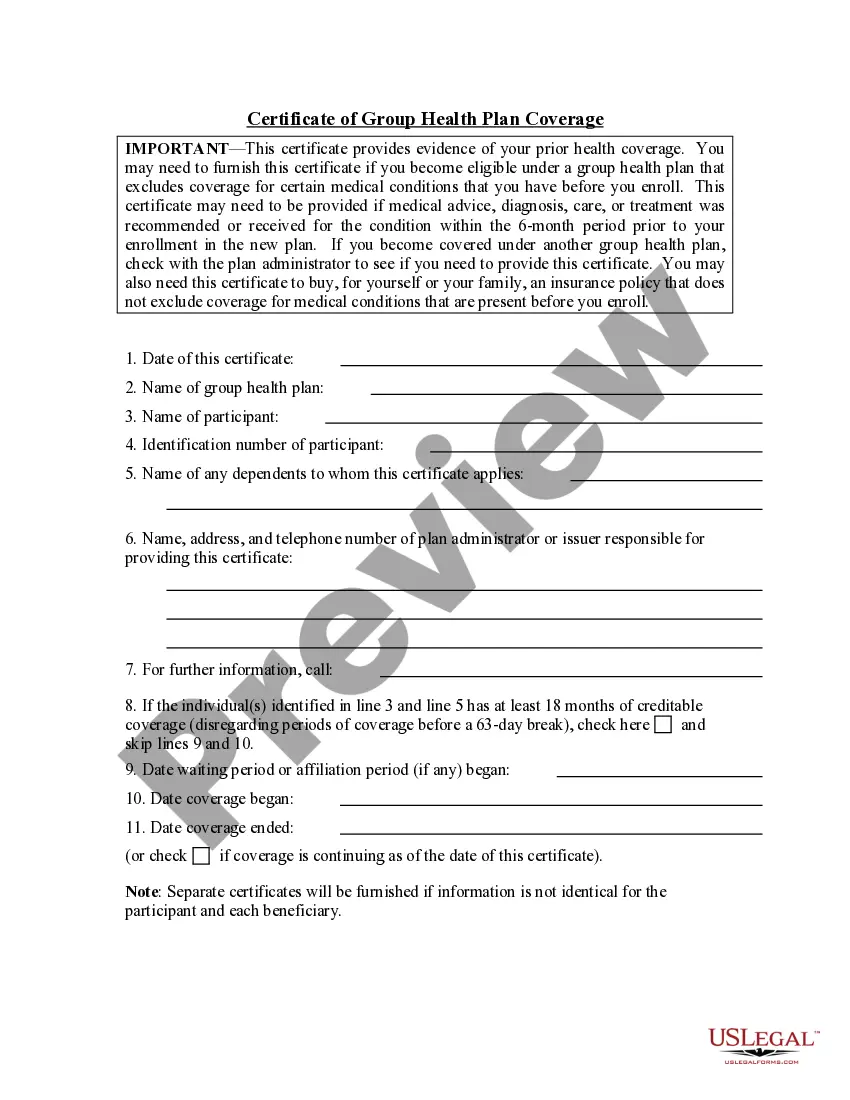
Certificate Health Plan With Tax Credits
Description
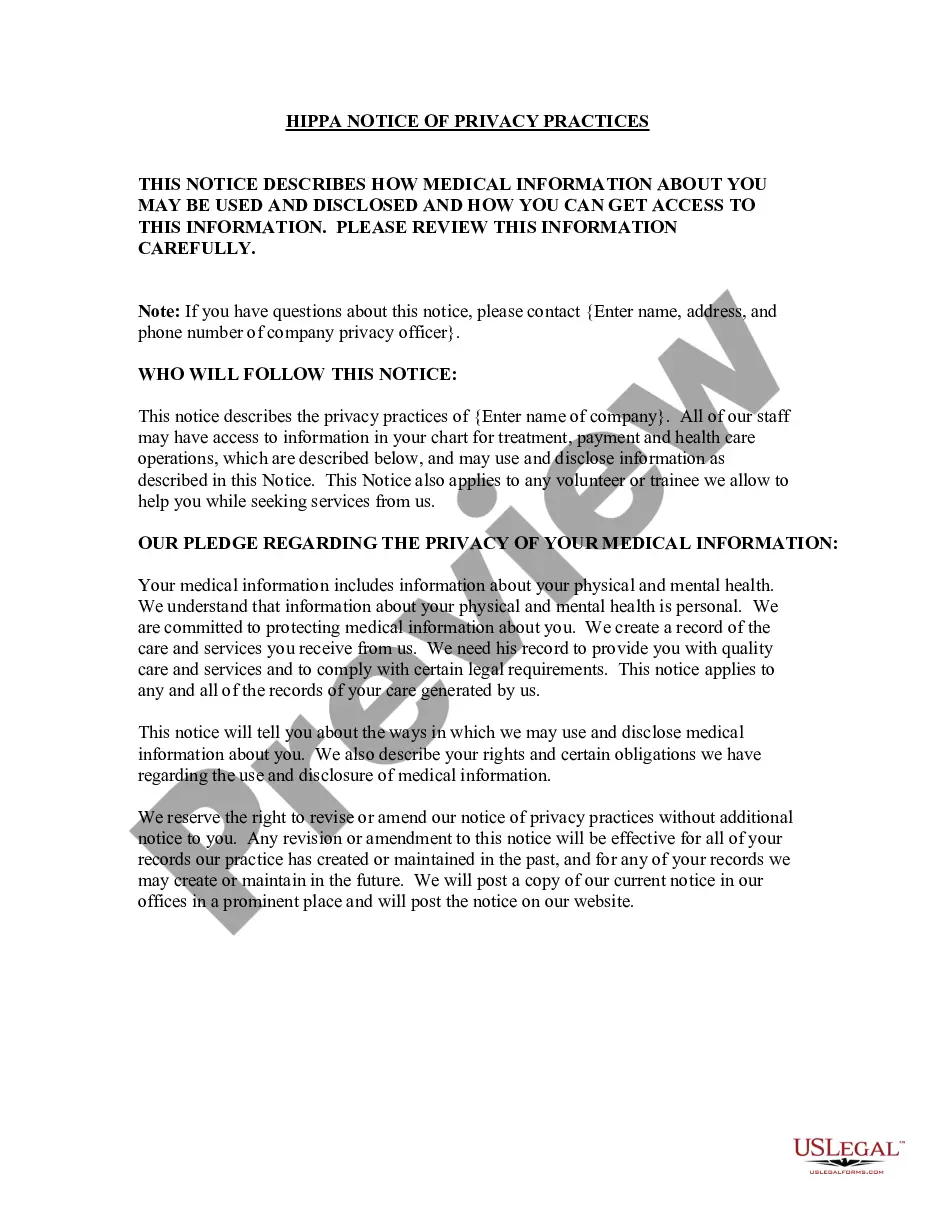
Get your form ready online
Our built-in tools help you complete, sign, share, and store your documents in one place.
Make edits, fill in missing information, and update formatting in US Legal Forms—just like you would in MS Word.
Download a copy, print it, send it by email, or mail it via USPS—whatever works best for your next step.
Sign and collect signatures with our SignNow integration. Send to multiple recipients, set reminders, and more. Go Premium to unlock E-Sign.
If this form requires notarization, complete it online through a secure video call—no need to meet a notary in person or wait for an appointment.
We protect your documents and personal data by following strict security and privacy standards.

Make edits, fill in missing information, and update formatting in US Legal Forms—just like you would in MS Word.

Download a copy, print it, send it by email, or mail it via USPS—whatever works best for your next step.

Sign and collect signatures with our SignNow integration. Send to multiple recipients, set reminders, and more. Go Premium to unlock E-Sign.

If this form requires notarization, complete it online through a secure video call—no need to meet a notary in person or wait for an appointment.

We protect your documents and personal data by following strict security and privacy standards.
Looking for another form?




How to fill out Certificate Of Group Health Plan Coverage?
Legal documents handling can be perplexing, even for the most proficient professionals.
When you are seeking a Certificate Health Plan With Tax Credits and lack the time to spend searching for the accurate and updated version, the procedures can be overwhelming.
- A strong web form collection can be transformative for anyone aiming to manage these scenarios effectively.
- US Legal Forms is a leading provider of online legal documents, with more than 85,000 state-specific legal forms accessible to you at any time.
- With US Legal Forms, you can access state- or county-specific legal and business documents.
Form popularity
FAQ
Form 1095-C affects your tax return by providing essential information regarding your health insurance coverage. If you had a Certificate health plan with tax credits, this form will help determine your eligibility for any tax credits or penalties related to health coverage. Understanding this form is crucial for accurate tax filing.
You can prove your health insurance for your tax return by using the 1095-C form, which details your coverage. This form verifies that you had a Certificate health plan with tax credits and ensures compliance with health care laws. Keeping this document organized will simplify your tax filing process.
You do not need to attach your 1095-C form to your tax return. However, it is vital to retain it in your records. This form serves as proof of your health coverage and can be beneficial if you need to demonstrate that you had a Certificate health plan with tax credits during the tax year.
You can show proof of coverage by providing the 1095-C form you received from your employer. This document clearly outlines your health insurance details and confirms whether you had a Certificate health plan with tax credits. Keep this form handy when preparing your tax return to ensure you have all necessary documentation.
If you fail to file your 1095-C, you might face delays in processing your tax return. The IRS uses this information to verify your health coverage, which can affect your eligibility for tax credits. It is crucial to ensure you have the proper documentation, such as a Certificate health plan with tax credits, to avoid complications.
You do not need to submit your 1095-C form directly to the IRS with your tax return. However, you should keep it for your records and provide it if the IRS requests proof of your health insurance coverage. The information from the form helps you to confirm that you had a Certificate health plan with tax credits during the tax year.
Yes, if you received a 1095-C form from your employer regarding your health insurance coverage, you need to include it when filing your taxes. This form provides essential information about the health plan you had, including whether it qualifies as a Certificate health plan with tax credits. Make sure to keep it with your tax records for future reference.
Typically, certificate programs do not qualify for tax credits related to health insurance. Tax credits are generally linked to health coverage options, like a Certificate health plan with tax credits, that meet specific criteria. If you are unsure about your options, consider visiting the uslegalforms platform for guidance on health insurance plans and available tax credits that suit your needs.
Using a tax credit for health insurance can be a wise decision, especially if it significantly reduces your monthly premiums and makes health care more affordable. When you enroll in a Certificate health plan with tax credits, you can access essential health services without overwhelming costs. This financial support can improve your overall well-being and help you manage health expenses more effectively.
To qualify for tax credits for health insurance, you generally need to meet specific income requirements and be enrolled in a qualified Certificate health plan with tax credits. Your household income should fall between 100% and 400% of the federal poverty level. Additionally, you must not be eligible for other forms of affordable coverage, such as employer-sponsored insurance or government programs like Medicaid.