Fcra Law For Inaccurate Information
Description
Get your form ready online
Our built-in tools help you complete, sign, share, and store your documents in one place.
Make edits, fill in missing information, and update formatting in US Legal Forms—just like you would in MS Word.
Download a copy, print it, send it by email, or mail it via USPS—whatever works best for your next step.
Sign and collect signatures with our SignNow integration. Send to multiple recipients, set reminders, and more. Go Premium to unlock E-Sign.
If this form requires notarization, complete it online through a secure video call—no need to meet a notary in person or wait for an appointment.
We protect your documents and personal data by following strict security and privacy standards.

Make edits, fill in missing information, and update formatting in US Legal Forms—just like you would in MS Word.

Download a copy, print it, send it by email, or mail it via USPS—whatever works best for your next step.

Sign and collect signatures with our SignNow integration. Send to multiple recipients, set reminders, and more. Go Premium to unlock E-Sign.

If this form requires notarization, complete it online through a secure video call—no need to meet a notary in person or wait for an appointment.

We protect your documents and personal data by following strict security and privacy standards.
Looking for another form?



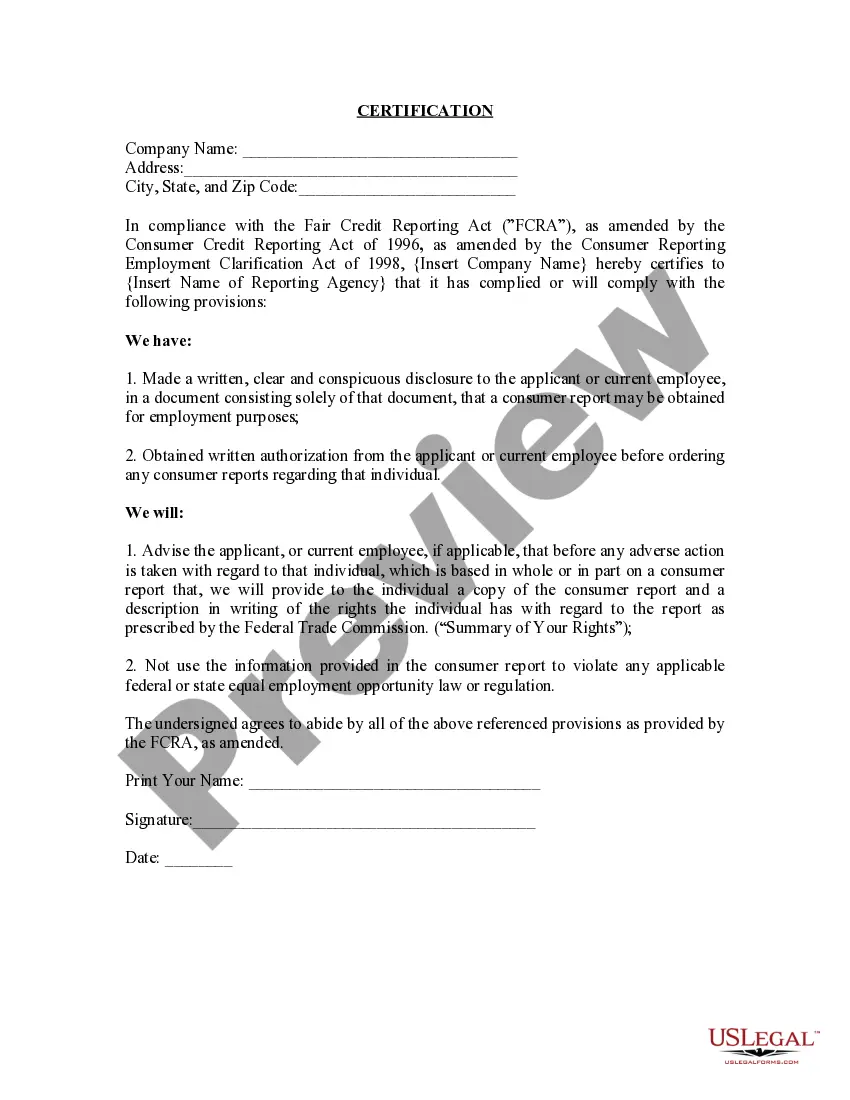
How to fill out FCRA Certification Letter To Consumer Reporting Agency?
- Log in to your existing US Legal Forms account and verify your subscription status. If your subscription has expired, renew it to maintain access.
- Begin by reviewing the available form templates in Preview mode to ensure you select the one that complies with your jurisdiction's requirements.
- If the desired form is unavailable or doesn't meet your needs, use the search feature to find a suitable alternative.
- Once you find the appropriate form, click the 'Buy Now' button and choose the subscription plan that best suits your requirements.
- Proceed with your payment by entering your credit card information or using PayPal to finalize your purchase.
- After payment, download the template to your device for easy access and completion at any time through the 'My Forms' section of your profile.
Using US Legal Forms not only simplifies the process of acquiring legal documents but also ensures that you have access to over 85,000 fillable forms, backed by premium expert assistance.
Start your hassle-free journey in obtaining the right legal forms today. Visit US Legal Forms to discover more!
Form popularity
FAQ
If a credit bureau verifies inaccurate information, they may be held accountable under the FCRA. Consumers have the right to seek remedies for the damage caused by this verification, including potential compensation. Such situations highlight the importance of understanding the FCRA law for inaccurate information, as it provides avenues for recourse. Engaging with platforms like US Legal Forms can help you navigate these disputes effectively.
A 609 letter to remove debt is a formal request you send to a credit bureau asking for verification of the information related to a disputed debt. This letter cites your rights under the FCRA and requests supporting documentation for the reported debt. Using a well-crafted 609 letter can help clear inaccuracies from your report, directly addressing the FCRA law for inaccurate information. It's a strategic move to enhance your credit score.
609 letters can be effective in disputing inaccuracies on your credit report. These letters leverage your rights under the FCRA to request verification of disputed items from credit bureaus. While results can vary, many consumers see positive outcomes by using this method, highlighting the importance of the FCRA law for inaccurate information. Knowing how to draft a 609 letter correctly can maximize your chances of success.
FCRA section 623 focuses on the responsibilities of information furnishers, such as lenders and creditors. It mandates that these entities provide accurate data to credit reporting agencies and correct any inaccuracies. This section directly ties into the FCRA law for inaccurate information, as it holds furnishers accountable for the integrity of the information they report. Therefore, understanding this law is vital for both consumers and furnishers alike.
Credit law 609 is a provision within the FCRA that allows consumers to request information from credit bureaus. Specifically, it gives you the right to dispute inaccuracies and obtain details about who accessed your credit report. This law supports your ability to challenge incorrect information effectively, aligning with the broader goals of the FCRA law for inaccurate information. Understanding your rights under this section can empower you to maintain control over your credit history.
Yes, the Fair Credit Reporting Act (FCRA) imposes strict rules against providing inaccurate information. This law protects consumers by requiring credit reporting agencies to ensure that the information they report is accurate and verifiable. If you find inaccuracies on your credit report, you can take action under the FCRA to have these errors corrected. Ensuring compliance with the FCRA law for inaccurate information is essential for maintaining your credit health.
Compensation for inaccurate credit reporting varies based on individual circumstances but can reach significant amounts. The FCRA law for inaccurate information helps recover damages caused by negligence in reporting. Factors include actual damages, emotional distress, and sometimes punitive damages. Consulting an attorney can provide a clearer picture of what to expect.
When you face inaccurate credit reporting, you can indeed pursue legal action. The FCRA law for inaccurate information gives you the authority to seek justice. If incorrect data affects your financial standing, collecting evidence of the inaccuracies is crucial. You may consider utilizing platforms like US Legal Forms to aid you in this process.
Yes, you have the right to sue for false information on your credit report. The FCRA law for inaccurate information supports this action by holding credit reporting agencies accountable. If you identify inaccuracies, you should dispute them directly and document your findings. An experienced attorney can guide you on the steps to take for a potential lawsuit.
Yes, you can sue someone if they have caused harm to your credit through inaccurate information. The FCRA law for inaccurate information allows individuals to take action against those who report wrong details about them. It is important to document any inaccuracies and respond swiftly. Consulting with a legal professional can help you understand your options.