Llc Form Companies File With Irs
Description
Get your form ready online
Our built-in tools help you complete, sign, share, and store your documents in one place.
Make edits, fill in missing information, and update formatting in US Legal Forms—just like you would in MS Word.
Download a copy, print it, send it by email, or mail it via USPS—whatever works best for your next step.
Sign and collect signatures with our SignNow integration. Send to multiple recipients, set reminders, and more. Go Premium to unlock E-Sign.
If this form requires notarization, complete it online through a secure video call—no need to meet a notary in person or wait for an appointment.
We protect your documents and personal data by following strict security and privacy standards.

Make edits, fill in missing information, and update formatting in US Legal Forms—just like you would in MS Word.

Download a copy, print it, send it by email, or mail it via USPS—whatever works best for your next step.

Sign and collect signatures with our SignNow integration. Send to multiple recipients, set reminders, and more. Go Premium to unlock E-Sign.

If this form requires notarization, complete it online through a secure video call—no need to meet a notary in person or wait for an appointment.

We protect your documents and personal data by following strict security and privacy standards.
Looking for another form?







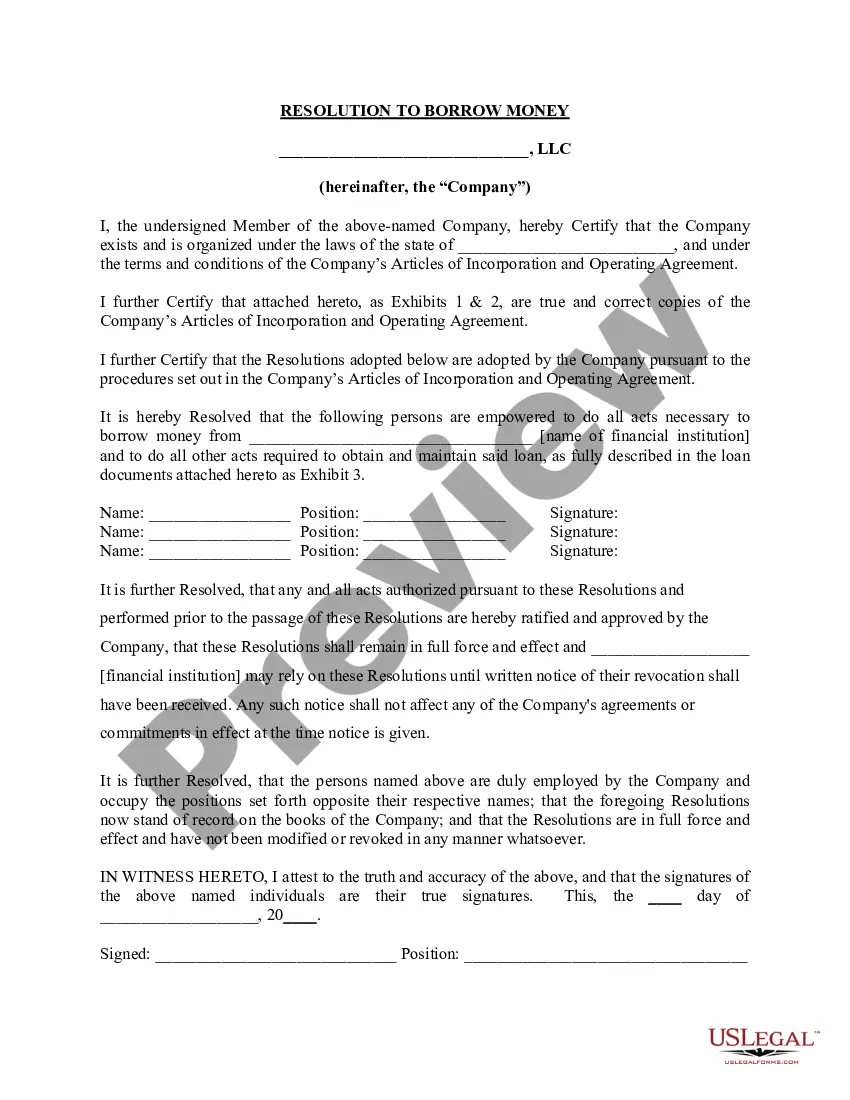
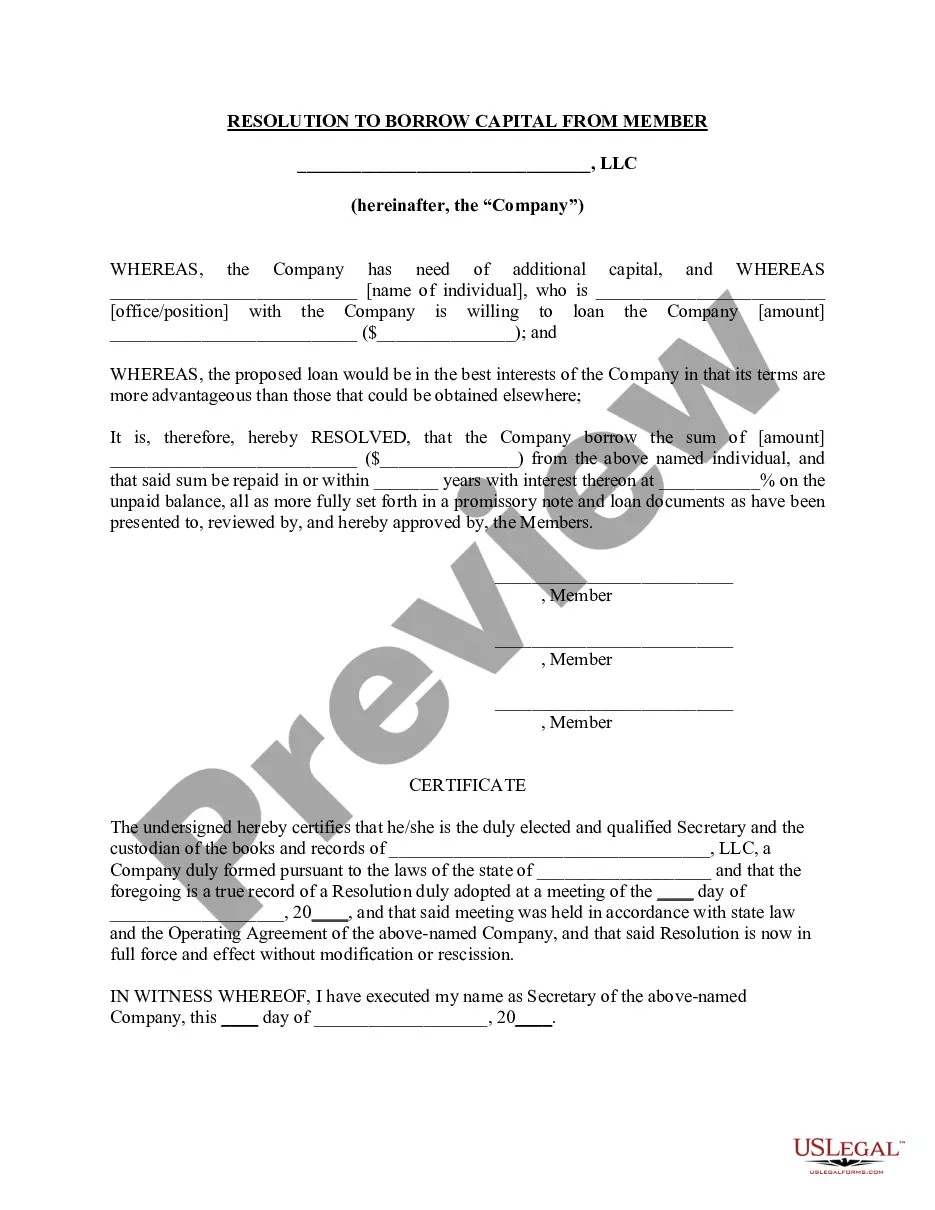
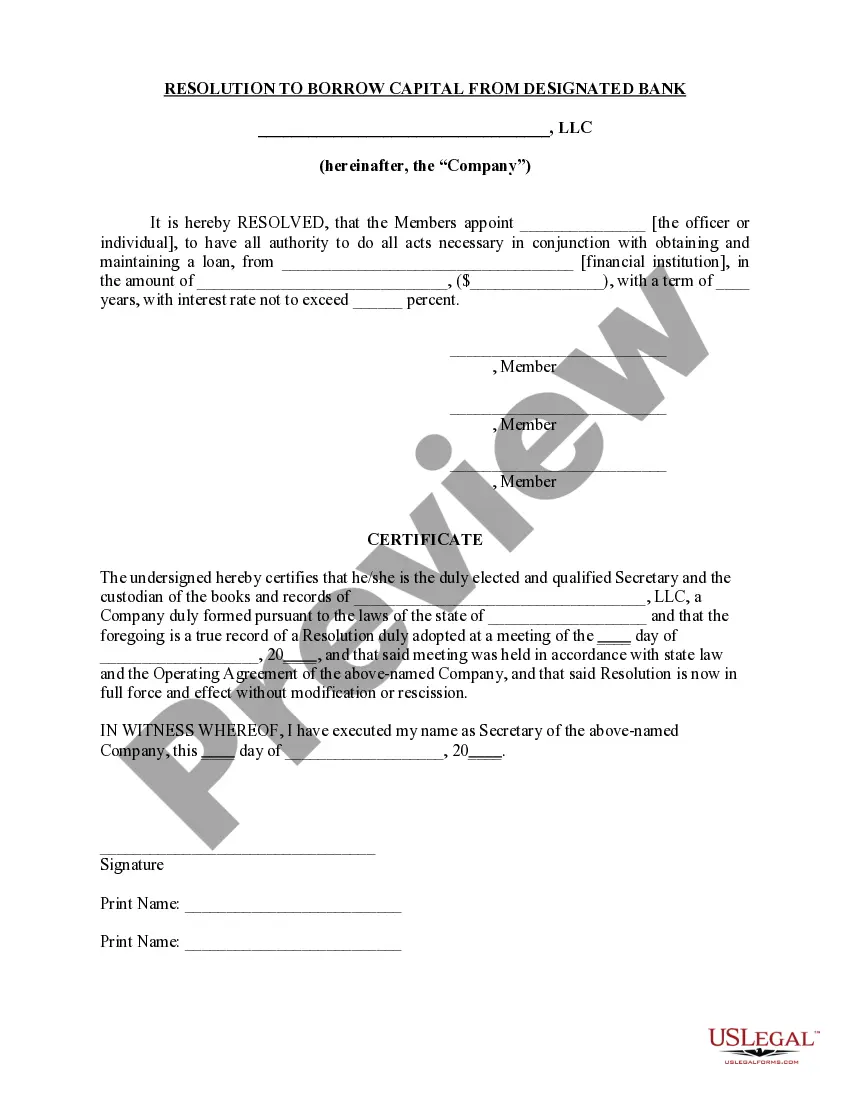
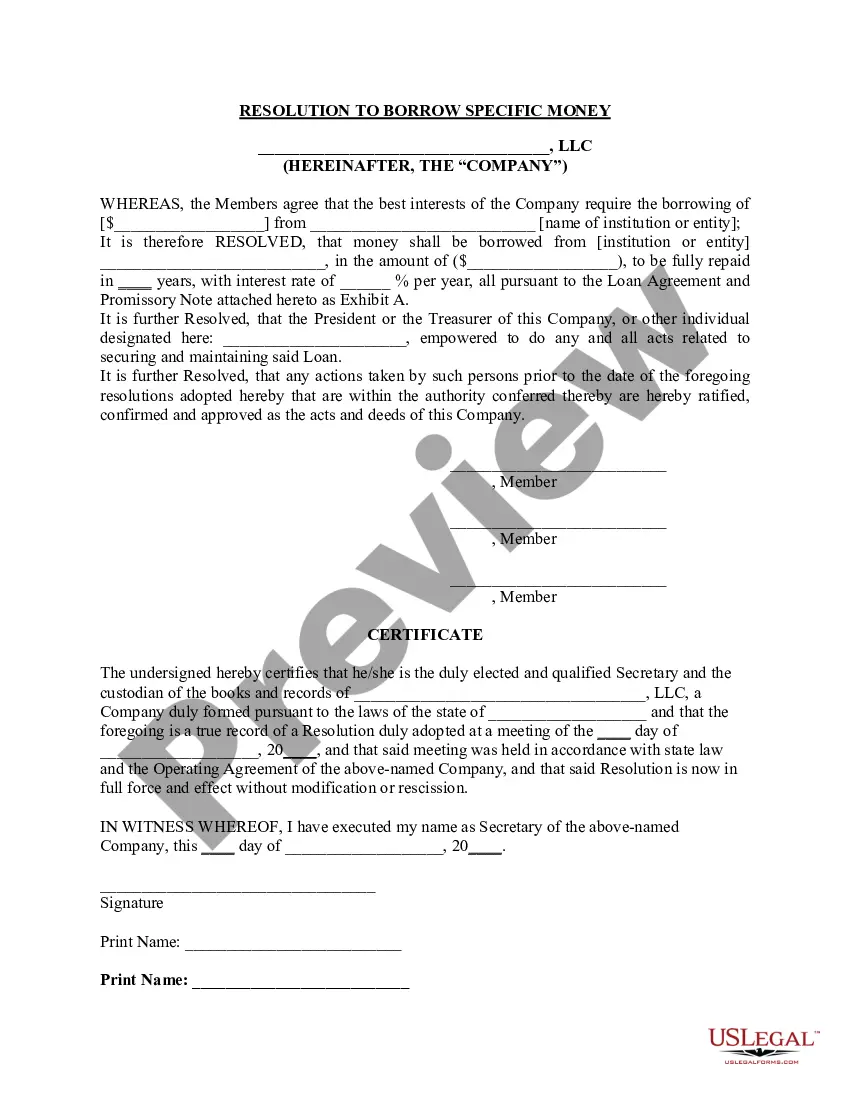
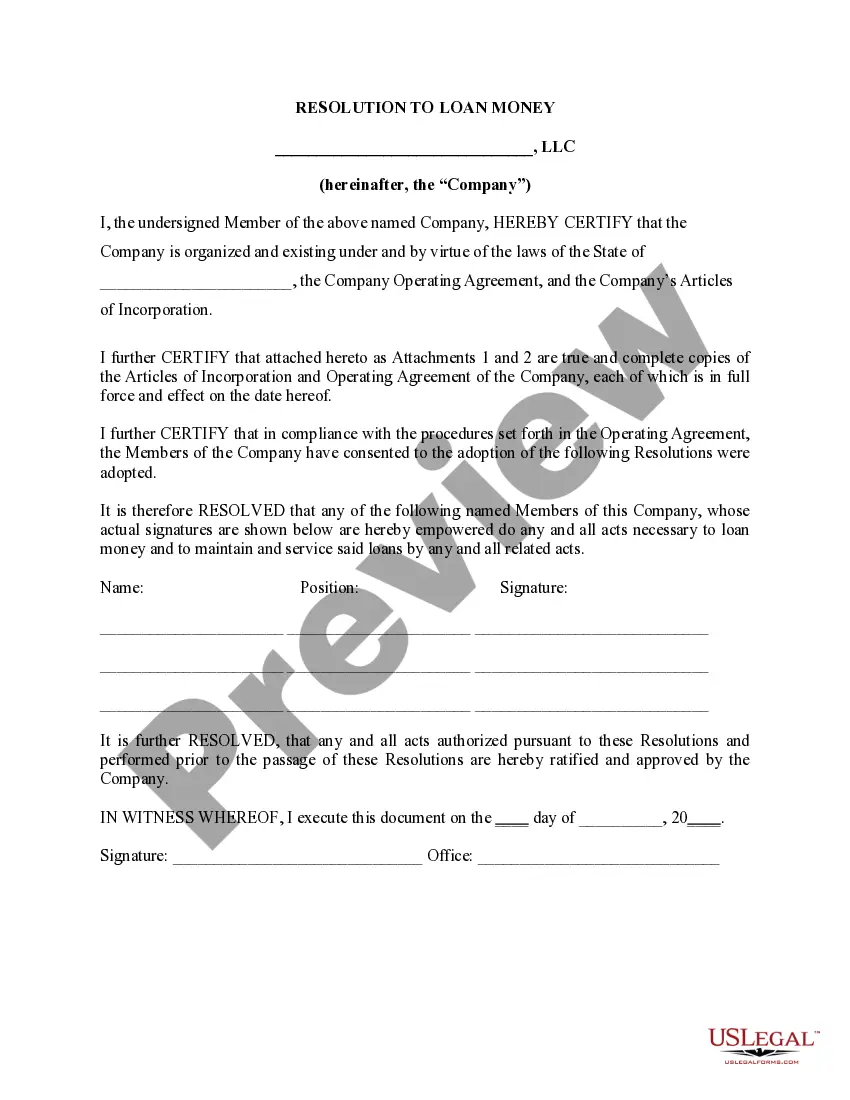
How to fill out Resolution Of Meeting Of LLC Members To Borrow Money?
- Log in to your US Legal Forms account if you are a returning user. Ensure your subscription is active; otherwise, consider renewing it.
- For new users, browse through the Preview mode to view detailed descriptions of the LLC form templates available. Confirm that you select the one that meets your legal needs.
- If the first form does not fit your requirements, utilize the Search function to find a suitable alternative that corresponds with your jurisdiction.
- Once you've identified the right form, click the Buy Now button and select your desired subscription plan. Creating an account is necessary to access the resource library.
- Complete your purchase by entering your payment information, whether by credit card or PayPal.
- Finally, download the form to your device. You can also access it anytime in the My Forms section of your account.
In conclusion, US Legal Forms simplifies the process of filing LLC forms with the IRS through its comprehensive library and user-friendly platform. By following these steps, you can ensure that your legal documents are both accurate and compliant.
Ready to file your LLC forms? Visit US Legal Forms today and utilize our robust collection for all your legal needs!
Form popularity
FAQ
You generally file your LLC and personal taxes together only if you are a single-member LLC. In that case, LLC income is reported on your personal tax return, often using Schedule C. However, if your LLC has multiple members, you will file the business taxes separately using Form 1065. Using tools from US Legal Forms can make this process clearer for you.
LLC income is reported to the IRS based on how the LLC chooses to be taxed. Single-member LLCs report income on Schedule C, while multi-member LLCs file Form 1065. Each member then receives a Schedule K-1 detailing their share of income, which they report on their personal taxes. For streamlined reporting, consider using US Legal Forms to ensure you have the right documents.
An LLC must report taxes regardless of how much it makes, but there are thresholds depending on its structure. For instance, single-member LLCs report income on Schedule C, while multi-member LLCs report on Form 1065. Even if your earnings are minimal, reporting is necessary for transparency with the IRS. Utilizing resources like US Legal Forms can simplify this process.
To report LLC income to the IRS, first determine your LLC's structure. For single-member LLCs, income is usually reported on Schedule C, while multi-member LLCs typically use Form 1065. It's essential to provide accurate income details and expenses to ensure you file correctly. If you're unsure about the forms, consider using US Legal Forms for guidance.
To show income from your LLC, you must accurately report all business earnings on your tax returns. Typically, LLC income is reported on Schedule C if you are a single-member LLC or on Form 1065 for multi-member LLCs. You need to keep clear records of your income and any allowable expenses to ensure compliance when you file with the IRS. Using platforms like US Legal Forms can help you streamline this process effectively.
You can order IRS forms by visiting the official IRS website, where most forms are available for immediate download. If you prefer physical copies, you can request them online, or by calling the IRS directly. Ensure you have the necessary forms your LLC needs, as getting the right documents is crucial for staying compliant with the IRS requirements that LLC form companies file with IRS.
LLCs typically file Form 1065 for partnership taxation, or Schedule C if they are single-member LLCs. Additionally, LLCs may need to file other IRS forms depending on their specific structure and business activities. It’s essential to be aware of what forms your LLC needs to file, as these documents ensure compliance with the IRS requirements that LLC form companies file with IRS.
LLCs generally use Form 8832 to elect their tax classification, while Form 2553 is necessary for those wishing to be taxed as an S corporation. These forms dictate how the LLC will be treated by the IRS, affecting tax rates and benefits. If you're unsure about which forms to file, consider utilizing uslegalforms to simplify the process and ensure your LLC form companies file with the IRS correctly. Filing accurately can help maximize your tax benefits.
An LLC files Form 1065 to report its income, deductions, and credits to the IRS. This form allows the IRS to see how much income the LLC generated and how it's distributed among owners. Filing this form is particularly important for multi-member LLCs, as it helps to clarify each owner's share of the income. Remember, LLC form companies file with IRS to ensure compliance and avoid penalties.
The classification of your LLC depends on its ownership structure and how it chooses to be taxed. A single-member LLC is typically treated as a sole proprietorship, whereas a multi-member LLC is considered a partnership unless it elects S corp status by submitting the necessary filings. Clarifying your LLC's classification will help you comply with IRS requirements efficiently, ensuring that your LLC forms file with the IRS correctly.