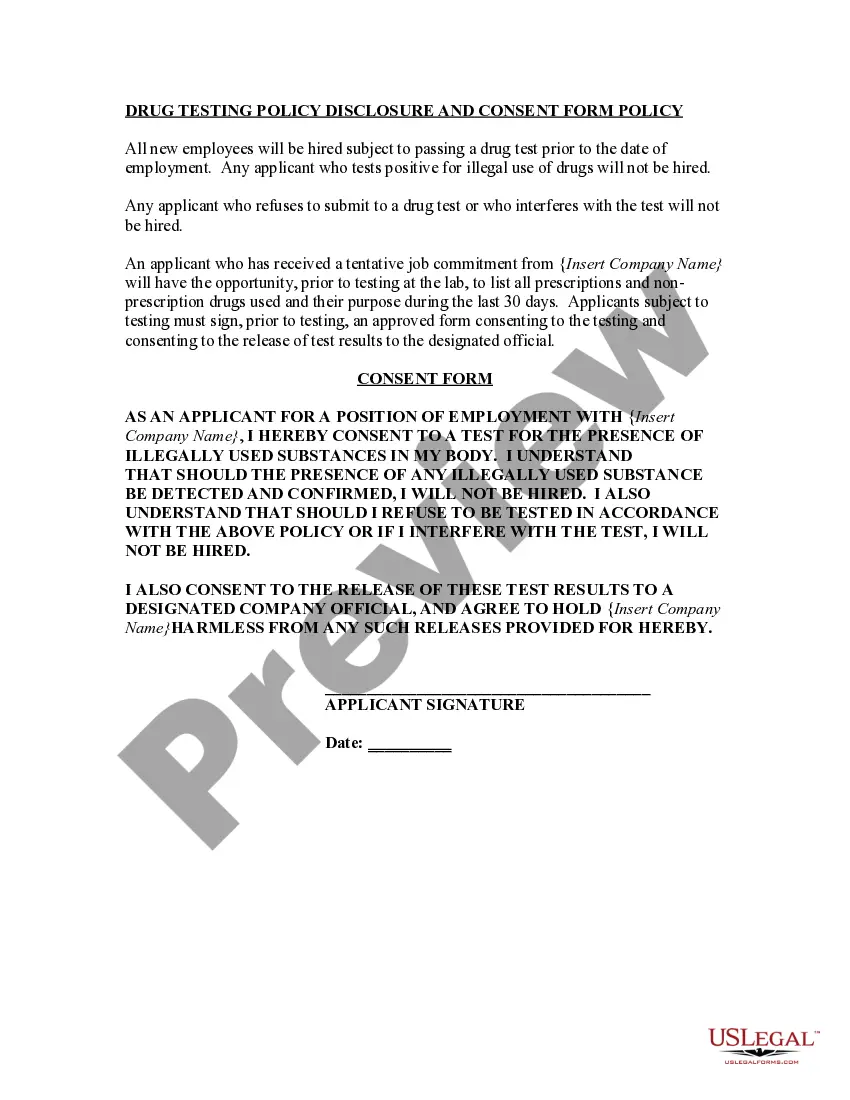
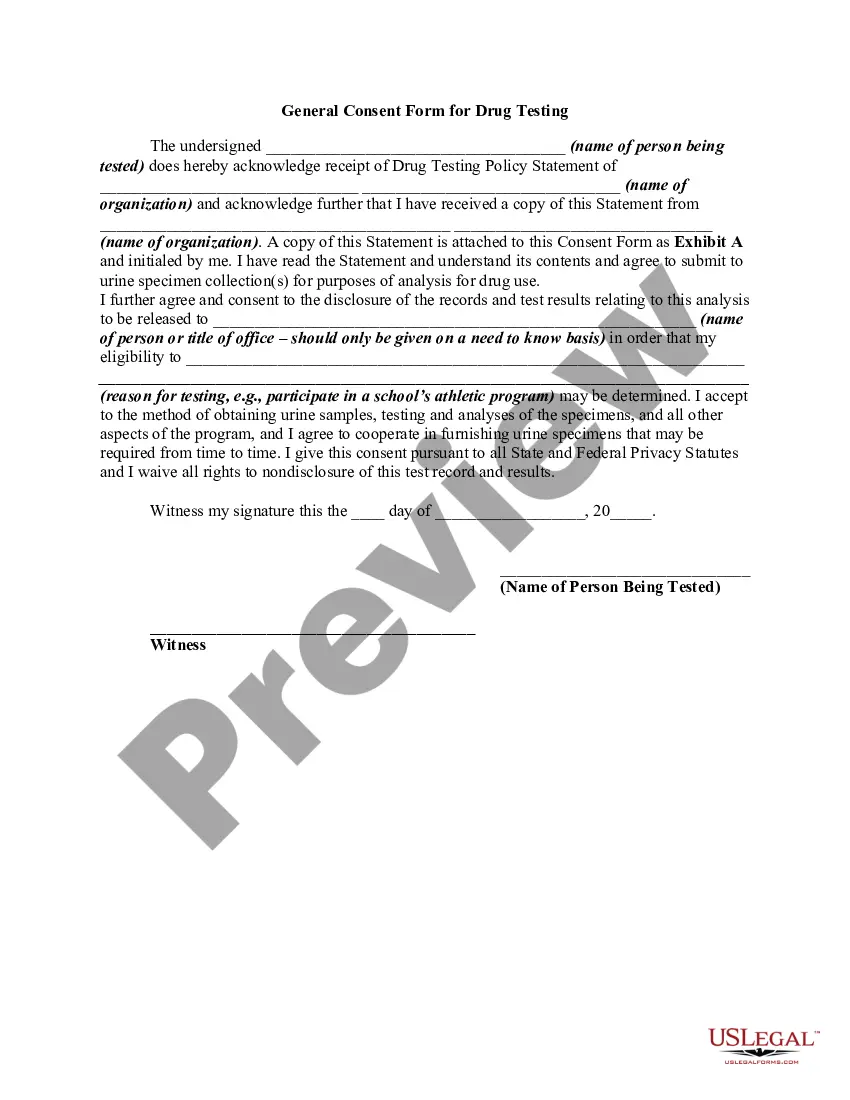
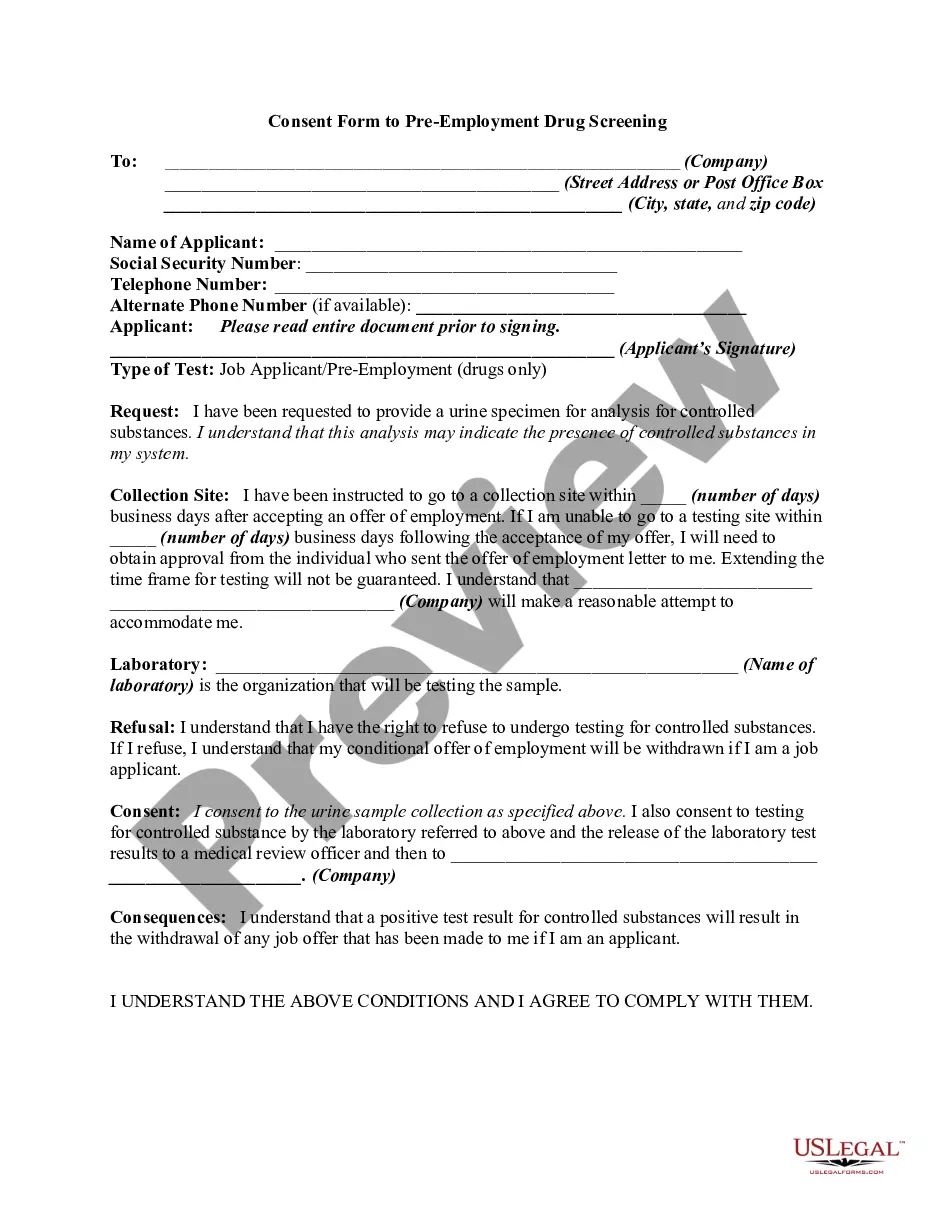
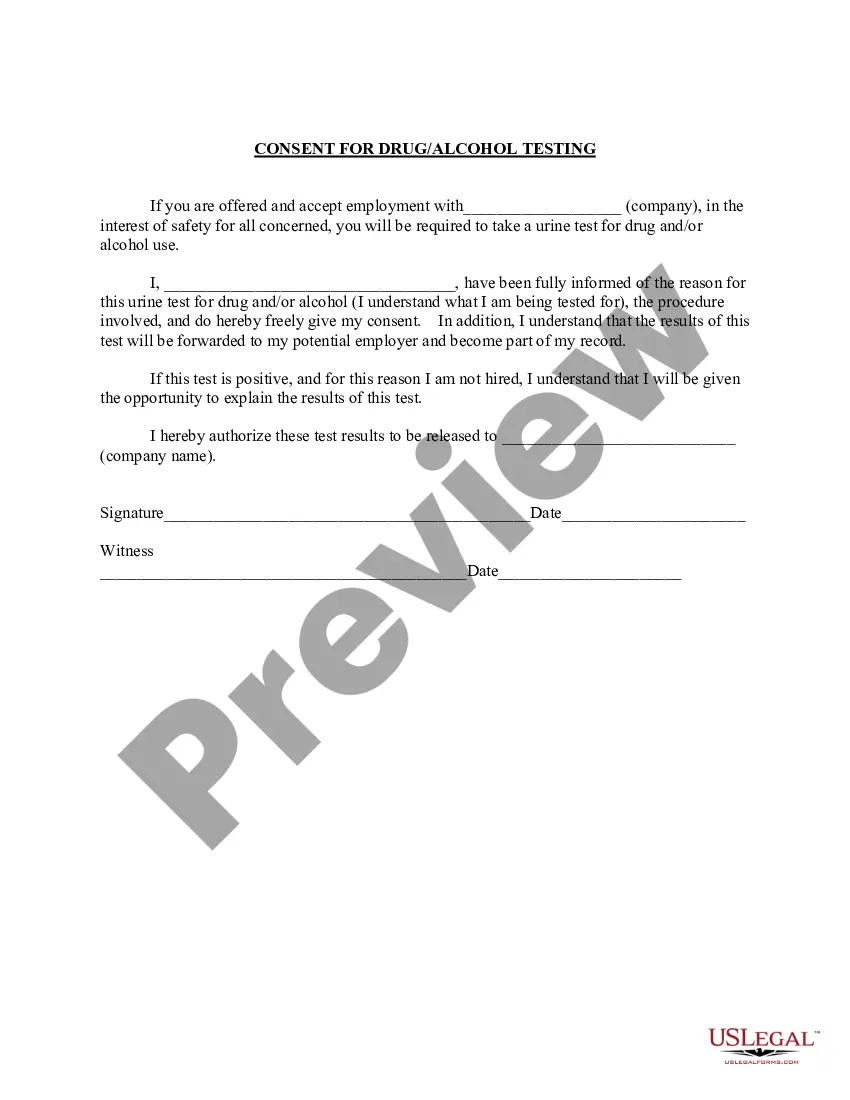
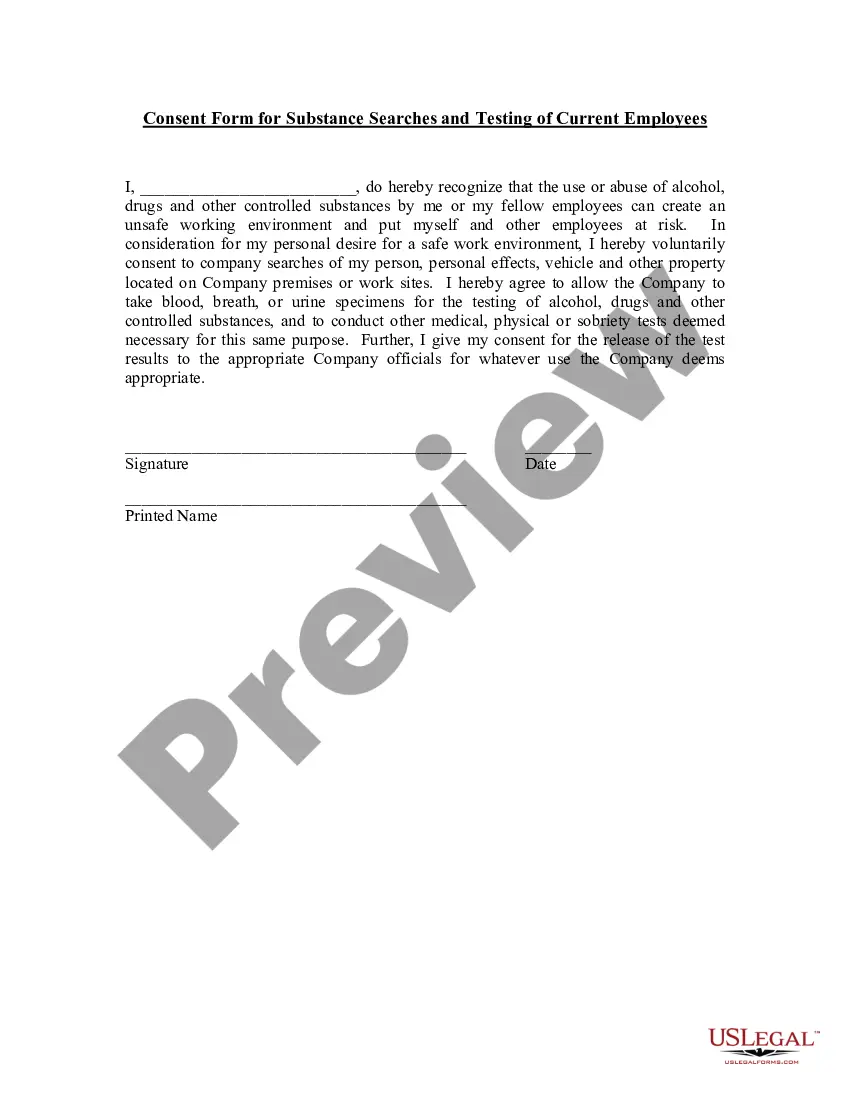
Drug Test For Jobs
Description
Get your form ready online
Our built-in tools help you complete, sign, share, and store your documents in one place.
Make edits, fill in missing information, and update formatting in US Legal Forms—just like you would in MS Word.
Download a copy, print it, send it by email, or mail it via USPS—whatever works best for your next step.
Sign and collect signatures with our SignNow integration. Send to multiple recipients, set reminders, and more. Go Premium to unlock E-Sign.
If this form requires notarization, complete it online through a secure video call—no need to meet a notary in person or wait for an appointment.
We protect your documents and personal data by following strict security and privacy standards.

Make edits, fill in missing information, and update formatting in US Legal Forms—just like you would in MS Word.

Download a copy, print it, send it by email, or mail it via USPS—whatever works best for your next step.

Sign and collect signatures with our SignNow integration. Send to multiple recipients, set reminders, and more. Go Premium to unlock E-Sign.

If this form requires notarization, complete it online through a secure video call—no need to meet a notary in person or wait for an appointment.

We protect your documents and personal data by following strict security and privacy standards.
Looking for another form?

How to fill out Drug Testing Policy Disclosure And Consent Form?
Whether for corporate purposes or for personal matters, everyone must navigate legal situations at some point in their life.
Filling out legal documents requires meticulous attention, starting from choosing the right form template.
After downloading, you can fill out the form with editing software or print it and finish it manually. With an extensive catalog from US Legal Forms available, you won’t need to waste time searching for the right template online. Use the library’s user-friendly navigation to find the suitable form for any purpose.
- For instance, if you select an incorrect version of a Drug Test For Jobs, it will be rejected when submitted.
- Thus, it is crucial to find a trustworthy source for legal forms like US Legal Forms.
- If you need to acquire a sample of Drug Test For Jobs, follow these simple steps.
- Use the search bar or explore the catalog to find the sample you require.
- Review the details of the form to confirm it suits your situation, state, and area.
- Click on the preview of the form to inspect it.
- If it is not the correct document, return to the search feature to locate the Drug Test For Jobs sample you need.
- Download the file once it meets your specifications.
- If you already possess a US Legal Forms account, click Log in to access previously saved documents in My documents.
- If you have yet to create an account, you can get the form by clicking Buy now.
- Choose the appropriate pricing option.
- Complete the registration form for your profile.
- Select your payment method: use a credit card or a PayPal account.
- Choose the file format you want and download the Drug Test For Jobs.
Form popularity
FAQ
Detection times for drugs depend on several factors, including the type of drug and individual metabolism. Generally, most drugs are detectable in urine for a few days to a few weeks. For example, marijuana may be detected for much longer compared to cocaine, which typically clears out faster. Understanding these timelines is crucial when preparing for a drug test for jobs.
In general, a drug test is more extensive and accurate than a drug screening, whereas a drug screening provides faster results and is a more cost-effective approach.
Urine, blood, breath, saliva, sweat, or hair samples may be used. Urine testing is most common because it is noninvasive, quick, and able to qualitatively detect a wide range of drugs. The window of detection depends on the frequency and amount of drug intake but is about 1 to 4 days for most drugs.
A drug test (also often toxicology screen or tox screen) is a technical analysis of a biological specimen, for example urine, hair, blood, breath, sweat, or oral fluid/saliva?to determine the presence or absence of specified parent drugs or their metabolites.
Urinalysis ? A urine test is the most common form of pre-employment drug testing and is typically conducted once a conditional offer of employment has been sent. A urine test can show traces of drug use even after the effects of the drug have worn off and remain in the body for an extended period of time.
Tests are commonly used for five categories of drugs: Amphetamines; Cocaine Marijuana; Opiates; and Phencyclidine (PCP). Additional categories may include barbiturates, Benzodiazepines, ethanol (alcohol), hydrocodone, MDMA, methadone, methaqualone, or propoxyphene.