Wrongful Interference With A Business Relationship Requires
Description
Get your form ready online
Our built-in tools help you complete, sign, share, and store your documents in one place.
Make edits, fill in missing information, and update formatting in US Legal Forms—just like you would in MS Word.
Download a copy, print it, send it by email, or mail it via USPS—whatever works best for your next step.
Sign and collect signatures with our SignNow integration. Send to multiple recipients, set reminders, and more. Go Premium to unlock E-Sign.
If this form requires notarization, complete it online through a secure video call—no need to meet a notary in person or wait for an appointment.
We protect your documents and personal data by following strict security and privacy standards.

Make edits, fill in missing information, and update formatting in US Legal Forms—just like you would in MS Word.

Download a copy, print it, send it by email, or mail it via USPS—whatever works best for your next step.

Sign and collect signatures with our SignNow integration. Send to multiple recipients, set reminders, and more. Go Premium to unlock E-Sign.

If this form requires notarization, complete it online through a secure video call—no need to meet a notary in person or wait for an appointment.

We protect your documents and personal data by following strict security and privacy standards.
Looking for another form?

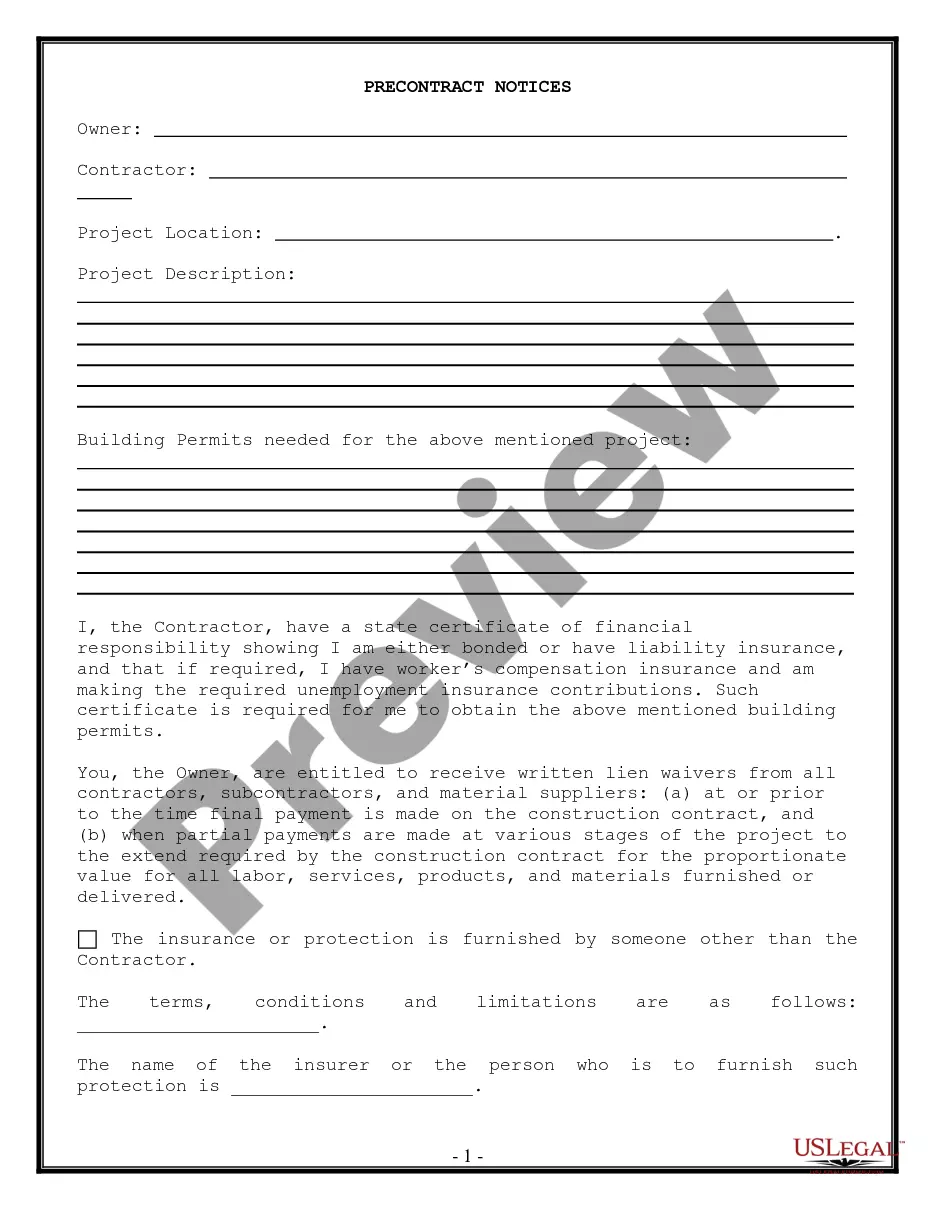






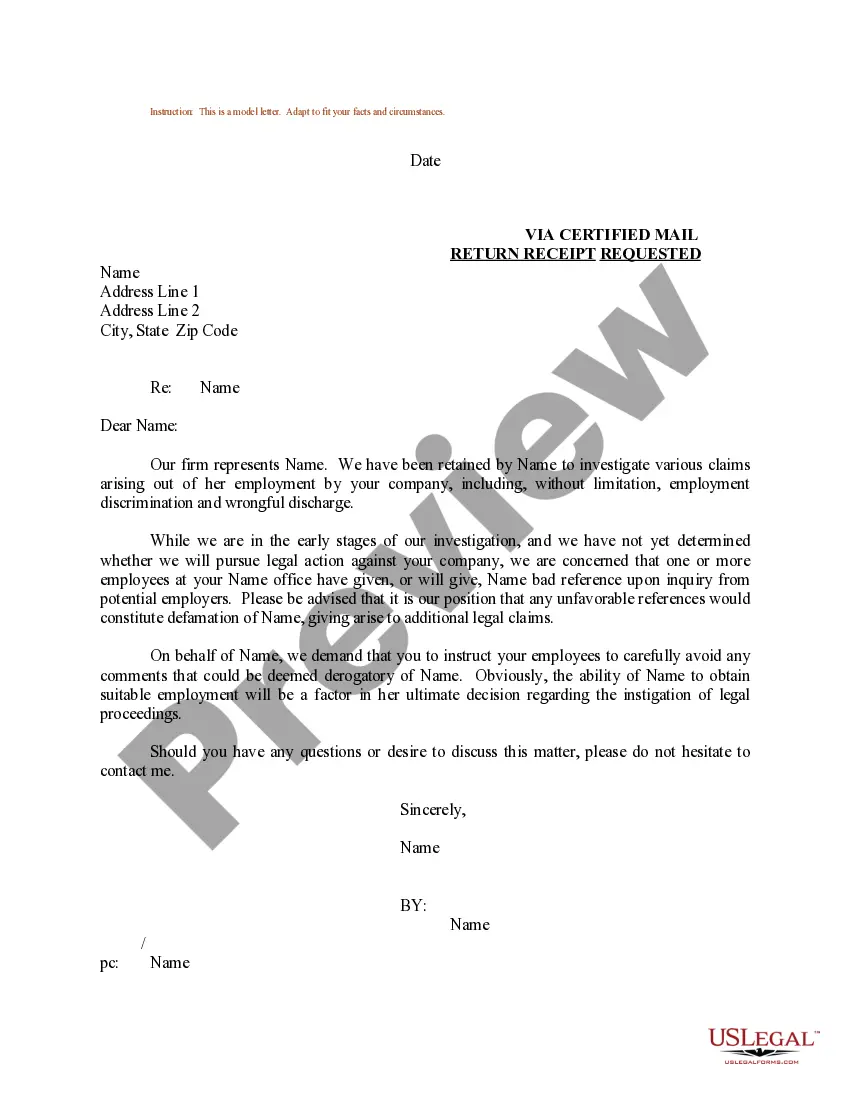
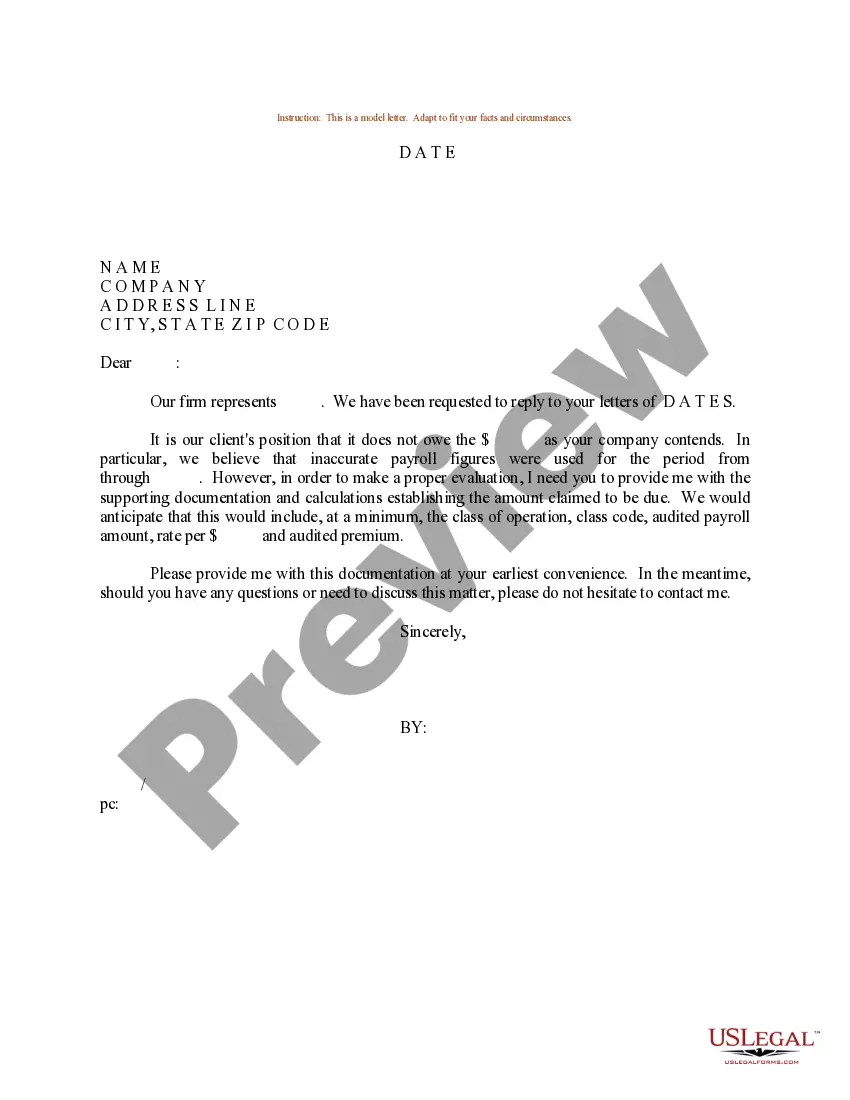
How to fill out Sample Letter For Employment Discrimination - Wrongful Discharge?
Creating legal documents from the beginning can occasionally be intimidating. Some situations may require extensive research and significant financial investment.
If you’re looking for a simpler and more budget-friendly method of preparing Wrongful Interference With A Business Relationship Requires or any other documentation without unnecessary obstacles, US Legal Forms is always accessible.
Our online library of more than 85,000 current legal forms covers almost every facet of your financial, legal, and personal affairs.
With just a few clicks, you can promptly obtain state- and county-compliant forms meticulously crafted for you by our legal experts.
Review the form preview and descriptions to confirm that you are looking at the document you need. Ensure the form you select meets the standards of your state and county. Choose the most appropriate subscription option to buy the Wrongful Interference With A Business Relationship Requires. Download the form, then complete, certify, and print it. US Legal Forms boasts a solid reputation and over 25 years of expertise. Join us today and make form execution a straightforward and efficient process!
- Utilize our website whenever you require a dependable and trustworthy service through which you can swiftly find and download the Wrongful Interference With A Business Relationship Requires.
- If you’re familiar with our site and have set up an account with us before, simply Log In to your account, find the template, and download it or re-download it anytime later in the My documents section.
- Not registered yet? No worries. It only takes a few minutes to create an account and browse the catalog.
- However, before rushing to download Wrongful Interference With A Business Relationship Requires, adhere to these guidelines.
Form popularity
FAQ
Wrongful interference with a business relationship requires a clear demonstration of intentional misconduct aimed at disrupting another party's business transactions. To succeed in such a claim, you must present evidence showing the disruption's harmful effects on your business. Understanding the legal standards and gathering appropriate documentation are essential steps in this process. Platforms like uslegalforms can provide valuable resources for navigating these legal challenges.
Wrongful interference with a contractual relationship requires showing that a third party intentionally caused one party to breach a valid contract. This can include actions such as persuading a party to break the contract or providing false information that leads to a breach. Establishing this type of claim often involves detailed evidence of the interference and its impact on the contractual relationship. Legal guidance can help streamline this process.
Yes, you can sue someone for interfering with your business if you can prove that their actions caused significant harm. Wrongful interference with a business relationship requires demonstrating intentional misconduct, which impacted your business operations. Filing a lawsuit can be a complex process, so it is advisable to seek professional legal assistance. This support can help you navigate your rights and potential remedies.
Actions that could be considered wrongful interference with a business relationship include making false statements about a competitor or encouraging a client to stop doing business with you. Additionally, if someone uses threats or coercion to disrupt your business dealings, this may also qualify as wrongful interference. Recognizing these behaviors is crucial for protecting your business interests. Consulting with legal experts can clarify your situation.
Wrongful interference with a business relationship requires proof that one party intentionally disrupted another party's business dealings. This disruption can occur through various actions, such as spreading false information or persuading clients to break contracts. To establish a claim, you must demonstrate that the interference caused harm to your business. Seeking legal advice can help you understand your rights and options.
Tortious Interference with Contract Tortious interference with a contract occurs when someone improperly induces a breach of contract between you and a third party. For example, let's say you have a contract to sell 100 widgets to Company A. But Company A has many lucrative contracts with Company B.
Proof of the Interference or Wrongful Act Along with knowledge and intent, the plaintiff must show that the defendant did something intentionally wrong to interfere with the contract. There are many business activities that may harm another company's profits that are not knowingly and intentionally malicious.
The requisite elements of tortious interference with contract claim are: (1) the existence of a valid and enforceable contract between plaintiff and another; (2) defendant's awareness of the contractual relationship; (3) defendant's intentional and unjustified inducement of a breach of the contract; (4) a subsequent ...
Tortious interference with contract rights can occur when one party persuades another to breach its contract with a third party (e.g., using blackmail, threats, influence, etc.) or where someone knowingly interferes with a contractor's ability to perform his contractual obligations, preventing the client from receiving ...
In California, to establish interference with prospective economic relations, a plaintiff must show that: (1) plaintiff and a third party had an economic relation; (2) the relation between plaintiff and the third party would likely have led to future benefits; (3) defendant knew of the relation; (4) defendant ...