Waiving Inheritance Without Tax
Description

Get your form ready online
Our built-in tools help you complete, sign, share, and store your documents in one place.
Make edits, fill in missing information, and update formatting in US Legal Forms—just like you would in MS Word.
Download a copy, print it, send it by email, or mail it via USPS—whatever works best for your next step.
Sign and collect signatures with our SignNow integration. Send to multiple recipients, set reminders, and more. Go Premium to unlock E-Sign.
If this form requires notarization, complete it online through a secure video call—no need to meet a notary in person or wait for an appointment.
We protect your documents and personal data by following strict security and privacy standards.

Make edits, fill in missing information, and update formatting in US Legal Forms—just like you would in MS Word.

Download a copy, print it, send it by email, or mail it via USPS—whatever works best for your next step.

Sign and collect signatures with our SignNow integration. Send to multiple recipients, set reminders, and more. Go Premium to unlock E-Sign.

If this form requires notarization, complete it online through a secure video call—no need to meet a notary in person or wait for an appointment.

We protect your documents and personal data by following strict security and privacy standards.
Looking for another form?



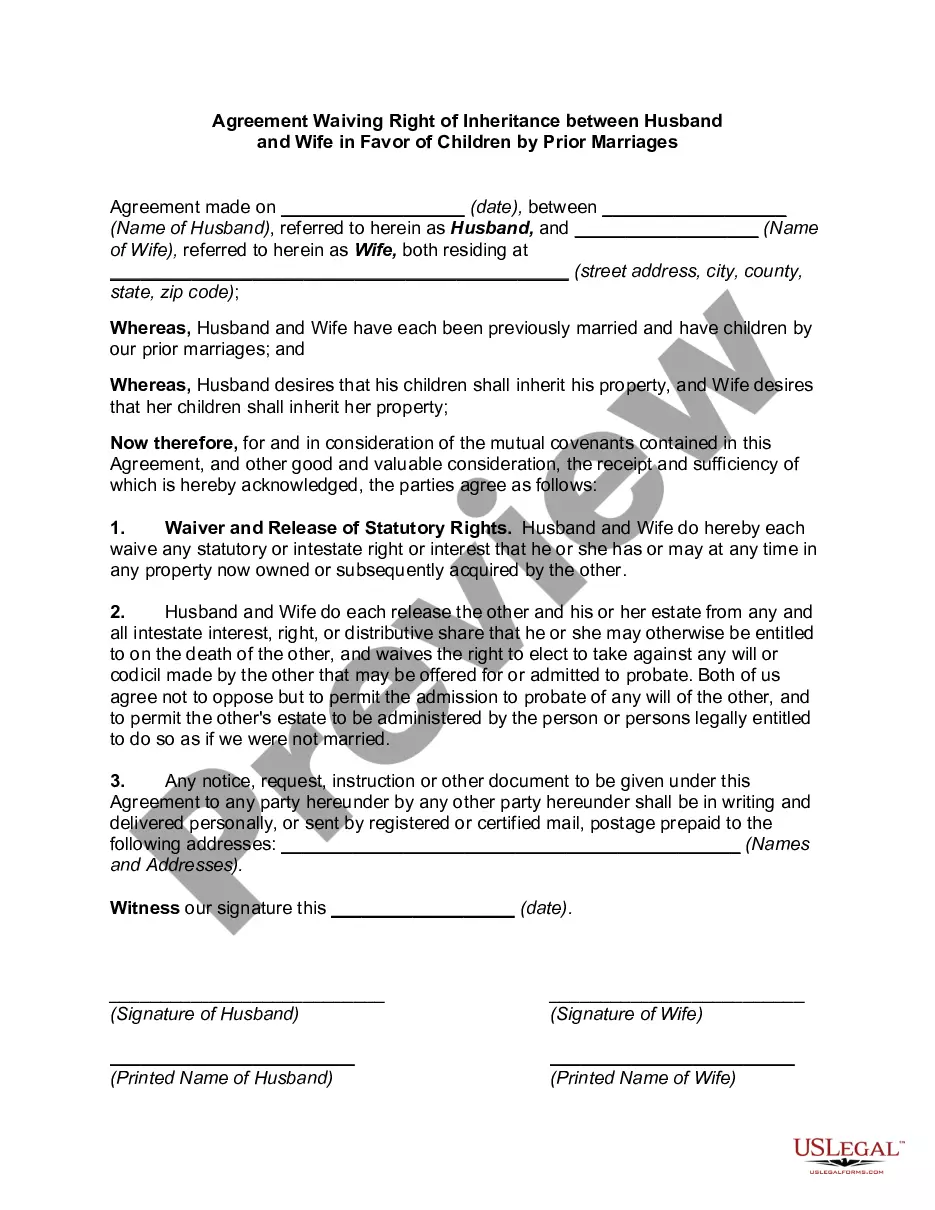
How to fill out Agreement Waiving Right Of Inheritance Between Husband And Wife In Favor Of Children By Prior Marriages?
Whether for professional objectives or personal issues, everyone eventually encounters legal circumstances at some point in their lives.
Filling out legal paperwork requires meticulous focus, starting with selecting the appropriate format template.
Once it has been downloaded, you can fill out the form using editing software or print it and complete it by hand. With an extensive catalog from US Legal Forms available, you won't need to waste time searching for the correct template online. Make use of the library’s straightforward navigation to find the right form for any situation.
- Obtain the template you need by using the search bar or browsing the catalog.
- Review the description of the form to confirm that it corresponds with your situation, state, and county.
- Click on the preview of the form to inspect it.
- If it is the incorrect document, return to the search feature to find the Waiving Inheritance Without Tax template you need.
- Download the file when it satisfies your criteria.
- If you currently have a US Legal Forms account, simply click Log in to access documents you've saved in My documents.
- If you do not have an account yet, you can download the form by clicking Buy now.
- Choose the suitable pricing option.
- Complete the account registration form.
- Select your payment method: you can utilize a credit card or PayPal.
- Choose the desired file format and download the Waiving Inheritance Without Tax.
Form popularity
FAQ
The federal estate tax exemption shields $12.06 million from tax as of 2022 (rising to $12.92 million in 2023).3 There's no income tax on inheritances.
In general, any inheritance you receive does not need to be reported to the IRS. You typically don't need to report inheritance money to the IRS because inheritances aren't considered taxable income by the federal government. That said, earnings made off of the inheritance may need to be reported.
Here are 4 ways to protect your inheritance from taxes: See if the alternate valuation date will help. For tax purposes, the estates are evaluated based on their fair market value at the time of the decedent's death. ... Transfer your assets into a trust. ... Minimize IRA distributions. ... Make charitable gifts. ... Next steps for you.
The disclaimer must be in writing: A signed letter by the person doing the disclaiming, identifying the decedent, describing the asset to be disclaimed, and the extent and amount, percentage or dollar amount, to be disclaimed, must be delivered to the person in control of the estate or asset, such as an executor, ...
If you received a gift or inheritance, do not include it in your income. However, if the gift or inheritance later produces income, you will need to pay tax on that income. Example: You inherit and deposit cash that earns interest income. Include only the interest earned in your gross income, not the inhereted cash.