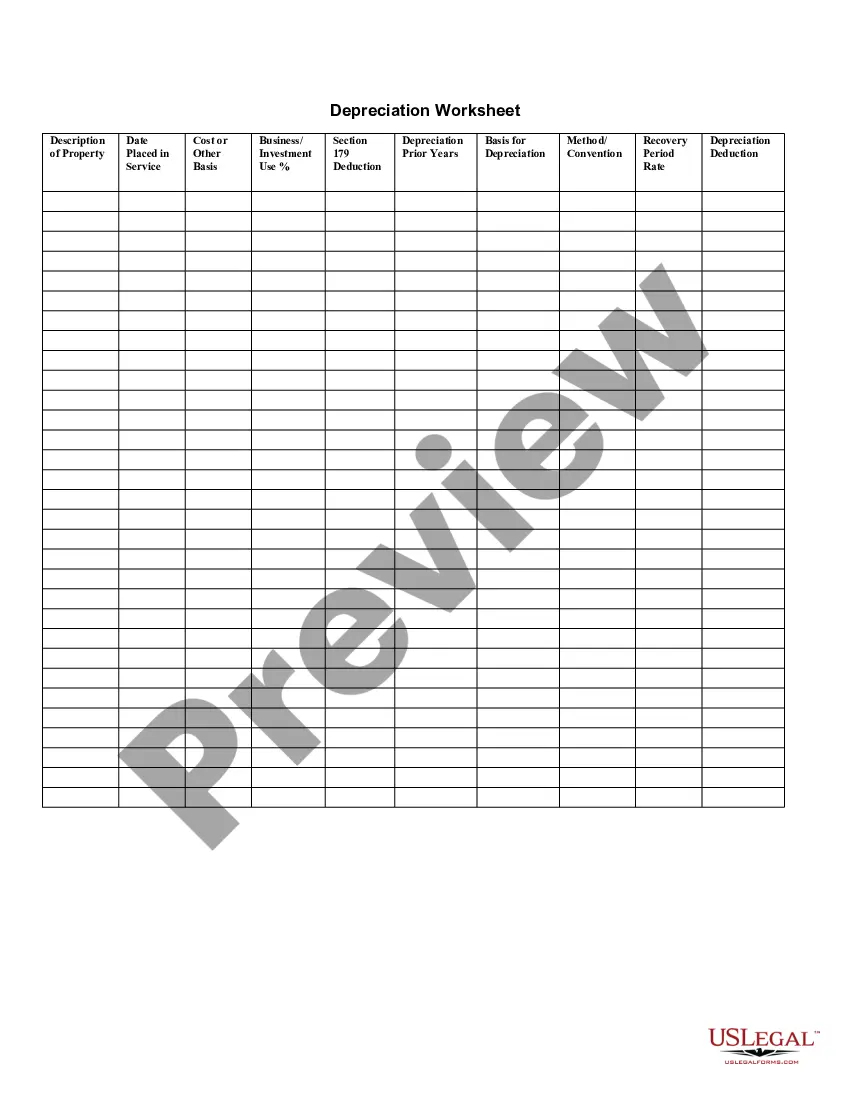
Template For Depreciation Worksheet
Description
Get your form ready online
Our built-in tools help you complete, sign, share, and store your documents in one place.
Make edits, fill in missing information, and update formatting in US Legal Forms—just like you would in MS Word.
Download a copy, print it, send it by email, or mail it via USPS—whatever works best for your next step.
Sign and collect signatures with our SignNow integration. Send to multiple recipients, set reminders, and more. Go Premium to unlock E-Sign.
If this form requires notarization, complete it online through a secure video call—no need to meet a notary in person or wait for an appointment.
We protect your documents and personal data by following strict security and privacy standards.

Make edits, fill in missing information, and update formatting in US Legal Forms—just like you would in MS Word.

Download a copy, print it, send it by email, or mail it via USPS—whatever works best for your next step.

Sign and collect signatures with our SignNow integration. Send to multiple recipients, set reminders, and more. Go Premium to unlock E-Sign.

If this form requires notarization, complete it online through a secure video call—no need to meet a notary in person or wait for an appointment.

We protect your documents and personal data by following strict security and privacy standards.
Looking for another form?

How to fill out Depreciation Worksheet?
Securing legal documents that comply with federal and state regulations is essential, and the web provides numerous alternatives to select from.
However, what is the benefit of spending time looking for the appropriate Template For Depreciation Worksheet example online when the US Legal Forms digital repository already has these templates gathered in one location.
US Legal Forms is the largest online legal repository with more than 85,000 fillable documents created by lawyers for any corporate and personal scenario.
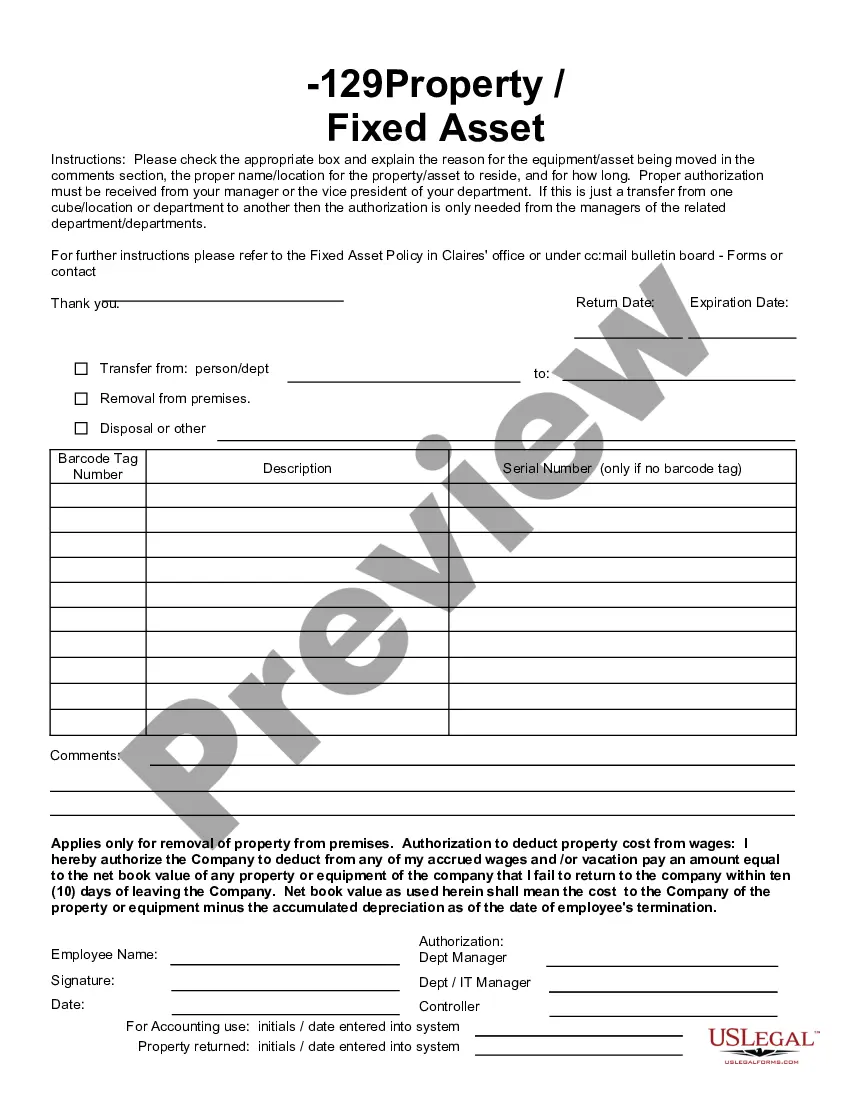
Review the template using the Preview feature or through the text description to ensure it satisfies your requirements.
- They are simple to navigate with all files categorized by state and intended use.
- Our experts stay updated with legislative changes, ensuring you can always trust that your form is current and compliant when acquiring a Template For Depreciation Worksheet from our site.
- Getting a Template For Depreciation Worksheet is straightforward and quick for both existing and new users.
- If you already possess an account with an active subscription, Log In and save the document sample you require in your desired format.
- If you are unfamiliar with our site, follow the steps below.
Form popularity
FAQ
To prepare a depreciation schedule in Excel, start by listing your assets in a spreadsheet. Next, input their costs, useful lives, and choose a depreciation method. You can then use a template for depreciation worksheet to streamline calculations, making your schedule easy to read and manage.
You can certainly create your own depreciation schedule by gathering the necessary data about your assets. By using the appropriate formulas and methods, you can track your assets' value over time. A template for depreciation worksheet can guide you through this process and ensure you don't overlook any important details.
Yes, you can create your own depreciation schedule with the right tools and information. By gathering your asset details and applying the appropriate depreciation method, you can establish a clear overview of your asset value over time. A template for depreciation worksheet can be a valuable resource in this process.
You can find a depreciation schedule template on various online platforms, including US Legal Forms. They offer customizable templates that meet legal standards and can help you create a detailed schedule tailored to your specific assets. This resource can save you time and ensure accuracy in your calculations.
Yes, you can create a depreciation schedule on your own. By using a template for depreciation worksheet, you can easily input your asset details and perform the calculations. However, if you prefer assistance or want to ensure compliance with tax regulations, consider using platforms like uslegalforms, which offer guided solutions tailored to your needs.
The syntax is =SYD(cost, salvage, life, per) with per defined as the period to calculate the depreciation. The unit used for the period must be the same as the unit used for the life; e.g., years, months, etc.
In the straight-line method, the depreciation amount is a constant percentage of the basis, equal to d=1/n. For a useful life of 5 years, the depreciation rate (d) for years 1 through 5 is 1/5, 1/5, 1/5, 1/5, 1/5. The total sums to 5/5 or 100%.
The DB function performs the following calculations. Fixed rate = 1 - ((salvage / cost) ^ (1 / life)) = 1 - (1000/10,000)^(1/10) = 1 - 0.7943282347 = 0.206 (rounded to 3 decimal places). Depreciation value period 1 = 10,000 * 0.206 = 2,060.00. Deprecation value period 2 = (10,000 - 2,060.00) * 0.206 = 1635.64, etc.
Formula: (asset cost ? salvage value) / useful life. How it works: You divide the cost of an asset, minus its salvage value, over its useful life. That determines how much depreciation you deduct each year.
You'll need three columns: The first column registers the depreciation deduction (aka depreciation expense) you plan to take each year. ... The second column shows the depreciation that has accumulated at the end of each year. The third column logs the book value of the asset at the end of each year.