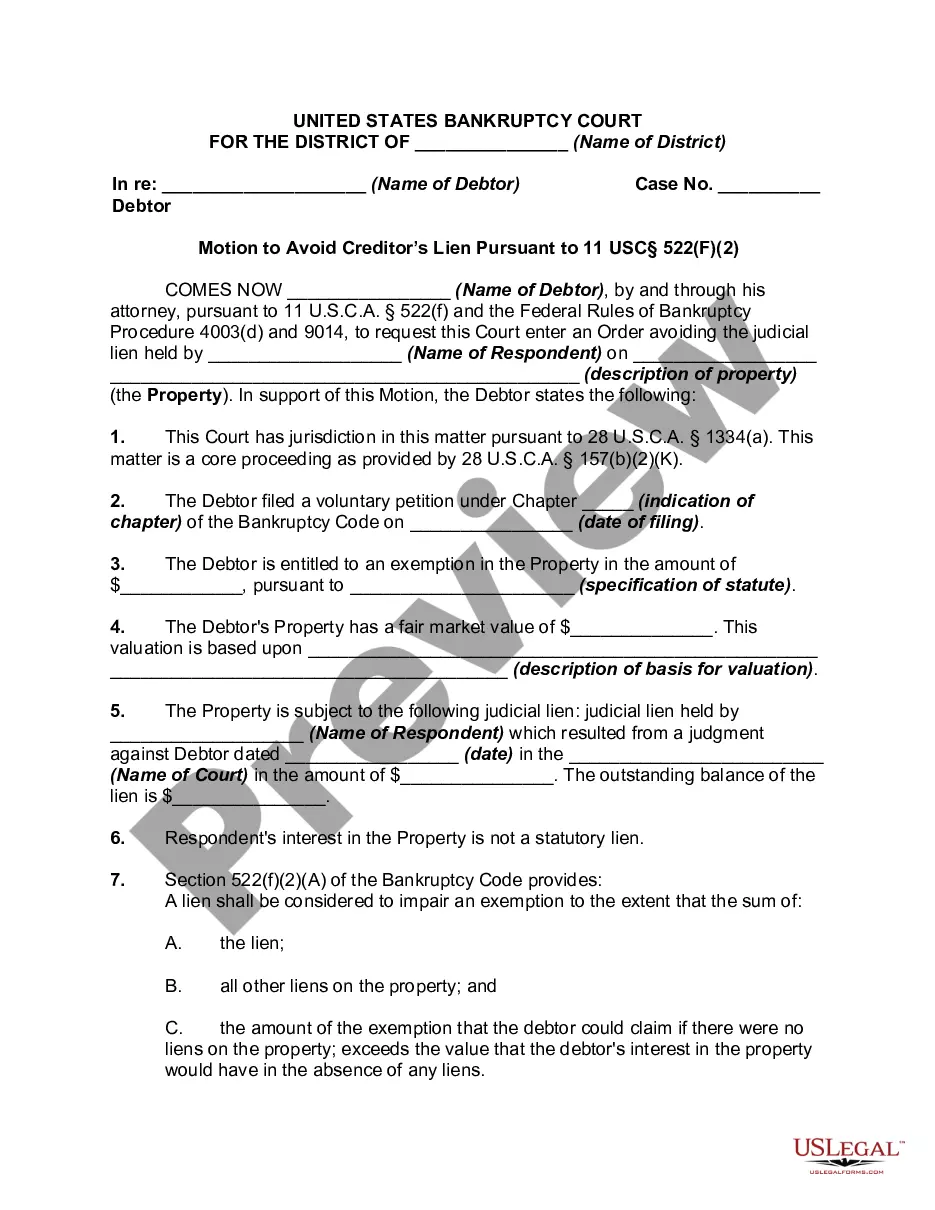
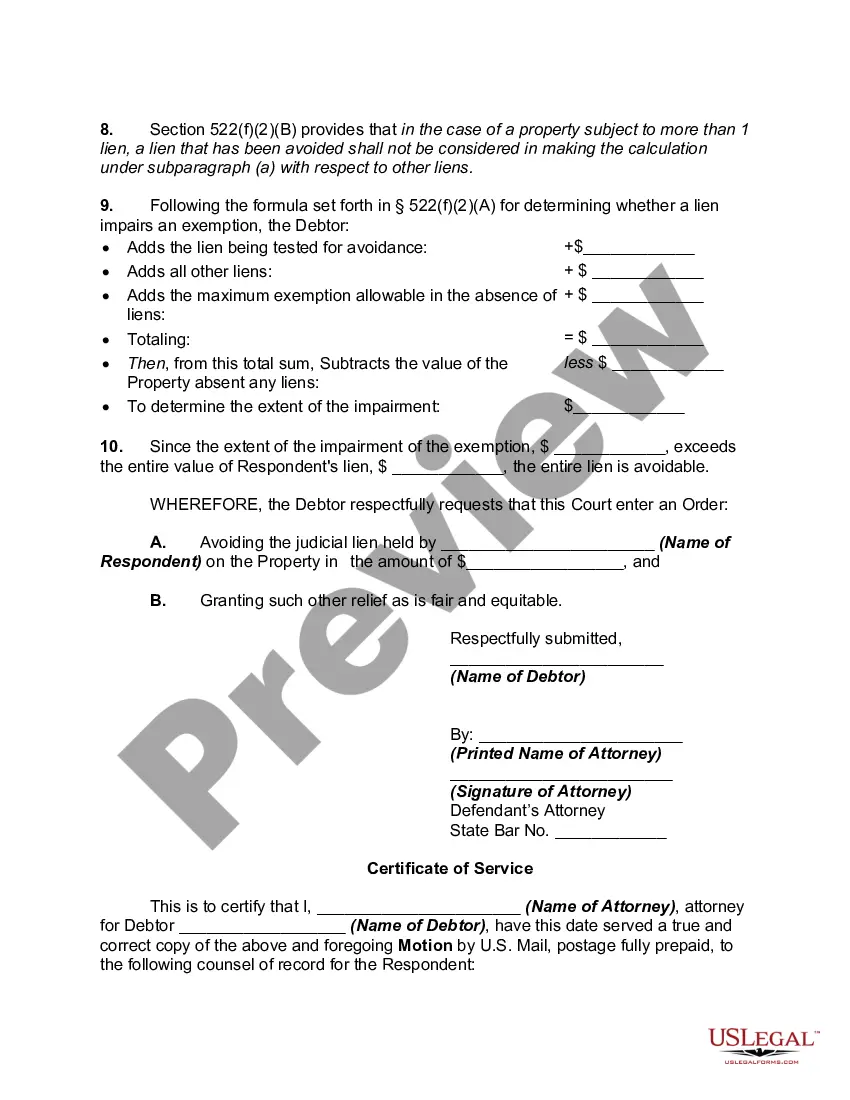
Motion To Avoid Lien Chapter 7 Withholding
Description
Get your form ready online
Our built-in tools help you complete, sign, share, and store your documents in one place.
Make edits, fill in missing information, and update formatting in US Legal Forms—just like you would in MS Word.
Download a copy, print it, send it by email, or mail it via USPS—whatever works best for your next step.
Sign and collect signatures with our SignNow integration. Send to multiple recipients, set reminders, and more. Go Premium to unlock E-Sign.
If this form requires notarization, complete it online through a secure video call—no need to meet a notary in person or wait for an appointment.
We protect your documents and personal data by following strict security and privacy standards.

Make edits, fill in missing information, and update formatting in US Legal Forms—just like you would in MS Word.

Download a copy, print it, send it by email, or mail it via USPS—whatever works best for your next step.

Sign and collect signatures with our SignNow integration. Send to multiple recipients, set reminders, and more. Go Premium to unlock E-Sign.

If this form requires notarization, complete it online through a secure video call—no need to meet a notary in person or wait for an appointment.

We protect your documents and personal data by following strict security and privacy standards.
Looking for another form?
How to fill out Motion To Avoid Creditor's Lien?
Handling legal paperwork and processes can be a lengthy addition to your schedule.
Motion To Avoid Lien Chapter 7 Withholding and similar forms typically necessitate you to locate them and comprehend the most effective method to fill them out proficiently.
Thus, whether you are managing financial, legal, or personal affairs, utilizing a thorough and user-friendly online database of forms readily available will be very beneficial.
US Legal Forms is the leading online platform for legal templates, featuring over 85,000 state-specific documents and a variety of resources to assist you in completing your paperwork seamlessly.
Is it your first time using US Legal Forms? Sign up and create a free account in just a few minutes, and you will gain access to the form library and Motion To Avoid Lien Chapter 7 Withholding. Then, follow the steps below to fill out your form: Ensure you have the correct form by utilizing the Review feature and examining the form description. Select Buy Now when ready, and pick the subscription plan that best fits you. Click Download to complete, sign, and print the form. US Legal Forms has 25 years of experience assisting users in managing their legal documents. Find the form you need today and simplify any process with ease.
- Browse the collection of pertinent documents accessible with a single click.
- US Legal Forms offers you state- and county-specific documents available for download at any time.
- Protect your document management tasks using a premium service that allows you to create any form within minutes without extra or hidden fees.
- Simply Log In to your account, locate Motion To Avoid Lien Chapter 7 Withholding, and download it immediately from the My documents section.
- You can also retrieve forms you have saved previously.
Form popularity
FAQ
Judgment liens have to be satisfied before the property can be sold or refinanced. Second, judgment creditors can levy upon your personal property or bank accounts. Third, your wages can be garnished. Garnishment is when the Court orders your employer to pay a portion of your pay directly to the judgment creditor.
Under New Jersey law, each debtor is entitled to an exemption protecting $1,000 of personal property from collection to satisfy a judgment. In addition, welfare, social security and unemployment benefits are protected from judgment levy.
And some states also allow judgment liens on the debtor's personal property -- things like jewelry, art, antiques, and other valuables. In New Jersey, a judgment lien can be attached to real estate only (not personal property).
This motion is filed by a debtor to avoid certain liens on property. The motion may be filed on negative notice or it may be set for a hearing, and it must be served upon all affected parties. There is no filing fee unless it is filed as a multi-part motion with a Motion to Reopen Case.
Debtors in New Jersey can protect certain personal property during Chapter 7 bankruptcy, such as clothing and some of their household goods and furnishings. There are state exemptions for certain disability benefits and miscellaneous exemptions that can protect assets like pensions, stocks, and life insurance proceeds.