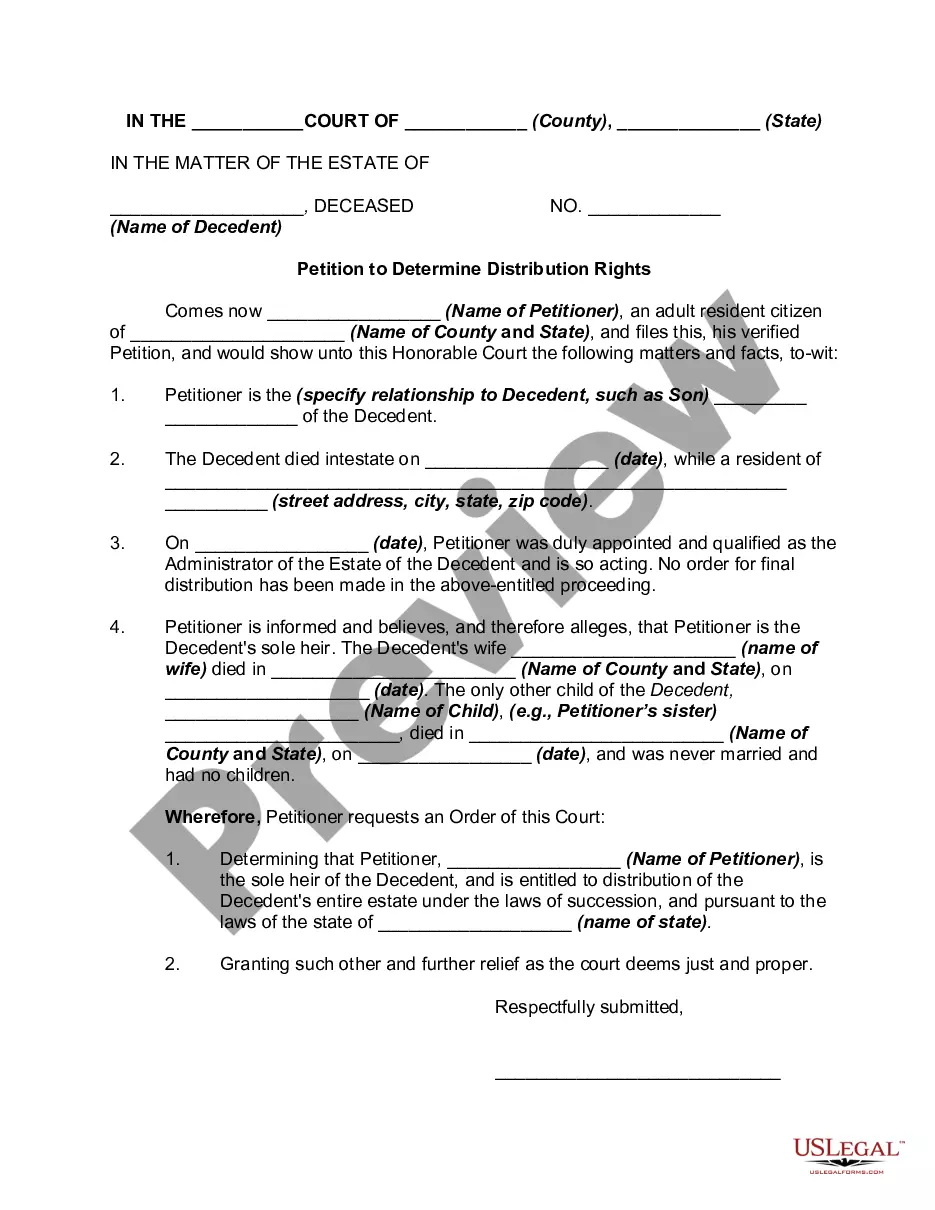
Executor Petition Estate With Surviving Spouse
Description
Get your form ready online
Our built-in tools help you complete, sign, share, and store your documents in one place.
Make edits, fill in missing information, and update formatting in US Legal Forms—just like you would in MS Word.
Download a copy, print it, send it by email, or mail it via USPS—whatever works best for your next step.
Sign and collect signatures with our SignNow integration. Send to multiple recipients, set reminders, and more. Go Premium to unlock E-Sign.
If this form requires notarization, complete it online through a secure video call—no need to meet a notary in person or wait for an appointment.
We protect your documents and personal data by following strict security and privacy standards.

Make edits, fill in missing information, and update formatting in US Legal Forms—just like you would in MS Word.

Download a copy, print it, send it by email, or mail it via USPS—whatever works best for your next step.

Sign and collect signatures with our SignNow integration. Send to multiple recipients, set reminders, and more. Go Premium to unlock E-Sign.

If this form requires notarization, complete it online through a secure video call—no need to meet a notary in person or wait for an appointment.

We protect your documents and personal data by following strict security and privacy standards.
Looking for another form?
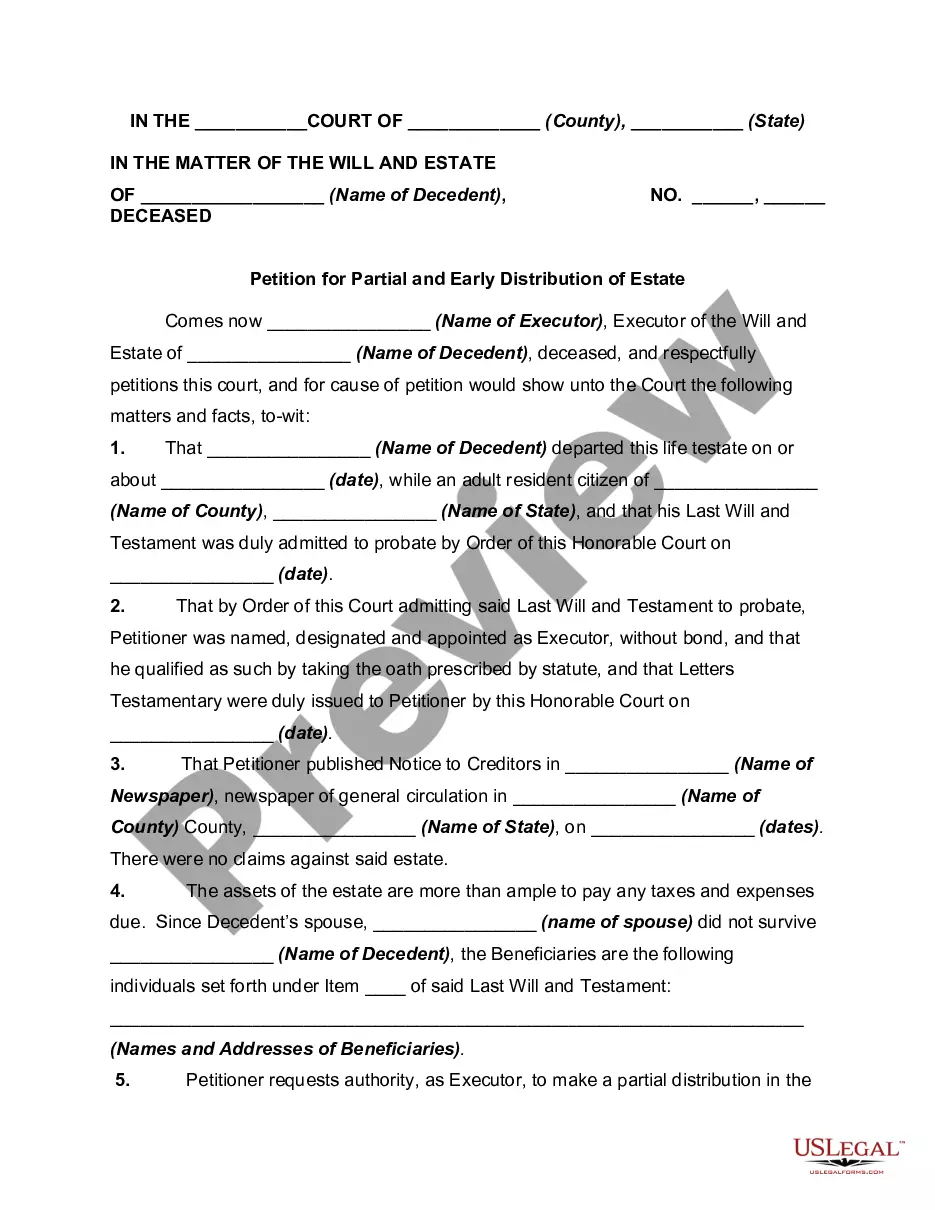
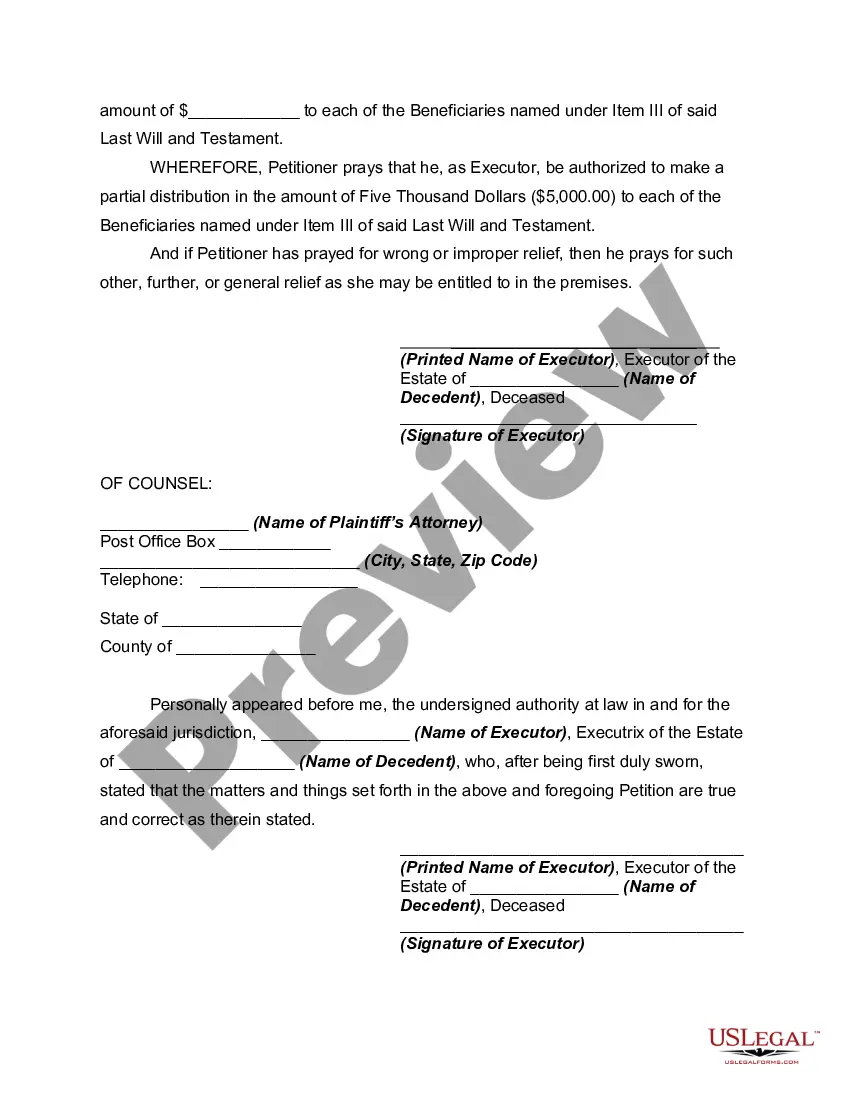
How to fill out Petition For Partial And Early Distribution Of Estate?
Whether for commercial objectives or personal matters, everyone must confront legal circumstances at some stage in their life.
Finalizing legal documentation requires meticulous consideration, starting from selecting the appropriate form template.
With a comprehensive US Legal Forms catalog at your disposal, you do not need to waste time searching for the correct template across the internet. Utilize the library’s straightforward navigation to find the suitable form for any situation.
- Locate the template you require using the search box or catalog navigation.
- Review the form’s description to confirm it corresponds with your situation, state, and locality.
- Click on the form’s preview to examine it.
- If it is not the right document, return to the search feature to find the Executor Petition Estate With Surviving Spouse sample you need.
- Download the file if it satisfies your specifications.
- If you possess a US Legal Forms account, simply click Log in to access previously saved documents in My documents.
- If you do not have an account yet, you can download the form by clicking Buy now.
- Select the appropriate pricing option.
- Complete the profile registration form.
- Choose your payment method: use a credit card or PayPal account.
- Select the document format you desire and download the Executor Petition Estate With Surviving Spouse.
- Once it is saved, you can fill out the form using editing software or print it and complete it manually.
Form popularity
FAQ
The executor is overseer, manager, distributor, and possible peacemaker in the execution of your estate plan. What qualities are important? Family members and friends who have demonstrated that they are trustworthy, honest, conscientious, and good with people are the best candidates.
Ensure Documents Are Accessible Examine your system and consider putting together a binder that has all the items your executor is likely to need, including bank statements, birth certificates, marriage certificates, divorce decrees, property deeds, insurance policies, deeds to real estate, and many more.
1. Gather the required information and documents Search for cash, securities, jewellery and other valuable items. Make arrangements for their safekeeping. Deal with any ?wasting? assets, such as perishable goods. Safeguard/arrange for periodic inspection of vacant real estate.
If there are no children, the spouse inherits everything. However, if the deceased person had children from a previous relationship and they did not have a will, the children will inherit a portion of the estate as well.
The executor of a deceased partner refers to an individual who takes the place of a partner in the firm and is responsible for fulfilling all the remaining obligations of the deceased partner.