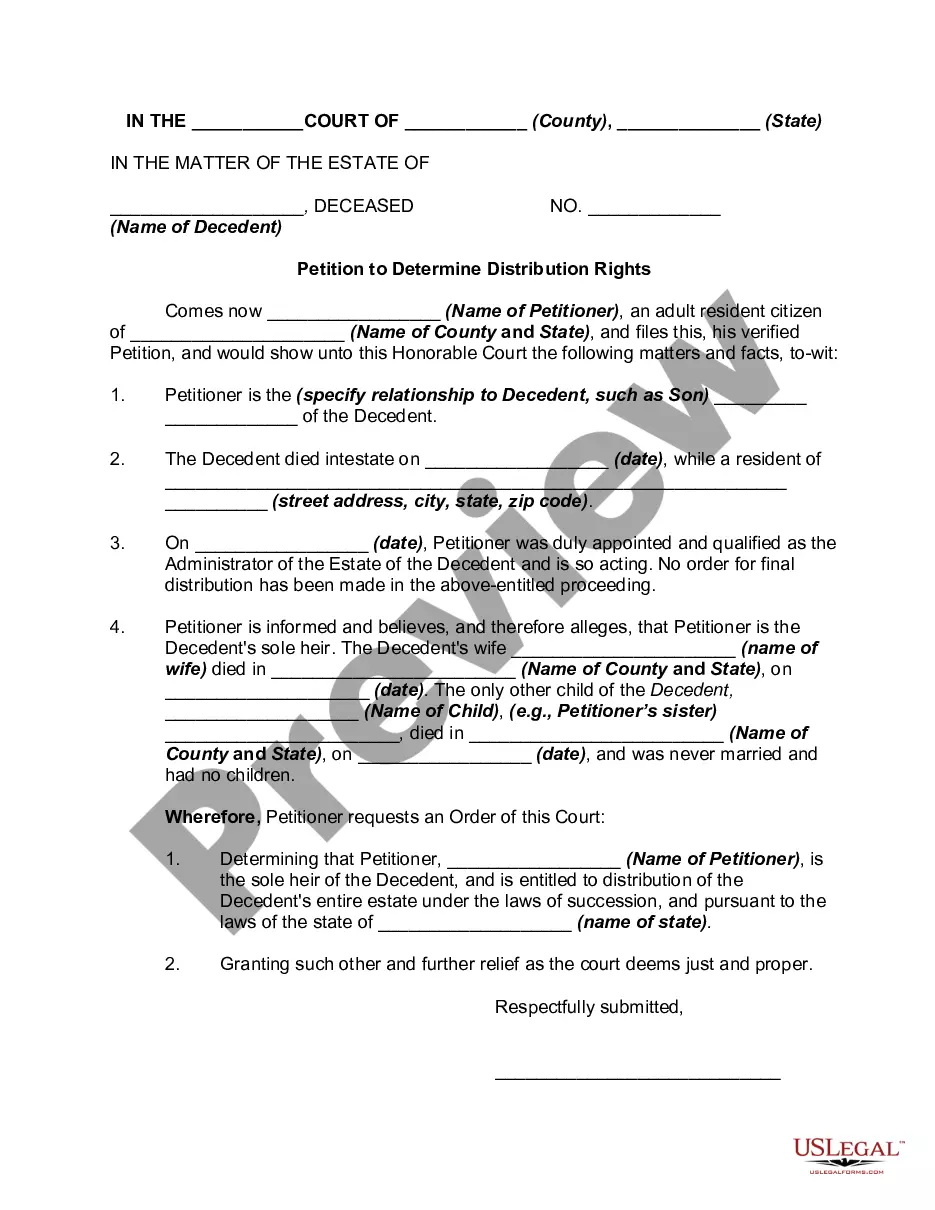
Estate Distribution Form For A Business
Description
Get your form ready online
Our built-in tools help you complete, sign, share, and store your documents in one place.
Make edits, fill in missing information, and update formatting in US Legal Forms—just like you would in MS Word.
Download a copy, print it, send it by email, or mail it via USPS—whatever works best for your next step.
Sign and collect signatures with our SignNow integration. Send to multiple recipients, set reminders, and more. Go Premium to unlock E-Sign.
If this form requires notarization, complete it online through a secure video call—no need to meet a notary in person or wait for an appointment.
We protect your documents and personal data by following strict security and privacy standards.

Make edits, fill in missing information, and update formatting in US Legal Forms—just like you would in MS Word.

Download a copy, print it, send it by email, or mail it via USPS—whatever works best for your next step.

Sign and collect signatures with our SignNow integration. Send to multiple recipients, set reminders, and more. Go Premium to unlock E-Sign.

If this form requires notarization, complete it online through a secure video call—no need to meet a notary in person or wait for an appointment.

We protect your documents and personal data by following strict security and privacy standards.
Looking for another form?








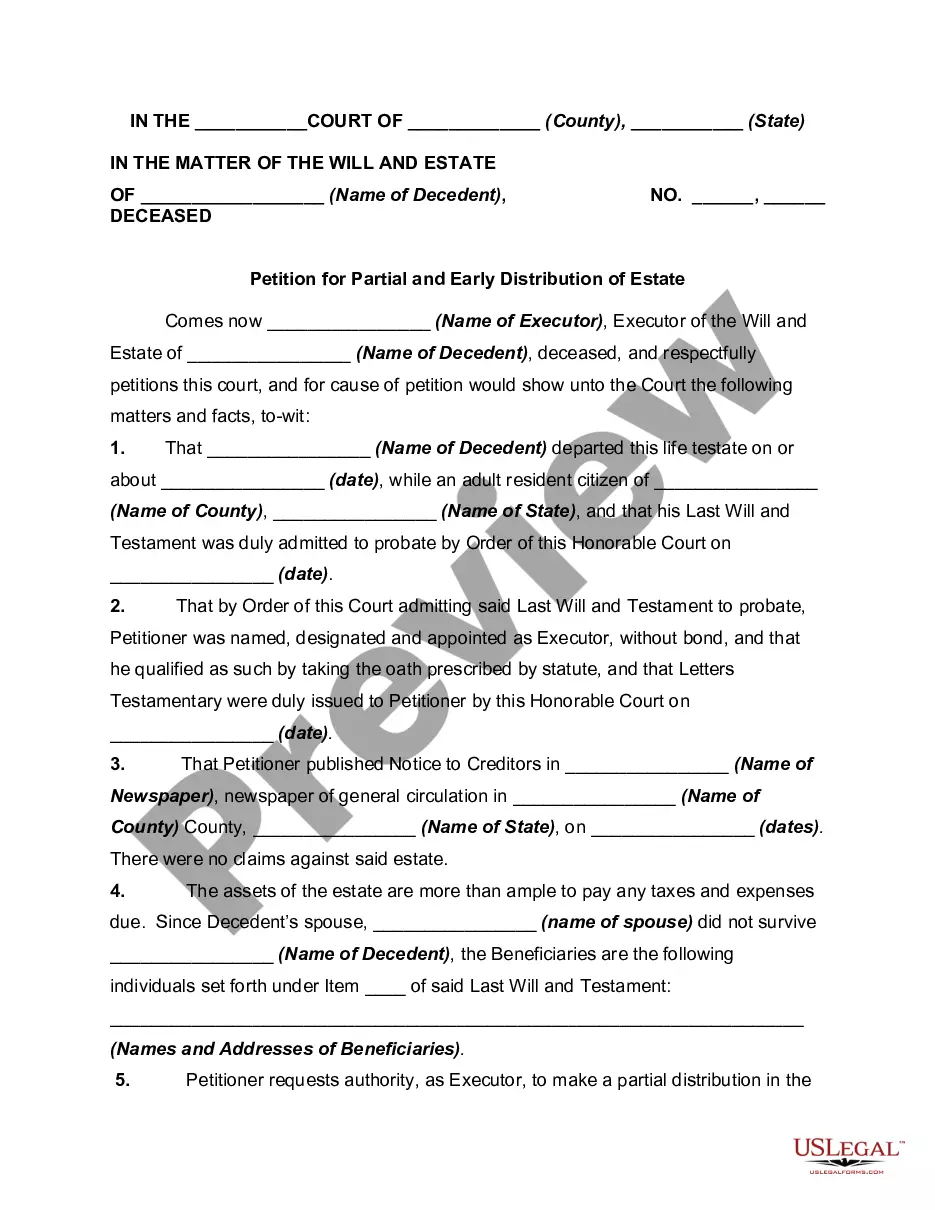
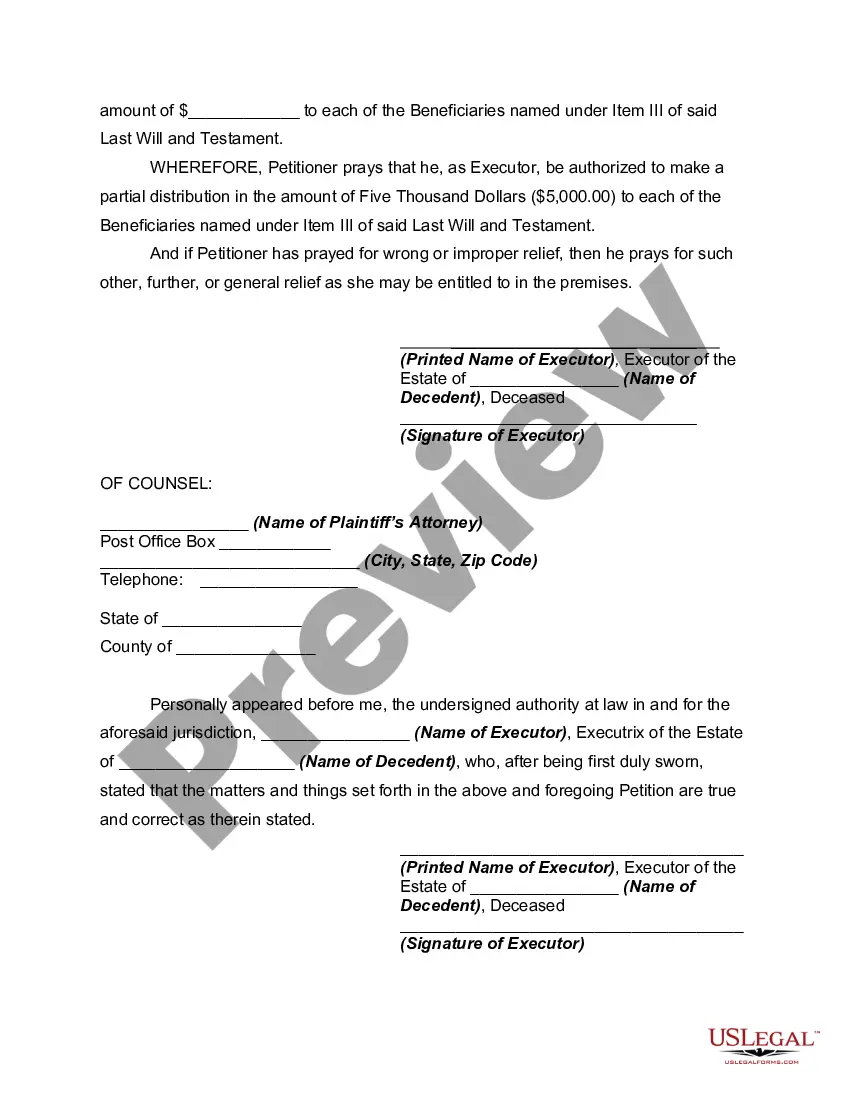
How to fill out Petition For Partial And Early Distribution Of Estate?
- If you're a returning user, start by logging in to your account to download the form template directly. Ensure your subscription is active, and renew if necessary.
- If you're new to US Legal Forms, begin by reviewing the form description and preview mode. Verify that it meets your requirements and aligns with local jurisdiction standards.
- Seek alternative templates if your needs aren’t fully met. Use the Search feature to locate the correct form that suits your situation.
- Proceed to purchase the document by clicking the Buy Now button. Select your subscription plan and create an account to gain access to a vast library of resources.
- Complete your payment by entering your credit card information or utilizing your PayPal account.
- Download your completed form and save it to your device. You can access it anytime from the My documents section of your profile.
US Legal Forms not only simplifies the process of obtaining legal documents but also provides an extensive library with over 85,000 editable forms. Users benefit from premium support, ensuring their documents are accurate and legally compliant.
In conclusion, using US Legal Forms for your estate distribution form enhances efficiency and accuracy in managing business estates. Start your journey today and streamline your legal documentation process!
Form popularity
FAQ
An EIN is required for an estate if the estate generates income or if it has gross assets exceeding a certain limit. This number helps the estate file a tax return and manage financial accounts. Without an EIN, handling the estate's affairs becomes burdensome and complicated. To streamline your efforts, look into an estate distribution form for a business, which can guide you through the necessary steps.
Yes, you generally need a new EIN if you inherit a business, as the IRS treats inherited businesses as separate entities. This new number is necessary because it helps manage any tax responsibilities associated with the estate. To simplify the process of transferring ownership and handling taxes, consider using an estate distribution form for a business as a guideline. This ensures that you've covered all the necessary bases.
Obtaining an EIN number for an estate typically takes about one to two weeks when applying online. If you submit your application via mail, it may take longer, usually around four to six weeks. Be proactive in this application process to ensure timely management of the estate's financial affairs. Using an estate distribution form for a business can help you stay organized as you navigate these timelines.
To fill out an EIN form for an estate, start by providing the name of the deceased and their social security number. Next, specify the type of entity, which in this case is an estate. Furthermore, ensure that you include information about the executor or administrator of the estate. For convenience, you can use resources like USLegalForms to access an estate distribution form for a business and streamline this process.
An estate EIN number is a unique nine-digit number formatted like this: 12-3456789. It is issued by the IRS to identify the estate of a deceased person for tax purposes. You will use this number when filing tax returns or opening bank accounts in the estate's name. If you need an estate distribution form for a business, gathering this information is essential.
In general, inheritance received from an estate is not considered taxable income at the federal level. However, some states impose inheritance taxes, making the specifics crucial for beneficiaries to understand. It's essential to clarify these tax implications when planning for an estate's distribution. Using the estate distribution form for a business helps simplify these considerations and ensure compliance.
Form 706, the United States Estate (and Generation-Skipping Transfer) Tax Return, is used to report the estate’s gross assets and determine any tax owed. Executors must file this form if the estate exceeds the federal exemption amount. Understanding how to complete and submit Form 706 is crucial for effective estate management and planning. An estate distribution form for a business can provide clarity on these responsibilities.
Form 8971 is used to report information about the beneficiaries of an estate and the value of property they receive. This form aids the IRS in tracking the distribution of estate assets and any potential tax implications for beneficiaries. By accurately completing Form 8971, executors help ensure compliance and facilitate smooth distributions. An estate distribution form for a business can streamline this process as well.
Individuals who make gifts exceeding the annual exclusion amount are required to file Form 709. This includes gifts to individuals as well as certain transfers that may be subject to generation-skipping taxes. Properly managing gifts can reduce potential estate taxes and ensure strategic planning. Using the estate distribution form for a business can help organize these financial transactions and filings seamlessly.
An estate tax return, like Form 706, is filed by the estate itself to report the deceased's assets and calculate taxes owed. On the other hand, an inheritance tax return involves taxes based on the value of the estate received by the beneficiaries, which varies by state. Understanding these differences is essential for both estate executors and beneficiaries to navigate tax obligations effectively. The estate distribution form for a business can assist in this understanding.