Examples
Description

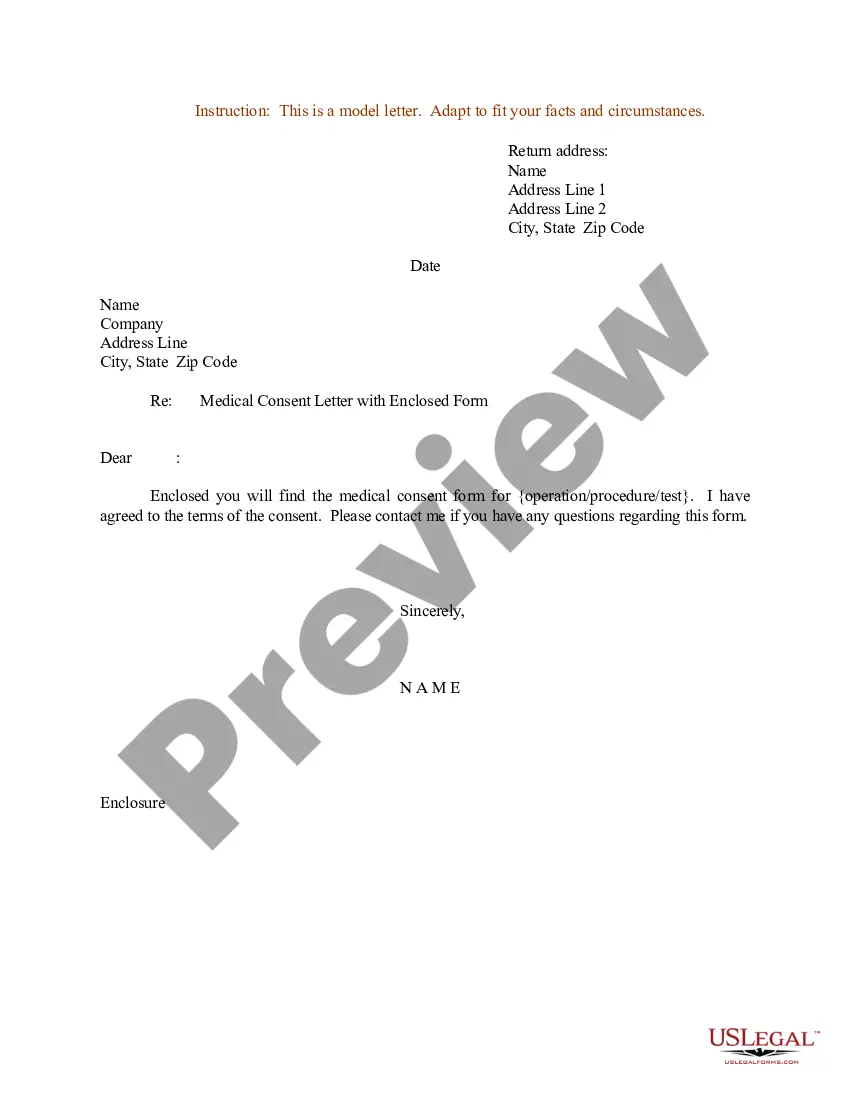
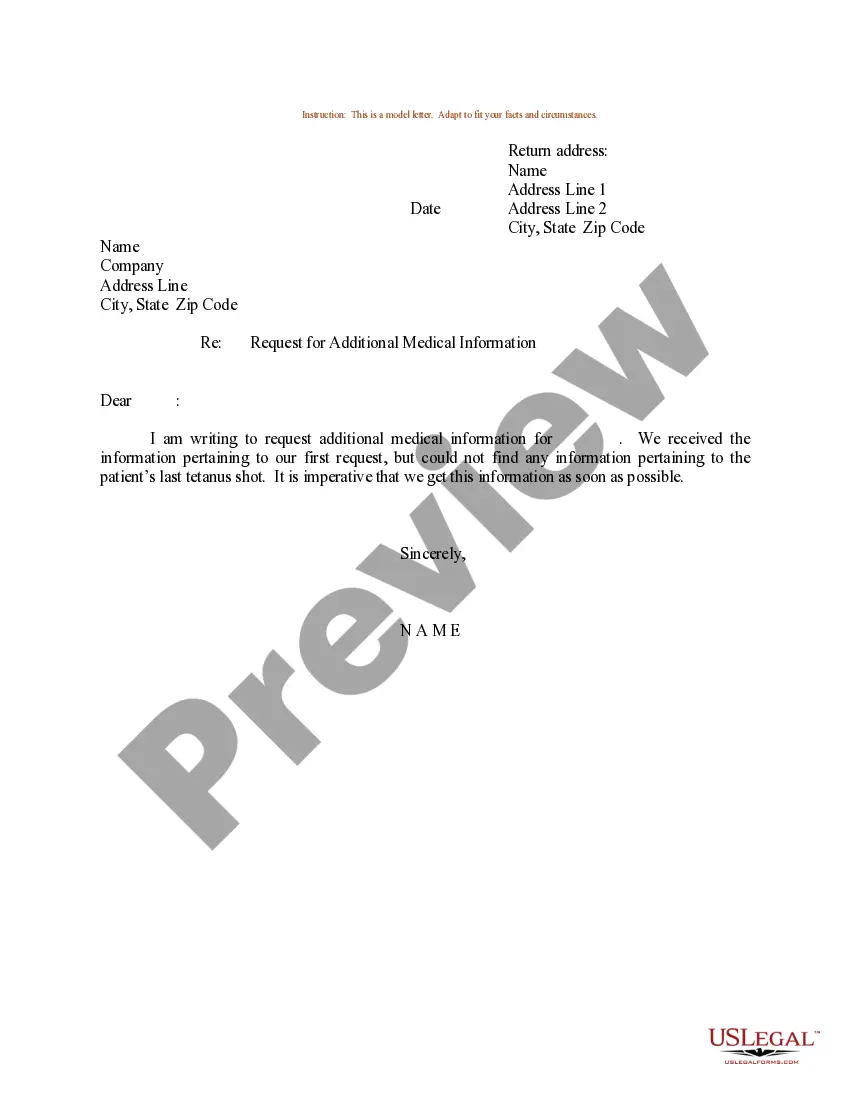
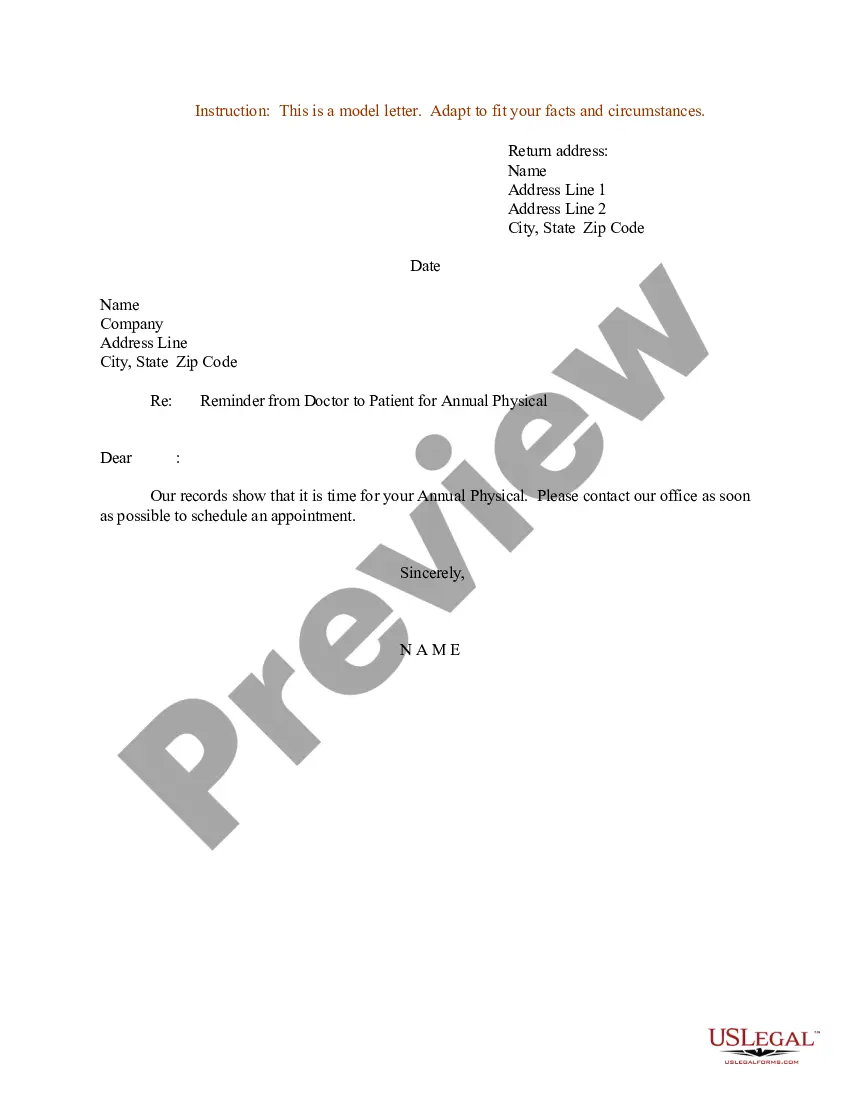
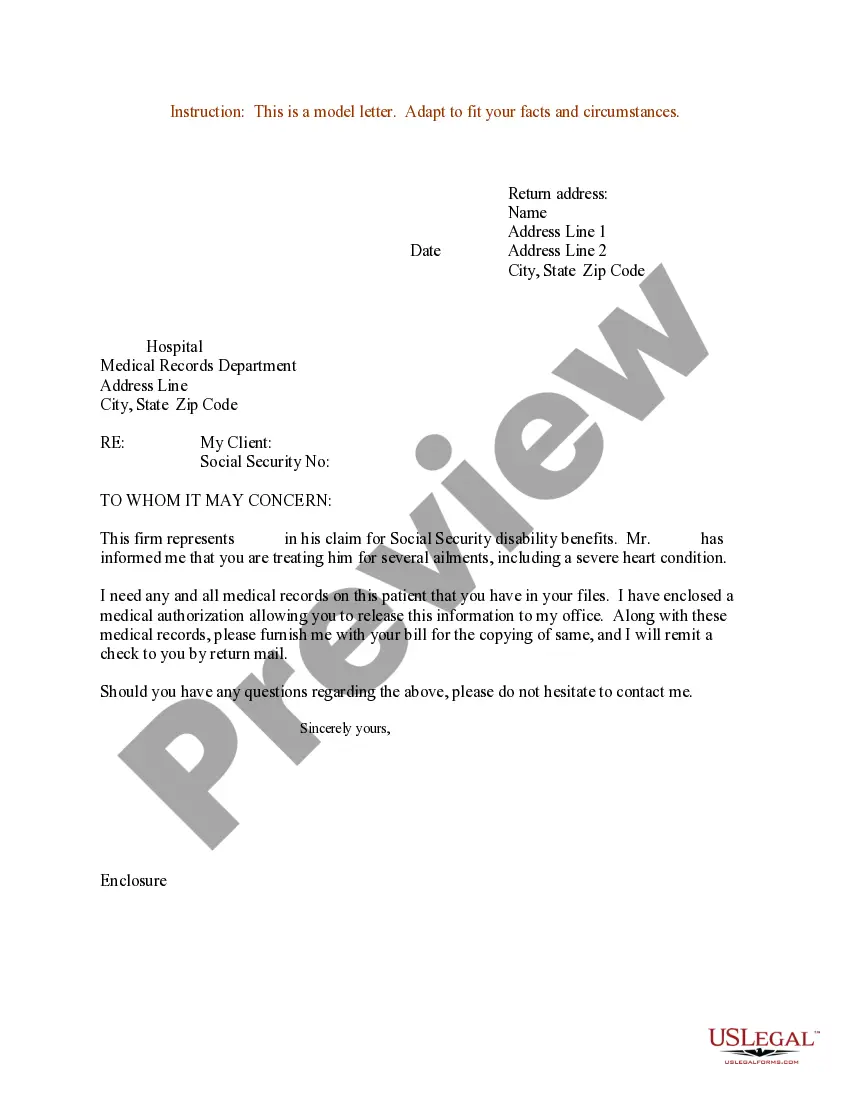



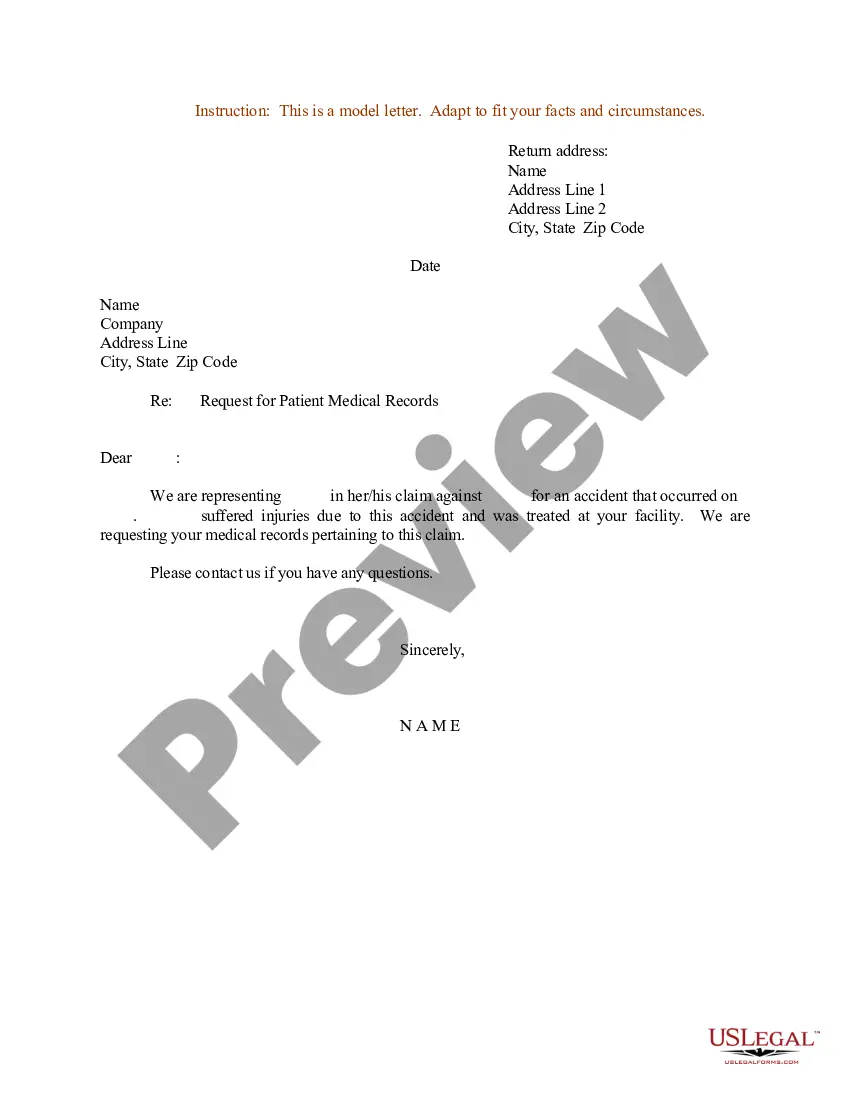
How to fill out Sample Letter For Request For Patient Medical Records?
- If you're a returning user, log in to access your account and download your desired form template directly by clicking the Download button, ensuring your subscription is active.
- For first-time users, start by reviewing the Preview mode and detailed form descriptions to confirm that you have selected the form that meets your legal requirements and adheres to your local jurisdiction.
- If the chosen template isn't what you need, simply utilize the Search tab to find a more suitable document that matches your needs.
- Once you’ve found the right form, click on the Buy Now button to choose your desired subscription plan and create an account for access to the extensive library.
- Complete the purchase by inputting your payment details via credit card or PayPal to secure your subscription.
- Finally, download the form to your device, enabling you to fill it out and access it anytime through the My Forms section of your profile.
Following these steps will help you to efficiently take advantage of the benefits of US Legal Forms, including access to a vast collection of legal documents and the ability to consult with experts for precise legal assistance.
Ready to simplify your legal document needs? Sign up for US Legal Forms today and enjoy a seamless experience!
Form popularity
FAQ
The correct way to write 'for example' is to place it in the middle of a sentence to introduce your examples. Typically, you would use a comma before 'for example' when it follows a complete thought. This format ensures clarity and improves the flow of your writing, allowing your examples to serve their purpose effectively.
To use 'for example' in a sentence, start with a statement you want to expand upon. Then, follow it with 'for example' and list your examples. For instance, 'There are many healthy snacks, for example, nuts, yogurt, and fruits.' This structure enhances your explanation by adding specific examples.
To write an example in a sentence, clearly state your main idea first. Then, introduce your example with phrases such as 'for example' or 'for instance.' This method allows you to create a connection between your main argument and the example you provide, making your message clearer.
The phrase 'get to examples' refers to the process of finding specific cases or scenarios that clarify a point. It's about expanding your understanding by looking at practical illustrations or models. When you seek examples, you gain insights that improve your comprehension and can even help in situations like writing legal documents.
To provide an example in a sentence, start with a general statement about your topic. You can follow it with phrases like 'for instance' or 'such as' to introduce your examples. This structure helps your audience understand the point you are making by illustrating it with clear examples.
When you want to include an example in a sentence, begin by introducing your point. You can structure your sentence like this: 'Many fruits are beneficial for health; for example, apples and bananas provide essential vitamins.' By using this format, you clarify your ideas while presenting relevant examples.
To get examples, you can start by researching specific topics online or in books that cater to your interest. You might search for phrases like 'examples of renewable energy' to find relevant information. Platforms like US Legal Forms also provide templates and examples that help you understand how to draft legal documents effectively.
Examples of sentences can illustrate different grammatical structures and uses. For instance, 'She walks to the store,' 'The sky is blue,' and 'He enjoys reading books' are all simple sentences. More complex examples include, 'Although it was raining, we decided to go for a walk.' Each of these examples shows how sentences can convey clear messages.
'Eg' is an abbreviation for the Latin phrase 'exempli gratia,' which means 'for example.' It is commonly used to introduce examples that clarify a statement or point. In written contexts, using 'eg' allows speakers to seamlessly provide instances that support their arguments without excessive wording. Incorporating examples can significantly enhance understanding and engagement in legal writing or presentations.
The three basic kinds of examples used in speeches include brief examples, extended examples, and hypothetical examples. Brief examples are short and straightforward, effectively illustrating points without elaboration. Extended examples delve deeper into a specific case, providing more context and detail. Hypothetical examples present imagined situations to help audiences visualize potential outcomes, especially useful in legal discussions.